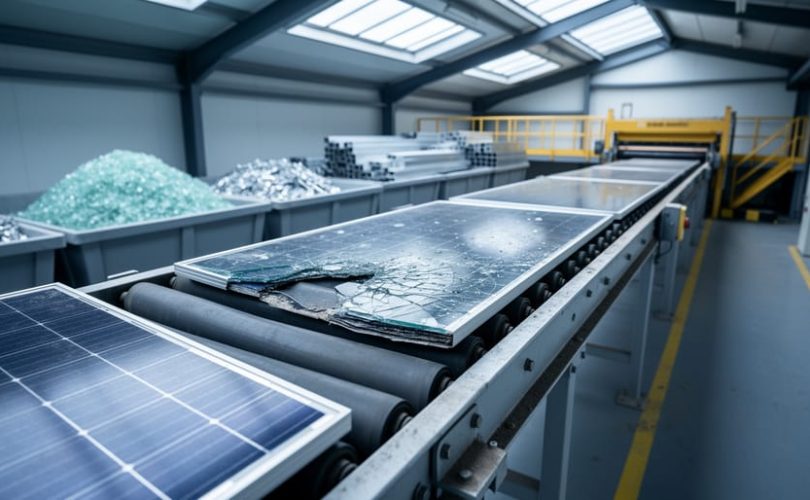
Solar panels contain up to 95% recoverable materials, yet less than 10% currently enter specialized recycling streams—a disparity that reveals both extraordinary potential and significant infrastructure gaps in photovoltaic waste management. As global solar installations approach 2 terawatts of cumulative capacity, the renewable energy sector faces a critical sustainability question: can the technology designed to combat climate change avoid creating its own environmental burden?
The answer hinges on understanding material composition and recovery economics. Standard crystalline silicon panels consist of glass (75%), aluminum frames (10%), semiconductor materials (5%), polymers (7%), and trace metals including silver and copper. While theoretically recyclable, the lifecycle of solar panels presents distinct end-of-life challenges that differentiate photovoltaic recycling from conventional electronic waste processing.
Current thermal and mechanical processes recover aluminum and glass efficiently, achieving 80-90% extraction rates for these bulk materials. However, valuable semiconductor materials like silicon, silver, and rare elements embedded in laminated structures require advanced chemical treatments that remain economically unviable at present scales. The European Union has mandated 85% recovery rates through the WEEE Directive, spurring technological development, while markets lacking regulatory frameworks see panels predominantly landfilled.
This examination addresses the complete recyclability spectrum—from proven large-scale processes to emerging innovations in delamination technology and material recapture. Understanding current capabilities, economic barriers, and breakthrough developments enables informed decisions for industry professionals implementing circular economy strategies and consumers evaluating solar energy’s comprehensive environmental profile. The path from theoretical recyclability to practical implementation will define photovoltaic sustainability for decades to come.
The Anatomy of a Solar Panel: What’s Inside That Determines Recyclability
Crystalline Silicon Panels (Mono and Multi-Crystalline)
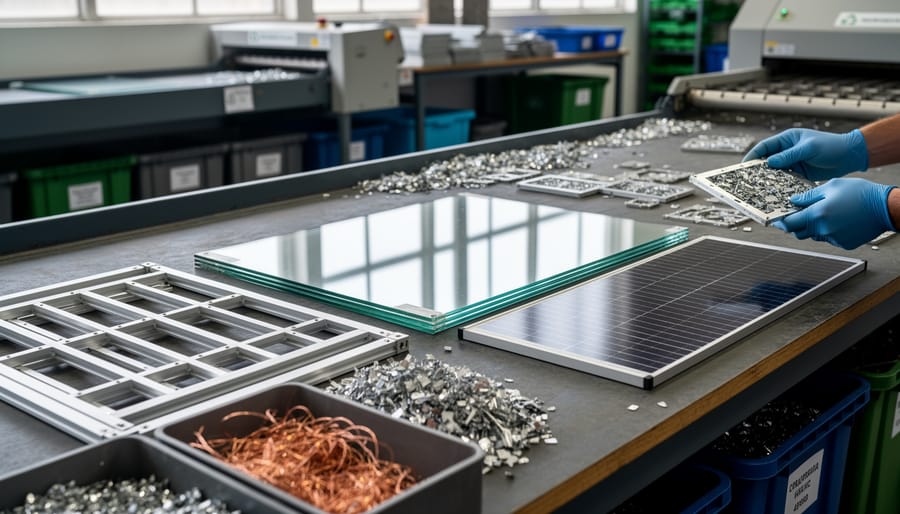
Crystalline silicon panels, whether monocrystalline or multi-crystalline (also called polycrystalline), share fundamental compositional similarities but exhibit distinct manufacturing characteristics that influence their recyclability. Both types consist of approximately 76% glass, 10% polymer materials (primarily EVA encapsulant), 8% aluminum framing, 5% silicon wafers, and trace amounts of metals including silver, copper, and lead in solder connections.
The primary difference lies in silicon purity and wafer structure. Monocrystalline panels feature single-crystal silicon with higher purity levels, resulting in uniform dark cells and superior efficiency. Multi-crystalline panels contain multiple silicon crystals with visible grain boundaries, offering slightly lower efficiency but reduced manufacturing costs. From a recycling perspective, monocrystalline silicon generally commands higher recovery value due to its refined composition, though both types undergo identical separation processes.
The recycling challenge for both panel types centers on delamination—separating the bonded layers of glass, encapsulant, silicon cells, and backsheet materials. Advanced thermal, chemical, or mechanical methods are required to recover individual components without degradation. University research collaborations are currently developing enhanced separation techniques that preserve silicon quality for remanufacturing. Educational programs in photovoltaic technology increasingly address these material recovery considerations, preparing professionals to optimize end-of-life panel management for both crystalline silicon variants.
Thin-Film Technologies
Thin-film solar panels represent approximately 5% of the global photovoltaic market and present distinct recycling challenges compared to their crystalline silicon counterparts. These panels utilize ultra-thin layers of photovoltaic materials—typically cadmium telluride (CdTe), copper indium gallium selenide (CIGS), or amorphous silicon—deposited onto glass, plastic, or metal substrates. The manufacturing process requires significantly less semiconductor material than traditional panels, making them lighter and more flexible.
However, this composition creates unique recycling complexities. The extremely thin active layers, often measuring just micrometers thick, demand specialized separation techniques to recover valuable materials like tellurium, indium, and gallium. These rare elements hold substantial economic value, yet their extraction requires more sophisticated processes than standard silicon recovery. Additionally, the presence of cadmium in CdTe panels necessitates careful handling due to toxicity concerns, though manufacturers have developed closed-loop recycling systems that can recover up to 95% of semiconductor materials.
The recycling infrastructure for thin-film technologies remains less developed than for crystalline panels, partly due to lower market volumes. Nevertheless, research partnerships between industry leaders and universities continue advancing chemical and thermal treatment methods that improve material recovery rates while reducing environmental impact.
Current State of Solar Panel Recycling: The Reality Check
Global Recycling Infrastructure and Regulations
The regulatory landscape for solar panel recycling varies significantly across global regions, reflecting different approaches to solar panel waste disposal and environmental responsibility.
Europe leads with the most comprehensive framework through the Waste Electrical and Electronic Equipment (WEEE) Directive, which has mandated producer responsibility for photovoltaic module recycling since 2012. Under this directive, manufacturers must finance collection and recycling operations, achieving minimum recovery rates of 85% by weight and component recycling rates of 80%. The European Union’s circular economy action plan further strengthens these requirements, pushing toward higher recovery targets and material-specific recycling goals.
In Asia, regulatory approaches are evolving rapidly. Japan implemented its own producer responsibility scheme in 2016, while China, despite being the world’s largest solar panel manufacturer, is developing comprehensive recycling regulations expected to address the anticipated surge in panel waste by 2030. South Korea has integrated photovoltaic modules into its Extended Producer Responsibility system, requiring manufacturers to meet specific collection and recycling quotas.
North America presents a more fragmented picture. The United States lacks federal solar panel recycling mandates, though Washington became the first state to require manufacturer-funded recycling programs in 2017. California is developing similar regulations, recognizing the growing need for structured end-of-life management.
These regulatory differences significantly impact recycling infrastructure development, with Europe’s mature systems contrasting sharply with emerging frameworks in other regions, ultimately affecting global recyclability rates and environmental outcomes.
Economic Barriers to Widespread Recycling
Despite solar panels containing valuable materials like silicon, silver, copper, and aluminum, recycling remains economically challenging in most markets. The primary barrier is cost: dismantling, separating, and purifying panel components requires specialized equipment and labor-intensive processes that often exceed the market value of recovered materials. Current recycling costs range from $20-30 per panel, while landfill disposal costs only $1-2, creating little financial incentive for proper end-of-life management.
The situation is further complicated by relatively low panel volumes reaching end-of-life today. Most installations from the early 2000s are still operational, meaning recycling facilities cannot achieve the economies of scale necessary to reduce processing costs. This creates a classic chicken-and-egg problem: without sufficient volume, recycling remains expensive, yet without economic viability, investment in advanced recycling infrastructure stalls.
Universities and research institutions are actively collaborating with industry partners to develop cost-effective separation techniques and identify high-value material recovery opportunities. As panel retirement volumes increase dramatically after 2030 and material prices potentially rise, the economic equation may shift favorably toward widespread recycling adoption.
How Solar Panel Recycling Actually Works
Mechanical Separation Processes
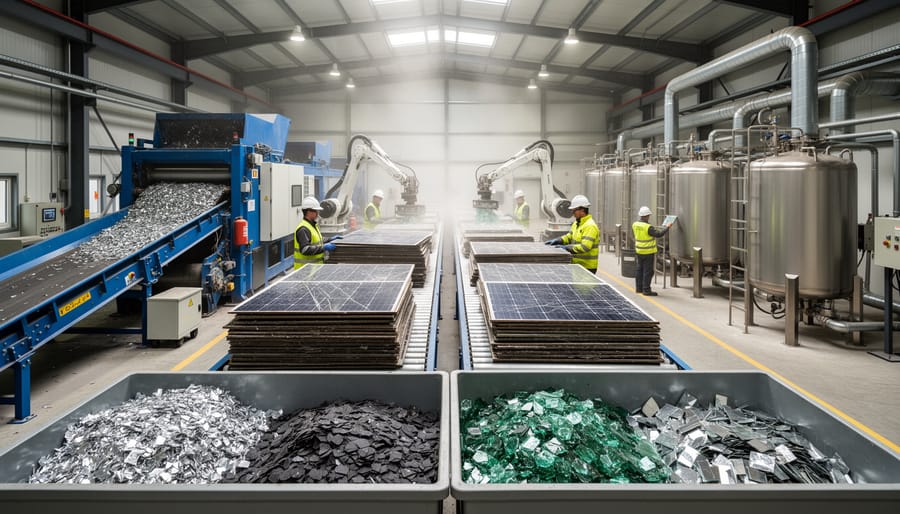
Mechanical separation processes form the crucial first stage of solar panel recycling, enabling the recovery of high-value materials before more intensive chemical treatments. This phase typically begins with thermal processing, where panels are heated to approximately 500-600°C to decompose the ethylene vinyl acetate (EVA) encapsulant layer that binds components together. This controlled heating weakens the adhesive properties without damaging the underlying materials, facilitating easier disassembly.
Following thermal treatment, mechanical shredding and crushing operations separate the major components. Industrial shredders break panels into manageable pieces, allowing automated systems to isolate aluminum frames, which constitute approximately 10% of a panel’s weight and maintain high scrap value. Junction boxes, containing copper wiring and electronic components, are typically removed either manually or through automated picking systems before shredding to preserve their recyclability and prevent contamination.
Glass recovery represents the most substantial mechanical separation achievement, as it comprises 75% of panel mass. Crushing operations reduce glass to cullet, which sorting systems separate from remaining materials using density differences and air classification techniques. Research collaborations between recycling facilities and universities have improved these separation efficiencies significantly, achieving glass recovery rates exceeding 95% in modern operations.
Physical separation methods also employ magnetic and eddy current systems to extract ferrous and non-ferrous metals from the crushed material stream. These mechanical processes successfully recover the bulk materials but leave behind the semiconductor layers and precious metals, which require specialized chemical processing for complete material recovery.
Chemical and Thermal Recovery
Chemical and thermal recovery represents the most sophisticated tier of solar panel recycling, capable of extracting high-purity materials that mechanical processes alone cannot recover. These advanced techniques target valuable elements including silicon, silver, and copper, which together constitute significant economic value in each module.
The chemical treatment process typically begins after mechanical separation has removed glass and aluminum. Specialized solutions dissolve or separate the remaining laminate layers, enabling recovery of silicon wafers from crystalline panels. Hydrometallurgical processes use acid or caustic baths to selectively extract metals. For instance, nitric acid solutions can recover silver from cell contacts with purity levels exceeding 95%, while copper is extracted through electrolytic methods. Some facilities employ pyrolysis, heating panels in oxygen-controlled environments to decompose polymer layers without combustion, leaving behind recoverable metals and silicon.
Research collaborations between recycling companies and universities have advanced thermal delamination techniques, where controlled heating separates bonded layers while preserving material integrity. This innovation significantly improves silicon recovery rates, which currently range from 80-90% at leading facilities compared to lower yields from purely mechanical methods.
The economic viability of these processes depends heavily on material prices and processing volumes. Silver recovery proves particularly lucrative given its concentration in solar cells and market value. However, the complexity of chemical treatments requires substantial capital investment and skilled operators, currently limiting widespread adoption to specialized recycling facilities rather than standard waste processing centers.
Material Recovery Rates: What Can Actually Be Salvaged
Understanding the gap between theoretical recyclability and commercial reality is essential for assessing solar panels’ true environmental impact. While solar panels contain valuable materials that can theoretically be recovered at high rates, current commercial practices often fall short of this potential.
Crystalline silicon panels, which dominate the market at approximately 95% share, demonstrate this disparity clearly. Glass comprises roughly 75% of panel weight and can theoretically be recovered at rates exceeding 95%. However, commercial operations typically achieve recovery rates between 85-90%, with the recycled glass often downgraded to lower-value applications like fiberglass or abrasives rather than reused in new solar panels.
Aluminum frames present a more encouraging picture, with commercial recovery rates consistently reaching 90-95%, closely matching theoretical potential. This material’s value and established recycling infrastructure facilitate efficient recovery and reuse in similar applications.
Silicon recovery reveals significant challenges. Theoretically, 85-90% of silicon can be reclaimed from solar cells, but current commercial processes recover only 50-65%. The recovered silicon frequently requires extensive reprocessing or gets downgraded to metallurgical-grade applications. Copper and silver, despite their high value, face similar obstacles. While laboratory processes demonstrate recovery potential above 95%, commercial facilities typically achieve 80-85% for copper and 70-80% for silver due to the complex separation processes required.
Thin-film technologies like cadmium telluride panels show different patterns. First Solar’s specialized recycling facilities report recovery rates exceeding 90% for glass and semiconductor materials, approaching theoretical limits through proprietary processes. However, these represent controlled, manufacturer-specific operations rather than widely available commercial services.
Research collaborations between recycling innovators and universities continue developing advanced separation techniques that could narrow this theoretical-commercial gap. Current industry-wide averages show approximately 80% total material recovery by weight, though value recovery often lags behind due to material downgrading. Enhanced regulatory frameworks and technological advancement remain crucial for improving these rates and ensuring recovered materials maintain their quality and market value.
Recyclable Solar PV Materials Innovation: Designing Tomorrow’s Circular Panels
Next-Generation Encapsulation and Lamination
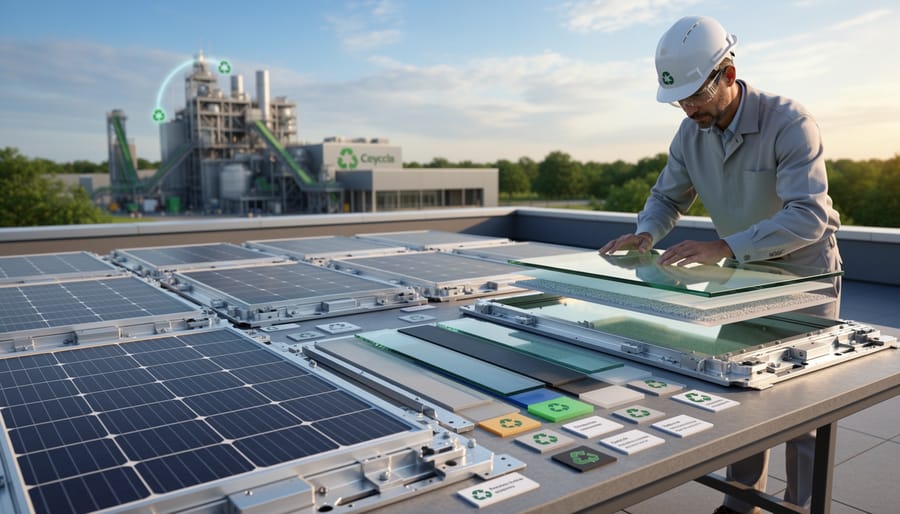
Researchers and manufacturers are addressing one of the most challenging barriers to solar panel recycling: the separation of laminated components. Traditional ethylene-vinyl acetate (EVA) creates such strong bonds between the glass, cells, and backsheet that separation requires energy-intensive thermal or chemical processes. However, emerging recycling technologies are driving innovation in encapsulation materials.
Several companies are now developing thermoplastic polyolefin (TPO) and ionomer-based encapsulants that maintain performance standards while allowing easier delamination at lower temperatures. These materials can be softened and separated without degrading the silicon cells or glass, preserving material value and reducing processing costs. In collaboration with universities, researchers are testing formulations that balance durability during the panel’s operational life with end-of-life recyclability.
Backsheet innovation represents another critical advancement. Conventional multilayer backsheets containing fluoropolymers resist recycling, but newer single-polymer designs enable simpler material recovery. Polyamide and polyester-based backsheets are gaining traction, offering comparable weather resistance while remaining compatible with standard recycling streams.
Industry stakeholders anticipate these design-for-recycling approaches will become standard within five years, supported by educational program offerings that train professionals in next-generation manufacturing techniques. This shift promises to increase recovery rates substantially while reducing recycling costs.
Design for Disassembly Principles
Forward-thinking manufacturers are revolutionizing solar panel design by embedding circular economy principles directly into module construction. Design for disassembly (DfD) focuses on creating panels that can be efficiently deconstructed at end-of-life, maximizing material recovery while minimizing processing costs and environmental impact.
Leading manufacturers now employ reversible adhesives and mechanical fasteners instead of traditional laminated encapsulation methods that bond layers permanently. These innovations allow separation of aluminum frames, glass sheets, and semiconductor materials without high-temperature processing or chemical treatments. Companies like Fraunhofer Institute for Solar Energy Systems collaborate with universities to develop standardized disassembly protocols that recyclers can implement industry-wide.
Modular junction box designs with snap-fit connections rather than potted assemblies enable quick removal and separate processing of valuable copper and electronics. Some manufacturers implement color-coded components and disassembly instructions directly on module backsheets, similar to consumer electronics recycling guides.
Material passports and digital labeling systems are emerging as essential DfD tools. These QR-coded identifiers provide recyclers with precise information about material composition, adhesive types, and optimal disassembly sequences. This transparency significantly reduces sorting time and contamination risks during recycling operations.
While widespread adoption remains limited, educational programs through industry consortia are training the next generation of engineers in DfD methodology. These initiatives represent critical steps toward closing the solar panel lifecycle loop and achieving true sustainability in photovoltaic technology.
The Environmental Impact: Recycling vs. Landfilling
The environmental comparison between recycling and landfilling solar panels reveals substantial differences in resource conservation and carbon emissions. Lifecycle analysis studies demonstrate that recycling recovers approximately 85-95% of valuable materials from crystalline silicon panels, including high-purity silicon, silver, copper, and aluminum. When these materials re-enter manufacturing supply chains, they offset virgin material extraction, reducing energy consumption by up to 70% compared to mining and refining new resources.
Carbon footprint assessments indicate that recycling a metric ton of photovoltaic panels prevents approximately 1,200-1,500 kilograms of CO2 equivalent emissions compared to landfill disposal combined with virgin material production. This reduction stems from avoided mining operations, reduced transportation of raw materials, and decreased energy-intensive refining processes. Research conducted in collaboration with universities has quantified that recycled silicon requires only 30% of the energy needed for virgin silicon production.
Resource conservation metrics further highlight recycling’s advantages. A single recycled solar panel yields enough aluminum for manufacturing three laptop cases, sufficient copper for powering 180 smartphones, and glass applicable to new construction materials. Conversely, landfilled panels lose these resources permanently while potentially leaching hazardous materials like lead and cadmium into soil systems over decades.
The economic value of recovered materials ranges from $10-15 per panel for crystalline silicon modules, creating financial incentives that support sustainable end-of-life management. Educational program offerings have emphasized these quantifiable benefits to train professionals in maximizing recovery rates. However, current global recycling rates remain below 20%, indicating significant unrealized environmental potential. Optimizing collection infrastructure and processing technologies could transform these metrics substantially by 2030.
What This Means for Solar Professionals and Stakeholders
The evolving landscape of solar panel recycling presents significant opportunities for aspiring photovoltaic professionals. As the industry matures and decommissioned panels increase exponentially over the coming decades, specialized expertise in end-of-life management will become increasingly valuable.
Career pathways are emerging across multiple domains. Technical roles include recycling process engineers who optimize material recovery systems, quality assurance specialists who ensure recovered materials meet industry standards, and reverse logistics coordinators who manage collection and transportation networks. Additionally, regulatory compliance experts will be needed to navigate evolving extended producer responsibility frameworks and environmental legislation across different jurisdictions.
The skill set required extends beyond traditional solar installation knowledge. Professionals entering this field should develop competencies in materials science to understand crystalline silicon, thin-film technologies, and component separation processes. Knowledge of environmental chemistry, industrial recycling systems, and circular economy principles provides crucial foundations. Project management capabilities combined with sustainability assessment methodologies enable professionals to evaluate and improve recycling operations systematically.
Educational institutions are responding to these workforce demands through curriculum innovation. Universities are incorporating circular economy modules into renewable energy programs, offering specialized courses in sustainable materials management, and establishing research partnerships with industry leaders. Mose Solar’s collaboration with academic institutions exemplifies this trend, providing students with practical exposure to recycling technologies and real-world challenges. These partnerships create pathways for internships, research projects, and knowledge exchange that bridge theoretical understanding with operational realities.
For stakeholders including solar farm operators, manufacturers, and policy makers, understanding recyclability implications is essential for long-term planning. Designing procurement strategies that prioritize recyclable products, establishing take-back programs, and investing in recycling infrastructure represent forward-thinking approaches that mitigate environmental liabilities while capturing economic value from recovered materials. As recycling technologies advance and regulatory frameworks strengthen, early adopters of comprehensive end-of-life strategies will gain competitive advantages in an increasingly sustainability-focused marketplace.
Solar panels are indeed highly recyclable in theory, with up to 95% of their materials—including glass, aluminum, silicon, and various metals—capable of being recovered and reintegrated into manufacturing cycles. The technical feasibility has been well-established through research conducted at leading universities and demonstrated by specialized recycling facilities across Europe, Asia, and North America. However, the current practical reality reveals a significant gap between this potential and actual recycling rates, particularly in markets lacking dedicated infrastructure and regulatory frameworks.
The primary challenge lies not in the recyclability of the materials themselves, but in the economic viability and accessibility of recycling processes. Traditional recycling methods often prove cost-prohibitive, making landfill disposal an unfortunate default in regions without mandated take-back programs. This underscores the critical importance of ongoing innovation in recyclable solar PV materials and processing technologies. Emerging techniques such as thermal and chemical treatments are improving recovery efficiency while reducing costs, making recycling increasingly competitive.
Achieving truly sustainable solar energy systems requires a multi-faceted approach combining technological advancement, infrastructure development, and supportive policy measures. Extended Producer Responsibility programs, similar to those implemented in the European Union, provide proven frameworks for ensuring end-of-life management. Educational initiatives connecting industry with academic institutions play a vital role in training the next generation of professionals equipped to advance recycling innovation. As the solar industry matures, establishing robust circular economy practices will be essential to maintaining solar energy’s environmental credibility and ensuring its long-term sustainability as a cornerstone of global renewable energy infrastructure.