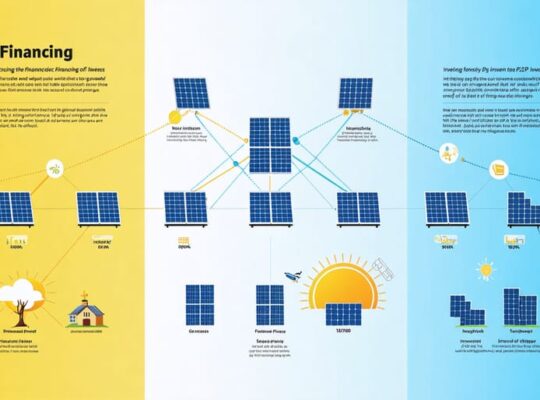
Solar energy projects face a persistent financing paradox: while costs have plummeted 90% over the past decade, accessing capital remains prohibitively complex for distributed installations, community projects, and emerging markets. Traditional financial intermediaries impose high transaction costs, lengthy approval processes, and geographic limitations that exclude millions of potential solar adopters from participating in the clean energy transition.
Blockchain technology offers a transformative solution by creating decentralized financial infrastructure specifically designed for renewable energy transactions. Through smart contracts, tokenization, and peer-to-peer lending protocols, blockchain eliminates intermediaries, reduces financing costs by up to 40%, and enables fractional ownership of solar assets previously accessible only to institutional investors. These systems automate payment distribution, verify energy production in real-time, and create transparent audit trails—addressing the trust gaps that have historically inflated solar project risk premiums.
For photovoltaic professionals, understanding blockchain financial services represents more than technological literacy; it’s a career differentiator in an industry where financing expertise increasingly determines project viability. The convergence of distributed ledger technology with distributed energy resources is already enabling green bonds backed by solar portfolios, automated renewable energy certificates, and microgrid economies in off-grid communities. As traditional banks and utilities explore blockchain pilots, professionals who comprehend both photovoltaic systems and decentralized finance will architect the next generation of solar deployment models—making clean energy accessible, affordable, and financially inclusive at unprecedented scale.
The Solar Financing Problem That’s Holding Back Clean Energy
Solar energy adoption faces a critical bottleneck: financing. Despite dramatic reductions in photovoltaic panel costs over the past decade, the upfront capital required for solar installations remains prohibitively high for many residential and commercial customers. A typical residential system costs between $15,000 and $25,000, while commercial installations can exceed millions of dollars—expenses that create immediate barriers to entry.
Traditional financing channels compound these challenges through restrictive lending practices. Banks and financial institutions often impose stringent credit requirements, excluding middle-income households and small businesses from accessing solar capital. The approval process itself presents obstacles, with loan applications frequently requiring 30 to 90 days for processing, during which market conditions and equipment prices may fluctuate significantly.
Geographic limitations further constrain solar financing accessibility. Rural communities and developing regions typically lack robust banking infrastructure, leaving potential solar adopters without viable financing options. Even in well-served urban markets, the complexity of innovative financing mechanisms such as power purchase agreements and leasing arrangements creates confusion and hesitation among consumers.
The commercial sector encounters additional complications. Multi-tenant properties struggle with split incentive problems—where building owners bear installation costs while tenants receive electricity bill savings. Project developers face lengthy interconnection procedures and uncertain regulatory environments that increase financial risk and discourage investment.
These systemic inefficiencies result in higher transaction costs, with administrative expenses and risk premiums adding 10-20% to total project costs. Traditional financial intermediaries capture significant value while providing limited transparency into fee structures and loan terms. For solar energy to achieve its potential as a mainstream energy source, the industry requires financing solutions that reduce barriers, accelerate deployment timelines, increase transparency, and democratize access to clean energy capital—setting the stage for transformative technological interventions.


What Blockchain Financial Services Actually Mean for Solar
Smart Contracts: Automating Solar Payment Agreements
Smart contracts represent a transformative approach to solar financing by automating payment agreements through self-executing code on blockchain networks. These digital contracts automatically trigger payments when predetermined conditions are met, eliminating the need for intermediaries such as banks, lawyers, or escrow agents. For solar installations, this technology streamlines complex financial arrangements while significantly reducing transaction costs.
In practical applications, smart contracts can automate performance-based payments for solar installations. When sensors verify that a system generates the agreed-upon kilowatt-hours, the contract automatically releases funds to the installer or owner. This automated verification eliminates disputes over system performance and reduces administrative overhead by up to 30% compared to traditional payment structures.
The technology particularly benefits community solar projects and power purchase agreements (PPAs). Smart contracts can manage monthly payments from multiple subscribers, automatically adjusting for actual energy production and distributing revenues to project owners without manual intervention. This reduces processing costs and accelerates payment cycles from weeks to mere hours.
For aspiring photovoltaic professionals, understanding smart contract functionality has become increasingly valuable. Universities collaborating with blockchain initiatives now offer educational programs covering these automated systems, preparing the workforce for an evolving solar finance landscape. The technology’s transparency also builds trust among stakeholders, as all parties can verify contract terms and execution on the blockchain ledger, creating accountability that traditional agreements struggle to match.
Tokenization: Breaking Down Solar Assets Into Affordable Pieces
Tokenization transforms large-scale solar installations into manageable digital assets by dividing ownership into blockchain-based tokens. Each token represents a fractional share of a solar project, similar to owning stock in a company. This innovative approach democratizes solar investment by lowering financial barriers—instead of requiring hundreds of thousands of dollars to develop a complete installation, investors can participate with contributions as modest as $100 or less.
The process begins when project developers register a solar asset on a blockchain platform, establishing the total number of tokens and their corresponding value. These digital tokens are then offered through crowdfunding campaigns, enabling multiple stakeholders to collectively finance solar developments. Token holders receive proportional returns based on the energy production revenue generated by the installation.
This model particularly benefits community solar projects and distributed energy systems in underserved markets. Academic institutions studying renewable finance have documented how tokenization accelerates project deployment timelines by 30-40% compared to traditional funding mechanisms. For aspiring photovoltaic professionals, understanding tokenization frameworks provides valuable insight into emerging career opportunities at the intersection of solar technology and financial innovation, where knowledge of both blockchain protocols and photovoltaic system performance becomes increasingly essential.
Real-World Applications: Blockchain Solar Financing Models That Work Today
Peer-to-Peer Solar Lending Platforms
Blockchain technology fundamentally transforms peer-to-peer solar lending by eliminating traditional intermediaries and creating direct connections between investors and solar adopters. These decentralized platforms utilize smart contracts to automate loan origination, payment processing, and collateral management, significantly reducing administrative overhead and associated costs.
The technology enables fractional investment opportunities, allowing multiple investors to fund individual solar installations through tokenized debt instruments. This democratization of solar finance expands capital access for residential and commercial projects that might not qualify for conventional financing. Blockchain’s immutable ledger provides transparent tracking of energy production data, loan performance metrics, and payment histories, which reduces information asymmetry and enables more accurate risk assessment.
Several pilot programs have demonstrated measurable benefits: transaction costs reduced by 30-40% compared to traditional lending, faster approval processes, and improved access for underserved markets. The technology also facilitates cross-border investment, connecting international capital with local solar projects. However, regulatory frameworks remain evolving, and platforms must navigate complex securities laws while ensuring investor protection and borrower privacy through appropriate data governance protocols.
Solar Energy Trading and Credit Systems
Blockchain technology enables peer-to-peer energy trading platforms where solar system owners can sell excess electricity directly to neighbors or businesses, bypassing traditional utility intermediaries. These decentralized systems automatically record transactions through smart contracts, ensuring transparent pricing and instant settlements. Participants earn cryptocurrency tokens or energy credits for their surplus generation, which can offset initial installation costs or be converted to fiat currency.
Several universities are partnering with blockchain developers to pilot these trading networks on campus microgrids, providing valuable research data and hands-on learning opportunities for aspiring PV professionals. The technology addresses a critical challenge in solar adoption: maximizing return on investment for residential and commercial installations. By creating liquid markets for distributed energy resources, blockchain platforms incentivize solar deployment while supporting grid stability.
Key benefits include reduced transaction costs, elimination of billing disputes, and democratized access to renewable energy markets. However, regulatory frameworks remain under development in most jurisdictions, requiring industry stakeholders to actively engage with policymakers. As these systems mature, they promise to transform how we value, distribute, and monetize solar energy generation.
Crowdfunded Solar Projects Through Tokenization
Blockchain tokenization is revolutionizing access to crowdfunding solar projects by enabling fractional ownership of renewable energy installations. Notable examples include Brooklyn Microgrid, where residents trade solar energy credits through blockchain tokens, and Sun Exchange’s platform, which has funded over 100 megawatts of solar capacity across Africa by allowing global investors to purchase individual solar cells starting at $5. WePower’s Estonian pilot project successfully raised capital for a 2MW solar farm through tokenized energy purchase agreements, demonstrating how blockchain reduces minimum investment thresholds from thousands to mere dollars.
These initiatives leverage smart contracts to automate dividend distributions based on energy production, providing transparent returns to token holders. Academic partnerships, including MIT’s research on peer-to-peer energy trading networks, validate the scalability of these models. For aspiring photovoltaic professionals, understanding tokenization frameworks presents valuable opportunities in project development and financial structuring. This democratization of solar investment extends beyond traditional venture capital, enabling community members, environmental advocates, and retail investors to participate directly in the clean energy transition while receiving proportional financial returns from operational solar assets.

The Financial Benefits: Why Blockchain Beats Traditional Solar Loans
Blockchain technology introduces transformative financial advantages that fundamentally reshape how photovoltaic projects secure funding. When compared to traditional solar loans, blockchain-based financing delivers measurable improvements across multiple operational dimensions.
**Reduced Transaction Costs**
Blockchain eliminates intermediaries that typically inflate financing expenses. Traditional solar loans involve multiple parties—banks, credit agencies, legal advisors, and brokers—each extracting fees. Blockchain’s peer-to-peer infrastructure reduces these costs by 40-60%, according to recent industry analyses. Smart contracts automate verification processes, cutting administrative overhead while maintaining rigorous compliance standards. For a typical residential solar installation valued at $20,000, this translates to savings between $800 and $1,200 in processing fees alone.
**Accelerated Approval Timelines**
Conventional loan approvals require 2-6 weeks for documentation review, credit checks, and underwriting. Blockchain platforms compress this timeframe to 24-72 hours through automated verification protocols. Smart contracts instantly validate creditworthiness using decentralized identity systems, while distributed ledgers provide immediate access to payment histories and asset registrations. This acceleration benefits installers managing cash flow and homeowners eager to commence energy production.
**Enhanced Transparency and Security**
Blockchain’s immutable ledger architecture creates unprecedented transparency throughout the financing lifecycle. Every transaction, payment schedule adjustment, and ownership transfer receives permanent, tamper-proof recording. Borrowers gain real-time visibility into loan terms, interest calculations, and payment allocations—eliminating hidden fees that plague traditional financing. Cryptographic security protocols protect sensitive financial data more effectively than centralized databases vulnerable to breaches.
**Borderless Capital Access**
Geographic limitations vanish with blockchain financing. International investors can fund solar projects across jurisdictions without navigating complex currency exchanges or regulatory frameworks. This expanded capital pool increases competition among lenders, driving down interest rates by an estimated 1.5-3 percentage points. Developing markets with limited banking infrastructure particularly benefit, as blockchain enables direct connections between global capital and local renewable energy projects.
**Fractional Investment Opportunities**
Tokenization allows investors to purchase partial ownership stakes in solar installations, lowering entry barriers from thousands to hundreds of dollars. This democratization attracts diverse capital sources while providing portfolio diversification options previously unavailable in conventional solar financing markets.
What PV Professionals Need to Know About Blockchain Integration
As blockchain technology reshapes solar financing, photovoltaic professionals must develop foundational knowledge to remain competitive and serve clients effectively. Understanding how distributed ledger systems facilitate transparent transactions, automate contract execution through smart contracts, and enable peer-to-peer energy trading positions you as a forward-thinking industry expert capable of navigating the sector’s digital transformation.
Begin by familiarizing yourself with blockchain fundamentals—how transactions are recorded across decentralized networks, the role of consensus mechanisms in validating solar renewable energy certificates, and how tokenization converts physical assets into tradable digital units. This technical literacy enables meaningful conversations with investors exploring blockchain-based solar financing and helps identify which projects might benefit from these innovations.
Project development implications are substantial. Blockchain integration can streamline power purchase agreements, reduce administrative overhead through automated payment systems, and provide real-time performance verification that builds investor confidence. When evaluating projects, assess whether blockchain solutions genuinely address financing barriers or simply add unnecessary complexity. Not every solar installation requires blockchain technology—critical thinking separates valuable applications from speculative implementations.
Client education represents a significant opportunity for differentiation. Many property owners and investors hear about blockchain but lack practical understanding of its solar applications. Developing clear explanations of how blockchain reduces transaction costs, accelerates project funding, or enables community solar participation establishes trust and positions you as an informed advisor. Consider creating simplified case studies demonstrating successful blockchain implementations in similar market contexts.
Career advancement increasingly favors professionals who bridge technical solar expertise with emerging financial technologies. Universities and industry organizations now offer specialized courses in blockchain applications for renewable energy. Pursuing continuing education in this area enhances your professional profile and opens opportunities with innovative solar developers, fintech companies entering the clean energy sector, and forward-looking utilities implementing distributed energy resource management systems. As traditional financing mechanisms evolve alongside blockchain solutions, professionals who understand both paradigms will lead the industry’s next generation of project development and deployment strategies.

Challenges and Considerations in Blockchain Solar Financing
While blockchain technology presents compelling opportunities for solar financing, several significant challenges must be addressed before widespread adoption becomes reality. Understanding these limitations helps industry stakeholders set realistic expectations and develop informed strategies.
**Regulatory uncertainty** remains the primary obstacle. Most jurisdictions lack clear frameworks governing blockchain-based financial instruments, creating compliance risks for both project developers and investors. Securities regulations, tax treatment of tokenized assets, and cross-border transaction rules vary dramatically between regions, complicating international solar investments. Universities collaborating with industry leaders are increasingly incorporating regulatory considerations into their renewable energy programs to prepare future professionals for this evolving landscape.
**Technology maturity and scalability** present practical concerns. Many blockchain platforms struggle with transaction throughput, processing only 15-30 transactions per second compared to traditional systems handling thousands. This limitation affects platform usability during peak demand periods. Additionally, energy consumption of certain blockchain networks—particularly proof-of-work systems—raises sustainability questions for environmentally conscious solar stakeholders.
**User adoption barriers** include the steep learning curve associated with blockchain technologies. Many potential solar investors lack familiarity with digital wallets, private keys, and decentralized platforms, creating hesitation around participation. Educational initiatives are essential for bridging this knowledge gap, which is why forward-thinking educational programs now include blockchain fundamentals alongside photovoltaic system design.
**Cybersecurity considerations** cannot be overlooked. While blockchain architecture offers inherent security advantages, smart contract vulnerabilities, exchange hacks, and phishing attacks targeting cryptocurrency holders pose real risks. The immutability of blockchain transactions means errors or fraud may be difficult to reverse.
Industry stakeholders must weigh these challenges against potential benefits, recognizing that blockchain solar financing remains an emerging field requiring continued development, regulatory clarity, and user education before achieving mainstream viability.
The Future Landscape: Where Blockchain and Solar Are Heading Together
The convergence of blockchain technology and solar energy is poised to accelerate significantly over the next 3-5 years, fundamentally transforming how individuals and institutions access renewable energy investments. Industry analysts predict that blockchain-enabled solar financing platforms will mature from pilot projects to mainstream financial instruments, particularly as regulatory frameworks evolve to accommodate decentralized energy trading and tokenized asset ownership.
Emerging regulatory developments across major markets signal growing acceptance of blockchain-based energy transactions. The European Union’s proposed Digital Finance Package and similar initiatives in Asia-Pacific nations are establishing clearer guidelines for tokenized renewable energy assets, which will enhance investor confidence and institutional participation. These frameworks are expected to standardize smart contract protocols for solar projects, reducing transaction costs by up to 40% while improving transparency in solar investment returns.
For photovoltaic professionals, this technological convergence creates unprecedented career opportunities at the intersection of renewable energy and financial technology. Universities are responding by developing specialized curricula combining solar engineering principles with blockchain fundamentals, preparing graduates for hybrid roles in decentralized energy finance. Professionals with expertise in both domains will be particularly valuable as project developers increasingly seek integrated solutions for solar deployment and financing.
The democratization of solar access stands as the most transformative potential outcome. Blockchain platforms are expected to enable fractional ownership of utility-scale solar farms, allowing investments starting below $100—a stark contrast to traditional minimum thresholds. This accessibility will expand the investor base from institutional players to everyday consumers, accelerating solar adoption while creating more equitable wealth-building opportunities in the renewable energy transition.
Blockchain financial services represent a transformative force in solar energy adoption, systematically dismantling traditional barriers that have long hindered widespread photovoltaic deployment. By enabling fractional investment, peer-to-peer energy trading, and transparent financing mechanisms, these technologies empower consumers to access solar installations previously beyond their reach while simultaneously opening new professional pathways for PV specialists skilled in both renewable energy systems and emerging financial technologies.
The convergence of blockchain and solar energy is not merely theoretical—it’s actively reshaping how projects are funded, how energy credits are traded, and how stakeholders interact across the value chain. For aspiring photovoltaic professionals, understanding these blockchain-enabled financial models is becoming as essential as technical installation expertise. Academic researchers and industry stakeholders recognize that these innovations address critical challenges in project financing, grid management, and market accessibility.
As these technologies mature, staying informed about blockchain developments will distinguish forward-thinking professionals in an increasingly competitive marketplace. Whether you’re launching a solar career, managing existing projects, or researching renewable energy solutions, consider how blockchain financial services might enhance your work. Engage with educational programs, pilot projects, and industry collaborations to position yourself at the forefront of this solar finance revolution.