
Understanding the intricate relationship between interest rates and stock market performance becomes essential when evaluating photovoltaic project financing and renewable energy portfolio strategies. Central bank monetary policy decisions directly influence capital availability, borrowing costs, and investor appetite for solar assets, creating ripple effects throughout energy markets that determine project viability and returns.
When interest rates rise, fixed-income securities become more attractive relative to equities, prompting capital reallocation away from stocks and increasing the discount rates applied to future cash flows from solar installations. This mechanism particularly impacts high-growth renewable energy companies whose valuations depend heavily on projected earnings years into the future. Conversely, lower interest rates reduce financing costs for solar projects, improve net present value calculations, and make equity investments more competitive, driving capital toward photovoltaic development and related stocks.
For solar industry professionals and investors, comprehending how interest rates transform solar returns provides critical insight for timing market entry, structuring project finance, and optimizing portfolio allocation. The correlation extends beyond simple inverse relationships, encompassing currency fluctuations, inflation expectations, and risk premiums that collectively shape investment decisions.
This comprehensive analysis examines theoretical frameworks governing interest rate impacts while delivering practical applications for photovoltaic economics, equipping readers with quantitative tools and strategic perspectives necessary for navigating macroeconomic influences on renewable energy investments in an evolving financial landscape.
The Fundamental Relationship Between Interest Rates and Capital Markets

How Central Bank Policy Affects Cost of Capital
Central banks influence market conditions through monetary policy adjustments that directly affect corporate financing costs and investment valuations. When central banks raise benchmark interest rates to combat inflation, commercial lending rates increase correspondingly, elevating the cost of debt capital for corporations, including renewable energy companies. This transmission mechanism operates through multiple channels: banks pass higher borrowing costs to businesses, bond yields rise as fixed-income securities adjust to new rate environments, and equity discount rates increase as investors demand higher returns to compensate for elevated risk-free rates.
For photovoltaic companies and solar project developers, these policy shifts create tangible economic consequences. Higher borrowing costs reduce project profitability margins, potentially rendering previously viable installations economically unfeasible. The weighted average cost of capital increases as both debt and equity components become more expensive, requiring projects to generate higher returns to justify investment.
Conversely, accommodative monetary policy with lower interest rates decreases financing costs, improving project economics and stimulating capital deployment in renewable energy infrastructure. This dynamic explains why solar stocks and clean energy indices often correlate inversely with interest rate movements. Understanding this relationship enables investors and project developers to anticipate market conditions, time capital raises strategically, and structure financing arrangements that mitigate interest rate sensitivity through appropriate debt-to-equity ratios and hedging instruments.
The Risk-Free Rate and Investment Decision-Making
Treasury yields serve as the cornerstone for investment decision-making across all asset classes, including renewable energy equities and photovoltaic project financing. When government bonds offer higher returns with virtually zero default risk, investors naturally reassess their required returns for riskier investments like solar development stocks.
The risk-free rate functions as the baseline opportunity cost. If a 10-year Treasury note yields 4%, rational investors will demand returns exceeding this threshold to justify the additional risk inherent in equity investments. For photovoltaic companies and renewable energy projects, this benchmark directly influences capital allocation decisions and valuation models.
Rising treasury yields compress the attractiveness of dividend-paying solar stocks, as fixed-income alternatives become more competitive. Academic researchers studying solar economics consistently observe that each percentage point increase in the risk-free rate typically elevates the weighted average cost of capital for PV projects by corresponding margins, affecting project internal rates of return.
For aspiring photovoltaic professionals, understanding this relationship proves essential when evaluating investment opportunities. Project developers must account for how treasury yield fluctuations alter financing costs, while financial analysts incorporate these rates into discounted cash flow models that determine fair stock valuations. This foundational principle connects macroeconomic monetary policy directly to solar market dynamics, informing strategic decisions across the renewable energy value chain.
Interest Rate Impact on Stock Market Performance
Discount Rate Effects on Present Value Calculations
The discount rate serves as the foundation for present value calculations, directly determining how future cash flows translate into today’s valuation metrics. When interest rates rise, the discount rate applied to future earnings increases proportionally, mathematically reducing the present value of those anticipated returns. This inverse relationship operates through a simple but powerful formula: higher denominator values in present value equations systematically decrease calculated outcomes.
For photovoltaic project developers and renewable energy investors, this mechanism carries substantial implications. Solar installations typically generate cash flows over 25-30 year operational lifespans, making their valuations particularly sensitive to discount rate fluctuations. A modest 1-2% increase in the discount rate can reduce the net present value of a solar project by 15-20%, fundamentally altering investment attractiveness and project financing feasibility.
Stock market valuations for solar companies follow identical principles. When central banks raise benchmark interest rates, equity analysts adjust their discounted cash flow models accordingly, applying higher discount rates to projected earnings streams. This recalibration mechanically compresses stock valuations, often triggering market corrections regardless of underlying operational performance. Companies with longer payback periods or those prioritizing growth over immediate profitability face disproportionate valuation pressure during rising rate environments.
Understanding these dynamics proves essential for aspiring photovoltaic professionals evaluating project economics and industry stakeholders assessing portfolio risk. Academic research consistently demonstrates this discount rate sensitivity, making it a cornerstone concept in renewable energy finance education programs offered through university collaborations and professional development initiatives.
Sector-Specific Vulnerabilities in the Energy Transition
Solar and renewable energy companies demonstrate heightened sensitivity to interest rate fluctuations due to their distinctive operational and financial characteristics. Unlike traditional energy firms that generate immediate cash flows from existing assets, renewable energy projects follow a front-loaded capital expenditure model requiring substantial upfront investment before revenue generation begins.
The capital-intensive nature of photovoltaic installations creates direct exposure to borrowing costs. Solar projects typically require 70-85% of total lifecycle costs during the construction phase, with payback periods extending 7-15 years. When interest rates rise, the present value of future cash flows diminishes significantly, reducing project attractiveness to investors and lowering stock valuations accordingly. Traditional energy companies, conversely, maintain more balanced capital structures with diversified revenue streams that partially insulate them from rate volatility.
Debt financing represents another critical vulnerability. Renewable energy developers routinely leverage 60-80% debt ratios to fund project development, substantially higher than the 30-50% common in conventional energy sectors. Each percentage point increase in interest rates can reduce project internal rates of return by 0.5-1.5 percentage points, directly impacting profitability margins and investor confidence.
Growth-oriented valuation models further amplify sensitivity. Investors typically value renewable energy stocks using discounted cash flow methodologies that project earnings 20-30 years forward. Rising interest rates increase discount rates applied to these projections, compressing valuations more dramatically than mature, dividend-paying traditional energy stocks valued on current earnings multiples.
The regulatory environment adds complexity. Many renewable projects depend on government incentives with fixed nominal values. As interest rates rise and inflation accelerates, these incentives lose real purchasing power, while financing costs simultaneously increase, creating a dual pressure point unique to the renewable sector. Understanding these sector-specific vulnerabilities enables investors and professionals to anticipate market movements and structure financing strategies that mitigate interest rate risk exposure.
Understanding PV Project Economics and Capital Structure

Project Finance Fundamentals for Solar Installations
Understanding the financial architecture of photovoltaic installations is essential for evaluating how interest rate fluctuations affect project viability and investment returns. Solar project finance typically employs specialized structures that balance risk and return for multiple stakeholders.
Most utility-scale solar projects utilize a capital structure comprising 60-80% debt and 20-40% equity, significantly higher leverage than traditional corporate finance. This debt-heavy approach maximizes tax equity benefits and improves return on equity when interest rates remain favorable. Commercial and industrial installations often maintain more conservative ratios around 50-70% debt, reflecting higher perceived risk profiles.
Primary financing mechanisms include project finance loans, where debt is secured by project cash flows rather than sponsor balance sheets, creating non-recourse or limited-recourse arrangements. Tax equity partnerships enable investors to monetize investment tax credits and accelerated depreciation benefits, particularly valuable for entities without sufficient tax appetite. Green bonds have emerged as attractive instruments for institutional investors seeking sustainable investment opportunities with predictable yields.
Interest rates directly impact debt service coverage ratios, typically requiring minimum thresholds of 1.3-1.5 times for lender approval. When rates rise, projects must generate higher revenues to maintain acceptable coverage levels, potentially rendering marginal projects financially unviable. Conversely, declining rates expand project feasibility by reducing financing costs, often triggering accelerated deployment cycles across the solar sector and subsequently affecting publicly traded solar company valuations in equity markets.
Key Financial Metrics: LCOE, NPV, and IRR
Understanding the financial viability of photovoltaic projects requires mastery of three fundamental metrics that form the backbone of investment analysis. These metrics become particularly critical when interest rates fluctuate, as they directly incorporate the time value of money into project evaluations.
The Levelized Cost of Energy (LCOE) represents the average cost per kilowatt-hour of electricity generated over a system’s lifetime. This metric accounts for all capital expenditures, operational costs, maintenance expenses, and financing charges, then divides by total expected energy production. LCOE enables direct comparison between different energy sources and technologies, making it indispensable for policy makers and investors. Rising interest rates increase the weighted average cost of capital, which elevates LCOE calculations and can make solar projects less competitive against conventional energy sources.
Net Present Value (NPV) calculates the difference between the present value of cash inflows and outflows over a project’s lifetime. A positive NPV indicates that projected returns exceed costs when discounted to present value using an appropriate discount rate. This discount rate typically reflects prevailing interest rates plus a risk premium. When interest rates rise, the discount rate increases, reducing NPV and potentially rendering previously viable projects unattractive.
Internal Rate of Return (IRR) identifies the discount rate at which NPV equals zero, essentially representing the project’s break-even return. Investors compare IRR against their required return threshold, which correlates with market interest rates. Comprehensive solar financial models integrate these metrics to provide holistic investment perspectives, particularly valuable during periods of monetary policy shifts that impact financing conditions across renewable energy markets.
How Interest Rates Directly Impact Solar PV Economics
Weighted Average Cost of Capital (WACC) Sensitivity
Interest rate fluctuations directly impact photovoltaic project feasibility through their influence on the Weighted Average Cost of Capital (WACC), which serves as the discount rate for evaluating solar investments. Understanding this transmission mechanism is essential for renewable energy professionals assessing project viability under changing monetary conditions.
WACC represents the blended cost of financing a solar installation through both equity and debt. The formula incorporates the cost of equity (typically derived from the Capital Asset Pricing Model, which includes risk-free rates) and the after-tax cost of debt. When central banks raise interest rates, both components increase proportionally. For photovoltaic projects, which often carry debt-to-equity ratios of 70:30 or higher, even modest rate increases can substantially elevate WACC.
Consider a practical example: A utility-scale solar project with an initial WACC of 6% might see this rise to 8% following a 200-basis-point interest rate increase. This seemingly minor adjustment dramatically reduces net present value calculations, as future cash flows are discounted more heavily. Projects generating consistent revenue streams over 25-year power purchase agreements become less attractive when discount rates climb, potentially rendering marginal installations economically unviable.
Academic research conducted through university collaborations has demonstrated that each 1% WACC increase can reduce solar project IRR by approximately 1.5-2%. This sensitivity underscores why renewable energy investors closely monitor Federal Reserve policy announcements and bond yield movements. For aspiring PV professionals, mastering WACC sensitivity analysis becomes crucial for developing resilient financial models that account for various interest rate scenarios, ensuring accurate project evaluation regardless of macroeconomic conditions.
Debt Service Coverage and Project Bankability
Rising interest rates fundamentally alter the financial landscape for photovoltaic projects by increasing debt service coverage ratio (DSCR) requirements and challenging project bankability. When lending rates climb, borrowers face higher monthly debt obligations, requiring projects to generate proportionally greater cash flows to satisfy lender criteria. Most financial institutions mandate minimum DSCR thresholds between 1.2 and 1.4 for solar projects, meaning annual net operating income must exceed debt payments by these multiples to demonstrate adequate safety margins.
Higher interest environments compress project feasibility boundaries, as increased capital costs directly reduce net present value calculations. A 200-basis-point rate increase can elevate debt service payments by 15-25 percent over typical 15-20 year financing periods, potentially rendering marginal projects unbankable. This particularly affects utility-scale installations where debt financing constitutes 60-80 percent of capital structures.
Educational programs through university collaborations increasingly emphasize sophisticated financial modeling techniques that account for interest rate sensitivity in feasibility analyses. Project developers must now incorporate stress testing scenarios and demonstrate resilience across various rate environments to secure financing. Enhanced power purchase agreement pricing or operational efficiency improvements become essential compensating mechanisms when rate increases threaten DSCR compliance, fundamentally reshaping project development strategies in the renewable energy sector.
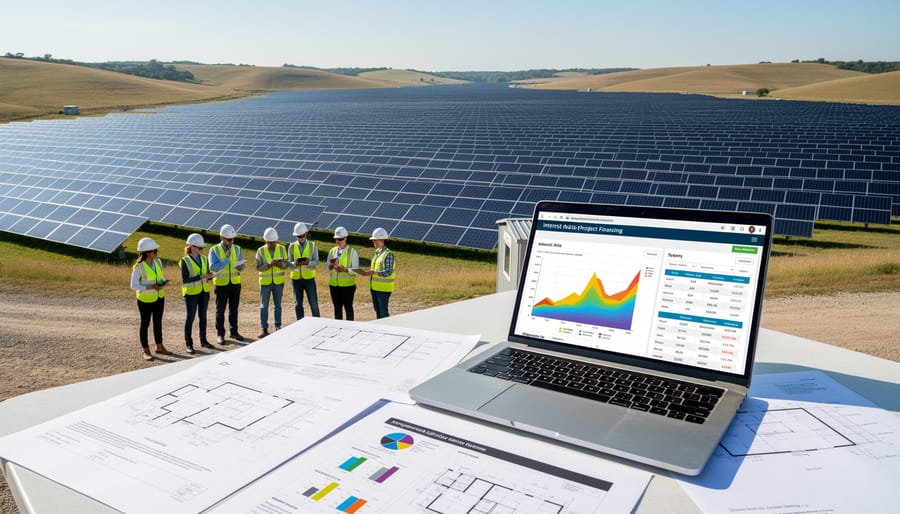
Impact on Levelized Cost of Energy (LCOE)
Interest rates fundamentally alter the Levelized Cost of Energy (LCOE) for photovoltaic systems through their direct impact on the discount rate used in present value calculations. When interest rates increase by just 1%, LCOE for solar projects can rise by 5-8%, significantly affecting competitive positioning. This sensitivity stems from solar energy’s capital-intensive nature, where approximately 70-80% of total costs occur upfront, making financing terms critical to project economics.
The LCOE formula incorporates the weighted average cost of capital (WACC), which reflects both debt and equity financing costs. In a low-interest environment (2-3% rates), solar LCOE may reach $30-40 per megawatt-hour, competing favorably with natural gas and coal. However, when rates climb to 6-7%, solar LCOE can exceed $50-60 per megawatt-hour, narrowing or eliminating cost advantages versus conventional generation.
This dynamic particularly impacts utility-scale projects with 20-25 year financing horizons. Academic research conducted through university collaborations demonstrates that interest rate volatility introduces substantial risk premiums into renewable energy valuations, affecting stock market performance of solar companies and investor appetite for new projects. Educational programs now emphasize financial modeling skills to help aspiring professionals navigate these complexities and optimize project structures under varying monetary policy conditions.
Real-World Implications for PV Developers and Investors
Corporate Solar Investment in High-Rate Environments
Corporate decision-makers face increasingly complex calculations when evaluating photovoltaic installations amid rising interest rates. The fundamental challenge lies in balancing upfront capital expenditure against long-term energy savings, a calculation that becomes less favorable as borrowing costs increase. When interest rates climb, the discount rate applied to future cash flows rises proportionally, extending payback periods and potentially jeopardizing project approval thresholds.
Financial officers typically employ net present value analysis and internal rate of return metrics to assess PV projects. In high-rate environments, companies may observe payback periods extending from five to seven years or beyond, depending on electricity prices and system costs. This extension can push projects outside acceptable investment horizons, particularly for organizations requiring returns within three to five years. However, progressive corporations recognize that energy cost escalation often outpaces interest rate increases, preserving the fundamental value proposition of solar installations.
Strategic companies are adopting smart solar financing strategies to navigate elevated capital costs. Power purchase agreements and operating leases enable corporations to deploy solar capacity without significant capital outlay, transferring interest rate risk to specialized financiers. Additionally, partnerships with academic institutions provide valuable research into optimizing system performance and financial structuring. Tax incentives, including investment tax credits and accelerated depreciation, remain critical factors that can offset interest rate impacts by reducing effective project costs by twenty-six percent or more, maintaining investment attractiveness despite macroeconomic headwinds.
Utility-Scale Project Pipeline Dynamics
Interest rate fluctuations create substantial ripple effects throughout utility-scale solar project pipelines, fundamentally altering development economics and timeline feasibility. When central banks raise rates, the weighted average cost of capital for large-scale photovoltaic installations increases proportionally, directly impacting project internal rates of return and net present value calculations. A typical 100-megawatt solar farm requires $80-120 million in capital, with 60-80% typically financed through debt instruments. A 200-basis-point interest rate increase can reduce project returns by 15-25%, potentially rendering marginal projects economically unviable.
Development timelines experience compression or extension based on rate environments. Rising rates often trigger accelerated construction schedules as developers rush to secure financing at current terms before further increases, while declining rates may encourage delayed financial close to capture more favorable conditions. This dynamic creates procurement bottlenecks and supply chain volatility, particularly affecting specialized equipment like inverters and tracking systems.
Power purchase agreement negotiations become increasingly complex during rate volatility periods. Offtakers demand lower pricing while developers require higher rates to maintain adequate returns, creating valuation gaps that can stall projects for 6-18 months. Additionally, refinancing opportunities for operational assets shift dramatically with rate changes, affecting portfolio optimization strategies for institutional investors.
The interconnection queue experiences corresponding fluctuations, with speculative project deposits increasing during low-rate environments and withdrawals accelerating when financing costs rise. Project developers must maintain sophisticated financial modeling capabilities, incorporating multiple rate scenarios and corresponding contingency planning to navigate these macroeconomic headwinds effectively while maintaining stakeholder confidence throughout extended development cycles.
Mitigation Strategies and Adaptive Approaches
Financial Engineering and Structure Optimization
Photovoltaic project developers increasingly employ sophisticated financial engineering techniques to mitigate interest rate exposure and optimize capital structures. Tax equity partnerships remain fundamental to solar financing, allowing investors to monetize Investment Tax Credits and Modified Accelerated Cost Recovery System benefits while developers retain operational control. These structures typically involve partnership flip or sale-leaseback arrangements, which distribute cash flows based on predetermined allocation schedules.
Rising interest rates necessitate proactive hedging strategies to protect project returns. Interest rate swaps enable developers to convert floating-rate debt to fixed rates, establishing predictable debt service obligations throughout the project lifecycle. Cap agreements provide protection against rate spikes while preserving benefits from potential decreases. Forward rate agreements lock in future borrowing costs, particularly valuable for projects under development.
Alternative financing mechanisms have emerged to address traditional debt constraints. Green bonds attract environmentally conscious investors willing to accept slightly lower yields for verified sustainability impacts. Lease financing structures reduce upfront capital requirements while maintaining investment tax credit eligibility. Community solar models aggregate smaller investors, democratizing participation while achieving economies of scale.
Research collaborations between financial institutions and universities have advanced understanding of optimal capital structures under varying rate environments. These partnerships develop quantitative models balancing debt capacity against equity return requirements, enabling more resilient financing frameworks. Academic programs increasingly incorporate these practical applications, preparing professionals to navigate complex financial landscapes effectively.

Technology and Efficiency as Economic Levers
When interest rates rise and capital costs increase, technological advancements become critical economic levers for maintaining project viability. Modern photovoltaic systems demonstrate remarkable efficiency improvements that directly counterbalance higher financing expenses, making solar investments resilient even in challenging monetary environments.
Contemporary solar panels featuring Passivated Emitter and Rear Cell (PERC) technology achieve conversion efficiencies exceeding 22 percent, compared to conventional panels at 15-17 percent. This substantial improvement means projects generate more revenue from identical surface areas, effectively reducing the levelized cost of energy regardless of interest rate fluctuations. The enhanced energy output accelerates payback periods, which becomes particularly valuable when discount rates increase.
System-level innovations further amplify these benefits. Bifacial modules capture reflected light from ground surfaces, increasing energy production by 10-30 percent without additional land requirements. Advanced inverter technologies minimize conversion losses, while optimized mounting structures reduce installation labor and materials costs. These cumulative improvements can decrease total system costs by 20-40 percent compared to previous generation equipment.
For project developers and investors, this technological trajectory provides strategic flexibility. Universities collaborating with industry partners continuously develop next-generation materials and manufacturing processes, ensuring ongoing cost reductions. Educational programs prepare professionals to implement these innovations effectively, creating competitive advantages that offset macroeconomic headwinds. When evaluating solar investments during high interest rate periods, factoring technology-driven efficiency gains becomes essential for accurate financial modeling and maintaining attractive returns.
Educational Resources for PV Professionals
Understanding the intricate relationship between interest rates and renewable energy markets requires specialized knowledge that bridges macroeconomic theory and sector-specific applications. For aspiring photovoltaic professionals, developing proficiency in financial analysis has become increasingly critical as solar projects compete for capital in dynamic economic environments.
Mose Solar recognizes this educational imperative and has established comprehensive training programs designed to equip professionals with the analytical tools necessary for navigating complex investment landscapes. These initiatives focus on helping participants understand how monetary policy decisions cascade through financial markets to ultimately affect solar project economics, from equipment financing costs to equity valuations of publicly traded renewable energy companies.
The company’s educational framework incorporates real-world case studies that demonstrate how interest rate fluctuations impact project Internal Rate of Return calculations, debt service coverage ratios, and levelized cost of energy projections. Through collaborative partnerships with universities, Mose Solar has developed curriculum modules that integrate traditional financial analysis with renewable energy-specific considerations, including policy incentive structures and grid integration economics.
Professional development offerings include workshops on financial modeling techniques, webinars featuring industry experts discussing current market conditions, and certification programs that validate competency in solar project finance. These resources address the growing demand for professionals who can perform sophisticated sensitivity analyses to assess how various interest rate scenarios might affect project viability and portfolio performance.
For those seeking to deepen their expertise, Mose Solar provides access to white papers, analytical frameworks, and downloadable reference materials that serve as ongoing professional resources. These educational tools enable practitioners to make data-driven recommendations when advising clients on project timing, capital structure optimization, and risk mitigation strategies in response to evolving macroeconomic conditions.
The intricate relationship between interest rates and capital markets fundamentally shapes the economic landscape for photovoltaic investments. As demonstrated throughout this analysis, rising interest rates directly impact project financing costs, discount rate calculations, and competitive positioning relative to traditional energy sources. Solar professionals must recognize that monetary policy decisions extend beyond abstract macroeconomic theory, translating into tangible effects on levelized cost of energy, project internal rates of return, and investor appetite for renewable energy portfolios.
Looking forward, the renewable energy sector faces a dynamic financial environment characterized by potential rate volatility and evolving policy frameworks. However, declining technology costs, improving efficiency metrics, and strengthened environmental regulations continue to support long-term growth trajectories despite short-term interest rate headwinds. Project developers who maintain flexibility in financing structures and diversify capital sources will navigate these conditions most effectively.
Financial literacy has emerged as an indispensable competency for photovoltaic professionals. Understanding how weighted average cost of capital, debt service coverage ratios, and equity return thresholds interact with monetary policy enables more sophisticated project evaluation and strategic decision-making. Academic institutions and industry organizations increasingly recognize this need, developing educational programs that integrate finance fundamentals with renewable energy engineering principles.
Collaboration between universities, research institutions, and industry practitioners will prove essential in preparing the next generation of solar professionals for this complex financial landscape. By synthesizing technical expertise with macroeconomic awareness, stakeholders can optimize investment strategies, enhance project viability, and accelerate the transition toward sustainable energy systems regardless of prevailing interest rate environments.