
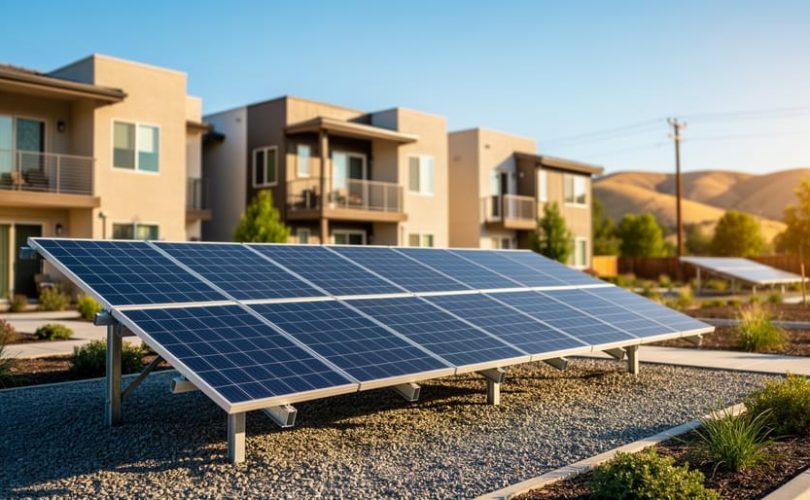
Verify your eligibility for PG&E’s Community Solar program by confirming you’re a residential or commercial customer within the utility’s service territory who lacks suitable roof space, lives in multifamily housing, or cannot install traditional rooftop panels due to shading, structural limitations, or rental agreements. Contact PG&E directly through their customer service portal to request enrollment information, as the utility currently operates limited community solar projects primarily through third-party developers rather than a widespread proprietary program.
Evaluate alternative community solar options beyond PG&E’s constrained offerings by researching California’s Senate Bill 100 provisions and comparing national community solar initiatives that demonstrate more robust subscription models. Many California residents assume PG&E offers comprehensive community solar access comparable to utilities in states like Minnesota or New York, yet the company’s current framework remains significantly underdeveloped compared to regulatory potential established through the California Public Utilities Commission’s 2022 community solar pilots.
Assess financial benefits by calculating projected subscription costs against traditional electricity rates, recognizing that community solar typically delivers 5-15% savings on energy bills through virtual net metering credits applied to monthly statements. Request transparent disclosure of subscription fees, credit calculation methodologies, and contract terms from any third-party provider operating within PG&E territory, as program structures vary substantially between developers managing community solar facilities.
Monitor PG&E’s evolving policy landscape as California regulators continue expanding distributed generation requirements that may compel the utility to develop more accessible community solar infrastructure. Understanding these regulatory dynamics proves essential for photovoltaic professionals advising clients and consumers seeking equitable renewable energy access without individual installation burdens.
What Is PG&E Community Solar and How Does It Work?
Program Structure and Participant Benefits
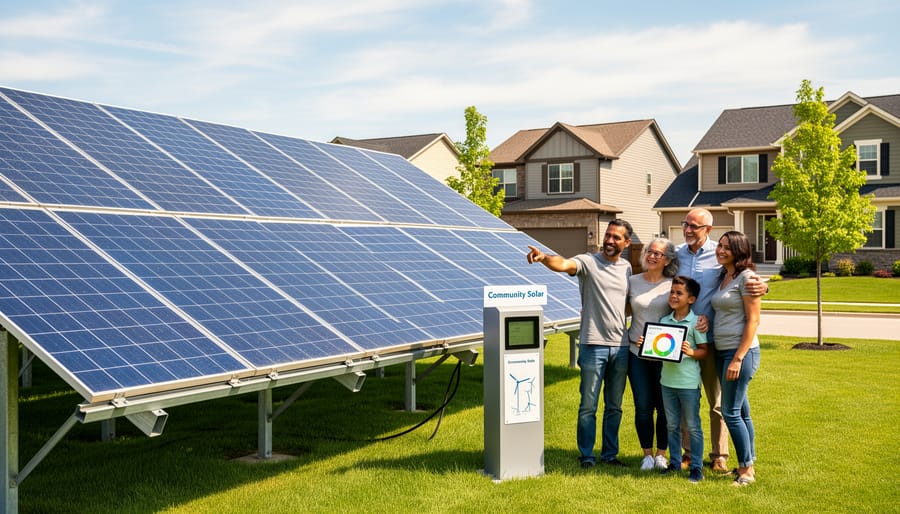
PG&E’s community solar program operates through a subscription-based model where participants purchase or lease a portion of a shared solar array’s capacity. Subscribers receive monthly bill credits proportional to their subscribed share of the system’s energy production, measured in kilowatt-hours. These credits offset electricity consumption charges on standard PG&E bills, with the credit rate typically set at the retail electricity rate or a predetermined discount percentage.
The billing mechanism functions through virtual net metering, allowing the solar production credits to be allocated across multiple subscriber accounts without requiring physical proximity to the generation facility. Participants receive two line items on their monthly statement: their regular electricity usage charges and a separate credit from their community solar subscription. Most programs require a monthly subscription fee or long-term contract commitment, though specific terms vary by project developer.
Economic benefits prove particularly significant for renters, apartment dwellers, and homeowners with unsuitable rooftops due to shading, structural limitations, or unfavorable orientations. These populations, representing approximately 50% of California households, gain access to solar energy savings previously unavailable through traditional rooftop installations. Subscribers typically realize 5-15% savings on electricity costs compared to standard utility rates, depending on subscription terms and local market conditions.
The program structure also benefits from economies of scale, as larger centralized installations achieve lower per-watt costs than residential systems. Educational institutions and community organizations have partnered with PG&E to develop demonstration projects that serve both as energy sources and training facilities for aspiring photovoltaic professionals, creating additional workforce development opportunities within California’s renewable energy sector.

Eligibility and Enrollment Requirements
Participation in PG&E’s community solar programs requires meeting specific eligibility criteria established by California Public Utilities Commission regulations. Residential and commercial customers within PG&E’s service territory qualify, provided they maintain an active account in good standing. Geographic availability varies depending on program implementation phases, with initial projects concentrated in designated disadvantaged communities and environmental justice zones to meet California’s equity mandates.
The enrollment process begins with verifying service address eligibility through PG&E’s online portal or customer service representatives. Prospective participants must review subscription terms, including capacity allocations typically ranging from 2 to 5 kilowatts for residential customers. Educational institutions and research organizations collaborating with PG&E may access specialized enrollment pathways designed to support renewable energy workforce development initiatives.
Applicants complete a standardized enrollment form specifying desired subscription levels and reviewing bill credit mechanisms. PG&E conducts a credit assessment for certain commercial participants, though residential customers generally face minimal financial barriers. Upon approval, subscribers receive detailed program documentation outlining monthly credit structures, contract durations typically spanning 10 to 20 years, and cancellation policies. Wait times vary by project capacity, with high-demand locations potentially requiring queue placement. Priority enrollment often extends to income-qualified households meeting specific affordability thresholds defined by state guidelines.
California’s Community Solar Policy Framework
Key Legislative Drivers
California’s legislative framework for community solar has evolved significantly to address equity concerns and expand renewable energy access beyond traditional rooftop installations. Assembly Bill 2316, passed in 2018, established the Enhanced Community Renewables program within investor-owned utility territories, including PG&E’s service area. This legislation requires utilities to develop community solar programs with specific carve-outs ensuring that at least 51% of program capacity serves low-income households and disadvantaged communities.
The California Public Utilities Commission’s implementation of AB 2316 mandates automatic 20% bill discounts for low-income participants, removing traditional barriers to solar adoption. This regulatory approach aligns with California’s renewable energy policies targeting environmental justice and equitable clean energy transition.
Senate Bill 100, which commits California to 100% clean electricity by 2045, further reinforces community solar’s role in achieving statewide renewable energy goals. The legislation recognizes that not all residents can install rooftop systems due to structural limitations, rental status, or financial constraints.
Additional regulatory drivers include the California Solar Initiative’s successor programs and the Self-Generation Incentive Program modifications that prioritize community-scale installations in underserved areas. These frameworks establish minimum participation thresholds for environmental and social justice communities, typically defined by CalEnviroScreen metrics including pollution burden and socioeconomic factors.
PG&E’s program design must comply with these multifaceted requirements while maintaining grid reliability and cost-effectiveness, creating a complex regulatory environment that shapes program structure and participant eligibility criteria.
Regulatory Oversight and Implementation Challenges
The California Public Utilities Commission (CPUC) serves as the primary regulatory authority overseeing PG&E’s community solar initiatives, establishing the framework within which these programs operate. Following the passage of Assembly Bill 2316 in 2022, the CPUC has been tasked with developing comprehensive program rules that balance utility concerns, consumer protections, and renewable energy advancement goals.
The Commission’s regulatory oversight encompasses several critical areas, including subscription pricing structures, credit allocation methodologies, and consumer disclosure requirements. These regulations determine how savings from community solar projects translate to participant bills, ensuring transparency in both costs and benefits. The CPUC has mandated that utilities like PG&E provide clear documentation of subscription fees, generation credits, and any associated administrative charges to prevent consumer confusion.
Implementation challenges have emerged particularly around interconnection timelines and grid capacity assessments. The CPUC continues to refine technical requirements for connecting community solar facilities to PG&E’s distribution network, addressing concerns about system reliability and integration costs. These deliberations often involve collaboration with universities and research institutions that provide data-driven analysis of grid impacts and optimal siting strategies.
Rate design presents another significant regulatory consideration. The Commission must establish compensation mechanisms that fairly value solar generation while maintaining utility revenue adequacy for grid maintenance. This balancing act has generated ongoing stakeholder discussions, with consumer advocates, environmental organizations, and utility representatives presenting differing perspectives on appropriate rate structures.
Educational program offerings developed through CPUC-mandated outreach initiatives aim to inform potential participants about enrollment procedures, eligibility criteria, and expected financial outcomes, helping Californians make informed decisions about community solar participation.
Community Solar’s Impact on Local Energy Autonomy
Distributed Generation Versus Centralized Control
PG&E’s community solar model represents a carefully controlled structure that raises important questions about the balance between distributed renewable generation and centralized utility oversight. Unlike community solar programs in other states that permit true member ownership or subscriber-driven project development, California’s framework maintains significant utility control over program design, participant enrollment, and benefit distribution.
The regulatory architecture established by California Assembly Bill 2316 positions utilities as program administrators rather than facilitators of independent community energy projects. PG&E determines project locations, manages subscription allocation, and controls the relationship between participating customers and solar facilities. This contrasts sharply with models in states like Minnesota and Colorado, where community members can collectively own generation assets or where third-party developers operate projects with minimal utility intermediation.
For photovoltaic professionals and researchers examining distributed energy systems, this structure presents a fundamental tension. Community solar conceptually promises decentralized energy production with localized benefits and democratic participation. However, PG&E’s implementation maintains the traditional utility-customer relationship, simply adding a layer of virtual net metering rather than enabling substantive energy autonomy.
The practical implications affect participants differently based on their expectations. Environmentally conscious consumers seeking renewable energy access benefit from simplified participation without installation barriers. However, those motivated by energy independence or community self-determination may find the program’s utility-mediated structure limiting.
Academic research from institutions including Stanford University and UC Berkeley has examined this governance model, questioning whether utility-administered programs genuinely advance distributed generation principles or merely modernize centralized control mechanisms. The educational value lies in recognizing that program structure fundamentally shapes outcomes beyond simple renewable capacity additions, influencing local energy resilience, economic benefits distribution, and long-term grid transformation pathways.
Economic Benefits for Local Communities
Community solar programs present substantial economic advantages for participating regions, creating a multiplier effect that extends beyond individual energy savings. The economic benefits of community solar initiatives primarily stem from keeping energy expenditures within local economies rather than exporting dollars to distant utility generators or fossil fuel suppliers.
Job creation represents a significant dimension of these programs. Community solar installations require local labor for site development, construction, ongoing maintenance, and administrative operations. Research from the Interstate Renewable Energy Council indicates that solar installations generate approximately 25 jobs per megawatt during construction phases, with additional permanent positions for operations and management. For PG&E’s service territory, expanding community solar capacity could translate to hundreds of employment opportunities across installation, engineering, and project management sectors.
Participants benefit from predictable energy costs through fixed subscription rates, insulating them from volatile electricity price fluctuations. This stability enables better household budgeting and protects low-to-moderate income subscribers from unexpected utility bill increases. Additionally, universities and research institutions collaborating on community solar projects contribute to workforce development, offering training programs that prepare professionals for California’s expanding renewable energy sector. These educational initiatives create pathways for aspiring photovoltaic technicians and engineers while strengthening local expertise in distributed generation technologies.
Technical Considerations for PG&E Community Solar Projects
PV Module Selection and System Design
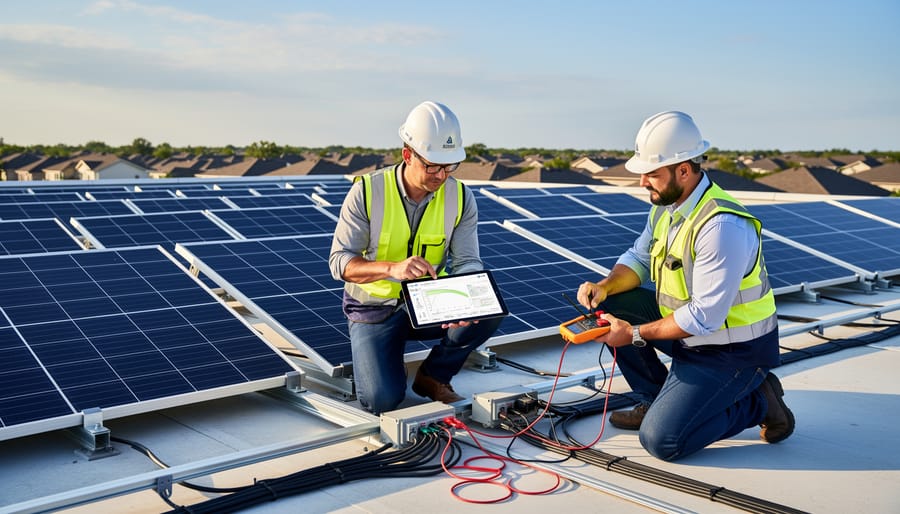
Community solar projects require careful module selection to optimize both performance and economic viability over the system’s 25-30 year operational lifetime. PG&E’s community solar initiatives typically employ monocrystalline photovoltaic modules due to their superior efficiency ratings, which range from 19-22% compared to multi-crystalline alternatives at 15-17%. This efficiency advantage proves particularly valuable when land availability presents constraints or when maximizing production capacity within designated service territories.
Monocrystalline PERC (Passivated Emitter and Rear Cell) technology has become the industry standard for larger community solar installations. PERC panels incorporate an additional layer on the rear surface that reflects unabsorbed light back into the silicon wafer, improving energy capture and enhancing performance in low-light conditions. This technology delivers approximately 5-7% higher output compared to conventional monocrystalline modules, directly impacting project economics through increased revenue generation.
The module selection process considers degradation rates, with premium monocrystalline PERC panels degrading at approximately 0.25-0.45% annually versus 0.5-0.8% for standard multi-crystalline options. Over a project’s lifetime, this differential significantly affects levelized cost of energy calculations that determine subscriber savings and project financial returns.
Temperature coefficients also influence technology choices, as California’s diverse climate zones require panels that maintain efficiency during high-temperature periods. Leading manufacturers now offer monocrystalline modules with temperature coefficients below -0.35%/°C, minimizing performance losses during summer peak demand periods when solar generation provides maximum grid value.
Interconnection and Grid Integration
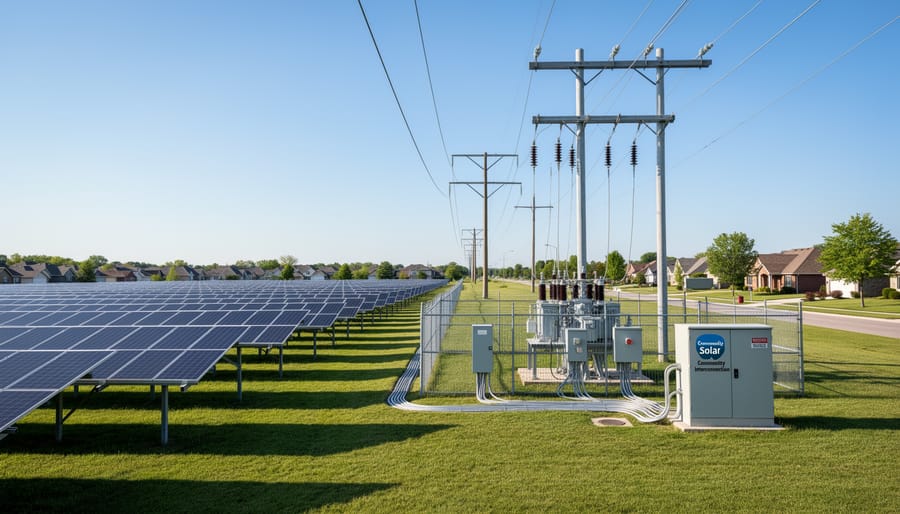
Connecting community solar facilities to PG&E’s distribution system requires compliance with strict grid interconnection requirements governed by California’s Rule 21 and PG&E’s Wholesale Distribution Tariff. Projects must undergo a comprehensive application process through PG&E’s Interconnection Portal, beginning with an initial screening to assess available hosting capacity at the proposed connection point.
The technical evaluation examines voltage regulation, protection coordination, and power quality impacts. Community solar installations typically connect at distribution voltage levels between 12 kV and 21 kV, though larger facilities may require substation-level interconnection. PG&E’s hosting capacity maps identify circuit segments where solar generation can be accommodated without infrastructure upgrades, critical information for developers seeking cost-effective deployment.
When proposed capacity exceeds available hosting capacity, developers face potential upgrade costs including transformer replacements, voltage regulator installations, or distribution line reinforcement. These Network Upgrade costs can range from tens of thousands to several million dollars depending on project size and grid conditions. The Fast Track process accommodates systems under 3 MW meeting specific technical screens, expediting approval for smaller community solar projects.
Universities collaborating with PG&E have conducted research demonstrating that strategic siting near load centers minimizes upgrade requirements. The interconnection timeline spans 6-18 months for standard projects, though complex applications requiring detailed impact studies may extend beyond two years. Understanding these technical parameters enables stakeholders to evaluate project feasibility and anticipate infrastructure investment needs.
Comparing PG&E to Alternative Community Solar Models
Community Choice Aggregation Programs
Within PG&E’s service territory, Community Choice Aggregation programs represent an alternative pathway to renewable energy participation that often surpasses traditional utility-administered community solar programs in scope and flexibility. CCAs like Marin Clean Energy, established in 2010 as California’s first CCA, and East Bay Community Energy provide locally controlled electricity procurement while PG&E continues handling transmission and distribution infrastructure.
These programs typically offer tiered renewable energy options. For instance, Marin Clean Energy’s Light Green service provides 60% renewable content at rates competitive with PG&E, while their Deep Green option delivers 100% local renewable energy. East Bay Community Energy similarly structures its Bright Choice program with 38% renewable content in the base tier and 100% renewable options for environmentally conscious participants.
CCAs distinguish themselves through community-focused initiatives, including educational partnerships with regional universities to develop workforce training programs in photovoltaic installation and energy management. Their governance structures enable direct community input on renewable project selection, often prioritizing local solar installations that enhance regional energy resilience. This localized approach contrasts with centralized utility programs, offering participants greater transparency in renewable energy sourcing while maintaining the reliability of PG&E’s established grid infrastructure.
Community-Owned Solar Cooperatives
Community-owned solar cooperatives represent an alternative model to utility-administered programs like PG&E’s Enhanced Community Renewables initiative, offering participants greater control over energy production and distribution. Unlike utility-managed programs where PG&E retains operational authority, cooperative models vest decision-making power in member-owners who collectively govern the solar installation through democratic processes.
These autonomous cooperatives typically operate under state cooperative corporation statutes, allowing members to determine energy pricing structures, reinvestment priorities, and system expansion plans. Members purchase shares that finance solar array development, receiving credits or direct electricity in proportion to their ownership stake. This structure fundamentally differs from PG&E’s subscriber model, where participants access renewable energy credits without owning generation assets or influencing operational decisions.
The governance distinction carries significant implications for energy autonomy. Cooperatives can prioritize local energy resilience, direct surplus revenues toward community programs, and collaborate with universities to develop educational initiatives around distributed generation technologies. Research partnerships have enabled some cooperatives to pilot advanced energy storage systems and microgrid configurations that enhance grid independence.
However, cooperatives face challenges that utility programs do not, including higher administrative costs, complex regulatory compliance requirements, and member recruitment obligations. While PG&E’s infrastructure and established processes reduce participant barriers to entry, cooperatives demand active member engagement and financial commitment, making them better suited for communities seeking substantive energy self-determination rather than simple renewable energy access.
Barriers and Opportunities for Expanding Community Solar
Economic and Regulatory Barriers
PG&E’s community solar deployment faces significant economic and regulatory obstacles that have slowed program implementation compared to other states. California’s complex utility rate structures create uncertainty around cost recovery mechanisms, as utilities must balance community solar credits against existing net metering programs and time-of-use rates. The California Public Utilities Commission’s regulatory framework requires extensive proceedings to establish credit values, interconnection standards, and subscriber management protocols, adding years to program development timelines.
Rate design conflicts emerge when community solar credits interact with California’s income-graduated fixed charges and tiered electricity pricing. Determining fair compensation for community solar generation while maintaining grid cost recovery presents ongoing challenges for regulators and utilities alike. PG&E must navigate these complexities while ensuring program costs don’t disproportionately impact non-participating ratepayers.
Additionally, the absence of standardized procurement processes increases administrative burdens for developers and delays project approvals. Universities researching renewable energy policy have documented how regulatory uncertainty deters private investment in community solar infrastructure. These barriers underscore the need for streamlined regulatory pathways and clear economic frameworks that balance stakeholder interests while accelerating California’s distributed solar deployment goals. Educational programs partnering with academic institutions increasingly address these policy challenges to prepare professionals for navigating evolving regulatory landscapes.
Emerging Opportunities and Innovations
The community solar landscape is evolving rapidly through technological advances and progressive policy frameworks. Battery storage integration represents a transformative opportunity for PG&E’s community solar initiatives, enabling subscribers to access stored solar energy during evening peak hours when grid electricity is most expensive and carbon-intensive. Advanced inverter technologies now provide grid stabilization services, allowing community solar facilities to support voltage regulation and frequency response—capabilities that enhance system value beyond simple energy generation.
California’s policy environment continues developing, with proposed legislation aimed at streamlining interconnection processes and expanding low-income participation requirements. The California Public Utilities Commission regularly evaluates program modifications that could increase subscriber flexibility and project viability. Market trends indicate growing interest in hybrid renewable energy systems that combine solar with storage, potentially offering more attractive value propositions for subscribers.
Educational partnerships between utilities, universities, and technical colleges are emerging as crucial pathways for workforce development. These collaborations create hands-on learning opportunities for aspiring photovoltaic professionals while demonstrating best practices in community-scale renewable deployment. Research institutions are analyzing subscriber behavior patterns and economic impacts, generating data that informs future program design. As technology costs decline and policy frameworks mature, community solar adoption is positioned to accelerate significantly, particularly if regulatory barriers diminish and interconnection timelines improve.
Educational Pathways for PV Professionals in Community Solar
Entering the photovoltaic profession with a focus on community solar requires a multidisciplinary educational foundation that combines technical expertise with policy knowledge and community engagement skills. Aspiring professionals should pursue coursework in solar energy systems design, electrical engineering fundamentals, and renewable energy integration, while also developing competencies in project finance, regulatory compliance, and stakeholder communication.
Several California universities have established specialized programs addressing community solar development. UC Berkeley’s Renewable and Appropriate Energy Laboratory offers research opportunities examining distributed solar deployment models, while Stanford’s Precourt Institute for Energy provides graduate-level courses on clean energy policy implementation. California State University campuses, including Sacramento and San Francisco, have developed certificate programs in solar technology that incorporate modules specifically addressing shared solar arrangements and utility-scale community projects.
Technical knowledge areas essential for PV professionals in this sector include understanding interconnection requirements for multi-subscriber systems, virtual net metering allocation methodologies, and grid integration challenges unique to distributed generation portfolios. Professionals must also master software tools for system monitoring, subscriber management platforms, and energy production forecasting specific to California’s climate zones.
The California Solar and Storage Association regularly conducts workshops on community solar program design, offering networking opportunities with industry leaders and utility representatives. These professional development sessions complement formal education by providing practical insights into PG&E’s evolving approach to shared renewable energy programs.
Collaborative educational initiatives between community colleges and solar installation companies have created apprenticeship pathways, combining classroom instruction with hands-on experience in project deployment. These programs specifically address workforce development needs in underserved communities, aligning with California’s environmental justice priorities for equitable clean energy access.
Professionals should also develop expertise in low-income program requirements, subscriber acquisition strategies, and the financial modeling unique to third-party owned community solar projects. Understanding California’s regulatory landscape, including Public Utilities Commission proceedings and legislative developments, remains essential for career advancement in this rapidly evolving sector.
PG&E’s community solar initiatives represent a constrained but evolving approach to expanding solar access within California’s complex regulatory environment. While the utility’s programs fall short of comprehensive community solar models available in other states, they demonstrate incremental progress toward addressing barriers that prevent many customers from installing rooftop systems. The current landscape reflects California’s balancing act between advancing renewable energy goals and navigating interconnection constraints, utility infrastructure limitations, and policy frameworks that continue to evolve.
For prospective participants, the key takeaway is understanding precisely what PG&E offers versus what true community solar entails. Current options primarily include subscribing to shared renewable energy projects through third-party developers or participating in pilot programs with limited availability. Evaluate subscription terms carefully, compare costs against conventional electricity rates, and verify whether claimed environmental benefits align with your sustainability objectives.
Photovoltaic professionals and industry stakeholders should monitor California’s legislative developments closely, as the state’s community solar framework remains in flux. Opportunities exist for developers who can navigate PG&E’s interconnection processes and design projects meeting both regulatory requirements and market demand. Collaboration with universities and educational institutions can foster research partnerships that advance technical understanding of distributed generation’s grid impacts while preparing the next generation of renewable energy professionals.
Looking forward, California’s community solar landscape will likely expand as policymakers recognize the equity implications of solar access limitations. For environmentally conscious consumers currently unable to install personal systems, engaging with advocacy organizations and staying informed about program availability remains essential. The transition toward genuine local energy autonomy requires sustained stakeholder engagement, policy innovation, and utility adaptation—making this an opportune moment for informed participation in shaping California’s renewable energy future.


