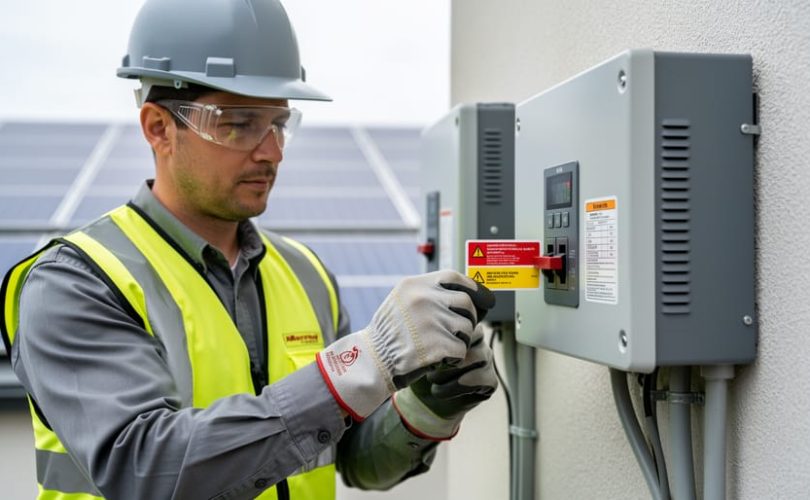
Verify compliance with NEC Article 690 requirements, which mandates specific labeling at multiple system locations including the main service disconnect, inverter, and junction boxes. These labels must remain legible for the system’s operational lifetime and include critical information such as system voltage, maximum current, and emergency shutdown procedures.
Install permanent, weather-resistant labels using UV-stable materials rated for outdoor exposure of at least 20 years. Labels must feature minimum 3/8-inch lettering for primary warnings and comply with ANSI Z535 standards for safety colors—white text on red backgrounds for danger warnings, black text on yellow for caution notices.
Document the system’s electrical characteristics at the main disconnect point, clearly displaying maximum operating voltage, short-circuit current, and string configuration details. This information enables first responders to safely assess the installation during emergencies and helps maintenance personnel perform routine inspections without accessing energized components.
Position arc-fault circuit interrupter notification labels within sight of the inverter location, as required by 2017 NEC updates. These labels must indicate the presence of rapid shutdown systems and provide clear instructions for emergency de-energization, protecting both property occupants and emergency personnel.
Understand jurisdiction-specific requirements beyond federal NEC standards, as many municipalities and states enforce additional labeling protocols. California’s Title 24, for example, requires supplementary labels identifying interconnection points and utility notification procedures. Consult local building departments and authorities having jurisdiction before finalizing your labeling strategy to ensure comprehensive compliance across all regulatory levels.
Why Solar PV Labeling Is Non-Negotiable
The Safety Imperative for First Responders
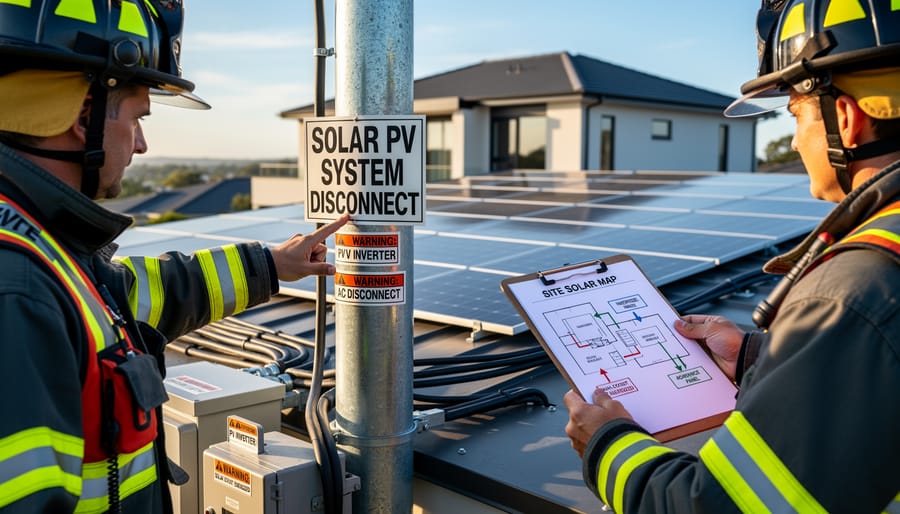
Emergency responders face unique hazards when confronting fires or other incidents at properties with photovoltaic systems. Unlike conventional electrical systems that can be de-energized at the main breaker, PV arrays continue generating electricity whenever exposed to light, creating persistent shock and electrocution risks. Proper labeling serves as a critical first line of defense for firefighters, paramedics, and other emergency personnel who must make split-second decisions in high-stress situations.
The National Fire Protection Association reports that inadequate marking of energized PV components has contributed to responder injuries and delayed emergency operations. Clear, reflective labels indicating the presence of photovoltaic systems, conductor locations, and shutdown procedures enable first responders to develop safer tactical approaches. These markings must identify DC voltage levels, isolator switch locations, and the path of concealed conduits to prevent accidental contact with live circuits.
Required warning labels at electrical equipment, service disconnects, and roof access points provide essential information that emergency personnel can assess quickly, even in low-visibility conditions. This standardized communication system reduces response times while minimizing exposure to electrical hazards. For installation professionals, understanding these safety imperatives reinforces why compliance with labeling requirements transcends mere regulatory obligation—it represents a fundamental commitment to protecting those who serve our communities.
Regulatory Compliance and Permit Approval
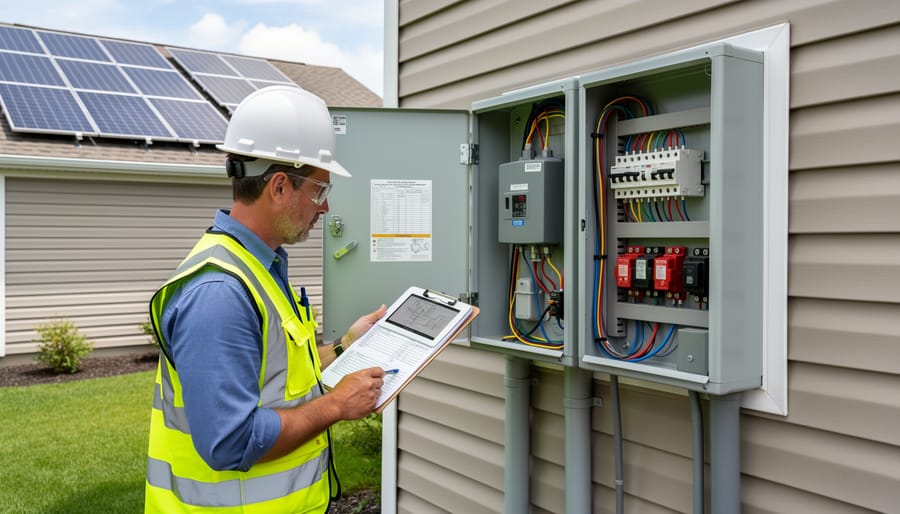
Labeling requirements for photovoltaic systems are firmly embedded within the National Electrical Code (NEC), particularly Articles 690 and 705, which establish the foundational standards for solar installation safety. These NEC provisions are adopted and enforced through local building codes, making compliance mandatory rather than optional. Authority Having Jurisdiction (AHJ) officials review labeling compliance during plan review and inspection phases before issuing permits or approvals for system operation.
The permitting process typically requires documentation showing that all required labels will be installed at specified locations, including inverters, disconnect switches, junction boxes, and service panels. Inspectors verify physical label presence, content accuracy, and durability during field inspections. Additionally, grid interconnection requirements often mandate specific labeling to ensure utility workers can safely identify system components and operational status.
Non-compliance carries significant consequences. Installations may fail inspection, delaying project completion and revenue generation. AHJs can issue stop-work orders, refuse final approval, or require costly remediation. Beyond immediate project impacts, inadequate labeling creates liability exposure if accidents occur due to insufficient safety warnings. Insurance claims may be denied, and professional licenses could face disciplinary action. For installations seeking incentives or certifications, labeling deficiencies can disqualify projects from financial benefits, underscoring the critical importance of meeting all regulatory labeling standards.
Core Labeling Requirements for Main Service PV Systems
Main Service Panel Warning Labels
When a photovoltaic system connects to a building’s electrical service, the main service panel becomes a critical junction point containing dual power sources. The National Electrical Code (NEC) Article 705.12 mandates specific warning labels to alert electricians and emergency responders to this potentially hazardous configuration.
The primary warning label must clearly identify the presence of multiple power sources feeding the electrical system. NEC Article 705.12(B)(2)(3)(a) requires a permanent label stating “WARNING: ELECTRIC SHOCK HAZARD. DO NOT RELOCATE THIS OVERCURRENT DEVICE.” This label prevents accidental repositioning of circuit breakers that could violate load center calculations and create dangerous conditions.
Additionally, a permanent marking or label must be applied to the service disconnecting means, stating “SOLAR ELECTRIC SYSTEM CONNECTED” or equivalent language that clearly communicates the dual power nature. This label must use minimum 3/8-inch text in reflective material or engraved letters to ensure visibility under emergency conditions and low-light scenarios.
Placement specifications require these warning labels to be positioned directly adjacent to the main service disconnect or on the panel door in clear view. The labels must remain legible throughout the system’s operational lifetime, necessitating weather-resistant materials for outdoor installations and UV-resistant inks for labels exposed to sunlight.
Compliance with NEC Article 705 also requires a dedicated label indicating the rated output current of the inverter and the rating of the supply overcurrent protective device. This information allows electricians to verify proper circuit protection without examining internal system documentation, enhancing both safety and maintenance efficiency for photovoltaic installations.
System Identification and Rating Labels
AC system rating labels serve as essential identification markers at the point of connection, providing critical electrical specifications for safe operation and maintenance. These labels must clearly display the maximum circuit current in amperes, ensuring personnel understand the electrical capacity of the system. The operating voltage range, typically including both nominal and maximum values, must be prominently shown to prevent improper connections or equipment damage.
Beyond basic electrical parameters, system rating labels should include the rated output power in kilowatts AC, which represents the inverter’s maximum continuous output. The power factor rating, where applicable, helps grid operators and technicians understand the system’s reactive power characteristics. Additionally, labels must specify the number of phases (single-phase or three-phase) and frequency (typically 50Hz or 60Hz depending on regional standards).
Installation professionals should position these labels at the main service disconnect or AC combiner box, ensuring visibility during routine inspections or emergency situations. The National Electrical Code requires permanent, weather-resistant materials capable of withstanding environmental exposure throughout the system’s operational lifetime. Many jurisdictions mandate that labels include manufacturer information, installation date, and system identification numbers for tracking and compliance verification. This comprehensive labeling approach enables first responders, utility workers, and maintenance technicians to quickly assess system characteristics without accessing technical documentation, ultimately enhancing safety protocols and operational efficiency.
Arc-Fault and Rapid Shutdown Markings
The National Electrical Code Section 690.12 establishes critical requirements for arc-fault protection and rapid shutdown system labeling to ensure safe operation and emergency response capabilities. These markings serve dual purposes: protecting personnel during maintenance and enabling first responders to quickly deactivate the system during emergencies.
Arc-fault circuit protection devices must be clearly labeled at their location, indicating their presence and function within the PV system. These labels alert maintenance personnel to the protective equipment’s location and operational status. The marking must be readily visible and permanent, using reflective or weather-resistant materials for outdoor installations.
Rapid shutdown controls require specific equipment labels identifying the location of initiation devices. According to NEC 690.12(E), labels must indicate where rapid shutdown switches or controls are positioned, typically at the main service disconnect or readily accessible location. The marking must state “PHOTOVOLTAIC SYSTEM EQUIPPED WITH RAPID SHUTDOWN” in white letters on red background, meeting minimum character height requirements.
Equipment labels must also identify boundary areas where conductors remain energized during rapid shutdown conditions. This information proves essential for emergency personnel assessing electrical hazards. Additionally, installations must comply with distributed generation standards that may impose supplementary marking requirements beyond NEC minimums. Documentation should specify exact equipment locations, control sequences, and voltage limitations to maintain comprehensive safety protocols.
Inverter and Disconnect Labeling
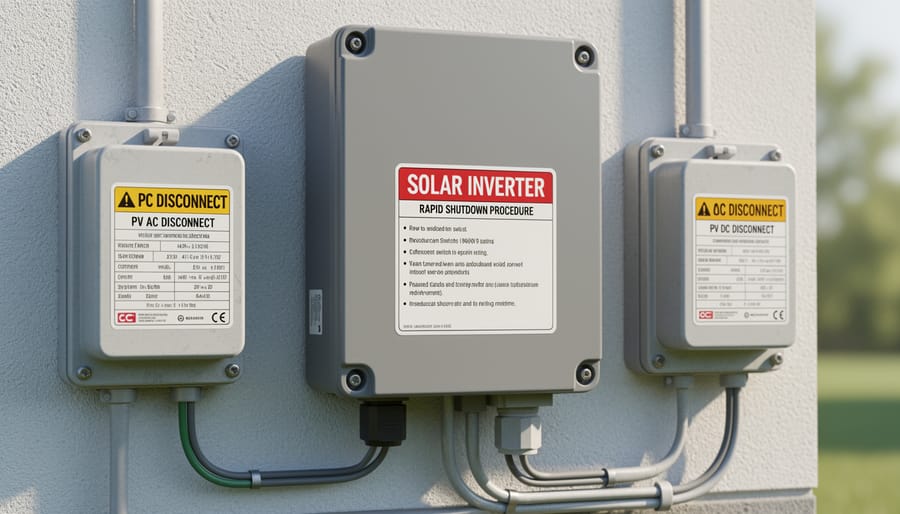
Inverters and disconnects represent critical safety components in photovoltaic systems and require comprehensive labeling to protect installers, maintenance personnel, and emergency responders. The National Electrical Code mandates specific labeling requirements that address both operational information and safety warnings.
Inverter labeling must clearly identify the equipment manufacturer, model number, and output specifications including maximum AC output voltage and current. Additionally, inverters require a warning label indicating that the unit may remain energized after utility power disconnection due to the photovoltaic system’s independent generation capability. This label must be permanently affixed and legible, typically using reflective or UV-resistant materials rated for the equipment’s installation environment.
AC and DC disconnect switches require distinct labeling approaches. AC disconnects must include labels identifying the source equipment, circuit designation, and available fault current. DC disconnects present unique challenges because photovoltaic circuits cannot be de-energized simply by opening a switch during daylight hours. Therefore, DC disconnect labels must explicitly state “WARNING: ELECTRIC SHOCK HAZARD. DO NOT TOUCH TERMINALS. TERMINALS ON BOTH THE LINE AND LOAD SIDES MAY BE ENERGIZED IN THE OPEN POSITION.”
Shutdown procedure labels provide step-by-step instructions for safely de-energizing the system, listing all disconnect locations in the proper sequence. These labels must be positioned at the main service disconnect and should include emergency contact information for qualified service personnel.
Outdoor equipment faces additional weatherproofing requirements. Labels must resist fading from UV exposure, withstand temperature extremes, and maintain adhesion despite moisture exposure. Manufacturers typically recommend laminated polyester or acrylic labels with aggressive adhesives specifically designed for outdoor electrical equipment, ensuring compliance throughout the system’s operational lifetime.
Label Content Specifications and Standards
Material and Durability Requirements
PV system labels must withstand decades of exposure to harsh environmental conditions, making material selection critical for compliance and safety. Industry standards require labels constructed from weather-resistant materials capable of enduring temperature extremes ranging from -40°C to +85°C without degradation or loss of legibility.
UV stability represents a primary consideration, as solar installations face continuous sun exposure. Labels must demonstrate resistance to UV radiation for minimum periods of 10-15 years, with premium options rated for 20+ years. Materials such as anodized aluminum, acrylic-polyester laminates, and UV-stabilized vinyl meet these durability requirements when properly manufactured.
Adhesive quality directly impacts label longevity and compliance. Professional-grade adhesives must maintain bonding strength across temperature fluctuations, resist moisture intrusion, and prevent peeling or curling. Acrylic-based adhesives typically outperform rubber-based alternatives in outdoor applications, providing superior aging characteristics and chemical resistance.
Environmental factors including humidity, salt spray in coastal installations, and industrial pollutants necessitate materials with appropriate IP (Ingress Protection) ratings. Labels should resist fading, with color fastness ratings ensuring critical safety information remains clearly visible throughout the system’s operational life. Testing certifications from recognized standards organizations verify material performance, giving installers confidence in long-term compliance. Regular inspection protocols should account for expected label lifespan, with replacement schedules addressing potential degradation in particularly challenging environments.
Text Size, Color, and Visibility Standards
Regulatory authorities mandate specific text characteristics to ensure PV system labels remain legible during routine inspections and critical emergency situations. The National Electrical Code requires minimum text heights of 3/8 inch (approximately 9.5mm) for warning labels, though local jurisdictions may impose stricter requirements. This dimension ensures readability from standard working distances, even in low-light conditions or when visibility is compromised by smoke or debris.
Color contrast standards specify white text on red backgrounds for warning labels, or black text on white backgrounds for informational placeholders. These combinations provide maximum visibility across diverse lighting conditions and accommodate individuals with common color vision deficiencies. The reflective or non-reflective nature of label materials significantly impacts nighttime visibility, with many jurisdictions requiring reflective materials for emergency disconnect labels.
Labels must withstand environmental degradation without losing legibility. UV-resistant materials and fade-proof inks ensure text remains readable throughout the system’s operational lifetime, typically 25-30 years. Testing protocols simulate extended sun exposure, temperature cycling, and moisture infiltration to verify long-term durability. Educational institutions collaborating with industry partners regularly evaluate emerging label technologies, helping establish best practices that exceed minimum compliance standards. First responders depend on these visibility requirements when making split-second safety decisions, making adherence to text size and contrast specifications essential for protecting personnel and property during emergency responses.
Required Label Language and Wording
The National Electrical Code Article 690 establishes precise language requirements for photovoltaic system labels to ensure consistency and immediate recognition during emergencies. Warning labels must include the statement “WARNING: ELECTRIC SHOCK HAZARD” or “DANGER: ELECTRIC SHOCK HAZARD” in capital letters, typically with a minimum letter height of 3/8 inch depending on viewing distance requirements. The text must clearly indicate that multiple power sources exist and that disconnecting utility power does not de-energize the equipment.
System information labels require specific technical data including maximum system voltage, short-circuit current ratings, and the date of installation. A compliant label example reads: “PHOTOVOLTAIC SYSTEM CONNECTED. Maximum System Voltage: 600VDC. Maximum Circuit Current: 45A. This equipment is energized during daylight hours.” Additionally, labels must specify the location of system disconnecting means using directional language such as “Main PV Disconnect Located: Exterior East Wall, Meter Cabinet.”
Local amendments may impose supplemental wording requirements beyond NEC minimums. Some jurisdictions mandate emergency contact information, utility account numbers, or specific formatting standards including red backgrounds for DC voltage warnings. Installers should verify current local code adoptions and consult with the authority having jurisdiction before finalizing label designs to ensure complete compliance with all applicable regulations.
Jurisdiction-Specific Variations and Additional Requirements
State and Local Code Amendments
While the National Electrical Code establishes baseline requirements for photovoltaic installation labeling, individual states and municipalities frequently adopt amendments that impose stricter standards. California’s Title 24 requirements, for example, mandate additional rapid shutdown labeling specifications beyond NEC minimums, including more detailed DC voltage warnings and specific label dimensions. Massachusetts enforces supplementary conductor identification requirements at junction boxes, while New York City requires bilingual labeling in certain districts.
Local jurisdictions often add site-specific mandates addressing regional concerns. Coastal municipalities may require weather-resistant label materials rated for salt-air environments, while areas prone to wildfires might demand enhanced emergency disconnect signage visible from public rights-of-way. Some counties require QR codes linking to system documentation, and others mandate utility-specific information on main service labels.
Understanding these variations is essential for maintaining regulatory compliance frameworks across different jurisdictions. Installers should consult the authority having jurisdiction before finalizing label designs, as non-compliance can delay inspections and system interconnection. Many state solar associations maintain updated databases of local amendments, and working with accredited training programs helps professionals stay current on evolving requirements. Documentation of jurisdiction-specific compliance demonstrates professional competency and protects against liability issues during system commissioning.
Utility Interconnection Labeling Requirements
Beyond standard electrical and safety labels, utility companies typically mandate specific interconnection labels before granting permission to operate a grid-tied photovoltaic system. These requirements ensure safe integration with the electrical grid and facilitate emergency response protocols.
The most critical utility-mandated label addresses anti-islanding protection. This label must clearly state that the PV system includes anti-islanding functionality, which automatically disconnects the system from the grid during power outages. This prevents dangerous backfeeding that could endanger utility workers performing repairs. The label typically reads “WARNING: ANTI-ISLANDING PROTECTION ENABLED” or similar language as specified by your local utility provider.
Utility contact information labels serve as essential communication tools for emergency responders and maintenance personnel. These labels must include the utility company’s name, emergency phone number, account number, and interconnection agreement number. Placement requirements vary, but utilities generally require this information at the main service panel, AC disconnect, and meter location.
Many utilities also require a rapid shutdown label indicating compliance with modern safety standards, particularly for systems installed after 2019 when enhanced shutdown requirements took effect. Some jurisdictions mandate bilingual labels in areas with significant non-English speaking populations.
Before finalizing your installation, consult your utility’s interconnection agreement documentation to verify all labeling specifications. Requirements differ substantially between providers, and non-compliance can delay or prevent system activation, resulting in lost energy production and revenue.
Best Practices for Installation Professionals
Creating a Labeling Checklist for Every Installation
Developing a comprehensive labeling checklist ensures compliance and reduces installation errors. Begin by reviewing all applicable codes, including the National Electrical Code Article 690, local amendments, and authority having jurisdiction requirements. Your checklist should categorize labels by system components: inverters, combiner boxes, disconnects, junction boxes, conduits, and point-of-interconnection equipment.
Structure your checklist to include label content verification, confirming each label displays required information such as voltage ratings, current specifications, and arc-fault warnings. Document specific placement requirements for each label type, noting visibility and accessibility standards. For ground-mounted systems, account for weather-resistant label materials and mounting methods that withstand environmental exposure.
Educational institutions offering renewable energy programs emphasize the importance of system-specific checklists that adapt to configuration variables. Consider creating separate sections for string inverters versus microinverter systems, as each architecture requires different labeling approaches. Include verification steps for rapid shutdown labeling, energy storage system warnings if applicable, and utility interconnection identification.
Digital checklists allow real-time updates as code requirements evolve and enable photo documentation of completed labels. Cross-reference your checklist with manufacturer specifications and warranty requirements, as some equipment necessitates additional labeling beyond code minimums. Regular checklist review with inspectors and industry colleagues strengthens compliance assurance.
Documentation and Photographic Evidence
Thorough documentation of label installation proves essential for meeting permit requirements and facilitating inspections. Capture high-resolution photographs of each installed label showing legibility, location, and surrounding context before system energization. Create a digital record system that includes label specifications, installation dates, installer credentials, and GPS coordinates for large-scale projects. Maintain a master file containing label templates, material certifications, and adhesive test results to verify long-term durability claims.
For permit submittals, compile documentation packages demonstrating adherence to compliance requirements including photographic evidence of all mandated labels with close-up and contextual shots. Implement cloud-based storage solutions enabling authorized personnel to access records during inspections or maintenance activities. Include installation checklists verifying each label type, placement location, and content accuracy against jurisdiction-specific codes. Document any field modifications or label replacements with timestamped records and photographic verification, establishing a comprehensive audit trail for system lifecycle management and supporting future troubleshooting or system modifications.

Common Labeling Mistakes and How to Avoid Them
Inspection failures frequently occur due to preventable labeling errors that compromise both compliance and safety. The most common mistake involves improper label placement where critical warnings become obscured by equipment, conduit, or structural elements after installation completes. Labels must remain visible and accessible throughout the system’s operational lifetime, requiring installers to consider future maintenance access and potential obstructions.
Insufficient information represents another prevalent issue. Labels lacking complete circuit voltage ratings, maximum system voltage, or proper directional arrows for shutdown procedures fail code requirements. Many installers mistakenly assume generic labels suffice, but jurisdiction-specific mandates often require precise wording and technical specifications. Educational programs through university collaborations emphasize the importance of referencing local amendments to national codes before finalizing label content.
Material non-compliance causes premature label degradation and regulatory rejection. Using indoor-rated labels for exterior applications or selecting materials unable to withstand ultraviolet exposure violates durability standards. Labels must resist environmental conditions including temperature extremes, moisture, and chemical exposure for the system’s expected service life.
Additional errors include incorrect font sizes that reduce readability, omitting required warning symbols, and failing to update labels after system modifications. Aspiring professionals should develop comprehensive checklists covering placement locations, required text elements, material specifications, and verification procedures. Regular training through industry educational offerings ensures installers remain current with evolving standards and avoid costly reinspection cycles.
Educational Resources for Aspiring PV Professionals
Understanding proper labeling requirements for PV system installations begins with comprehensive education and training. Aspiring photovoltaic professionals must pursue structured learning pathways that emphasize both technical competencies and regulatory compliance, including mandatory labeling standards.
Professional training programs offered through accredited institutions provide foundational knowledge covering NEC Article 690 requirements, OSHA safety protocols, and jurisdiction-specific labeling mandates. These programs typically combine classroom instruction with hands-on laboratory experience, ensuring students gain practical skills in creating and applying compliant labels for various PV system components.
Certification programs such as those offered by the North American Board of Certified Energy Practitioners (NABCEP) include extensive coverage of installation standards and labeling requirements. The NABCEP PV Installation Professional certification exam specifically tests knowledge of proper warning label placement, arc-fault protection labeling, rapid shutdown system identification, and emergency responder safety information.
Mose Solar actively collaborates with leading universities and technical institutions to develop curriculum that addresses emerging standards and evolving compliance requirements. These partnerships ensure that educational content remains current with the latest code updates and industry best practices. Through sponsored laboratory facilities and guest lecture series, students gain exposure to real-world installation scenarios and learn to navigate complex labeling requirements across different jurisdictions.
Community colleges and vocational schools increasingly offer associate degree programs and certificate courses focused on solar technology. These programs provide accessible entry points for career changers and recent graduates interested in the renewable energy sector. Many institutions now incorporate specific modules on documentation practices, label design standards, and inspection preparation, recognizing that proper labeling knowledge is essential for professional competence and career advancement in the photovoltaic industry.
Proper labeling of photovoltaic systems represents far more than regulatory compliance—it embodies a fundamental commitment to safety, professionalism, and industry excellence. As this overview demonstrates, mandatory labeling requirements serve critical functions in protecting installers, first responders, maintenance personnel, and property owners throughout a system’s operational lifetime. The comprehensive nature of these requirements, spanning electrical hazard warnings, system identification, and emergency shutdown information, reflects the inherent complexities and potential risks associated with PV installations.
For aspiring photovoltaic professionals, mastering labeling protocols constitutes an essential competency that distinguishes qualified installers from amateurs. The evolving landscape of codes and standards, including NEC updates and jurisdiction-specific modifications, necessitates ongoing professional development and education. Installers who maintain current knowledge demonstrate credibility and reduce liability exposure while contributing to broader industry reputation.
The renewable energy sector continues expanding rapidly, creating unprecedented opportunities for those committed to technical excellence. Educational institutions and industry organizations offer specialized training programs addressing installation best practices, including comprehensive labeling requirements. Investing in structured professional development ensures practitioners remain current with regulatory changes while building the expertise necessary for long-term career success. By prioritizing proper labeling practices and continuous learning, photovoltaic professionals protect public safety while advancing the industry’s mission of sustainable energy deployment.