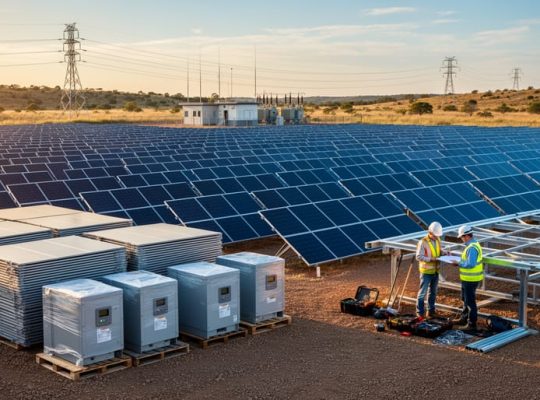
Solar photovoltaic economics has emerged as a pivotal force reshaping global energy markets, with system costs plummeting by over 80% in the past decade while efficiency rates continue to climb. This revolutionary shift transforms PV from a niche renewable technology into a mainstream energy solution that consistently outperforms traditional power generation on both cost and environmental metrics. Recent analysis from the International Energy Agency reveals that utility-scale solar installations now deliver electricity at $0.04-0.06 per kilowatt-hour in many markets, undercutting coal and natural gas alternatives while offering predictable long-term returns on investment.
Modern PV economics extends far beyond simple installation costs, encompassing sophisticated financial models that factor in technology improvements, policy incentives, and emerging revenue streams from grid services and carbon markets. As global investment in solar capacity surpassed $200 billion in 2022, understanding the intricate dynamics of PV economics has become essential for energy professionals, investors, and policymakers shaping our transition to a sustainable energy future.
This rigorous exploration of PV economics provides critical insights into investment strategies, market trends, and optimization techniques that drive profitable solar deployment across residential, commercial, and utility-scale applications.
Understanding Solar PV Investment Fundamentals
Initial Investment Components
The initial investment in a photovoltaic system comprises several key components that must be carefully evaluated when developing solar power financial models. The most substantial cost element is typically the solar panels themselves, accounting for approximately 30-40% of the total system cost. Current market prices range from $0.70 to $1.50 per watt for quality photovoltaic modules, depending on efficiency ratings and manufacturer specifications.
Inverter systems represent the second-largest hardware expense, typically constituting 10-15% of the total investment. These essential components convert DC power from solar panels into usable AC electricity. Additional hardware costs include mounting systems, wiring, and electrical components, which collectively account for 15-20% of the system cost.
Installation expenses form a significant portion of the initial investment, typically ranging from 20-25% of the total cost. This includes labor, site preparation, and necessary permits. Professional installation ensures optimal system performance and compliance with local building codes and electrical standards.
Additional system requirements may include monitoring equipment, safety devices, and grid connection hardware. These components generally represent 5-10% of the total investment. Some installations may also require battery storage systems, which can add 20-30% to the base system cost but provide enhanced energy independence and backup capabilities.
Planning for contingencies and maintenance reserves is also crucial, typically accounting for 3-5% of the initial investment to ensure system reliability and longevity.

Financial Incentives and Support Mechanisms
Financial incentives play a crucial role in improving the economic viability of photovoltaic installations. The Investment Tax Credit (ITC) remains one of the most significant federal incentives in the United States, offering a 30% tax credit for residential and commercial solar installations through 2032. This substantial benefit, combined with various solar project financing options, significantly reduces initial investment costs.
State-level incentives further enhance financial returns, with programs like Solar Renewable Energy Credits (SRECs) allowing system owners to earn additional revenue by selling environmental attributes of their generated power. Net metering policies, adopted by numerous utilities, enable consumers to offset their electricity bills by feeding excess power back to the grid at retail rates.
Many municipalities offer property tax exemptions for solar installations, preventing increased property taxes despite the added home value. Performance-based incentives (PBIs) provide ongoing payments based on actual system generation, ensuring long-term revenue streams. Commercial installations can also benefit from accelerated depreciation through the Modified Accelerated Cost Recovery System (MACRS), allowing businesses to deduct their solar investment over five years.
These support mechanisms, when combined, can reduce payback periods from 8-12 years to 4-6 years, depending on location and system specifications. Understanding and leveraging these incentives is crucial for optimizing investment returns in photovoltaic systems.
Cost-Benefit Analysis of Modern PV Systems
Energy Production vs. Cost Metrics
The relationship between energy production and cost metrics in photovoltaic systems forms the foundation of solar investment decisions. Modern solar panels typically achieve efficiency rates between 15% and 22%, with premium modules reaching up to 25% in optimal conditions. This efficiency directly impacts the levelized cost of electricity (LCOE), which currently averages between $0.04 and $0.06 per kWh for utility-scale installations.
Power output varies significantly based on geographical location, panel orientation, and environmental factors. A standard 1kW system in optimal conditions produces approximately 1,600-2,000 kWh annually in sun-rich regions, while areas with less solar irradiance might generate 1,100-1,400 kWh. This variation directly affects the return on investment timeline and overall system economics.
Production efficiency is further influenced by degradation rates, which typically range from 0.3% to 0.8% annually. Premium panels often guarantee performance at 85% of rated output after 25 years, providing more predictable long-term energy production metrics. System losses, including inverter efficiency (97-99%), wiring losses (1-2%), and soiling (2-5%), must be factored into production calculations.
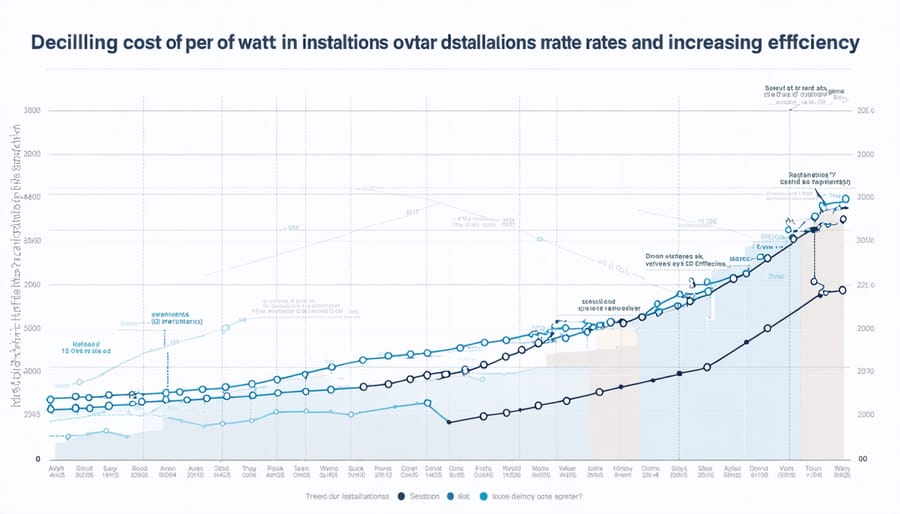
Cost metrics have shown consistent improvement, with module prices declining by approximately 70% over the past decade. Current installation costs range from $1.50 to $3.50 per watt, depending on system size and location. Operations and maintenance costs typically add $0.01-0.02 per kWh to the total cost structure.
The intersection of production capacity and cost metrics reveals the system’s financial viability. Modern installations achieve payback periods between 5-10 years in most markets, with lifetime cost benefits extending well beyond the initial investment period. When analyzing these metrics, investors should consider both direct production values and indirect benefits such as renewable energy credits and grid independence value.
Long-term Financial Benefits
Investing in photovoltaic systems offers substantial long-term financial advantages that extend well beyond the initial installation costs. The cost-saving benefits of solar energy become increasingly apparent over time, particularly when considering the system’s 25-30 year operational lifespan.
Energy savings represent the most significant financial benefit, with most commercial installations achieving complete return on investment within 5-7 years. Modern PV systems typically generate electricity at $0.06-0.08 per kilowatt-hour over their lifetime, compared to the national average utility rate of $0.14 per kilowatt-hour. This difference results in substantial savings, especially as conventional electricity rates continue to rise annually.
Maintenance costs for PV systems remain remarkably low throughout their operational life. Annual maintenance typically requires only basic panel cleaning and routine inspections, averaging 1-2% of the initial system cost per year. Most quality solar panels come with 25-year performance warranties, ensuring consistent energy production and financial returns. Inverters, while requiring replacement every 10-15 years, represent a minimal portion of the overall lifetime system cost.
System longevity further enhances the financial proposition. Modern solar panels maintain approximately 80% of their original efficiency even after 25 years of operation. This degradation rate of only 0.5-0.8% annually ensures steady energy production and reliable financial returns throughout the system’s lifetime. Additionally, technological improvements in panel manufacturing have resulted in more durable components, reducing the likelihood of unexpected maintenance costs.
The financial benefits extend beyond direct energy savings. Many regions offer performance-based incentives, tax benefits, and renewable energy credits that can provide additional revenue streams. Property value typically increases with PV installation, with studies showing an average premium of 4% for homes with solar systems. Commercial properties benefit from enhanced corporate sustainability profiles and reduced operating costs, contributing to improved business valuation.
Market Trends Shaping PV Economics
Technology Advancements and Cost Reductions
Technological advancements in photovoltaic systems have been a primary driver in making solar energy increasingly cost-competitive with traditional power sources. Over the past decade, innovations in cell architecture, manufacturing processes, and materials science have contributed to substantial improvements in both efficiency and cost reduction. The future of solar technology continues to show promising developments in efficiency gains and cost optimization.
Module efficiency has seen remarkable improvements, with commercial panels now routinely achieving 20-22% efficiency, compared to 14-16% just a decade ago. This enhanced performance means fewer panels are needed to produce the same amount of energy, reducing both installation costs and space requirements. Advanced manufacturing techniques, including automated production lines and improved silicon wafer processing, have significantly decreased production costs, with prices falling by more than 80% since 2010.
Perovskite solar cells and multi-junction technologies are emerging as game-changers, promising even higher efficiencies while maintaining cost-effectiveness. Research institutions and manufacturers are also making substantial progress in developing more durable materials that extend system lifespans and reduce maintenance costs.
The implementation of artificial intelligence and machine learning in production processes has further optimized manufacturing efficiency and quality control, resulting in better yields and lower costs. Smart monitoring systems and predictive maintenance technologies have also reduced operational expenses throughout the system’s lifetime.
These technological improvements have contributed to a consistent decline in the levelized cost of electricity (LCOE) for solar PV systems. Current projections indicate that costs will continue to decrease as new innovations reach commercial scale, making solar power an increasingly attractive investment for both residential and commercial applications. The combination of higher efficiency ratings and lower production costs has significantly improved the economic proposition of solar PV systems, leading to shorter payback periods and higher returns on investment.
Grid Parity and Market Maturity
Grid parity, the point at which solar photovoltaic electricity costs equal or fall below conventional electricity prices, has become a reality in many markets worldwide. This milestone represents a fundamental shift in the energy landscape, making solar PV a commercially viable alternative to traditional power sources without requiring subsidies or incentives.
The achievement of grid parity varies significantly by region, influenced by factors such as local electricity prices, solar resource availability, and installation costs. In regions with high electricity rates and abundant sunshine, such as California and parts of Southern Europe, solar PV reached grid parity earlier than in other markets. As of 2023, many additional markets have joined this list, demonstrating the technology’s increasing competitiveness.
Market maturity indicators show strong positive trends, with established supply chains, standardized quality protocols, and professional installation networks becoming commonplace. The industry has witnessed significant consolidation among manufacturers and developers, leading to more stable pricing and improved product reliability. This maturation has attracted institutional investors and traditional energy companies, further legitimizing the sector.
Key evidence of market maturity includes:
– Decreasing soft costs through streamlined permitting and installation processes
– Standardized financing products from mainstream lenders
– Improved warranty and insurance options
– Professional operation and maintenance services
– Established secondary markets for solar assets
The competitive positioning of solar PV continues to strengthen as technology improvements drive efficiency gains and manufacturing scales up. Learning curve effects have consistently reduced costs, with module prices declining by approximately 20% for every doubling of cumulative production. This trend, combined with rising fossil fuel costs and increasing carbon pricing mechanisms, enhances solar PV’s economic advantage over conventional energy sources.
Forward-looking market indicators suggest continued improvement in solar PV’s competitive position, particularly as energy storage solutions become more affordable and grid integration challenges are resolved through smart technology deployment.

The economics of photovoltaic systems continue to evolve favorably, driven by technological advancements, manufacturing efficiencies, and supportive policy frameworks. As installation costs decrease and energy conversion efficiencies improve, the financial viability of PV systems strengthens across both residential and commercial sectors. Recent market analyses indicate that solar PV has reached grid parity in numerous regions, making it increasingly competitive with traditional energy sources without subsidies.
Looking ahead, several key factors will shape the economic landscape of PV systems. Continued improvements in manufacturing processes and scale economies are expected to further reduce hardware costs. Energy storage solutions are becoming more affordable, enhancing the overall value proposition of PV installations. Additionally, the integration of smart grid technologies and innovative financing mechanisms will likely expand market accessibility and improve return on investment metrics.
Market projections suggest robust growth in global PV installations through 2030, supported by corporate sustainability initiatives, government renewable energy targets, and increasing consumer demand for clean energy solutions. However, investors and stakeholders should remain mindful of potential challenges, including supply chain dynamics, regulatory changes, and grid integration costs.
The transition toward sustainable energy systems positions PV technology as a cornerstone of future energy infrastructure, offering promising economic returns while contributing to environmental sustainability. As the industry matures, the combination of technological innovation and market optimization will continue to enhance the economic attractiveness of photovoltaic investments.