Off-grid solar power systems represent the ultimate test of energy independence, operating without utility backup to power everything from remote mining operations to entire island communities. The world’s largest installations process megawatts of solar energy through sophisticated battery storage arrays, demonstrating that renewable technology can replace fossil fuel infrastructure even in the most demanding applications.
These massive systems differ fundamentally from grid-connected installations in three critical aspects: they require substantial battery capacity to manage multi-day weather variations, employ advanced forecasting algorithms to balance generation with consumption in real-time, and integrate multiple backup power sources to ensure continuous operation. The DeGrussa Copper Mine in Australia exemplifies this capability, combining 10.6 MW of solar generation with 6 MW of battery storage to reduce diesel consumption by over one million liters annually.
Understanding large-scale off-grid systems provides essential insights for photovoltaic professionals entering distributed energy markets. These projects reveal engineering solutions for capacity sizing, where designers typically provision 150-200% of average daily consumption to accommodate seasonal variations and consecutive cloudy days. Battery systems in these installations commonly store 8-24 hours of full load capacity, compared to 2-4 hours in grid-connected applications where the utility serves as backup.
The technical challenges confronting off-grid designers—load forecasting accuracy, component redundancy, and thermal management in remote locations—directly inform grid-connected projects incorporating storage. As utilities increasingly value solar-plus-storage for grid stability and peak demand reduction, lessons from proven off-grid megaprojects become critical knowledge for renewable energy professionals. These installations demonstrate that solar technology has matured beyond supplemental generation into complete, reliable power systems capable of replacing conventional infrastructure across diverse operational environments.
Defining the Largest Off-Grid Solar Power Systems
Technical Specifications That Define ‘Largest’
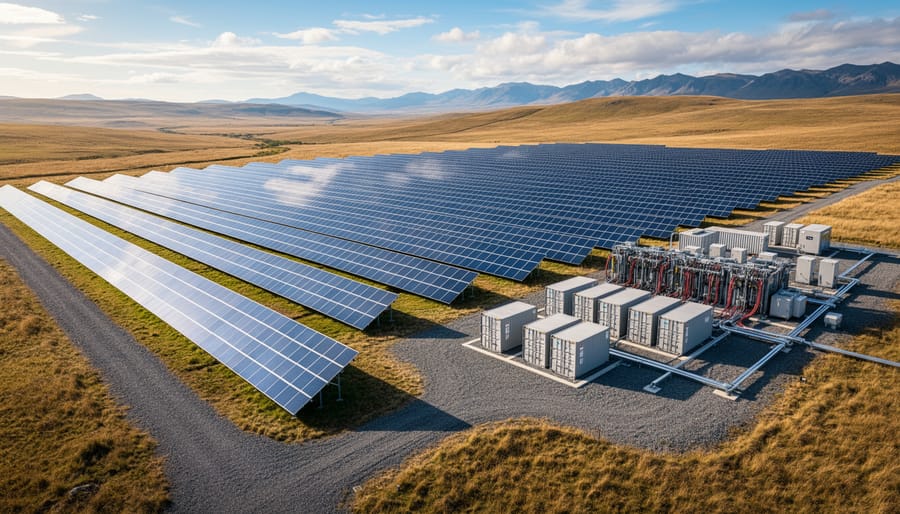
Determining the “largest” off-grid solar power system requires understanding three primary metrics that industry professionals use for classification. These measurements provide standardized comparisons across diverse installations worldwide.
System capacity, measured in megawatts (MW) or gigawatts (GW), represents the maximum instantaneous power generation potential under optimal conditions. This metric indicates how much electricity the photovoltaic array can produce at peak performance. For off-grid applications, capacity directly correlates with the system’s ability to meet substantial baseload demands without grid support.
Energy storage capacity, quantified in megawatt-hours (MWh) or gigawatt-hours (GWh), measures the total energy that battery systems can store and discharge. This specification proves particularly critical for off-grid installations, as storage determines operational autonomy during periods without sunlight. The ratio between generation capacity and storage capacity reveals how many hours the system can operate independently—a key performance indicator for true off-grid functionality.
Physical footprint, typically measured in hectares or square kilometers, accounts for the total land area occupied by solar panels, inverters, storage infrastructure, and supporting facilities. This metric becomes essential when evaluating environmental impact and land-use efficiency.
Industry standards from organizations like the International Electrotechnical Commission (IEC) and the Solar Energy Industries Association (SEIA) provide frameworks for categorizing installations. Systems exceeding 10 MW generally qualify as utility-scale, while those surpassing 100 MW enter the “large-scale” classification. For off-grid systems specifically, the combination of generation capacity with storage duration defines true operational independence.
The Off-Grid vs. Grid-Connected Spectrum
The traditional binary classification of solar installations as either off-grid or grid-connected has become increasingly inadequate as sophisticated energy systems emerge. Modern large-scale solar projects increasingly occupy a middle ground, incorporating elements of both configurations to optimize performance, reliability, and economic viability.
Hybrid systems represent the most significant evolution in this space, integrating grid-connected solar storage systems with islanding capabilities that allow seamless disconnection during grid failures. These installations maintain autonomy when needed while benefiting from grid connectivity during normal operations. Such configurations are particularly valuable for critical infrastructure facilities, industrial operations, and commercial complexes requiring uninterrupted power.
Microgrids exemplify this convergence further, operating as self-contained networks that can function independently or synchronize with the main grid. Many remote mining operations, island communities, and military installations now deploy multi-megawatt solar arrays with substantial battery storage that technically qualify as off-grid yet maintain grid interconnection points for additional flexibility.
The distinction increasingly centers on operational priority rather than absolute configuration. Systems designed with self-sufficiency as the primary objective but grid backup as secondary support differ fundamentally from grid-tied systems with battery backup. Understanding this spectrum is essential for professionals designing next-generation solar installations, as project requirements often demand features from both traditional categories to meet complex energy security, economic, and sustainability objectives.
Current Record-Holders: The World’s Largest Off-Grid Solar Installations
Mining and Industrial Operations
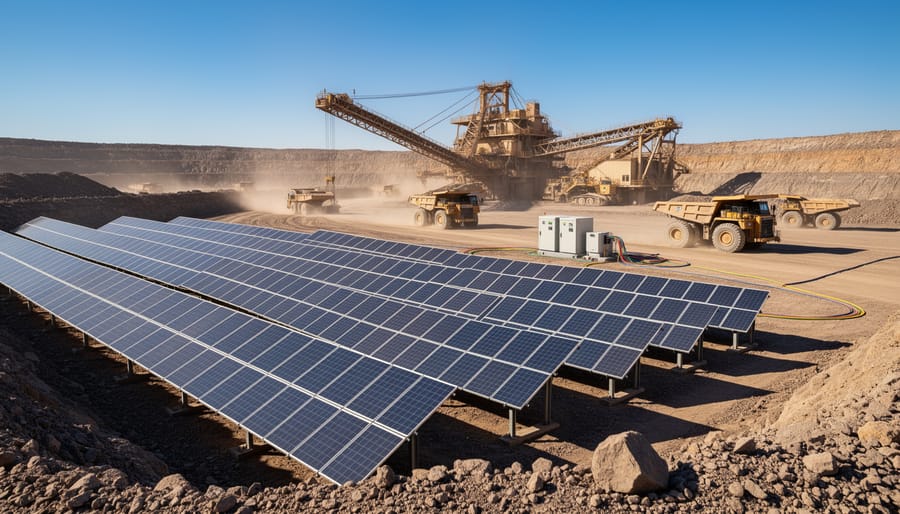
Remote mining operations represent some of the most compelling applications for large-scale off-grid solar power systems. These facilities, often located hundreds of kilometers from existing electrical infrastructure, face prohibitive grid connection costs that make independent renewable energy economically advantageous.
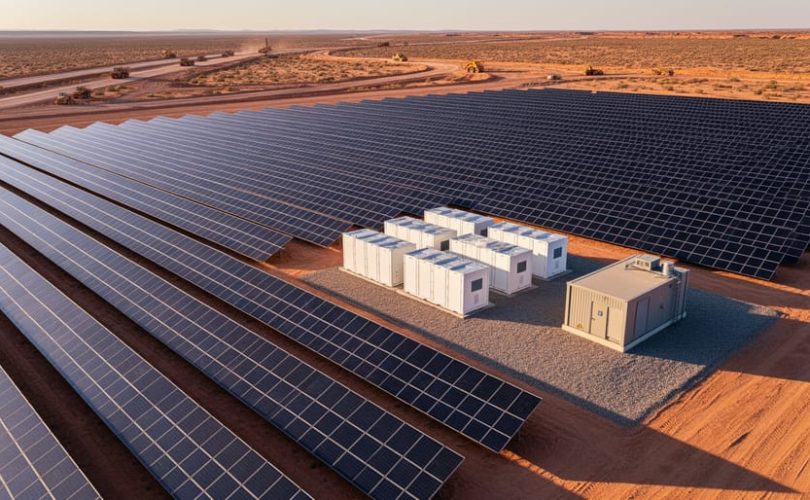
The DeGrussa Copper-Gold Mine in Western Australia exemplifies this trend with a 10.6 MW solar array integrated with a 6 MW / 1.5 MWh battery energy storage system. Operational since 2016, this hybrid installation significantly reduces the mine’s diesel consumption, demonstrating the technical and financial viability of solar solutions in resource extraction. The storage component addresses the intermittency challenges inherent to solar generation, ensuring continuous power availability for critical mining operations.
In Chile’s Atacama Desert, the Gabriela Mistral copper mine operates a 13 MW off-grid photovoltaic system, benefiting from the region’s exceptional solar irradiance levels. This installation showcases how geographical advantages amplify the effectiveness of solar deployments in mining contexts.
The Agnew Gold Mine in Australia has advanced this model further with a 56 MWh battery storage system complementing its 18 MW solar array and existing wind turbines, creating a sophisticated microgrid that minimizes fossil fuel dependence. This integrated approach highlights the evolution toward hybrid renewable systems that combine multiple generation sources with substantial storage capacity.
These installations serve as practical laboratories for off-grid technology development, with insights transferable to grid-connected applications. Mining companies increasingly collaborate with universities to research optimization strategies, storage technologies, and predictive maintenance protocols that benefit the broader photovoltaic industry while advancing sustainability objectives in resource extraction sectors.
Island and Remote Community Systems
Island nations and remote communities face unique energy challenges that make large-scale solar-plus-storage systems particularly compelling. These isolated locations must balance reliability, cost, and environmental sustainability without grid interconnection support.
Ta’u Island in American Samoa exemplifies successful island electrification through a 1.4 MW solar array paired with 6 MWh of battery storage, providing nearly 100% renewable energy to its 600 residents. The system demonstrates how proper sizing and storage capacity enable continuous power supply despite variable solar generation and weather patterns.
Technical challenges in these deployments include saltwater corrosion, extreme weather resilience, and limited maintenance infrastructure. Engineers address these through specialized coatings, reinforced mounting systems, and modular designs that facilitate repairs with locally available resources. Remote monitoring capabilities enable off-site diagnostics, reducing the need for frequent technician visits.
King Island in Australia and Tokelau in the Pacific showcase similar implementations, with solar contributing 65-100% of electricity needs. These projects incorporate diesel backup generators that activate during extended low-solar periods, ensuring uninterrupted service while maximizing renewable penetration.
The economic case for island solar systems strengthens as diesel fuel transportation costs often exceed mainland prices by 200-300%. Battery technology advances continue improving system reliability, with lithium-ion solutions increasingly replacing earlier lead-acid configurations for enhanced performance and longevity in tropical climates.
Military and Government Installations
Military and government facilities increasingly rely on large-scale off-grid solar installations to ensure operational continuity independent of civilian infrastructure. These systems provide critical power redundancy for defense operations, remote communication stations, and classified research facilities where grid dependence poses security vulnerabilities. The U.S. Department of Defense has deployed multi-megawatt solar arrays at forward operating bases and testing ranges, particularly in locations where extending traditional grid connections proves impractical or strategically undesirable. These installations typically integrate advanced battery storage systems to maintain 24/7 power availability for mission-critical applications. International examples include Australian defense facilities in remote territories and NATO installations requiring autonomous energy security. Government agencies prioritize these systems not only for energy independence but also for resilience against physical and cyber threats to centralized power infrastructure. The integration of solar generation with diesel backup and sophisticated energy management systems demonstrates the scalability of photovoltaic technology in demanding environments where reliability directly impacts national security operations and emergency response capabilities.
The Critical Role of Energy Storage in Large Off-Grid Systems
Battery Technologies Enabling Scale
Energy storage represents the cornerstone of successful large-scale off-grid solar installations, with advanced battery storage technologies enabling unprecedented system capacities. Lithium-ion batteries currently dominate the multi-megawatt off-grid sector due to their high energy density, declining costs, and proven reliability. These systems typically feature modular configurations that allow for scalable deployment, with individual installations now reaching 100+ MWh capacity in remote mining operations and island communities.
Flow batteries present compelling advantages for large off-grid applications, particularly vanadium redox and zinc-bromine chemistries. Their ability to decouple power and energy capacity provides exceptional flexibility for extended discharge durations, essential for locations experiencing prolonged periods of low solar irradiance. Unlike lithium-ion systems, flow batteries maintain performance across deep discharge cycles without significant degradation, making them ideal for off-grid scenarios where battery cycling is intensive.
Emerging technologies are rapidly advancing the viability of massive independent solar installations. Solid-state batteries promise enhanced safety profiles and energy densities exceeding conventional lithium-ion by 40-50 percent. Additionally, researchers at leading universities are collaborating with industry partners to develop iron-air and aluminum-ion batteries specifically optimized for grid-scale storage, offering potential cost reductions of 60 percent compared to current technologies. These innovations, combined with sophisticated battery management systems and predictive analytics, enable off-grid solar installations to deliver reliable, dispatchable power comparable to traditional grid infrastructure while maintaining complete energy independence.
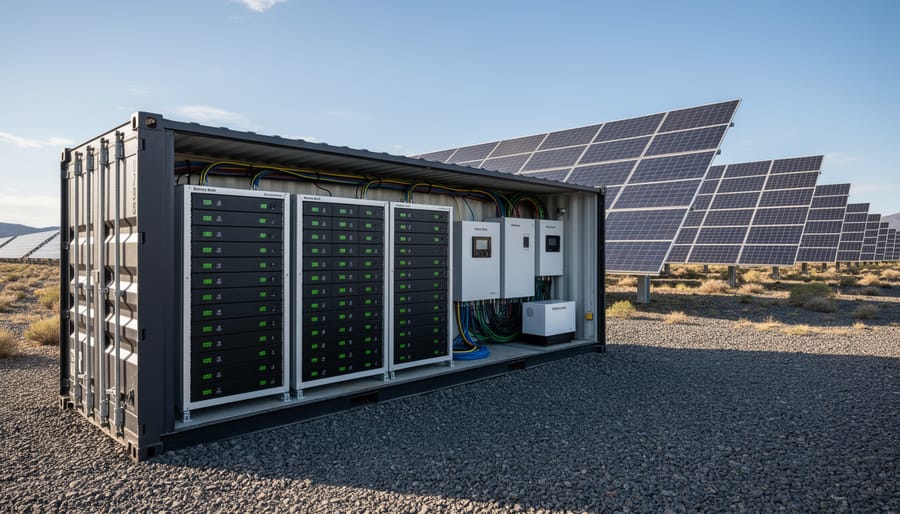
Storage Sizing and System Design Principles
Designing the largest off-grid solar power systems requires meticulous attention to storage sizing parameters that extend beyond simple kilowatt-hour calculations. The foundation of proper system design rests on understanding three critical factors: days of autonomy, depth of discharge, and comprehensive load profiling.
Days of autonomy represents the duration a battery bank can sustain full electrical loads without solar input. For large-scale off-grid installations, this typically ranges from three to seven days, depending on geographic location, weather patterns, and criticality of applications. Remote industrial facilities often specify five-day autonomy to account for extended periods of cloud cover, while systems in consistently sunny climates may operate effectively with shorter reserves.
Depth of discharge directly impacts battery longevity and replacement economics. Understanding energy storage fundamentals reveals that lithium-ion batteries tolerate 80-90% depth of discharge with minimal cycle life reduction, whereas lead-acid technologies should remain above 50% state of charge for optimal lifespan. This distinction significantly influences storage capacity requirements and total system costs.
Load profiling involves detailed analysis of consumption patterns across hourly, daily, and seasonal timeframes. Large off-grid systems serving diverse loads require sophisticated monitoring to identify peak demands, baseline consumption, and cyclical variations. Advanced installations incorporate load management systems that prioritize critical functions during low-generation periods, effectively reducing required storage capacity while maintaining operational reliability. Temperature compensation factors, charging inefficiencies, and aging degradation must also be incorporated into sizing calculations to ensure long-term performance meets design specifications.
How Grid-Connected Storage Technology Advances Off-Grid Applications
Smart Inverter and Power Management Systems
The most sophisticated off-grid solar installations integrate advanced power management technologies originally developed for grid-connected applications. Bidirectional inverters serve as the cornerstone of these systems, enabling seamless conversion between DC solar generation and AC consumption while managing battery charge-discharge cycles with precision. Unlike traditional unidirectional inverters, these units optimize power flow in both directions, maximizing system efficiency and battery longevity.
Modern charge controllers employ maximum power point tracking algorithms that extract optimal energy from solar arrays under varying conditions. These microprocessor-controlled devices prevent battery overcharging and deep discharge scenarios that reduce storage capacity over time. In large-scale installations, multiple charge controllers work in parallel, coordinating through centralized monitoring platforms.
Intelligent energy management systems represent the operational intelligence behind successful off-grid projects. These platforms integrate weather forecasting data, load prediction algorithms, and real-time performance metrics to optimize energy distribution. Advanced hybrid system configurations increasingly incorporate AI-driven predictive maintenance features that identify component degradation before failures occur.
Universities collaborating with industry leaders have developed sophisticated control protocols that balance generation, storage, and consumption autonomously. These innovations enable large off-grid systems to achieve reliability levels approaching grid-connected installations, making renewable energy viable for remote industrial operations and isolated communities.
Monitoring and Optimization Software
Grid-scale monitoring platforms have become indispensable for managing the largest off-grid solar installations, providing real-time visibility into system performance across thousands of interconnected components. These sophisticated software solutions collect data from inverters, battery management systems, weather stations, and individual panel strings to create comprehensive operational dashboards that facility managers use to optimize energy production and consumption patterns.
Advanced predictive algorithms analyze historical performance data alongside meteorological forecasts to anticipate energy availability and potential system issues before they impact reliability. Machine learning models can detect subtle degradation patterns in solar panels or battery cells, triggering preventive maintenance protocols that minimize downtime in remote locations where technical support response times may be extended. This proactive approach proves particularly valuable for isolated installations serving critical infrastructure like mining operations or island communities.
Modern monitoring platforms also enable sophisticated load management strategies, automatically prioritizing essential services during periods of reduced solar generation or unexpected demand spikes. Integration with weather prediction models allows system operators to make informed decisions about energy storage deployment, ensuring continuous power delivery even during extended cloudy periods. Universities collaborating with renewable energy developers increasingly incorporate these monitoring technologies into educational programs, providing students hands-on experience with the data analytics skills essential for managing tomorrow’s distributed energy resources.
Engineering Challenges Unique to Large-Scale Off-Grid Systems
Load Balancing Without Grid Backup
Managing power stability in large off-grid solar installations presents unique challenges absent in grid-connected systems. Without utility infrastructure as backup, these systems must independently balance generation fluctuations from cloud cover, seasonal variations, and nighttime periods against unpredictable demand patterns.
The primary complexity lies in maintaining voltage and frequency stability during rapid transitions. When solar generation suddenly drops or load spikes occur, battery energy storage systems must respond within milliseconds to prevent power disruptions. This requires sophisticated battery management systems coupled with advanced inverter technology capable of seamless transitions between charging, discharging, and standby modes.
Demand-side management becomes essential in these environments. Large off-grid installations typically implement tiered load prioritization, automatically curtailing non-critical loads during supply constraints while maintaining essential services. This automated load shedding prevents complete system failure but requires careful programming and ongoing monitoring.
Oversizing generation and storage capacity provides operational headroom, though this increases capital costs significantly. Many successful large-scale off-grid systems incorporate 30-50 percent excess capacity to accommodate variability. Universities researching energy resilience have documented that predictive algorithms using weather forecasting and historical consumption data can optimize this balance, reducing required oversizing while maintaining reliability standards comparable to grid-connected installations.
Maintenance and Component Reliability
Operating large off-grid solar installations in remote locations presents significant maintenance challenges that demand meticulous planning and robust component selection. Geographic isolation complicates routine servicing, equipment replacement, and emergency repairs, often requiring specialized logistics including helicopter transport or extended personnel deployments. These constraints make preventive maintenance schedules critical, with facility operators typically implementing quarterly inspections and real-time remote monitoring systems to identify potential failures before they cascade into system-wide outages.
Component reliability becomes paramount when replacement parts may require weeks to procure and install. High-quality inverters, charge controllers, and battery management systems must meet rigorous performance standards, with many installations specifying industrial-grade equipment rated for extreme temperature variations and extended operational cycles. Redundancy architecture provides essential backup capacity, incorporating multiple inverter strings and parallel battery banks to maintain power delivery during component failures.
The storage infrastructure requirements for these systems extend beyond basic electrical specifications to include environmental controls, fire suppression systems, and structural integrity monitoring. Universities collaborating on off-grid research emphasize that proper component selection and maintenance protocols can extend system lifespans beyond 25 years while maintaining 90+ percent availability rates, even in challenging operational environments.
Economic Considerations and Return on Investment
Large off-grid solar installations require substantial upfront capital investment, yet they often deliver compelling long-term economic returns compared to alternatives like diesel generators or grid extension. The levelized cost of energy (LCOE) for these systems typically ranges between $0.15 and $0.35 per kilowatt-hour, depending on system size, location, and battery storage capacity. This metric accounts for all lifetime costs including equipment, installation, maintenance, and financing, divided by total energy production.
For industrial mining operations or remote communities, the economic case becomes particularly strong when considering avoided diesel fuel costs, which can exceed $1.00 per kilowatt-hour when accounting for transportation and storage in isolated locations. Payback periods for large off-grid solar systems generally range from 5 to 12 years, influenced by factors including solar resource quality, system efficiency, and displacement of expensive fossil fuel alternatives.
Battery storage represents the most significant cost component beyond solar panels, comprising 30 to 50 percent of total system expenditure. However, declining lithium-ion battery prices have improved project economics substantially, dropping approximately 85 percent since 2010 according to industry data. This trend continues to enhance the financial viability of off-grid solar installations.
Universities collaborating on renewable energy research have contributed valuable economic modeling tools that help stakeholders evaluate project feasibility more accurately. Educational programs now incorporate financial analysis training, equipping aspiring professionals with skills to conduct comprehensive cost-benefit assessments. Beyond direct energy savings, large off-grid systems provide additional economic benefits including energy price stability, reduced carbon emissions liability, and increased operational independence. For organizations committed to sustainability goals, these intangible benefits often justify premium investments in solar technology, even when payback periods extend beyond traditional thresholds.
Future Trends: Where Off-Grid Solar Storage Is Heading
Integration of Hydrogen Storage
Green hydrogen production represents a transformative solution for seasonal energy storage in large-scale off-grid solar installations. During periods of excess solar generation, electrolyzers convert surplus electricity into hydrogen through water splitting, creating a storable energy carrier that can be retained for weeks or months. This addresses the fundamental challenge of renewable intermittency, particularly during extended cloudy periods or winter months when solar output diminishes significantly.
The hydrogen storage pathway involves three key components: electrolyzers for production, pressurized tanks or underground caverns for storage, and fuel cells or hydrogen turbines for reconversion to electricity. Current projects demonstrate round-trip efficiencies of 35-45%, though technological advancements continue improving these metrics. Universities collaborating with industry leaders are researching catalyst materials and membrane technologies to enhance electrolyzer efficiency and reduce production costs.
For remote mining operations, island communities, and isolated industrial facilities operating the largest off-grid systems, hydrogen storage provides energy security beyond what battery systems alone can deliver. Educational programs increasingly emphasize power-to-gas technologies, preparing the next generation of photovoltaic professionals to design integrated solar-hydrogen microgrids. While capital costs remain substantial, declining electrolyzer prices and the potential for hydrogen as both energy storage and industrial feedstock make this approach increasingly viable for gigawatt-scale off-grid installations.
Modular and Scalable System Architectures
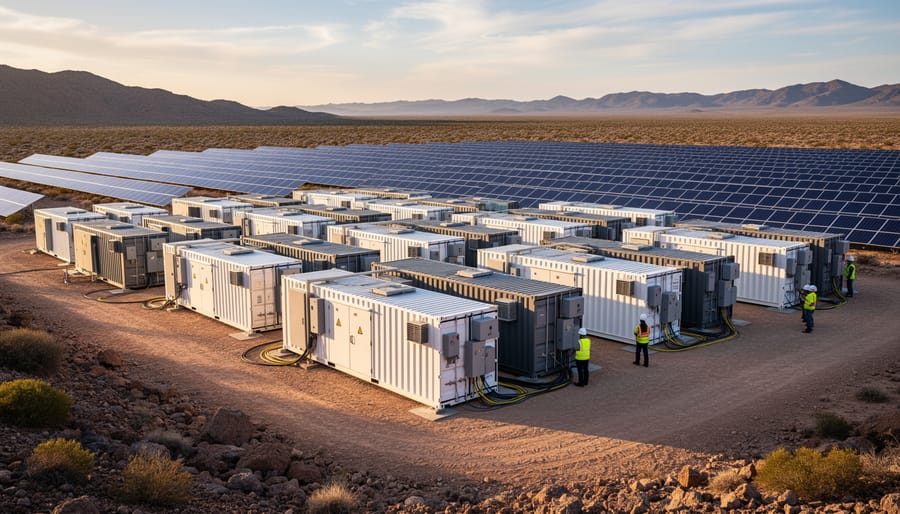
Modern large-scale off-grid solar installations increasingly rely on containerized and modular system architectures to overcome deployment challenges in remote locations. These pre-fabricated units integrate photovoltaic panels, inverters, battery storage, and control systems within standardized shipping containers, enabling rapid installation and simplified logistics.
Modular designs offer significant advantages for projects in mining operations, island communities, and agricultural facilities where traditional infrastructure development proves impractical. Each container functions as a self-contained power generation unit, allowing system capacity to scale incrementally by adding additional modules as energy demands grow. This approach reduces upfront capital requirements and minimizes deployment risks compared to traditional monolithic installations.
The containerized format also enhances system resilience through redundancy. If one module requires maintenance or experiences technical issues, remaining units continue operation, maintaining partial power availability. Furthermore, these standardized systems facilitate technology upgrades, as individual containers can be replaced or retrofitted with improved components without complete system overhauls.
Leading manufacturers now collaborate with universities to optimize containerized system designs, incorporating advanced thermal management, dust protection, and remote monitoring capabilities. These innovations have reduced installation timelines from months to weeks, making off-grid solar power increasingly viable for temporary installations, disaster relief operations, and expanding industrial facilities requiring flexible energy infrastructure.
The evolution of large-scale off-grid solar installations provides invaluable insights for advancing grid-connected storage systems. Understanding the operational challenges, energy management strategies, and storage optimization techniques employed in massive standalone systems directly informs the design of more resilient and efficient grid-tied applications. Both domains increasingly rely on sophisticated battery technologies, intelligent load management, and predictive analytics—creating a convergence that benefits the entire photovoltaic industry.
Modern off-grid megaprojects have demonstrated that energy independence at scale requires the same technological foundations as advanced grid-connected storage: high-capacity lithium-ion or flow batteries, real-time monitoring systems, and adaptive inverter technology. This technological overlap means professionals mastering one domain gain transferable expertise applicable to the other, making comprehensive education essential for career advancement.
For aspiring photovoltaic professionals seeking to excel in these advanced applications, structured educational pathways are increasingly critical. Mose Solar’s educational programs offer specialized training that bridges theoretical knowledge with practical implementation, covering both off-grid architecture and grid-connected storage integration. These programs equip participants with the analytical skills needed to evaluate system performance, optimize component selection, and navigate the regulatory landscape governing both independent and interconnected installations.
As renewable energy transitions accelerate globally, professionals who understand the full spectrum from isolated microgrids to utility-scale grid storage will lead innovation. The lessons learned from the world’s largest off-grid systems continue shaping smarter, more adaptable energy infrastructure—positioning educated specialists at the forefront of this transformative industry.