Showing 5 Result(s)
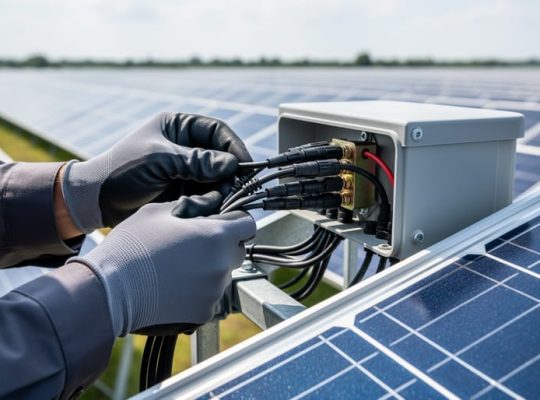
Gloved technician fastening MC4 connectors and organizing cables at a solar panel junction box, with a utility-scale solar array softly blurred in the background under diffused daylight.

BOS-5 Standards: Why Your Solar Investment Depends on This Certification

BOS-5 certification represents the photovoltaic industry’s rigorous standard for Balance of System components—the critical yet often overlooked elements beyond solar panels that determine system longevity and financial performance. Developed through collaboration between component manufacturers, testing laboratories, and industry organizations, this qualification protocol subjects connectors, junction boxes, cables, and associated hardware to accelerated aging tests that simulate 25 years of field exposure in controlled laboratory conditions.
Understanding BOS-5 matters significantly for project stakeholders because …
SCADA control cabinet with network cables at the edge of a large solar photovoltaic farm, shown with a translucent padlock symbol for cybersecurity; rows of solar panels and a small inverter substation softly blurred in the background under side lighting.

Why Your Solar Farm Needs SCADA Cybersecurity Clauses in Your Insurance Policy

Solar photovoltaic installations equipped with Supervisory Control and Data Acquisition (SCADA) systems face unprecedented cybersecurity threats that directly impact operational continuity, financial performance, and insurance eligibility. As renewable energy infrastructure becomes increasingly digitized and interconnected, SCADA networks managing solar arrays have evolved from isolated operational technology systems into prime targets for ransomware attacks, unauthorized access attempts, and sophisticated cyber intrusions that can disable generation capacity across multiple facilities simultaneously.
The convergence of information …

Marine surveyor in a high-visibility vest photographing shrink-wrapped solar panel pallets on a dock, with a container ship and port cranes softly blurred in the background under overcast light

How Marine Cargo Insurance Protects Your PV Module Shipments (Before They Leave the Port)

Understand your contractual obligations under Incoterms before a single solar panel leaves the factory floor. Whether you select FOB, CIF, or DAP terms determines precisely when insurance responsibility transfers between supplier and buyer, directly impacting who bears financial risk if panels crack during ocean transit or suffer water damage in port storage.
Verify that marine cargo insurance policies specifically cover photovoltaic modules with appropriate valuations reflecting current market prices, not just invoice costs. Solar panels face unique shipping vulnerabilities—micro-cracks from vibration, moisture ingress …

Eye-level wide photo of utility-scale solar panels under dark storm clouds with low golden sunlight, distant transmission towers, and an idle construction crane on the horizon.

Why Force Majeure Clauses Can Make or Break Your Solar Project

When a typhoon destroys solar panels awaiting installation, when government regulations suddenly prohibit grid connections, or when a pandemic halts construction for months, solar projects face events beyond any party’s control. These scenarios invoke force majeure and change-in-law provisions—contractual safeguards that determine who bears the financial burden when the impossible or unforeseeable occurs.
Force majeure, French for “superior force,” excuses contractual performance when extraordinary events make obligations impossible or impracticable to fulfill. In photovoltaic projects, these clauses protect …

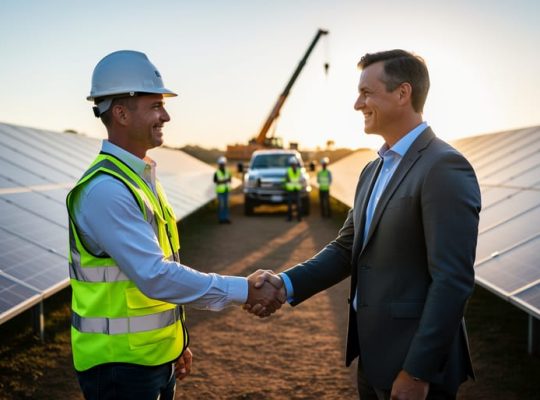
Solar project manager in a safety vest shakes hands with a business professional next to rows of ground-mounted solar panels at sunset, with a blurred crew, pickup truck, and crane in the background.

How Trade Credit Insurance Protects Your Solar Business When Contractors Fail

Trade credit insurance functions as a specialized risk management tool that protects solar companies from financial losses when contractors, suppliers, or buyers default on payment obligations or become insolvent. In the renewable energy sector, where project timelines span months and supply chains involve substantial capital investments, this protection mechanism has become increasingly critical for maintaining operational stability.
The solar industry’s rapid expansion creates unique vulnerability points. Panel manufacturers often extend payment terms to installation contractors…