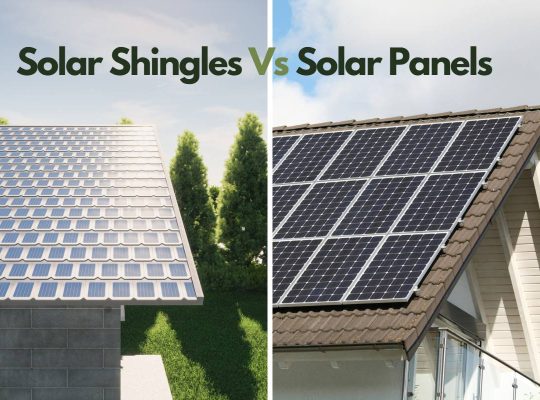
Conceptual illustration of solar panels enhanced with multicolored quantum dots, set against a cityscape background, representing advanced solar energy technology.

Quantum Dot Solar Cells: The Breakthrough Making PV Panels More Powerful

Quantum dot solar cells represent a revolutionary leap in photovoltaic technology, promising to shatter the theoretical efficiency limits of conventional solar panels. By harnessing nanoscale semiconductor particles that can be precisely tuned to capture specific wavelengths of light, these next-generation solar cells offer unprecedented potential for maximizing solar energy conversion. Recent breakthroughs have demonstrated conversion efficiencies exceeding 16%, while maintaining significantly lower production costs compared to traditional silicon-based cells.

The integration of quantum dots into solar technology marks a critical intersection of nanotechnology and renewable energy, addressing both the escalating global energy demand and the urgent need for sustainable power solutions. These versatile nanocrystals, typically ranging from 2-10 nanometers in diameter, can be engineered to absorb light across the entire solar spectrum, including previously untapped infrared radiation. This breakthrough enables the development of more efficient, flexible, and cost-effective solar panels that could fundamentally transform the renewable energy landscape.

As scientists and engineers continue to refine quantum dot synthesis methods and optimize device architectures, this technology stands poised to revolutionize solar energy harvesting, potentially making clean, renewable power more accessible and economically viable than ever before.

Understanding Quantum Dots in Solar Applications

What Are Quantum Dots?

Quantum dots are semiconductor nanocrystals typically ranging from 2 to 10 nanometers in diameter, making them smaller than the wavelength of visible light. These microscopic particles exhibit unique optical and electronic properties due to quantum confinement effects, which occur when electrons are confined in all three spatial dimensions. What makes quantum dots particularly remarkable is their ability to be precisely tuned to absorb and emit specific wavelengths of light by simply adjusting their size.

In the context of solar applications, quantum dots function as highly efficient light harvesters. When photons strike these nanocrystals, they generate electron-hole pairs, which can be captured and converted into electrical current. One of their most valuable characteristics is their bandgap tunability, allowing them to be optimized for different parts of the solar spectrum. Additionally, quantum dots can be synthesized from various semiconductor materials, including lead sulfide, cadmium selenide, and more environmentally friendly alternatives like copper indium selenide.

These versatile nanoparticles can be processed in solution and deposited onto surfaces using cost-effective manufacturing techniques, making them particularly attractive for next-generation solar cell development.

Colorful microscopic image of quantum dots at different sizes emitting various wavelengths of light
Microscopic visualization of quantum dots showing their nanocrystal structure and size-dependent color properties

How Quantum Dots Enhance Solar Energy Capture

Quantum dots excel at capturing solar energy through their unique ability to tune bandgap energies and enhance photon absorption across the solar spectrum. These semiconductor nanocrystals, typically ranging from 2-10 nanometers in diameter, complement traditional PV module fundamentals by capturing high-energy photons more efficiently.

When photons strike quantum dots, they excite electrons from the valence band to the conduction band, creating electron-hole pairs. The bandgap energy of quantum dots can be precisely controlled by adjusting their size, allowing for optimal absorption of different wavelengths of light. Smaller quantum dots exhibit larger bandgaps, absorbing higher-energy blue light, while larger dots capture lower-energy red light.

This size-dependent absorption enables quantum dots to overcome the Shockley-Queisser limit that constrains traditional solar cells. Through multiple exciton generation (MEG), a single high-energy photon can generate multiple electron-hole pairs, potentially increasing conversion efficiency beyond conventional limits. Additionally, quantum dots can be engineered to reduce thermal losses and enhance charge carrier extraction, making them particularly valuable for next-generation solar technology development.

Benefits of Quantum Dot Solar Technology

Side-by-side comparison diagram of quantum dot vs traditional solar cell energy conversion process
Diagram showing how quantum dots capture and convert solar energy compared to traditional solar cells

Increased Energy Conversion Efficiency

Quantum dot solar cells have demonstrated remarkable potential in enhancing energy conversion efficiency through their unique optical and electronic properties. Recent quantum dot efficiency breakthroughs have shown conversion rates exceeding 16.6%, marking a significant improvement over traditional thin-film technologies.

The enhanced efficiency stems from quantum dots’ ability to capture a broader spectrum of solar radiation, including wavelengths that conventional photovoltaic materials typically miss. Through quantum confinement effects, these nanocrystals can be precisely tuned to absorb specific wavelengths of light, maximizing the solar spectrum utilization.

Multiple exciton generation (MEG) in quantum dots further contributes to improved efficiency. Unlike traditional solar cells where one photon generates one electron-hole pair, quantum dots can produce multiple electron-hole pairs from a single high-energy photon. This phenomenon substantially increases the theoretical efficiency limit beyond the Shockley-Queisser limit of 33%.

Advanced surface engineering and bandgap tuning techniques have also reduced energy losses associated with charge carrier recombination. The implementation of core-shell structures and surface ligand modifications has improved charge extraction efficiency, leading to better overall performance. These improvements, combined with reduced production costs, position quantum dot solar technology as a promising candidate for next-generation photovoltaic applications.

Cost-Effectiveness and Scalability

The manufacturing costs of quantum dot solar cells have shown promising trends toward economic viability, particularly as production processes become more refined. Current estimates indicate that large-scale production could achieve costs between $0.20 and $0.30 per watt, making them potentially competitive with traditional silicon-based solar cells.

The scalability of quantum dot solar technology benefits from several key advantages. The solution-processing techniques used in manufacturing allow for roll-to-roll printing and spray coating methods, which are significantly more cost-effective than the high-temperature vacuum processes required for conventional solar cells. Additionally, the raw materials needed for quantum dot production are abundant and relatively inexpensive compared to rare earth elements used in some other solar technologies.

Recent advancements in automated production methods have reduced manufacturing complexity while improving consistency and quality control. Industrial-scale facilities can now produce quantum dots with precise size distributions and uniform properties, essential for maintaining high efficiency in solar applications. The potential for integrating quantum dot production into existing manufacturing infrastructure further reduces implementation costs.

However, challenges remain in scaling up production while maintaining the high quality standards necessary for optimal performance. Current research focuses on improving production yields and developing more efficient synthesis methods to reduce waste and energy consumption during manufacturing. As these challenges are addressed, the cost-effectiveness of quantum dot solar technology continues to improve, making it an increasingly viable option for commercial deployment.

Current Applications and Implementation

Commercial Solar Panel Integration

Several leading solar manufacturers have successfully integrated quantum dot technology into commercial photovoltaic products, marking a significant advancement in solar panel efficiency. Companies like UbiQD and Nanosys have developed quantum dot-enhanced solar windows and films that are currently being implemented in pilot projects across various locations.

Major solar panel manufacturers have begun incorporating quantum dot layers into their traditional silicon-based panels, reporting efficiency improvements of 15-20% compared to conventional designs. These hybrid panels maintain the durability and reliability of traditional solar modules while leveraging the enhanced light absorption capabilities of quantum dots.

Notable commercial applications include building-integrated photovoltaics (BIPV) where quantum dot-enhanced glass panels serve dual purposes as both windows and energy generators. These installations have been particularly successful in commercial buildings and greenhouses, where the technology’s ability to selectively utilize specific wavelengths of light proves advantageous.

Current market offerings include transparent solar films embedded with quantum dots, which can be retrofitted onto existing windows, and next-generation solar panels that incorporate quantum dot layers during manufacturing. These products demonstrate improved performance in low-light conditions and maintain higher efficiency levels at elevated temperatures compared to traditional panels.

Despite higher initial costs, the enhanced performance and increasing manufacturing scale are gradually making quantum dot solar solutions more economically viable. Industry analysts project that as production volumes increase and manufacturing processes become more refined, the cost per watt will continue to decrease, making these advanced solar solutions increasingly competitive in the commercial market.

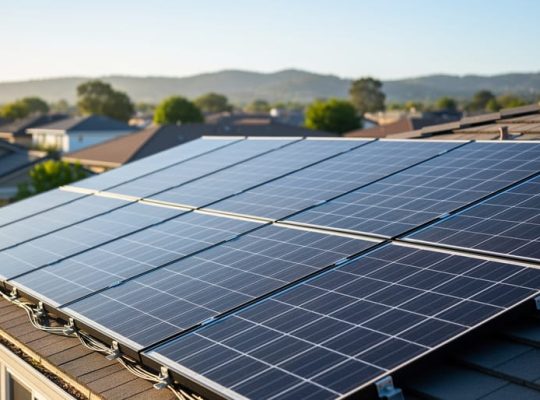
Large-scale installation of quantum dot solar panels on modern commercial building rooftop
Real-world installation of quantum dot enhanced solar panels on a commercial building

Research and Development Progress

Recent advancements in quantum dot solar technology have marked significant progress in improving solar cell efficiency and cost-effectiveness. Researchers at leading institutions have achieved breakthrough results in quantum dot synthesis and implementation, contributing to the latest solar innovation trends.

A notable development comes from collaborative research between MIT and Stanford University, where scientists have successfully increased quantum dot solar cell efficiency to 16.6% by optimizing the quantum dot layer structure. This represents a substantial improvement from previous benchmarks of 12-13% efficiency.

The development of lead-free quantum dots has also gained momentum, addressing environmental concerns while maintaining high performance. Research teams have demonstrated promising results using copper-based and zinc-based alternatives, achieving stability comparable to traditional lead-based quantum dots.

Advances in manufacturing processes have enabled better control over quantum dot size distribution and surface chemistry, crucial factors for optimal energy conversion. New coating techniques have improved the uniform deposition of quantum dots, enhancing overall cell performance and reliability.

Current research focuses on several key areas:
– Multiple exciton generation optimization
– Enhanced light absorption through strategic quantum dot placement
– Development of more efficient electron transport layers
– Implementation of tandem cell architectures
– Scale-up of manufacturing processes for commercial viability

These developments suggest quantum dot solar technology is progressing rapidly toward commercial feasibility, with researchers predicting efficiency rates exceeding 20% within the next few years. The combination of improved performance and reduced production costs positions quantum dot solar cells as a promising contributor to next-generation photovoltaic solutions.

Future Prospects and Challenges

Technical Challenges

Despite the promising potential of quantum dot solar technology, several significant technical challenges must be addressed before widespread commercial adoption becomes feasible. The primary obstacle remains the relatively low power conversion efficiency compared to traditional silicon-based solar cells. While recent breakthroughs have shown improvements, current quantum dot solar cells typically achieve efficiencies between 16-18%, falling short of commercial silicon cells.

Material stability presents another crucial challenge, as quantum dots can degrade when exposed to oxygen and moisture, potentially reducing their long-term performance. Researchers are actively working on developing more stable surface chemistry and improved encapsulation methods to enhance durability under real-world conditions.

Manufacturing scalability also poses significant hurdles. Current production methods for high-quality quantum dots often involve complex synthesis procedures that are difficult to scale up while maintaining consistent particle size and properties. This complexity contributes to higher production costs, making market competitiveness challenging.

Additionally, charge carrier mobility and collection efficiency remain areas requiring improvement. The interface between quantum dots and charge transport layers often contains defects that can trap electrons and holes, reducing overall device performance. Research efforts are focused on developing better surface passivation techniques and optimizing device architecture to minimize these losses.

Environmental concerns regarding the use of heavy metals in certain quantum dot compositions also need to be addressed through the development of alternative, non-toxic materials while maintaining high performance levels.

Market Potential

The quantum dot solar market is projected to experience substantial growth over the next decade, with analysts forecasting a compound annual growth rate (CAGR) of 23.4% between 2024 and 2030. This remarkable expansion is driven by increasing demand for high-efficiency solar solutions and the technology’s potential to revolutionize the renewable energy sector. As one of the most promising future solar technologies, quantum dot solar cells are expected to capture a significant share of the photovoltaic market.

Industry experts estimate that the global quantum dot solar market could reach $8.2 billion by 2030, primarily fueled by technological advancements and declining manufacturing costs. Major semiconductor manufacturers and solar companies are increasing their investments in quantum dot research and development, recognizing its potential to achieve theoretical efficiency limits exceeding 40%.

The technology’s versatility and compatibility with existing manufacturing processes make it particularly attractive for commercial adoption. As production scales up and efficiencies improve, quantum dot solar cells are expected to become increasingly cost-competitive with traditional silicon-based panels. This market growth is further supported by governmental renewable energy initiatives and increasing corporate commitments to sustainable energy solutions, positioning quantum dot technology as a key driver in the transition to more efficient solar power generation.

Quantum dot technology represents a pivotal advancement in the evolution of solar photovoltaic systems, offering unprecedented potential for improving solar cell efficiency and cost-effectiveness. The unique ability of quantum dots to harness a broader spectrum of solar energy, combined with their tunable bandgap properties, positions them as a transformative force in renewable energy technology.

The implementation of quantum dots in solar cells has demonstrated remarkable progress, with recent developments achieving efficiency rates that approach those of traditional silicon-based cells while offering additional advantages such as reduced manufacturing costs and enhanced flexibility in application. Their ability to overcome the Shockley-Queisser limit through multiple exciton generation has opened new pathways for exceeding conventional solar cell efficiency boundaries.

Looking ahead, quantum dot solar technology shows promise for revolutionizing the renewable energy landscape. Continued research and development efforts are focusing on improving stability, optimizing manufacturing processes, and scaling production for commercial viability. The technology’s potential for integration into existing solar infrastructure, coupled with its adaptability to various environmental conditions, suggests a bright future for quantum dot-based solar solutions.

As global energy demands continue to rise and the need for sustainable power sources becomes increasingly urgent, quantum dot solar technology stands at the forefront of photovoltaic innovation, offering a compelling pathway toward more efficient and accessible solar energy harvesting systems.