
A photovoltaic cell or device converts sunlight to electrical energy through the photovoltaic effect, a quantum mechanical process where photons from solar radiation liberate electrons within semiconductor materials, generating direct current electricity. This fundamental conversion process stands as the cornerstone of modern solar energy systems, transforming approximately 15-23% of incident solar energy into usable electrical power in commercial applications, with cutting-edge laboratory cells achieving efficiencies exceeding 47% through multi-junction configurations.
Understanding this conversion extends beyond basic physics into practical considerations that determine long-term system performance, economic viability, and environmental impact. The efficiency of photon-to-electron conversion varies significantly across silicon-based, thin-film, and emerging perovskite technologies, with each material system exhibiting distinct performance characteristics under diverse operating conditions. Temperature coefficients, spectral response variations, and degradation mechanisms directly influence how effectively photovoltaic devices maintain their conversion efficiency throughout 25-30 year operational lifespans.
Professional photovoltaic practitioners must grasp both the semiconductor physics governing charge carrier generation and the engineering principles that optimize energy harvest across system lifecycles. This knowledge enables informed technology selection, predictive performance modeling, and strategic maintenance planning. From material science fundamentals through real-world installation considerations, mastering photovoltaic conversion principles empowers stakeholders to maximize renewable energy returns while advancing global decarbonization objectives through scientifically grounded decision-making and systematic performance optimization strategies.
The Photovoltaic Conversion Process: From Photons to Electric Current
Understanding the Photovoltaic Effect
The photovoltaic effect is the fundamental physical process that enables a photovoltaic cell or device to convert sunlight into electrical energy. This phenomenon occurs when semiconductor materials absorb photons from sunlight, initiating a chain of events that generates usable electricity.
When sunlight strikes the surface of a photovoltaic cell, photons carrying specific energy levels interact with the semiconductor material, typically silicon. If a photon possesses sufficient energy equal to or greater than the material’s band gap energy, it can dislodge an electron from its atomic bond. This process, known as photon absorption, creates an electron-hole pair where the freed electron leaves behind a positively charged vacancy.
The semiconductor structure within photovoltaic cells features two distinct layers: an n-type layer with excess electrons and a p-type layer with electron deficiencies. At their junction, an electric field forms naturally, creating what researchers call the depletion region. This built-in electric field serves as the driving force that separates the photogenerated electron-hole pairs before they can recombine.
Once separated, electrons migrate toward the n-type layer while holes move toward the p-type layer. This directional movement of charge carriers establishes an electrical potential difference across the cell. When external conductors connect the two layers, electrons flow through the circuit, generating direct current electricity that powers devices or feeds into the grid.
Understanding this complete PV system process provides the foundation for optimizing conversion efficiency and maximizing energy output throughout a system’s operational lifetime.

The Role of Semiconductor Materials in Energy Conversion
Semiconductor materials form the foundation of photovoltaic technology, enabling the direct conversion of sunlight into electrical energy through their unique electronic properties. Silicon dominates the commercial PV market, accounting for approximately 95% of all solar panels manufactured globally, primarily due to its abundance, well-understood properties, and proven reliability over multi-decade operational lifespans.
Crystalline silicon exists in two primary forms within PV applications: monocrystalline and polycrystalline. Monocrystalline silicon, characterized by its uniform crystal structure, typically achieves conversion efficiencies between 20-22% in commercial applications, while polycrystalline silicon, with its multi-crystal composition, generally reaches 15-17% efficiency. These materials function as semiconductors because their atomic structure creates an energy band gap of approximately 1.1 electron volts, ideal for absorbing visible and near-infrared wavelengths of sunlight.
The semiconductor’s role centers on creating a p-n junction, where positively charged (p-type) and negatively charged (n-type) silicon layers meet. This junction establishes an internal electric field that separates electron-hole pairs generated by photon absorption, driving electrons toward electrical contacts and creating usable current. The quality of the semiconductor material directly influences conversion efficiency and long-term performance stability.
Beyond silicon, emerging semiconductor materials are expanding PV capabilities. Cadmium telluride and copper indium gallium selenide represent thin-film alternatives offering lower manufacturing costs and flexibility in application. Perovskite materials, currently advancing through research stages in collaboration with universities, demonstrate remarkable efficiency gains and potential for tandem cell configurations. Each semiconductor material presents distinct advantages regarding absorption coefficients, temperature coefficients, and degradation characteristics, factors that significantly impact lifecycle performance and energy yield across various environmental conditions and operational scenarios.
Types of Photovoltaic Technologies and Their Conversion Characteristics
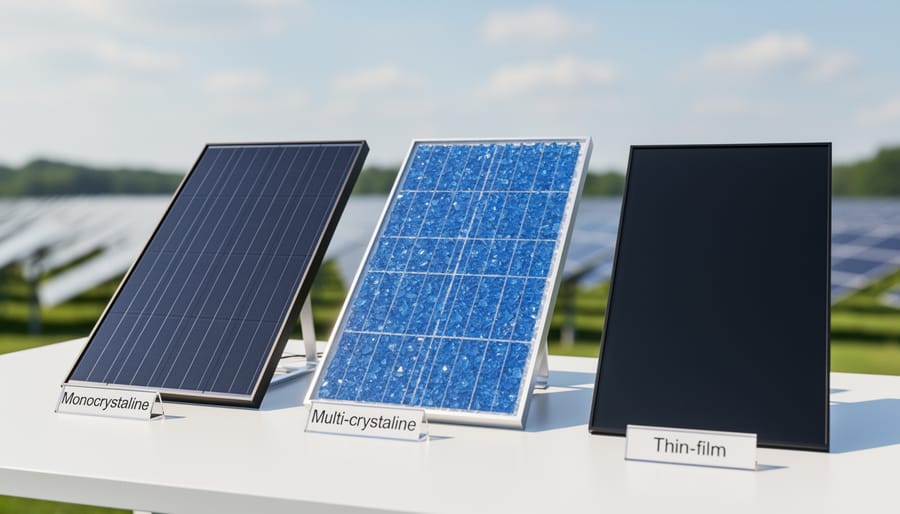
Monocrystalline vs. Multi-Crystalline Conversion Efficiency
Monocrystalline and multi-crystalline (also known as polycrystalline) photovoltaic cells represent the two dominant silicon-based technologies in today’s solar market, each offering distinct conversion efficiency profiles. Understanding their performance differences enables informed decision-making for system design and investment planning.
Monocrystalline cells consistently achieve higher conversion efficiencies, typically ranging from 20% to 22% in commercial applications, with premium modules reaching up to 24% under standard test conditions. Their superior performance stems from the uniform crystal structure, which allows electrons to move more freely with minimal resistance. Multi-crystalline cells, manufactured from multiple silicon fragments melted together, demonstrate efficiencies between 17% and 19% due to grain boundaries that create electron pathways with slightly higher resistance.
Real-world performance data reveals that efficiency advantages extend beyond laboratory conditions. Field studies conducted by research institutions show monocrystalline systems generating approximately 10-15% more electricity per square meter annually compared to multi-crystalline installations in identical locations. This difference becomes particularly pronounced in high-temperature environments, where monocrystalline cells exhibit superior temperature coefficients, typically losing 0.3-0.4% efficiency per degree Celsius versus 0.4-0.5% for multi-crystalline variants.
The cost-efficiency equation has shifted considerably in recent years. While multi-crystalline technology historically offered lower upfront costs, manufacturing advances have narrowed the price gap to approximately 5-10%. Combined with their space efficiency and enhanced energy yield, monocrystalline systems increasingly deliver superior long-term return on investment, particularly for installations with spatial constraints or demanding performance requirements.
Advanced Technologies: PERC and Emerging Innovations
Passivated Emitter and Rear Cell (PERC) technology represents a significant advancement in photovoltaic efficiency, addressing inherent energy losses in conventional solar cells. This innovation adds a dielectric passivation layer to the cell’s rear surface, reducing electron recombination and reflecting unabsorbed light back through the silicon. The result is efficiency gains of 1-2 percentage points over standard cells, translating to substantial energy yield improvements over a system’s operational lifetime.
PERC cells achieve these gains through two mechanisms: surface passivation minimizes electron-hole recombination at the rear contact, while the reflective layer provides photons a second opportunity for absorption. This dual approach has made PERC the dominant commercial technology, with manufacturers reporting efficiencies exceeding 22% in mass production.
Beyond PERC, several emerging technologies promise further conversion improvements. Bifacial solar cells capture light from both sides, increasing energy generation by 5-30% depending on installation conditions. Heterojunction technology (HJT) combines crystalline silicon with thin amorphous silicon layers, achieving laboratory efficiencies above 26%. Perovskite solar cells, while still in development, demonstrate remarkable efficiency potential and could enable tandem configurations with silicon cells.
These innovations extend beyond efficiency metrics to impact lifecycle performance. Higher conversion efficiency reduces the photovoltaic array size needed for equivalent power output, lowering material requirements and installation costs. University research collaborations continue advancing these technologies, with academic institutions partnering with industry to accelerate commercial deployment while offering educational programs that prepare professionals to implement these next-generation systems effectively.
Building-Integrated Photovoltaics: Solar Tiles and Shingles
Building-integrated photovoltaics represent an innovative approach where photovoltaic materials perform dual functions: converting sunlight to electricity while serving as functional building components. Solar tiles and shingles integrate semiconductor materials directly into roofing products, eliminating the need for separate mounting systems. These products utilize thin-film or crystalline silicon cells embedded within weather-resistant materials that meet building code requirements for durability and fire resistance. The conversion process remains identical to traditional panels—photons excite electrons in the semiconductor layer—but the form factor allows seamless architectural integration. Performance typically ranges from 10-20% efficiency depending on the technology employed. While conversion rates may be slightly lower than conventional rack-mounted systems due to aesthetic design constraints and thermal considerations, building-integrated solutions offer reduced installation costs and enhanced property value. These integrated systems face unique lifecycle challenges including thermal management from direct building contact and limited ventilation, requiring careful consideration during system design to optimize long-term energy production.

Conversion Efficiency Throughout the System Lifecycle
Initial Performance and Manufacturing Quality
The conversion efficiency a photovoltaic cell achieves from sunlight to electricity depends significantly on manufacturing quality and process control. Modern fabrication facilities employ rigorous quality assurance protocols to ensure each cell meets specified performance standards before system integration. Critical manufacturing parameters include silicon purity levels exceeding 99.9999%, precise doping concentrations, uniform anti-reflective coating application, and optimal junction depth formation.
Advanced production lines utilize automated optical inspection systems, electroluminescence imaging, and flash testing to identify defects that compromise conversion efficiency. These quality control measures detect microcracks, junction irregularities, and material inconsistencies that could reduce initial performance by 2-5% or create potential failure points during operation.
Manufacturing variations between facilities and technologies directly impact the baseline efficiency ratings. Premium monocrystalline cells typically achieve 20-22% laboratory efficiency, though commercial module efficiency often measures 18-20% due to cell interconnection losses and encapsulation effects. Many leading manufacturers now collaborate with universities to refine production techniques and develop next-generation materials that enhance both initial performance and long-term reliability. Educational program offerings increasingly emphasize these quality control methodologies, preparing professionals to maintain high standards throughout the photovoltaic supply chain and ensuring systems deliver optimal electricity generation from their first day of operation.
Degradation Rates and Performance Loss Over Time
Photovoltaic systems experience gradual performance decline throughout their operational lifetime, with long-term performance degradation typically averaging 0.5% to 0.8% annually for crystalline silicon modules. This means a system delivering 100% capacity in year one will operate at approximately 80-90% efficiency after 25 years. Premium modules often exhibit lower degradation rates of 0.3-0.5% per year, while thin-film technologies may experience slightly higher rates initially before stabilizing.
Several mechanisms drive this degradation. Light-induced degradation occurs within the first few hundred hours of operation, causing an initial 1-3% power loss before stabilization. Potential-induced degradation results from voltage stress between cells and frames in high-voltage systems. Environmental factors including ultraviolet exposure, thermal cycling, humidity ingress, and mechanical stress from wind or snow loading accelerate material breakdown. Encapsulant discoloration, cell microcracks, and solder bond fatigue compound these effects over decades of operation.
Mitigation strategies significantly extend performance longevity. Advanced encapsulation materials resist yellowing and delamination. Anti-reflective coatings maintain light transmission efficiency. Proper installation with adequate ventilation reduces thermal stress, while regular cleaning prevents soiling losses. Quality manufacturing processes minimize initial defects that propagate over time. University research programs continue developing materials and designs that resist degradation mechanisms, with some next-generation modules targeting degradation rates below 0.25% annually, ensuring systems maintain higher productivity throughout their warranted lifespan.
Environmental Factors Affecting Conversion
Environmental conditions significantly influence photovoltaic conversion efficiency throughout a system’s operational lifetime. Temperature presents a primary concern, as elevated cell temperatures typically reduce voltage output and overall efficiency by approximately 0.4-0.5% per degree Celsius above standard test conditions. This thermal effect necessitates proper ventilation design and mounting strategies in hot climates.
Soiling from dust, pollen, bird droppings, and atmospheric pollutants creates an optical barrier that reduces light transmission to the semiconductor material. Studies indicate efficiency losses ranging from 2-25% depending on location, tilt angle, and rainfall patterns. Regular maintenance protocols and anti-soiling coatings help mitigate these impacts.
Shading poses critical challenges because even partial obstruction of cell strings can disproportionately affect power output due to series circuit configurations. Bypass diodes provide protection but cannot fully compensate for shading losses. Weather conditions including cloud cover, humidity, and atmospheric particulates alter the solar spectrum and intensity reaching the array surface, causing daily and seasonal conversion variations that system operators must anticipate for accurate performance modeling and energy forecasting.
Optimizing Conversion Performance in PV System Management
Monitoring and Performance Analysis
Effective monitoring systems are essential for optimizing the conversion of sunlight to electricity throughout a photovoltaic system’s operational life. Advanced real-time performance monitoring platforms track key metrics including current output, voltage levels, temperature coefficients, and overall conversion efficiency against baseline expectations.
Modern monitoring solutions employ pyranometers to measure incident solar radiation, allowing operators to calculate performance ratios that reveal actual efficiency versus theoretical capacity. String-level monitoring identifies underperforming arrays caused by soiling, shading, or component degradation, while module-level electronics provide granular data on individual panel performance.
Thermal imaging cameras detect hotspots indicating potential failures, while electrical testing equipment measures fill factor degradation and series resistance increases. Data analytics platforms aggregate information from multiple sensors, applying machine learning algorithms to identify performance trends and predict maintenance needs before significant efficiency losses occur.
Universities collaborating with industry partners have developed standardized testing protocols and diagnostic frameworks that enable consistent performance assessment across diverse installations. These tools empower system operators to implement targeted corrective measures, from cleaning schedules to component replacement strategies, ensuring sustained optimal conversion efficiency throughout the system lifecycle.
Maintenance Practices That Preserve Conversion Capability
Sustaining optimal photovoltaic conversion efficiency requires systematic maintenance protocols that directly impact long-term energy production. Regular panel cleaning removes dust, pollen, bird droppings, and environmental debris that can reduce sunlight absorption by 15-25% in heavily soiled conditions. The cleaning frequency depends on local environmental factors, with arid or industrial areas requiring more frequent attention than regions with regular rainfall.
Comprehensive inspection protocols should occur quarterly, examining electrical connections, junction boxes, and inverter performance indicators. Visual assessments identify potential issues including micro-cracks, delamination, hot spots, and moisture intrusion that compromise conversion capability. Thermal imaging technology detects temperature anomalies indicating cell degradation or electrical resistance problems before they significantly impact output.
Implementing maintenance best practices extends system lifespan while preserving conversion efficiency. Vegetation management prevents shading that disrupts series-connected cell strings, while monitoring system performance data establishes baseline metrics for detecting degradation trends. Inverter maintenance, including firmware updates and ventilation system cleaning, ensures maximum DC-to-AC conversion efficiency throughout operational life. Professional maintenance programs, often developed through university collaborations, provide systematic approaches that maintain 95-98% of original conversion capability over 25-year warranties, protecting the substantial investment in photovoltaic technology.

System Design Considerations for Maximum Conversion
Maximizing sunlight conversion to usable electricity requires careful attention to system design parameters beyond cell technology selection. Panel orientation and tilt angles significantly impact energy capture throughout the year. In the Northern Hemisphere, south-facing installations typically yield optimal results, while Southern Hemisphere systems benefit from north-facing orientations. The ideal tilt angle generally approximates the site’s latitude, though seasonal adjustments can enhance performance for fixed installations. Tracking systems that follow the sun’s path increase energy harvest by 25-40% compared to fixed arrays, though they introduce mechanical complexity and maintenance requirements.
Inverter selection critically influences overall system efficiency. String inverters offer cost-effective solutions for uniform installations, while microinverters and power optimizers provide module-level optimization, particularly valuable when shading or orientation varies across the array. Modern inverters achieve conversion efficiencies exceeding 98%, transforming direct current from panels into alternating current for grid connection or local consumption.
System configuration choices including series-parallel string design, wire sizing, and array layout affect voltage drops and thermal management. Optimizing conversion efficiency requires integrating these design elements with site-specific conditions, load profiles, and regulatory requirements, ensuring maximum energy yield throughout the system’s operational lifetime.
The Broader Impact: From Conversion to Grid Integration
Inverters and DC-to-AC Conversion
While photovoltaic cells generate direct current (DC) electricity, most residential and commercial applications require alternating current (AC) power. Inverters serve as the critical bridge in this conversion process, transforming DC output from solar arrays into grid-compatible AC electricity. These sophisticated power electronics employ rapid switching techniques, typically operating at frequencies between 20-100 kHz, to create alternating waveforms that match grid specifications of 50-60 Hz.
Modern inverters achieve conversion efficiencies exceeding 98%, meaning minimal energy loss during the DC-to-AC transformation. Beyond basic conversion, contemporary inverters incorporate maximum power point tracking (MPPT) algorithms that continuously optimize system performance by adjusting voltage and current to extract maximum available power from PV arrays under varying conditions. Three primary inverter configurations exist: string inverters connecting multiple panels in series, microinverters attached to individual modules, and power optimizers offering hybrid functionality. Selection depends on system size, shading patterns, and performance requirements. Advanced inverters also provide grid support functions including voltage regulation, frequency stabilization, and reactive power control—capabilities increasingly mandated by utility interconnection standards. Many institutions collaborating with universities are developing next-generation inverter technologies featuring enhanced durability, improved thermal management, and integrated energy storage capabilities to support evolving grid requirements.
Energy Storage and Conversion Optimization
The electricity generated by photovoltaic cells requires sophisticated energy storage and management systems to maximize system value and reliability. Battery integration has become essential as solar generation is inherently intermittent, with power production fluctuating based on weather conditions and time of day. Modern lithium-ion battery systems store excess energy produced during peak sunlight hours for use during evening demand periods or cloudy conditions, significantly improving overall system utilization.
Energy management systems employ advanced algorithms to optimize charge-discharge cycles, protecting battery longevity while ensuring power availability when needed. These intelligent controllers monitor real-time generation, consumption patterns, and grid conditions to make split-second decisions about energy routing. Research conducted through university partnerships continues to advance battery chemistry and control strategies, extending storage system lifespans from typical 10-year warranties toward 15-20 year operational periods that better align with photovoltaic panel lifecycles.
The integration of storage transforms photovoltaic systems from variable generators into dispatchable resources, enabling participation in grid services and demand response programs. This capability substantially increases the economic value proposition for both residential and commercial installations, while supporting broader grid stability as renewable penetration increases across electrical networks.
Understanding how photovoltaic cells convert sunlight to electricity forms the foundation for effective lifecycle management of solar energy systems. This knowledge empowers professionals to optimize system performance, anticipate degradation patterns, and implement appropriate maintenance strategies throughout operational lifespans. As photovoltaic technologies continue advancing, the interplay between conversion efficiency, material selection, and long-term reliability becomes increasingly critical for maximizing return on investment and environmental benefits.
Mose Solar remains committed to advancing photovoltaic education through comprehensive training programs and collaborative research initiatives with leading universities. Our educational offerings equip aspiring professionals with both theoretical understanding and practical skills necessary for managing modern solar installations effectively. Whether you’re entering the renewable energy sector, conducting academic research, or managing existing photovoltaic systems, deepening your knowledge of conversion principles and lifecycle optimization strategies positions you at the forefront of this transformative industry. We encourage all stakeholders to engage with ongoing professional development opportunities, contributing to the collective expertise driving solar technology forward and accelerating the global transition to sustainable energy solutions.