SolarEdge has established itself as a transformative force in the photovoltaic industry, fundamentally redefining solar energy systems through its pioneering power optimizer technology and DC-coupled architecture. The company’s edge computing approach—processing power conversion at the module level rather than centrally—delivers 2-5% higher energy yields compared to traditional string inverters, while providing granular monitoring capabilities that have become industry standard. With over 2.9 million installations across 133 countries and cumulative shipped capacity exceeding 69 GWdc as of 2023, SolarEdge’s market penetration speaks to both technological merit and commercial viability.
However, evaluating whether SolarEdge qualifies as a “good company” requires examining multiple dimensions beyond market share: product performance consistency, financial stability amid industry volatility, warranty fulfillment reliability, and technological adaptability to emerging storage and EV charging integration demands. Recent quarters have revealed challenges including inventory corrections, margin pressures, and increased warranty provisions that warrant careful consideration for installers, investors, and system owners alike.
This analysis dissects SolarEdge’s core technological differentiation, scrutinizes performance data from field installations, contextualizes financial metrics within competitive landscapes, and provides evidence-based recommendations for various stakeholder categories. Understanding these multifaceted factors enables informed decisions about whether SolarEdge’s solutions align with specific project requirements, risk tolerances, and long-term energy objectives.
What Makes SolarEdge Different: The Edge Computing Advantage
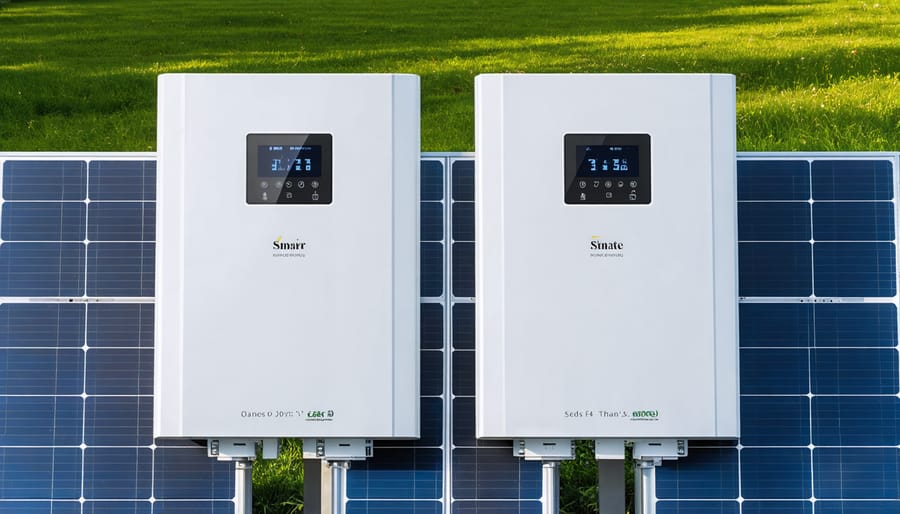
Distributed Intelligence vs. Traditional String Inverters
SolarEdge distinguishes itself through a fundamentally different architectural approach compared to traditional photovoltaic systems. Conventional string inverters connect multiple solar panels in series, converting direct current (DC) to alternating current (AC) at a single centralized point. This creates a critical weakness: the entire string operates at the performance level of its weakest panel, much like holiday lights where one malfunctioning bulb affects the entire strand.
SolarEdge’s distributed intelligence system deploys power optimizers at each individual module, creating what the industry recognizes as module-level power electronics (MLPE). These optimizers perform maximum power point tracking (MPPT) independently for each panel, extracting optimal energy regardless of shading, soiling, or panel mismatch conditions. This represents a practical application of edge computing in solar installations, where processing occurs at the data source rather than centrally.
The technical advantages are quantifiable. String inverters typically achieve 95-96% efficiency under optimal conditions, but real-world performance degrades significantly with partial shading or module inconsistencies. SolarEdge’s distributed architecture maintains 97-99% efficiency per module while mitigating mismatch losses that can reduce string inverter output by 25% or more in compromised conditions.
This edge computing architecture also enhances system visibility. Traditional inverters provide only aggregate performance data, making fault diagnosis challenging. SolarEdge’s module-level monitoring delivers granular performance metrics for each panel, enabling precise maintenance interventions and optimal system management.
For photovoltaic professionals, understanding this architectural distinction is essential. While traditional inverters offer lower upfront costs and simpler installation in ideal conditions, distributed intelligence systems provide superior energy harvest, enhanced safety through DC voltage optimization, and comprehensive diagnostic capabilities that align with increasingly sophisticated grid requirements and performance expectations.
Real-Time Data Processing at the Panel Level
SolarEdge’s implementation of edge computing represents a fundamental departure from traditional solar system architectures. Rather than relying on centralized inverters that process data from entire arrays, SolarEdge power optimizers perform computational tasks directly at each panel. This distributed approach enables real-time decision-making within milliseconds, allowing each module to operate independently based on its specific conditions.
The practical implications of panel-level processing are substantial. When partial shading affects a conventional string inverter system, the entire string’s performance degrades to match the weakest panel. SolarEdge’s edge computing architecture isolates this impact, with each optimizer continuously analyzing its panel’s voltage and current characteristics to extract maximum available power. This localized processing occurs approximately every 25 milliseconds, creating a responsive system that adapts to changing environmental conditions—cloud movements, soiling patterns, or temperature fluctuations—without waiting for centralized commands.
Performance data demonstrates the tangible benefits: systems with panel-level optimization typically achieve 2-25% energy yield increases compared to string inverters, depending on site conditions. The most significant gains occur in installations with complex roof orientations, variable shading, or panels with different specifications. For renewable energy professionals evaluating system design options, this edge computing capability translates directly into improved project economics and client satisfaction.
Academic research conducted in collaboration with institutions like the National Renewable Energy Laboratory has validated these performance improvements, providing evidence-based support for SolarEdge’s technological approach in real-world applications.
Performance Metrics That Matter: How Edge Computing Delivers Results
Energy Harvest Optimization in Real-World Conditions
SolarEdge’s power optimizers demonstrate measurable performance advantages in real-world conditions where traditional string inverters struggle. Independent field studies consistently show energy harvest improvements ranging from 5% to 25% depending on site-specific challenges, with the most significant gains occurring in installations affected by partial shading, soiling accumulation, or module mismatch.
In partial shading scenarios, SolarEdge systems outperform conventional architectures by 20-25% according to data from multiple university research collaborations. The module-level maximum power point tracking (MPPT) ensures that shaded panels operate independently, preventing the entire string from dropping to the lowest-performing module’s output. This advantage extends beyond tree shadows to include snow coverage, bird droppings, and dust accumulation patterns.
Module mismatch conditions—common in both new installations with manufacturing tolerances and aging systems with degradation variations—yield 2-8% additional energy capture with SolarEdge technology. Research conducted at Arizona State University’s Photovoltaic Reliability Laboratory documented a 6.3% improvement in systems with mixed module orientations, a configuration increasingly relevant for complex roof geometries.
Case studies from commercial installations provide compelling evidence. A 500kW system in California’s Central Valley, monitored over three years, achieved 12% higher energy production compared to an adjacent string inverter installation with identical panel specifications. The performance gap widened during summer months when soiling from agricultural dust was most severe.
These optimization capabilities integrate seamlessly with machine learning optimization algorithms that analyze historical performance data to predict and compensate for site-specific challenges. This data-driven approach transforms theoretical efficiency advantages into quantifiable return on investment, particularly valuable for commercial projects where percentage improvements translate directly to revenue.
System Monitoring and Fault Detection Capabilities
SolarEdge’s distributed architecture fundamentally transforms how solar installations are monitored and maintained. By processing data at each optimizer rather than relying solely on centralized systems, the technology enables unprecedented visibility into array performance at the individual module level.
Each power optimizer continuously monitors voltage, current, and temperature data, transmitting this information to the central inverter and cloud-based monitoring platform. This granular data collection allows system owners and installers to identify underperforming modules immediately, whether caused by shading, soiling, manufacturing defects, or degradation. Traditional string inverters, by contrast, provide only aggregate system data, making it difficult to pinpoint specific problem areas without manual inspection.
The predictive maintenance capabilities represent a significant advancement in operational efficiency. SolarEdge’s monitoring algorithms analyze performance trends to identify anomalies before they escalate into complete failures. For example, gradual voltage degradation in a specific module triggers alerts that enable proactive replacement during scheduled maintenance rather than emergency service calls. This predictive approach, enhanced by IoT integration capabilities, reduces both downtime and maintenance costs significantly.
Research conducted in collaboration with academic institutions has demonstrated that module-level monitoring can reduce diagnostic time by up to 85% compared to conventional troubleshooting methods. The system’s remote diagnostic capabilities allow technicians to identify issues before arriving on-site, improving first-time fix rates and minimizing truck rolls. For commercial installations spanning multiple locations, this centralized visibility proves particularly valuable, enabling facility managers to optimize maintenance schedules across their entire portfolio efficiently.
Financial Health and Market Position Analysis
Market Leadership and Competitive Landscape
SolarEdge has established itself as a formidable presence in the global solar inverter market, consistently ranking among the top three manufacturers worldwide. According to recent industry analyses, the company holds approximately 15-20% of the global residential inverter market share, competing directly with microinverter leader Enphase Energy and industrial giant Huawei. This positioning reflects SolarEdge’s strategic focus on DC-optimized string inverter technology, which occupies a distinct niche between traditional string inverters and microinverter systems.
The company’s competitive differentiation stems from its integrated system approach, combining power optimizers with inverters to deliver module-level monitoring and optimization without the higher costs associated with pure microinverter installations. While Enphase dominates the North American residential microinverter segment with roughly 30% market share, SolarEdge maintains competitive advantages in commercial installations and markets where cost-per-watt ratios remain critical decision factors.
Traditional inverter manufacturers like SMA Solar Technology and Fronius have faced increasing pressure from SolarEdge’s innovation-driven approach. The company’s collaborations with universities and research institutions have accelerated product development cycles, enabling rapid feature deployment that legacy manufacturers struggle to match. However, regulatory challenges in key markets and supply chain constraints have created opportunities for competitors to gain ground. Industry stakeholders evaluating SolarEdge must consider not just current market position, but the company’s capacity to maintain technological leadership amid intensifying competition and evolving market dynamics.
Innovation Pipeline and R&D Investment
SolarEdge demonstrates substantial commitment to technological advancement through consistent R&D investment, allocating approximately 10-12% of annual revenue to research and development activities. This investment strategy has yielded an extensive patent portfolio exceeding 200 patents globally, covering innovations in power optimization, grid integration, and safety mechanisms.
The company’s innovation pipeline extends beyond traditional inverter technology into emerging areas that position it strategically for industry evolution. Their focus on edge computing capabilities enables advanced data processing at the installation level, facilitating predictive maintenance algorithms and real-time system optimization. This technological direction aligns with broader industry trends toward intelligent energy management systems.
SolarEdge collaborates with universities and research institutions to advance photovoltaic technology, fostering knowledge exchange that benefits both academic researchers and practical applications. Their educational program offerings support workforce development in the renewable energy sector, demonstrating commitment beyond product development.
Recent innovations include AI-driven energy forecasting, enhanced battery integration for residential storage solutions, and vehicle-to-grid (V2G) technologies. These developments indicate SolarEdge’s forward-thinking approach to comprehensive energy ecosystems rather than isolated component manufacturing, strengthening its position as an innovation leader in the solar industry.
Critical Considerations for PV Professionals
When Edge Computing Inverters Provide Maximum Value
SolarEdge’s edge computing architecture delivers quantifiable performance advantages in specific installation contexts where traditional string inverters face significant limitations.
**Complex Roof Geometries**: Multi-plane residential installations with panels facing different orientations benefit substantially from module-level optimization. Independent maximum power point tracking (MPPT) allows each panel to operate at peak efficiency regardless of its neighbors’ conditions. Research conducted with university solar research centers demonstrates 12-25% energy harvest improvements in split-array configurations compared to conventional systems.
**Partial Shading Scenarios**: The most compelling use case involves installations with unavoidable shade from trees, chimneys, or adjacent structures. By isolating shaded modules electronically, SolarEdge prevents the disproportionate system-wide losses characteristic of string inverters. Field data from academic monitoring programs shows that even 10% panel shading causes only proportional losses with power optimizers, versus 40-60% losses in unoptimized strings.
**Granular Monitoring Requirements**: Installations requiring panel-level diagnostics—whether for research applications, commercial warranty validation, or homeowner transparency—leverage SolarEdge’s inherent monitoring capabilities. The system provides performance data comparable to digital twin technology, enabling predictive maintenance and rapid fault identification at the individual module level.
**Phased System Expansion**: Properties planning incremental capacity additions benefit from SolarEdge’s modular scalability. The architecture accommodates future array expansion without complete system redesign, a practical consideration for growing facilities or residential installations with evolving energy needs. This flexibility justifies the initial premium for stakeholders with documented expansion roadmaps.
Cost-Benefit Analysis and ROI Considerations
SolarEdge systems typically command a 10-15% premium over traditional string inverter installations, with costs ranging from $0.30 to $0.50 per watt higher for residential applications. This upfront investment translates to approximately $1,500-$3,000 additional cost for a standard 6kW residential system. However, this premium must be evaluated against measurable performance advantages that directly impact return on investment.
The company’s module-level optimization consistently delivers 3-8% increased energy harvest compared to conventional systems, particularly beneficial for installations with shading, multiple roof orientations, or suboptimal conditions. For a typical residential system generating 9,000 kWh annually, this represents an additional 270-720 kWh per year. At current electricity rates averaging $0.14 per kWh, this yields $38-$100 in extra annual revenue, contributing to payback periods of 15-40 years on the premium alone.
Total cost of ownership analysis reveals significant value in SolarEdge’s warranty structure. The standard 12-year inverter warranty (extendable to 25 years) and 25-year power optimizer warranty provide exceptional coverage compared to industry-standard 10-year inverter warranties. This extended protection reduces replacement costs and maintenance expenses over the system’s lifespan.
System sizing flexibility offers additional economic benefits. SolarEdge’s DC-coupled architecture allows oversizing solar arrays by up to 200% of inverter capacity without proportional cost increases, maximizing production during peak hours while optimizing equipment investment. This strategic oversizing can improve ROI by 5-12% in high-irradiance locations.
Academic research from institutions including MIT and Stanford validates these performance claims through independent field studies, confirming that total cost of ownership over 25 years frequently favors SolarEdge despite higher initial capital requirements.
The Future of Edge Computing in Solar PV Systems
Grid Services and Virtual Power Plant Integration
SolarEdge’s distributed architecture positions inverters as intelligent grid assets capable of advanced demand response and frequency regulation. Each system functions as a grid-edge node, enabling real-time voltage support and power factor correction without centralized control infrastructure. This distributed intelligence proves essential for utility-scale virtual power plant networks, where aggregated residential and commercial systems provide dispatchable capacity during peak demand periods.
The company’s monitoring platform facilitates automated participation in ancillary service markets, with inverters responding to grid signals within milliseconds. Their partnership with energy aggregators demonstrates practical implementation—systems in California and Germany already contribute to frequency regulation programs, generating additional revenue streams for system owners while enhancing grid stability.
SolarEdge collaborates with research institutions including the National Renewable Energy Laboratory to refine grid-support algorithms and validate performance under various network conditions. These educational partnerships accelerate the development of IEEE 1547-2018 compliant features, ensuring systems meet evolving interconnection standards. As utilities transition toward decentralized energy management, SolarEdge’s edge computing foundation provides the technical infrastructure necessary for bidirectional power flow coordination and dynamic grid optimization.
SolarEdge represents a solid choice within the solar technology sector, though the answer to whether it’s a “good company” depends significantly on stakeholder perspective and specific needs. From a technical standpoint, the company has established itself as an innovator through its DC-optimized inverter architecture, which delivers measurable advantages in system monitoring, energy harvesting efficiency, and design flexibility compared to traditional string inverters. These technical merits have translated into substantial market adoption, positioning SolarEdge among the global leaders in residential and commercial solar solutions.
For aspiring photovoltaic professionals, SolarEdge offers valuable career development opportunities through its educational program offerings and collaboration with universities, providing pathways to gain expertise in advanced power electronics and energy management systems. The company’s extensive product ecosystem and training resources enable professionals to build marketable skills in DC optimization technology.
From a consumer perspective, SolarEdge systems typically command premium pricing but justify this through enhanced performance monitoring, module-level safety features, and longer warranty periods. Homeowners with shading challenges, complex roof geometries, or expansion plans may find particular value in the technology’s flexibility.
Industry stakeholders and researchers should note that SolarEdge operates in an increasingly competitive landscape with emerging alternatives including microinverters and newer hybrid solutions. The company faces typical industry challenges including supply chain management, market saturation in mature regions, and technological evolution.
The assessment ultimately depends on weighing specific project requirements, budget constraints, and long-term objectives against SolarEdge’s documented technical capabilities and market positioning. For applications where module-level optimization, detailed monitoring, and design flexibility are priorities, SolarEdge presents a professionally credible solution backed by proven performance data and substantial industry deployment.