Grid interconnection represents the critical bridge between distributed energy resources and the broader electrical infrastructure, serving as the foundational framework for modern renewable energy integration. As solar photovoltaic systems continue their exponential growth worldwide, understanding the technical requirements and compliance standards for grid interconnection has become essential for energy professionals, utilities, and system integrators alike.
This complex interface demands careful consideration of power quality, safety mechanisms, and synchronized operation to ensure seamless integration with existing grid infrastructure. From voltage regulation and frequency matching to anti-islanding protection and power factor correction, grid interconnection encompasses a sophisticated array of technical parameters that must be precisely managed to maintain grid stability and reliability.
The evolving landscape of smart grid technologies and renewable energy adoption has further transformed grid interconnection from a purely technical challenge into a strategic imperative. Modern interconnection standards not only address traditional power flow management but also incorporate advanced capabilities for real-time communication, dynamic response, and grid support functions that enhance overall system resilience.
For professionals in the renewable energy sector, mastering grid interconnection principles has become fundamental to designing and implementing successful solar PV installations that meet both regulatory requirements and operational excellence standards.

The Essential Components of Grid Interconnection
Inverters and Power Electronics
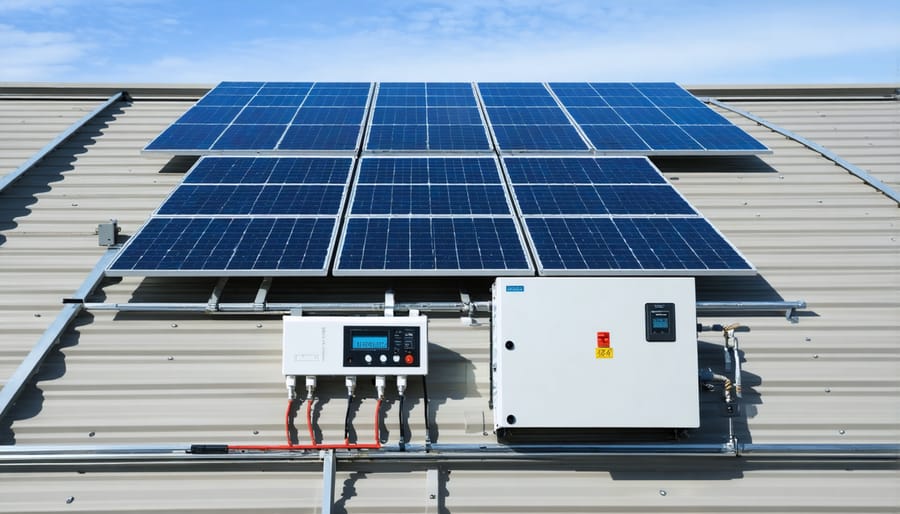
Inverters play a crucial role in grid interconnection by converting the direct current (DC) generated by solar PV system efficiency into alternating current (AC) compatible with the power grid. These sophisticated power electronics devices employ advanced switching techniques, typically using insulated-gate bipolar transistors (IGBTs), to create a clean sinusoidal AC waveform that matches grid frequency and voltage requirements.
Modern grid-tied inverters incorporate multiple functions essential for safe and efficient grid integration. They continuously monitor grid conditions and automatically disconnect if voltage or frequency deviates from acceptable ranges. Maximum Power Point Tracking (MPPT) algorithms optimize power output by adjusting operating parameters in real-time, while anti-islanding protection ensures safety during grid outages.
Power quality features include harmonic filtering, reactive power compensation, and voltage regulation capabilities. Many inverters now support advanced grid support functions such as low-voltage ride-through (LVRT) and frequency response, contributing to grid stability. Smart inverter functionality enables two-way communication with grid operators, allowing for remote monitoring and control.
The selection of appropriate inverter technology depends on system size, grid requirements, and local regulations. String inverters, microinverters, and central inverters each offer distinct advantages for different applications, while hybrid inverters provide additional functionality for systems with energy storage components.
Protection and Safety Equipment
Protection and safety equipment plays a crucial role in grid interconnection systems, ensuring the safety of personnel and equipment while maintaining grid stability. The primary protective devices include overcurrent protection devices (OCPDs), surge arresters, and isolation mechanisms that prevent dangerous electrical conditions.
A fundamental component is the anti-islanding protection, which automatically disconnects the solar system when grid power fails, preventing hazardous backfeeding. Ground fault protection devices (GFPDs) are essential for detecting and interrupting ground faults, while arc fault circuit interrupters (AFCIs) protect against dangerous arc faults.
Grid interconnection systems must incorporate disconnect switches that allow manual isolation of the PV system from the grid. These switches must be readily accessible, clearly labeled, and capable of being locked in the open position for maintenance purposes.
Monitoring equipment and sensors are vital components that continuously assess system parameters such as voltage, current, and frequency. These devices trigger protective responses when measurements exceed predetermined thresholds. Modern systems often include smart protection features that can detect grid instabilities and respond accordingly.
All protection devices must comply with relevant standards, including UL 1741 and IEEE 1547, and undergo regular testing and maintenance to ensure reliable operation. System designers must carefully coordinate these protective mechanisms to achieve selective tripping, ensuring that only affected portions of the system are isolated during fault conditions.
Meeting Grid Interconnection Standards
Voltage and Frequency Requirements
Voltage and frequency requirements are critical parameters for successful grid interconnection of photovoltaic systems. The inverter output must match the grid’s nominal voltage within specified tolerances, typically ±10% of the nominal grid voltage. For low-voltage distribution networks in the United States, this is generally 120/240V for single-phase and 208/480V for three-phase connections.
Frequency synchronization is equally important, with most grid codes requiring compliance within ±0.5 Hz of the nominal grid frequency (60 Hz in the United States, 50 Hz in many other countries). Modern inverters utilize sophisticated phase-locked loop (PLL) systems to maintain precise frequency matching and phase angle alignment with the grid.
Power quality standards dictate maximum allowable voltage fluctuations, harmonics, and power factor requirements. IEEE 1547 standards specify that the total harmonic distortion (THD) must not exceed 5% at the point of common coupling. The power factor should typically be maintained between 0.95 leading and 0.95 lagging to ensure stable grid operation.
During grid disturbances, inverters must respond appropriately through voltage ride-through and frequency ride-through capabilities. These features allow the system to remain connected during temporary voltage or frequency deviations, supporting grid stability while protecting the equipment from damage.
Power Quality Standards
Power quality standards form a critical framework for maintaining grid stability when integrating renewable energy systems. These standards ensure that interconnected systems operate within specified parameters to prevent voltage fluctuations, harmonic distortion, and other power quality issues that could compromise grid reliability.
Key requirements include voltage regulation within ±5% of nominal voltage, frequency maintenance within 59.3-60.5 Hz, and total harmonic distortion (THD) limits typically below 5%. Modern inverters must incorporate advanced features such as low-voltage ride-through (LVRT) and reactive power support capabilities to maintain grid stability during disturbances.
As the future of PV technology evolves, power quality standards continue to adapt to address emerging challenges. Systems must comply with IEEE 1547 standards, which outline specific requirements for synchronization, isolation, and power quality monitoring. Additionally, grid operators often implement specific requirements for power factor correction, typically mandating operation between 0.95 leading and 0.95 lagging.
Real-time monitoring and control systems are essential for maintaining these standards, with advanced metering infrastructure (AMI) providing continuous feedback on power quality parameters. Compliance with these standards ensures seamless integration of renewable energy sources while maintaining grid stability and reliability.
Anti-Islanding Protection
Anti-islanding protection is a crucial safety mechanism that prevents distributed generation systems, such as solar PV installations, from continuing to energize a portion of the grid during power outages. This protection ensures the safety of utility workers and prevents damage to electrical equipment.
When a grid outage occurs, solar inverters must detect the loss of grid power and automatically disconnect from the network within a specified timeframe, typically less than two seconds. This rapid disconnection prevents the formation of “islands” – isolated sections of the grid that remain energized by local generation sources while disconnected from the main grid.
Modern inverters employ multiple detection methods to identify islanding conditions. These include active methods, which introduce small disturbances to test grid stability, and passive methods that monitor voltage, frequency, and phase angles. The most common techniques include:
– Under/over voltage detection
– Under/over frequency detection
– Phase jump detection
– Impedance measurement
– Active frequency drift
Grid codes and standards, such as IEEE 1547 and UL 1741, specify strict requirements for anti-islanding protection. These standards mandate regular testing and certification of inverter anti-islanding functionality to ensure reliable operation. System designers must verify that their chosen inverters meet local utility requirements and maintain proper anti-islanding protection throughout the system’s lifetime.
Common Challenges and Solutions
Technical Integration Challenges
Grid interconnection projects often face several technical challenges that require careful consideration and strategic solutions. Voltage regulation stands as a primary concern, particularly in areas with high penetration of distributed energy resources. To address this, modern inverters with advanced grid support functions and proper sizing of conductors are essential.
Power quality issues, including harmonic distortion and power factor variations, can impact both the grid and connected equipment. Implementation of appropriate filtering systems and power factor correction devices helps maintain stability and compliance with utility requirements.
Protection coordination presents another significant challenge, as traditional protection schemes may need modification to accommodate bi-directional power flow. This requires careful analysis of relay settings and the potential addition of advanced protection devices to ensure safety and reliability.
System stability concerns arise from the intermittent nature of renewable energy sources. The solution typically involves implementing energy storage systems, advanced forecasting methods, and sophisticated control algorithms to manage power fluctuations effectively.
Communication and control infrastructure must be robust and reliable. Modern SCADA systems, secure protocols, and redundant communication channels are crucial for successful integration. Regular testing and maintenance of these systems ensure continued proper operation.
Grounding and isolation requirements can be complex, particularly in larger installations. Proper design of grounding systems and isolation transformers is essential for safety and compliance with electrical codes.
Compliance and Documentation
Successful grid interconnection requires careful attention to compliance and thorough documentation throughout the process. Project developers must navigate complex regulatory requirements established by utilities, local authorities, and national standards organizations.
Essential documentation typically includes interconnection applications, single-line diagrams, equipment specifications, and site plans. These must be prepared according to utility-specific formats and requirements. Professional certification and testing documentation for inverters, protective relaying, and other critical components must also be submitted.
The approval process often involves multiple review stages, including initial application screening, technical review, and final inspection. Maintaining detailed records of all communications, submissions, and approvals is crucial for project success and future reference.
Key compliance considerations include:
– Safety certification of all equipment
– Power quality standards adherence
– Protection system coordination
– Metering requirements
– Insurance documentation
– Operating agreements
Project managers should establish a comprehensive documentation system early in the planning phase. This system should track permit applications, technical submissions, utility correspondence, and inspection reports. Regular updates and proper filing of amendments ensure smooth progression through the interconnection process while maintaining compliance with evolving grid codes and standards.
Future Trends in Grid Interconnection
The landscape of grid interconnection is rapidly evolving, driven by technological advancements and the increasing integration of renewable energy sources. As emerging solar technologies continue to develop, several key trends are shaping the future of grid integration.
Smart inverter technology is becoming increasingly sophisticated, offering enhanced grid support functions and improved communication capabilities. These advanced inverters can autonomously respond to grid conditions, providing voltage regulation, frequency support, and power quality management. The implementation of artificial intelligence and machine learning algorithms is enabling more precise control and optimization of grid-connected systems.
Grid modernization initiatives are focusing on the development of hybrid AC-DC systems, which can more efficiently accommodate both traditional power sources and renewable energy installations. This approach reduces conversion losses and improves overall system reliability.
Blockchain technology is emerging as a potential solution for managing distributed energy resources and enabling peer-to-peer energy trading. This could revolutionize how grid-connected systems interact and trade power within local communities.
Standardization efforts are moving toward more unified global requirements, with IEEE 1547-2018 serving as a foundation for future developments. This harmonization of standards will facilitate international market growth and technological innovation while ensuring system compatibility and safety.
Energy storage integration is becoming increasingly critical, with new technologies and control strategies being developed to optimize the interaction between storage systems and the grid. This trend is particularly important for managing the intermittent nature of renewable energy sources and maintaining grid stability.
Grid interconnection stands as a critical cornerstone in the successful integration of renewable energy systems into our existing power infrastructure. Throughout this discussion, we’ve explored the essential technical requirements, standards, and best practices that ensure safe and efficient grid connections. The importance of proper planning, compliance with regulatory frameworks, and implementation of appropriate safety measures cannot be overstated.
Understanding and implementing correct grid interconnection procedures not only ensures system reliability but also contributes to the broader goal of sustainable energy transition. From equipment specifications to protection systems, each component plays a vital role in maintaining grid stability and power quality. The successful integration of distributed energy resources depends heavily on adherence to established interconnection standards and protocols.
As the renewable energy sector continues to evolve, staying informed about grid interconnection requirements and maintaining open communication with utility providers becomes increasingly important. By following proper interconnection procedures and maintaining compliance with current standards, stakeholders can contribute to a more resilient and sustainable power grid while ensuring the long-term success of their renewable energy installations.