
Perovskite quantum dots represent a groundbreaking advancement in solar power basics and next-generation photovoltaic technology. These nanoscale semiconducting crystals, typically measuring between 2-20 nanometers, have emerged as revolutionary materials for enhancing solar cell efficiency and advancing optoelectronic applications. Their exceptional optical properties, including precise bandgap tunability and high photoluminescence quantum yield, make them ideal candidates for pushing the boundaries of conventional solar technology.
Unlike traditional quantum dots, perovskite-based variants offer superior defect tolerance, simplified synthesis processes, and remarkable color purity – characteristics that have captured the attention of researchers and industry professionals worldwide. Their potential to achieve power conversion efficiencies exceeding 20% while maintaining cost-effective manufacturing processes positions them at the forefront of sustainable energy innovation.
Recent breakthroughs in stabilization techniques and manufacturing scalability have accelerated their transition from laboratory curiosities to commercially viable materials. This convergence of exceptional performance, economic viability, and environmental sustainability signals a transformative moment in photovoltaic technology, promising to revolutionize both solar energy harvesting and display technologies.
Understanding Perovskite Quantum Dots
Chemical Structure and Composition
Perovskite quantum dots exhibit a distinctive crystal structure characterized by the chemical formula ABX₃, where A represents a monovalent cation (typically cesium, methylammonium, or formamidinium), B denotes a divalent metal cation (usually lead or tin), and X represents halide anions (chloride, bromide, or iodide). This unique composition enables precise control over the quantum dot’s optoelectronic properties through compositional engineering.
The nanocrystalline structure of perovskite quantum dots typically ranges from 2-20 nanometers in diameter, with the exact size influencing their quantum confinement effects and resulting optical properties. The three-dimensional framework consists of corner-sharing BX₆ octahedra, with A cations occupying the cuboctahedral voids.
What makes perovskite quantum dots particularly interesting is their composition flexibility. By adjusting the ratio and type of constituent elements, researchers can fine-tune important properties such as bandgap energy, photoluminescence quantum yield, and stability. The halide composition especially plays a crucial role in determining the emission wavelength, allowing for precise color tuning across the visible spectrum.
The surface chemistry of these quantum dots is equally important, as it affects their stability and interaction with surrounding materials in various applications. Surface passivation strategies often involve organic ligands that help maintain structural integrity and enhance performance characteristics.

Quantum Confinement Effects
Quantum confinement effects in perovskite quantum dots arise when the physical dimensions of the semiconductor nanocrystals become smaller than their exciton Bohr radius. This confinement results in discrete energy levels rather than continuous bands, leading to size-dependent optical and electronic properties. As the dot size decreases, the bandgap energy increases, allowing precise control over the material’s light absorption and emission characteristics.
In perovskite quantum dots, the quantum confinement manifests through three spatial dimensions, creating a zero-dimensional system where charge carriers are confined in all directions. This confinement enhances the binding energy between electrons and holes, resulting in stronger excitonic effects and improved photoluminescence quantum yields compared to bulk perovskite materials.
The quantum size effect enables tunable emission wavelengths across the visible spectrum by simply adjusting the dot size during synthesis. Typically, smaller dots (3-5 nm) emit blue light, while larger dots (10-12 nm) produce red emission. This size-dependent behavior follows the quantum mechanical principle that energy levels become more widely spaced as the confining dimension decreases.
Additionally, the strong quantum confinement in perovskite quantum dots leads to enhanced oscillator strength and reduced non-radiative recombination rates, contributing to their exceptional optoelectronic properties and high photoluminescence quantum efficiency. These characteristics make them particularly valuable for applications in displays, lighting, and solar energy conversion.
Applications in Solar Cell Technology
Enhanced Light Absorption
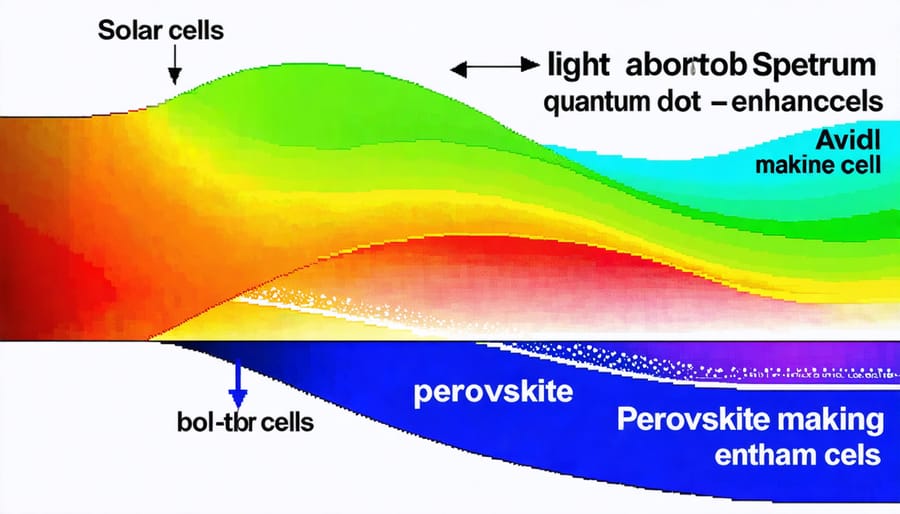
Perovskite quantum dots exhibit exceptional light absorption properties that make them particularly valuable for photovoltaic applications. These nanocrystals demonstrate a remarkably high absorption coefficient, typically an order of magnitude higher than traditional semiconductor materials. This enhanced absorption capability allows them to capture photons across a broader spectrum of solar radiation, including both visible and near-infrared wavelengths.
The superior light-harvesting efficiency of perovskite quantum dots stems from their unique electronic band structure and quantum confinement effects. By precisely controlling the size of these quantum dots during synthesis, researchers can fine-tune their bandgap energies to optimize photon absorption at specific wavelengths. This size-dependent tunability enables the development of multi-junction solar cells that can harvest energy from different portions of the solar spectrum more effectively.
Furthermore, perovskite quantum dots demonstrate exceptional defect tolerance and high photoluminescence quantum yield, often exceeding 90%. Their strong absorption properties allow for the use of significantly thinner active layers in solar cells, typically requiring only several hundred nanometers of material compared to several micrometers needed in conventional silicon cells. This reduction in material usage not only decreases production costs but also improves charge collection efficiency by reducing the distance that carriers must travel before being collected at the electrodes.
Improved Energy Conversion
Perovskite quantum dots have demonstrated remarkable improvements in energy conversion efficiency, making them increasingly attractive for photovoltaic applications. Recent research shows that these nanocrystalline materials can achieve power conversion efficiencies exceeding 18% in single-junction solar cells, a significant advancement from earlier iterations that struggled to reach 10%.
The enhanced efficiency stems from several key factors. First, the quantum confinement effect in perovskite quantum dots enables precise tuning of the bandgap, allowing for optimal light absorption across the solar spectrum. Second, their high defect tolerance and superior carrier transport properties contribute to reduced energy losses during the conversion process.
Multiple exciton generation (MEG) in perovskite quantum dots further boosts their efficiency potential. This phenomenon allows a single high-energy photon to generate multiple electron-hole pairs, theoretically enabling conversion efficiencies beyond the Shockley-Queisser limit of traditional solar cells.
Recent developments in surface passivation techniques and composition engineering have led to improved stability and reduced non-radiative recombination losses. Scientists have successfully demonstrated that carefully controlled synthesis methods can produce quantum dots with near-unity photoluminescence quantum yield, indicating extremely efficient light-to-electricity conversion.
The combination of these advantages positions perovskite quantum dots as promising candidates for next-generation solar technologies, particularly in tandem solar cell configurations where they can complement existing silicon-based devices.
Integration with Existing Technologies
Perovskite quantum dots are increasingly being integrated into existing photovoltaic systems, representing one of the most promising solar technology innovations of the past decade. The primary implementation method involves incorporating these quantum dots as an additional layer in traditional silicon solar cells, creating what’s known as tandem solar cells. This integration allows for enhanced light absorption across a broader spectrum of wavelengths, potentially increasing overall device efficiency.
Current manufacturing processes have been adapted to accommodate perovskite quantum dot integration through solution processing techniques, which are compatible with existing production lines. Notable developments include the successful incorporation into both rigid and flexible solar panels, with minimal modification to established manufacturing protocols.
Research laboratories and industrial facilities have demonstrated successful integration through various methods, including spray coating, spin coating, and screen printing. These techniques have proven particularly effective in maintaining the quantum dots’ unique optical properties while ensuring proper adhesion to underlying layers.
The compatibility of perovskite quantum dots with silicon-based technologies has been a crucial factor in their rapid adoption, allowing manufacturers to enhance existing products without completely overhauling production facilities. This approach has significantly reduced implementation costs and accelerated market entry timelines.
Current Challenges and Future Prospects
Stability and Durability Issues
Despite their promising potential, perovskite quantum dots face significant stability and durability challenges that currently limit their widespread commercial adoption. These nanocrystals are particularly susceptible to environmental factors, including moisture, oxygen, heat, and prolonged light exposure, which can trigger degradation of their structural integrity and optical properties.
The primary stability concerns include phase segregation, where the crystal structure breaks down under operational conditions, and surface defects that develop over time. These issues can lead to decreased quantum yield, color shift, and reduced overall performance. Additionally, the presence of toxic lead in many perovskite formulations raises environmental and safety concerns, driving research toward lead-free alternatives.
Research institutions worldwide are actively developing solutions to enhance stability. Current approaches include surface passivation techniques, protective coating applications, and composition engineering. Scientists are exploring various encapsulation methods and investigating more stable crystal structures through careful manipulation of the material’s chemical composition.
Recent breakthroughs have shown promise in improving stability through the incorporation of organic cations and inorganic compounds that strengthen the crystal structure. Some research groups have achieved stability improvements of several months under normal operating conditions, though this still falls short of the years-long durability required for commercial applications.
Ongoing efforts focus on developing standardized testing protocols and establishing better understanding of degradation mechanisms to create more resilient perovskite quantum dot materials.
Manufacturing Scalability
Scaling up perovskite quantum dot production from laboratory to commercial scale presents several significant challenges that researchers and manufacturers are actively addressing. The primary hurdle lies in maintaining precise control over particle size distribution and crystal structure during mass production, which directly affects the quantum dots’ optical and electronic properties.
Current manufacturing methods, primarily based on hot-injection synthesis, face limitations in batch-to-batch consistency and throughput. However, innovative approaches such as continuous flow reactors and microfluidic systems are showing promise in achieving more uniform production at larger scales. These advanced techniques, combined with sustainable manufacturing processes, are helping to bridge the gap between laboratory success and industrial implementation.
Quality control remains crucial, with automated monitoring systems being developed to ensure consistent product characteristics. Recent advances in precursor chemistry and surface modification techniques have improved stability during manufacturing, addressing previous scalability concerns. Additionally, the development of standardized protocols for synthesis and purification has enhanced reproducibility across different production facilities.
Cost optimization is being achieved through improved precursor utilization, reduced waste generation, and automated processing systems. These improvements, coupled with increasing demand for quantum dot applications, are driving down production costs and making commercial-scale manufacturing more economically viable.

Future Research Directions
The future of perovskite quantum dot research holds immense promise, with several exciting directions emerging in both fundamental science and practical applications. Researchers are actively exploring ways to enhance the stability of perovskite quantum dots through surface modification techniques and novel encapsulation methods. A key focus area is the development of lead-free alternatives that maintain high performance while addressing environmental concerns.
Significant efforts are being directed toward improving quantum yield and color purity, particularly for blue-emitting perovskite quantum dots, which currently lag behind their red and green counterparts in efficiency. Advanced synthesis methods, including continuous flow production and automated manufacturing processes, are being investigated to scale up production while maintaining precise control over particle size and composition.
Integration of perovskite quantum dots with other emerging technologies, such as 2D materials and plasmonic nanostructures, presents exciting opportunities for enhanced performance in both photovoltaic and display applications. Researchers are also exploring hybrid systems combining different types of quantum dots to achieve broader spectral coverage and improved device efficiency.
Machine learning and artificial intelligence are increasingly being employed to accelerate materials discovery and optimization, potentially leading to new compositions and architectures with superior properties. The development of tandem solar cells incorporating perovskite quantum dots alongside traditional semiconductors represents another promising avenue for achieving higher conversion efficiencies.
Perovskite quantum dots represent a transformative advancement in solar technology, offering unprecedented potential to revolutionize the photovoltaic industry. Their exceptional optical and electronic properties, combined with cost-effective manufacturing processes, position them as a promising solution for next-generation solar cells. The ability to achieve high power conversion efficiencies while maintaining material stability has attracted significant attention from both research institutions and industry players.
The impact of perovskite quantum dots extends beyond traditional solar applications. Their tunable bandgap and superior light-harvesting capabilities make them ideal candidates for building-integrated photovoltaics, transparent solar cells, and tandem devices. These innovations could dramatically increase the versatility and adoption of solar technology across various sectors, from residential buildings to industrial applications.
Looking ahead, the continued development of perovskite quantum dots could help address critical challenges in renewable energy adoption. Their potential to enhance solar cell efficiency while reducing production costs aligns perfectly with global sustainability goals. As research progresses and manufacturing techniques improve, we can expect to see increased commercialization of perovskite quantum dot-based solar technologies.
The future success of this technology will depend on ongoing collaboration between academic institutions and industry partners to overcome remaining challenges in stability and scalability. With sustained investment and research focus, perovskite quantum dots could play a pivotal role in accelerating the global transition to renewable energy sources.