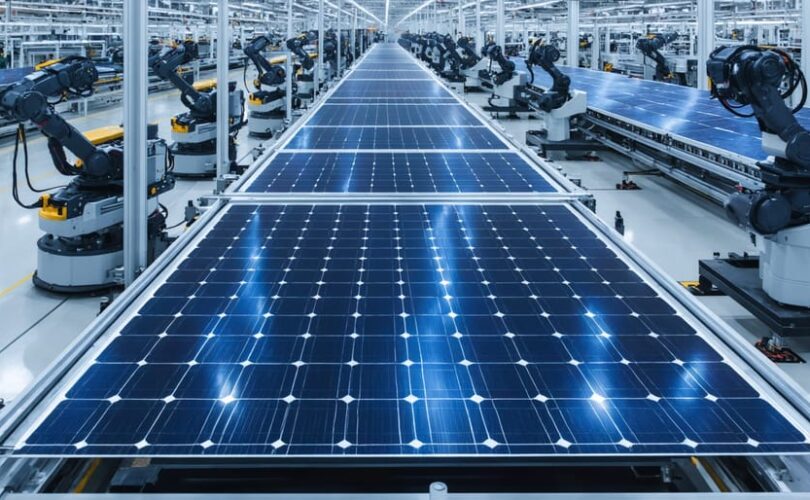
JA Solar operates one of the world’s most sophisticated networks of photovoltaic manufacturing facilities, combining strategic geographic positioning with cutting-edge automation to produce over 60 gigawatts of solar modules annually. The company’s manufacturing footprint spans key locations across China, Vietnam, Malaysia, and the United States, each facility engineered to leverage advanced robotics, artificial intelligence-driven quality control, and Industry 4.0 integration that sets new standards for efficiency and precision in solar panel production.
Understanding where and how JA Solar manufactures its products reveals critical insights into the renewable energy supply chain. The company’s vertically integrated approach encompasses ingot casting, wafer slicing, cell fabrication, and module assembly across strategically positioned facilities that reduce logistics costs while ensuring supply chain resilience. Each manufacturing location employs automated material handling systems, real-time production monitoring, and intelligent defect detection technologies that maintain consistency across millions of solar cells produced daily.
The geographic distribution of JA Solar’s facilities reflects both market proximity strategies and regional manufacturing advantages. Primary production bases in Hebei, Anhui, Jiangsu, and Yunnan provinces in China handle the bulk of capacity, while Southeast Asian facilities serve growing international markets with optimized trade advantages. Recent expansion into North American manufacturing addresses localization requirements and tariff considerations increasingly important to commercial and utility-scale projects.
This comprehensive examination maps JA Solar’s global manufacturing infrastructure while detailing the automated processes that enable their production scale, providing essential knowledge for industry professionals evaluating solar manufacturers and understanding modern photovoltaic production capabilities.
JA Solar’s Global Manufacturing Footprint
Primary Manufacturing Hubs in China
JA Solar operates an extensive network of manufacturing facilities across China, strategically positioned to leverage regional advantages while maintaining production efficiency. The company’s primary manufacturing hubs represent a substantial portion of its global production capacity, employing advanced automation technologies to meet growing international demand.
The Hebei province facilities, located in Ningjin and邢台 (Xingtai), serve as cornerstone production sites with combined annual capacity exceeding 10 GW for solar cells and modules. These plants benefit from proximity to Beijing’s research institutions, facilitating collaboration with universities on photovoltaic innovation and workforce development programs. The Hebei locations specialize in high-efficiency PERC and TOPCon cell production, incorporating automated material handling systems and intelligent quality control mechanisms.
In Jiangsu province, JA Solar’s Yangzhou facility focuses on both wafer and cell manufacturing, with vertical integration capabilities that enhance supply chain control. This strategic positioning in China’s solar industry corridor provides access to specialized suppliers and skilled technical talent. The Yangzhou plant operates continuous production lines with minimal human intervention, utilizing robotic systems for cell sorting and module assembly.
The Anhui manufacturing base contributes significantly to module production capacity, while Inner Mongolia facilities leverage the region’s abundant renewable energy resources and favorable land costs. These locations produce crystalline silicon ingots and wafers, forming the upstream foundation of JA Solar’s integrated manufacturing chain. Each hub incorporates real-time monitoring systems that optimize energy consumption and maintain consistent product quality across geographical boundaries, demonstrating the company’s commitment to operational excellence and sustainable manufacturing practices.
International Production Facilities
JA Solar’s strategic expansion beyond China reflects the company’s commitment to geographic diversification and enhanced regional market access. This international growth addresses multiple business objectives, including proximity to key markets, supply chain resilience, and mitigation of trade-related uncertainties.
The company’s Southeast Asian operations anchor its international manufacturing network. In Malaysia, JA Solar established production facilities that leverage the country’s established electronics manufacturing ecosystem and skilled workforce. The Malaysian plant focuses on solar cell and module production, benefiting from favorable government policies supporting renewable energy manufacturing. This location provides strategic access to the rapidly growing ASEAN solar market while maintaining competitive production costs.
Vietnam represents another cornerstone of JA Solar’s international expansion strategy. The Vietnamese facility capitalizes on the nation’s emerging position as a manufacturing hub, offering both cost advantages and proximity to diverse Asian markets. This plant incorporates similar automated production technologies deployed in domestic facilities, ensuring consistency in quality standards across the global network. The Vietnam location also serves as a hedge against potential trade barriers, enabling the company to serve various markets with products manufactured outside China.
Geographic diversification provides JA Solar with operational flexibility and market adaptability. Multiple manufacturing locations reduce dependency on single-country production, enhancing supply chain resilience against regional disruptions. Additionally, local production facilities enable faster response times to regional customer demands and reduce shipping costs and carbon footprints associated with long-distance transportation.
These international facilities operate under the same rigorous quality control protocols and automation standards as domestic plants. By replicating proven manufacturing processes across locations, JA Solar maintains product consistency while expanding its global production capacity to meet increasing worldwide demand for photovoltaic solutions.
Automated Manufacturing Processes Across JA Solar Facilities
Wafer and Cell Production Automation
JA Solar’s manufacturing facilities leverage advanced automation throughout the solar PV cell manufacturing process, significantly enhancing production efficiency and product consistency. The wafer production line begins with automated wire saws that slice silicon ingots into ultra-thin wafers with precision tolerances of micrometers. These systems operate continuously, monitored by optical sensors that detect variations in thickness and immediately adjust cutting parameters.
Following slicing, robotic handling systems transfer wafers through texturing chambers where automated chemical etching creates microscopic pyramid structures on the silicon surface. This texturing process, controlled by computerized dosing systems, maximizes light absorption while maintaining uniform surface patterns across thousands of wafers per hour. The automation ensures consistent etch depths and reduces chemical waste through precise reagent management.
In the diffusion stage, automated furnaces maintain exact temperature profiles as wafers move through phosphorus doping processes. Computer-controlled atmosphere management systems regulate gas flows and temperature gradients, creating the p-n junction critical for photovoltaic conversion. Multiple sensors continuously monitor process parameters, with real-time adjustments maintaining optimal conditions.
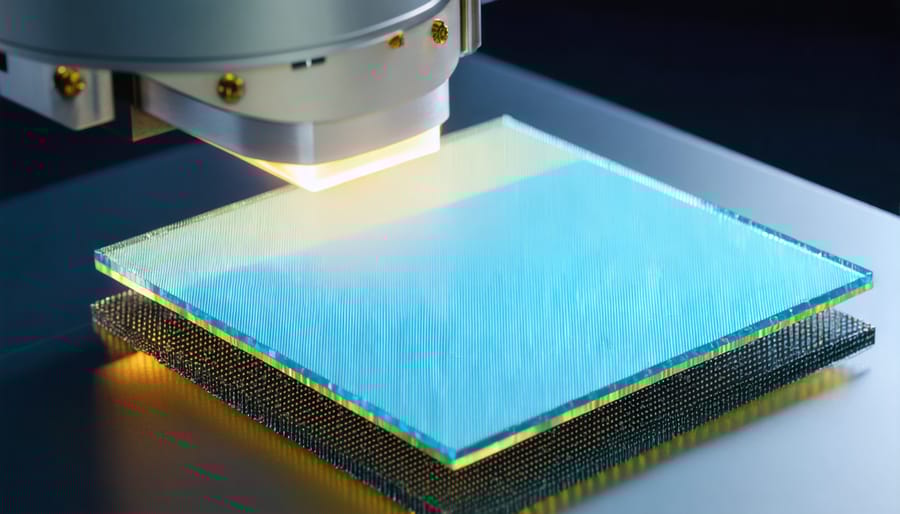
JA Solar’s implementation of monocrystalline PERC technology relies heavily on automated deposition equipment that applies passivation layers with nanometer precision. Robotic systems handle cells through multiple processing stations, while laser scribing equipment creates rear contact openings with microscopic accuracy.
Comprehensive quality control systems employ automated optical inspection stations equipped with high-resolution cameras and artificial intelligence algorithms. These systems scan every cell for micro-cracks, contamination, and electrical performance variations. Cells failing specifications are automatically sorted, while data analytics track production trends, enabling predictive maintenance and continuous process optimization across JA Solar’s global manufacturing network.
Module Assembly and Testing Systems
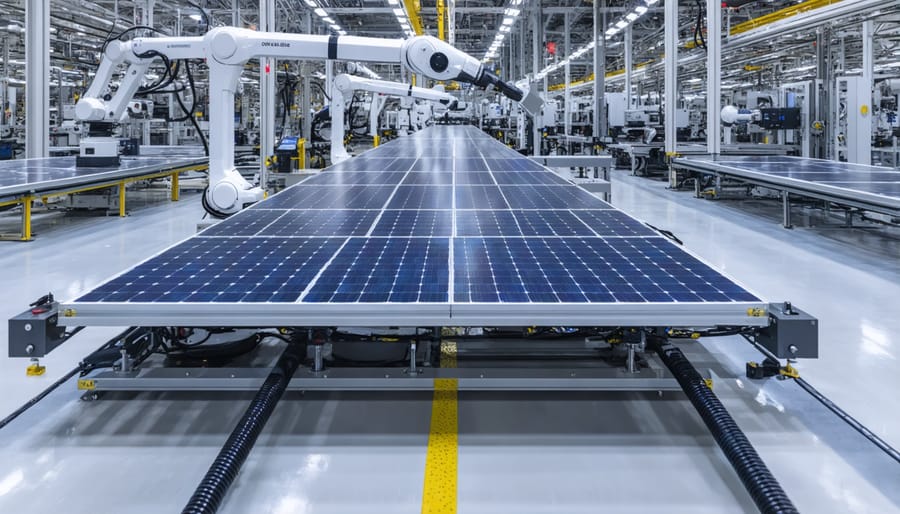
JA Solar’s module assembly facilities employ sophisticated automated systems that integrate precision engineering with quality assurance protocols. The manufacturing process begins with automated cell stringing, where robotic systems interconnect individual photovoltaic cells using specialized soldering techniques. These machines maintain consistent connection quality while operating at speeds exceeding 2,500 cells per hour, ensuring electrical continuity and minimizing micro-crack formation during handling.
Following stringing, modules enter automated lamination chambers where encapsulant materials bond the cell assembly between protective glass and backsheet layers. These vacuum laminators operate at precisely controlled temperatures and pressures, typically around 150 degrees Celsius, creating hermetic seals that protect cells from environmental degradation. The lamination process duration averages 15-20 minutes per module, with simultaneous processing of multiple units maximizing throughput.
Automated framing stations then apply aluminum frames to laminated modules, using pneumatic systems that ensure uniform pressure distribution and perfect angular alignment. Robotic dispensing equipment applies structural adhesives and sealants with micrometer precision, followed by corner key insertion for mechanical reinforcement. Junction box attachment occurs through automated processes that position and secure electrical enclosures while establishing weatherproof connections to module terminals.
Quality verification employs comprehensive automated testing protocols at JA Solar facilities. Electroluminescence inspection systems utilize specialized cameras to detect invisible defects including microcracks, broken cells, and electrical mismatches by capturing infrared emissions under electrical excitation. Flash testing chambers measure electrical parameters by exposing modules to calibrated light pulses simulating standard test conditions, verifying power output, voltage, current, and efficiency ratings. These non-destructive testing procedures ensure each module meets specified performance standards before shipment, with data automatically logged into manufacturing execution systems for traceability and quality documentation purposes.
Smart Factory Integration and Industry 4.0
JA Solar leverages advanced Industry 4.0 technologies across its manufacturing facilities to maintain consistent quality and optimize production efficiency. The company implements AI-driven visual inspection systems that detect microscopic defects in solar cells with accuracy surpassing human capabilities, ensuring only premium products reach customers. IoT sensors continuously monitor equipment performance, environmental conditions, and production parameters in real-time, enabling predictive maintenance that minimizes downtime. Through digital twin technologies, JA Solar creates virtual replicas of production lines to simulate process adjustments before implementation, reducing waste and accelerating innovation cycles. Sophisticated data analytics platforms aggregate information from multiple global facilities, allowing engineers to identify efficiency patterns and replicate best practices across all locations. This integrated approach enables JA Solar to maintain uniform quality standards whether production occurs in China, Vietnam, or Malaysia, while continuously improving yield rates and reducing manufacturing costs through data-driven insights.
Production Capacity and Technology Deployment by Location
Monocrystalline vs. Multi-Crystalline Production Sites
JA Solar’s manufacturing network strategically divides production capabilities based on cell technology requirements. The company’s newer facilities in Yangzhou, Yiwu, and Ningjin predominantly focus on mono PERC (Passivated Emitter Rear Cell) technology, which delivers higher efficiency ratings compared to traditional alternatives. These sites feature advanced automation systems specifically designed for the precision requirements of monocrystalline versus multi-crystalline production, incorporating laser-based cutting systems and automated quality inspection stations that can detect microscopic defects in real-time.
The mono PERC production lines utilize robotic handling systems throughout the entire manufacturing process, from ingot slicing to final cell testing, minimizing human contact and reducing contamination risks. In contrast, facilities maintaining multi-crystalline production capabilities, such as certain lines in Hefei and Shanghai, employ comparatively simpler automation frameworks suitable for the less demanding tolerance requirements of polycrystalline technology.
JA Solar has progressively transitioned most production capacity toward mono PERC technology, with approximately 85 percent of current output dedicated to this higher-efficiency format. This strategic shift reflects market demand for premium solar products while demonstrating the company’s commitment to technological advancement and collaboration with research institutions to refine automated manufacturing processes continuously.
Vertical Integration Across the Manufacturing Network
JA Solar’s manufacturing network demonstrates sophisticated vertical integration, coordinating production stages across strategically positioned facilities worldwide. This integrated approach enables the company to maintain quality control and optimize efficiency from raw material processing through final module assembly.
The company’s supply chain begins with polysilicon sourcing and wafer production at dedicated facilities in China, where advanced purification processes ensure high-grade silicon suitable for photovoltaic applications. These wafers then move to cell manufacturing plants equipped with PERC (Passivated Emitter and Rear Cell) and TOPCon technologies, where silicon wafers transform into highly efficient solar cells through precise deposition and diffusion processes.
Module assembly represents the final integration stage, occurring at multiple facilities positioned near key markets in Asia, Europe, and North America. This geographic distribution reduces transportation costs while enabling rapid response to regional demand fluctuations. JA Solar coordinates logistics between facilities using digital supply chain management systems that track materials, monitor inventory levels, and optimize production scheduling across the network.
The vertical integration model allows JA Solar to implement consistent quality standards throughout production while maintaining flexibility to scale operations. By controlling multiple production stages, the company reduces dependency on external suppliers and responds more effectively to technological advances, incorporating innovations systematically across their manufacturing network to maintain competitive advantages in efficiency and cost management.
Quality Control and Certification Standards
JA Solar maintains rigorous quality control standards across all its manufacturing locations through sophisticated automated quality assurance systems that ensure product consistency regardless of geographic dispersement. Each facility employs advanced electroluminescence testing equipment that detects microscopic defects invisible to the human eye, combined with automated optical inspection systems that examine every cell and module at multiple production stages. These automated systems process thousands of measurements per second, capturing data on electrical performance, physical dimensions, and potential defects with precision that far exceeds manual inspection capabilities.
The company’s commitment to international compliance is evidenced by its comprehensive certification portfolio. All JA Solar manufacturing facilities maintain certifications from internationally recognized bodies including the International Electrotechnical Commission (IEC), Underwriters Laboratories (UL), and TÜV Rheinland. These certifications require ongoing verification that products meet strict safety, performance, and reliability standards. The IEC 61215 and IEC 61730 certifications validate module design qualification and safety requirements, while UL certification ensures compliance with North American safety standards. TÜV certification further demonstrates adherence to European quality benchmarks and provides independent verification of manufacturing processes.
Maintaining consistency across geographically dispersed sites presents unique challenges that JA Solar addresses through standardized protocols and centralized quality management systems. The company implements identical testing procedures, calibration standards, and performance benchmarks at each location, supported by real-time data monitoring that connects facilities worldwide. Quality control personnel receive standardized training programs, often developed in collaboration with universities specializing in photovoltaic technology, ensuring that expertise remains uniform across regions. Regular inter-facility audits and cross-site quality comparisons further reinforce consistency. Additionally, JA Solar’s investment in educational program offerings for quality assurance professionals helps maintain high standards by continuously updating staff knowledge on emerging testing methodologies and certification requirements. This comprehensive approach ensures that whether manufactured in China, Malaysia, or Vietnam, JA Solar modules meet identical performance specifications and quality standards.
Strategic Advantages of JA Solar’s Manufacturing Network
JA Solar’s strategic positioning of manufacturing facilities across multiple continents delivers significant competitive advantages that extend beyond simple production capacity. The company’s location strategy reflects a sophisticated understanding of global market dynamics, regulatory environments, and supply chain optimization.
Cost efficiency represents a primary advantage of JA Solar’s geographic distribution. By establishing manufacturing hubs in regions with competitive labor costs and favorable industrial policies, particularly in China and Southeast Asia, the company maintains lower production expenses while preserving quality standards. This cost structure enables JA Solar to offer competitive pricing in markets where affordability remains a crucial factor for solar adoption. Simultaneously, their substantial investment in automation technology reduces long-term labor dependency, creating a balanced approach that leverages both geographic advantages and technological efficiency.
Supply chain resilience has become increasingly critical in recent years, and JA Solar’s multi-location strategy provides essential risk mitigation. By distributing production across facilities in different countries, the company minimizes vulnerability to regional disruptions, whether from natural disasters, political instability, or pandemic-related challenges. This geographic diversification ensures continuous production capability and reliable product delivery to customers worldwide.
Market access benefits manifest through JA Solar’s ability to serve regional markets with reduced logistics costs and shorter delivery times. Manufacturing facilities positioned near major solar markets enable faster response to customer demands and provide flexibility in meeting region-specific requirements, including compliance with local content regulations and technical standards.
The company’s automated manufacturing infrastructure also facilitates rapid scaling capabilities. When market demand increases in specific regions, JA Solar can replicate proven automated processes across facilities, expanding production capacity efficiently. This scalability, combined with collaborative relationships with universities for workforce development, positions JA Solar to adapt quickly to evolving market conditions while maintaining technological leadership in the photovoltaic industry.

Educational Implications for Aspiring PV Professionals
For aspiring photovoltaic professionals, understanding JA Solar’s global manufacturing network provides valuable insight into modern solar industry requirements. The geographic distribution of production facilities demonstrates how successful companies balance regional market access with operational efficiency, a strategic consideration that professionals at all levels must understand.
Working in contemporary PV manufacturing environments requires a diverse skill set. Technical competencies in automated solar production systems, quality control protocols, and supply chain management have become essential. Engineers and technicians must be comfortable with robotics, data analytics, and process optimization software that drive modern fabrication lines. Additionally, professionals benefit from understanding international trade regulations, logistics coordination, and cross-cultural communication skills necessary for operating within global production networks.
Educational programs that emphasize these competencies prepare students for industry realities. Collaborations between manufacturers and universities create pathways for hands-on learning in automated manufacturing environments. Programs offering coursework in renewable energy engineering, materials science, and industrial automation provide foundational knowledge, while internships at facilities like JA Solar’s manufacturing sites offer practical experience.
Career advancement in this sector increasingly depends on understanding how global production systems function. Professionals who comprehend the interconnected nature of manufacturing locations, technology transfer between facilities, and regional market dynamics position themselves as valuable assets to organizations navigating the complex landscape of international solar production.
JA Solar’s strategic selection of manufacturing locations across China, Southeast Asia, and expanding international markets demonstrates a sophisticated understanding of global photovoltaic production dynamics. By positioning facilities in regions offering favorable policy environments, skilled workforces, and supply chain proximity, the company has achieved remarkable production efficiency while maintaining quality standards. The integration of advanced automation technologies throughout these facilities positions JA Solar at the forefront of the industry’s digital transformation, with intelligent manufacturing systems reducing production costs and enhancing product consistency.
For industry professionals, researchers, and renewable energy stakeholders, understanding the geographic and technological landscape of major manufacturers like JA Solar is essential for informed decision-making. The company’s collaboration with universities and educational institutions further strengthens the industry’s knowledge foundation, preparing the next generation of photovoltaic professionals for an increasingly automated production environment. As solar energy demand continues accelerating globally, JA Solar’s model of combining strategic location selection with manufacturing automation excellence provides valuable insights into the future trajectory of photovoltaic production. This approach not only ensures competitive positioning but also contributes to the broader goal of making clean energy more accessible and affordable worldwide.