
The evolution of solar panel efficiency stands as one of renewable energy’s most remarkable technological achievements. From a modest 6% conversion rate in the 1950s to today’s commercial panels exceeding 20%, photovoltaic technology has undergone a transformative journey driven by relentless innovation and scientific breakthrough. This progress represents not just incremental improvements in manufacturing processes, but fundamental advances in material science, quantum physics, and nano-engineering. As global energy demands intensify and climate change concerns mount, understanding the trajectory of PV efficiency becomes crucial for industry professionals, researchers, and policymakers alike. The past decade alone has witnessed unprecedented acceleration in efficiency gains, with laboratory prototypes now approaching the theoretical Shockley-Queisser limit of 33% for single-junction cells. This dramatic improvement trajectory, coupled with plummeting production costs, positions solar technology at the forefront of the renewable energy revolution, promising even more significant advances in the decades to come.
The Evolution of Solar Cell Efficiency
First Generation PV Technologies
First-generation photovoltaic technologies, dominated by crystalline silicon solar cells, laid the foundation for modern solar energy conversion. These traditional cells, first developed at Bell Labs in 1954, achieved an initial efficiency of 6%. Through decades of research and development, single-crystal silicon cells have steadily improved, reaching commercial efficiencies of 15-20% by the early 2000s.
The evolution of first-generation PV technology has been marked by significant manufacturing improvements and material refinements. Monocrystalline silicon cells, produced from single silicon crystals, consistently demonstrate higher efficiency rates compared to their polycrystalline counterparts. Modern monocrystalline cells routinely achieve efficiencies of 22-25% in commercial production, with laboratory specimens reaching up to 26.7%.
Key technological advances that enhanced first-generation PV efficiency include the development of anti-reflection coatings, improved contact metallization, and enhanced surface texturing techniques. The introduction of Passivated Emitter and Rear Cell (PERC) technology in the 1980s marked a significant breakthrough, enabling better light absorption and reduced electron recombination.
Despite their relatively higher production costs compared to newer technologies, first-generation silicon solar cells continue to dominate the commercial market, representing approximately 95% of global PV installations. Their proven reliability, stable performance, and established manufacturing processes make them the benchmark against which newer technologies are measured.

Modern High-Performance Cells
Recent advancements in photovoltaic technology have led to remarkable improvements in cell efficiency, with modern high-performance solar cells reaching unprecedented levels of performance. Passivated Emitter and Rear Cell (PERC) technology has emerged as a significant breakthrough, achieving commercial efficiencies above 22% by incorporating additional reflecting layers and improved surface passivation.
Multi-junction cells represent another major advancement, utilizing multiple semiconductor layers to capture different portions of the solar spectrum. These sophisticated devices have achieved laboratory efficiencies exceeding 47% under concentrated sunlight, though their commercial applications remain limited due to manufacturing complexity and cost considerations.
Heterojunction technology (HJT) combines crystalline silicon with thin-film amorphous silicon layers, resulting in enhanced absorption capabilities and reduced electrical losses. Commercial HJT cells routinely achieve efficiencies above 24%, with some manufacturers reporting numbers approaching 26%.
Perovskite-silicon tandem cells have shown remarkable potential, with recent developments pushing laboratory efficiencies beyond 29%. These cells combine traditional silicon technology with perovskite materials, offering a promising pathway to exceed the theoretical efficiency limits of single-junction silicon cells.
These innovations demonstrate the industry’s continuous progress toward higher efficiency standards while maintaining cost-effectiveness and reliability in real-world applications.
Key Technological Breakthroughs
Material Science Innovations
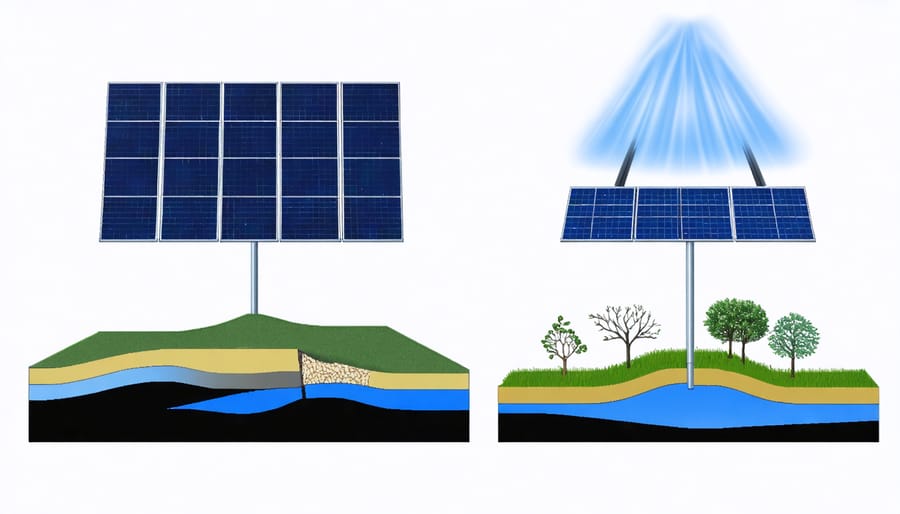
The evolution of photovoltaic efficiency has been largely driven by breakthroughs in material science, with each advancement pushing the boundaries of energy conversion capabilities. Recent solar panel innovations in materials have played a crucial role in achieving higher efficiency rates while reducing production costs.
Perovskite materials represent one of the most significant developments, demonstrating remarkable potential with efficiency improvements from 3.8% in 2009 to over 25% in recent laboratory tests. When combined with traditional silicon in tandem cells, these materials have achieved efficiency rates exceeding 29%, marking a substantial advancement in photovoltaic technology.
Multi-junction cells utilizing different semiconductor materials have proven particularly effective at capturing broader portions of the solar spectrum. The implementation of gallium arsenide (GaAs) and indium gallium phosphide (InGaP) in multi-junction configurations has enabled efficiency rates above 40% under concentrated sunlight conditions.
Surface texturing and anti-reflective coatings have also contributed significantly to efficiency gains. Advanced nano-structured materials and selective optical coatings help minimize reflection losses and maximize light absorption, improving overall cell performance by up to 10%.
The development of transparent conducting oxides (TCOs) and improved electron transport layers has enhanced charge collection efficiency, while innovations in passivation materials have reduced surface recombination losses. These advancements, combined with more efficient dopant materials and contact metallization techniques, have resulted in steadily increasing conversion efficiencies across all photovoltaic technologies.
Manufacturing Process Advancements
Manufacturing processes have played a pivotal role in advancing photovoltaic efficiency over the decades. The introduction of automated production lines in the 1980s marked a significant shift from manual cell fabrication, leading to more consistent quality and reduced defects. The implementation of laser cutting technology improved precision in cell sizing and reduced material waste, contributing to both cost reduction and performance optimization.
A major breakthrough came with the development of selective emitter technology, which enhanced the collection of light-generated carriers and improved front surface passivation. The incorporation of anti-reflective coatings through plasma-enhanced chemical vapor deposition (PECVD) significantly reduced surface reflection losses, boosting overall cell efficiency.
Screen printing techniques evolved from basic metal contact application to sophisticated double and triple printing methods, resulting in finer gridlines and reduced shading losses. The introduction of heterojunction cell manufacturing processes enabled better surface passivation and reduced recombination losses, pushing efficiency boundaries further.
Modern manufacturing advances include the implementation of artificial intelligence for quality control, automated defect detection, and process optimization. These smart manufacturing systems have significantly reduced variation in cell performance and increased yield rates. The development of bifacial cell production techniques has enabled modules to capture light from both sides, increasing energy yield in field applications.
Recent innovations in metallization processes, including copper plating instead of traditional silver screen printing, have reduced costs while improving conductivity. The integration of advanced wafer cleaning processes and sophisticated texturing techniques has further enhanced light absorption capabilities, contributing to the steady increase in commercial cell efficiencies.
Current Market Standards and Future Projections
Commercial Module Efficiency Rates
Commercial solar modules have made significant strides in efficiency rates over recent years, with mainstream silicon-based panels now typically achieving 15-20% efficiency in real-world conditions. Premium monocrystalline panels from leading manufacturers regularly achieve 20-22% efficiency, while the highest-performing commercially available modules can reach up to 23-25% efficiency under optimal conditions.
These improvements have been driven by various technological advancements, including PERC (Passivated Emitter and Rear Cell) technology, which has become the industry standard. PERC cells typically deliver 0.5-1% higher efficiency compared to traditional cell architectures, helping manufacturers to optimize PV system performance while maintaining cost-effectiveness.
| Technology Type | Typical Efficiency Range | Cost Category | Best Use Case |
|---|---|---|---|
| Standard Polycrystalline | 15-17% | Budget | Large installations |
| Monocrystalline PERC | 19-21% | Mid-range | Residential/commercial |
| HJT/IBC Premium | 22-25% | Premium | Space-constrained |
| Multi-junction | 40%+ | Research/space | Specialized applications |
Multi-junction cells used in specialized applications can achieve even higher efficiency rates, reaching up to 40%, though these remain too expensive for widespread commercial deployment. The most efficient commercially available panels utilize heterojunction technology (HJT) or interdigitated back contact (IBC) cells, which combine multiple efficiency-enhancing features.
Current market standards emphasize the balance between cost and performance, with most commercial installations utilizing modules in the 19-21% efficiency range. This represents a substantial improvement from the 12-14% commercial solar efficiency rates common between 2015 and 2016, demonstrating the industry’s continuous advancement in converting solar energy into usable electricity. Market adoption data shows that solar panel efficiency rates have increased by approximately 50% over the past decade while costs have simultaneously declined, making higher-efficiency modules accessible to a broader range of applications.
Bar chart comparing current commercial solar panel efficiency rates across different manufacturers and technologies
Research Developments and Future Potential
Recent research developments in photovoltaic technology have pushed the boundaries of theoretical efficiency limits. Scientists at leading research institutions have achieved breakthrough efficiencies exceeding 47% using multi-junction solar cells in laboratory conditions, approaching the Shockley-Queisser limit of approximately 33% for single-junction cells.
Emerging technologies show particular promise in surpassing current efficiency limitations. Perovskite solar cells have demonstrated remarkable progress, with efficiency improvements from 3.8% in 2009 to over 25% in recent years. Tandem cell configurations, combining different photovoltaic materials to capture broader portions of the solar spectrum, are advancing rapidly toward commercial viability.
Quantum dot solar cells and organic photovoltaics represent other promising frontiers, with researchers exploring novel materials and architectures to enhance light absorption and charge collection. The integration of artificial intelligence in solar cell design and manufacturing processes is accelerating the discovery of new materials and optimal configurations.
Looking ahead, experts project that commercial solar panel efficiencies could reach 30% by 2030 through continued advancement in materials science and manufacturing techniques. Research into ultra-high-efficiency concepts, such as hot carrier cells and intermediate band solar cells, suggests potential efficiencies above 50% may be achievable in the coming decades, though significant technological hurdles remain to be overcome.
Economic Implications of Improved Efficiency
The economic implications of improved photovoltaic efficiency extend far beyond the laboratory, significantly impacting both manufacturers and consumers. As conversion efficiencies have increased, production costs per watt have consistently decreased, following a trend similar to Swanson’s Law, which suggests that solar panel prices drop by approximately 20% for every doubling of cumulative shipped volume.
This efficiency-driven solar cost reduction has transformed the solar energy landscape. The journey from expensive niche technology to affordable mainstream energy source has unfolded through several critical economic milestones:
- Early 2000s baseline costs and barriers: Solar panels typically cost $4-5 per watt, making them economically viable only in specialized applications and off-grid installations where alternatives were unavailable.
- Mid-2010s breakthrough to grid parity: Costs dropped to approximately $1-2 per watt, allowing solar to achieve grid parity in sunny regions like California, Arizona, and parts of the Southwest, where abundant sunlight compensated for still-higher upfront costs.
- 2020s achievement of cost competitiveness: Prices fell below $0.60 per watt for utility-scale installations, making solar competitive with fossil fuels even without subsidies in many markets worldwide.
- Current 2026 pricing and payback periods: Utility-scale installations now average $0.40-0.45 per watt, with residential systems ranging from $2.50-3.00 per watt (including installation and balance-of-system costs). Modern high-efficiency panels typically deliver a solar panel payback period of 4-6 years in most U.S. markets, compared to 15-20 years for earlier generations.
- Projected 2030 cost targets: Industry forecasts suggest continued price erosion to $0.25-0.30 per watt for utility-scale projects, with levelized cost of energy (LCOE) potentially reaching $0.015-0.020 per kilowatt-hour, making solar one of the most economical electricity sources globally.
Higher efficiency panels require less raw material, reduced manufacturing steps, and smaller installation areas to produce the same power output, contributing to overall cost savings throughout the supply chain. These efficiency improvements have fundamentally altered the economics of solar deployment.
The economic benefits of improved efficiency are particularly evident in installation and balance-of-system costs. Higher-efficiency panels mean fewer modules are needed to achieve desired power output, reducing labor costs, mounting hardware requirements, and land use. This has made solar power increasingly competitive with traditional energy sources, achieving grid parity in regions covering more than 80% of global electricity demand.
For consumers, the return on investment has become increasingly attractive. The improved economic proposition has driven widespread adoption, creating a positive feedback loop where increased demand leads to further investment in efficiency improvements and manufacturing scale. Commercial and industrial buyers, in particular, have accelerated solar adoption as payback periods have shortened and financing options have expanded.
Continued efficiency improvements remain a crucial driver of the solar industry’s growth and competitiveness. Each percentage point gain in module efficiency translates directly to lower installed costs and faster payback periods, reinforcing solar’s position as an increasingly dominant energy technology in the global transition to renewable power.