
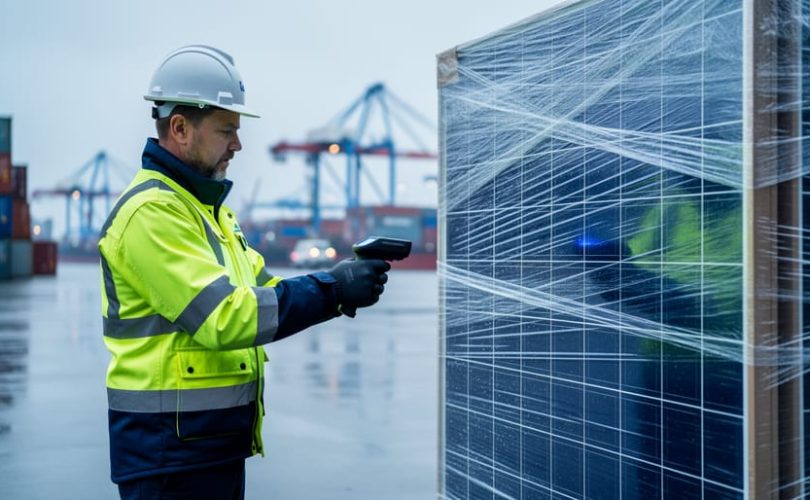
The Forced Labor Enforcement Task Force, established under the Uyghur Forced Labor Prevention Act (UFLPA), has fundamentally reshaped solar supply chain compliance since June 2022. For photovoltaic industry professionals, understanding this enforcement mechanism is no longer optional—it directly determines whether your solar modules clear U.S. Customs or face detention and seizure at the border.
The Task Force operates on a rebuttable presumption: all goods wholly or partially manufactured in China’s Xinjiang region are presumed products of forced labor and banned from importation unless importers provide clear and convincing evidence otherwise. This presumption extends beyond Xinjiang-based entities to encompass polysilicon and other materials that may have originated from or transited through the region, creating unprecedented traceability demands throughout the solar supply chain.
The enforcement impact has been substantial. U.S. Customs and Border Protection has detained thousands of solar shipments, representing billions of dollars in held merchandise. The implications cascade beyond importers to affect project developers, EPCs, and asset owners facing delayed installations, budget overruns, and contract disputes.
This regulatory environment demands sophisticated compliance strategies that balance supply chain transparency with commercial viability. Solar professionals must navigate complex documentation requirements, supplier verification protocols, and emerging traceability technologies while maintaining competitive procurement practices. Understanding the Task Force’s enforcement priorities, evidentiary standards, and evolving strategy list is essential for anyone engaged in solar module sourcing, project development, or regulatory compliance within the North American photovoltaic market.
What Is the Forced Labor Enforcement Task Force?
Legislative Origins and Legal Authority
The Uyghur Forced Labor Prevention Act (UFLPA) emerged from bipartisan Congressional concern regarding human rights violations in China’s Xinjiang region, where evidence documented systematic forced labor in multiple industries, including polysilicon production critical to solar panel manufacturing. Signed into law in December 2021 and implemented in June 2022, the UFLPA established a rebuttable presumption that goods mined, produced, or manufactured wholly or in part in Xinjiang are prohibited from entry into the United States unless importers can demonstrate clear and convincing evidence that their supply chains are free from forced labor.
The legislation specifically mandated creation of the Forced Labor Enforcement Task Force (FLETF), chaired by the Department of Homeland Security and comprising representatives from nine federal agencies including Customs and Border Protection, the Department of Commerce, and the Office of the United States Trade Representative. The task force’s statutory responsibilities include developing enforcement strategies, identifying high-priority sectors and entities, and issuing regular public guidance to help importers understand compliance requirements. For the solar industry, this legislative framework represents perhaps the most significant supply chain due diligence challenge in recent history, as polysilicon from Xinjiang previously accounted for substantial global production capacity.
Key Agencies and Their Roles
The Forced Labor Prevention Act enforcement framework relies on coordinated action across multiple federal agencies, each contributing specialized expertise to combat supply chain exploitation in the solar industry and beyond.
U.S. Customs and Border Protection (CBP) serves as the primary enforcement authority, conducting risk assessments on imported goods and detaining shipments suspected of forced labor connections. CBP officers examine documentation, verify supply chain traceability, and issue Withhold Release Orders when evidence suggests violations. Their role is particularly critical for photovoltaic module imports, where polysilicon sourcing remains under intense scrutiny.
The Department of Homeland Security (DHS) provides investigative support and coordinates intelligence gathering across borders. DHS collaborates with international partners to identify forced labor operations and develops enforcement strategies based on emerging threat patterns.
The Department of Labor (DOL) maintains the List of Goods Produced by Child Labor or Forced Labor, providing essential research that informs CBP detention decisions. DOL’s documentation helps renewable energy professionals understand which materials and regions pose compliance risks.
The State Department contributes diplomatic engagement and human rights reporting, working with foreign governments to address labor violations at their source. This agency also supports educational initiatives that align with academic research programs examining supply chain ethics in emerging energy technologies.
Together, these agencies create a comprehensive enforcement network that demands rigorous compliance documentation from solar industry stakeholders.
The Polysilicon Problem: Why Solar Is in the Crosshairs
Xinjiang’s Role in Global Polysilicon Production
Xinjiang Uyghur Autonomous Region has established itself as the epicenter of global polysilicon manufacturing, accounting for approximately 35-40% of worldwide production capacity as of 2023. This concentration represents a significant portion of the raw material essential for photovoltaic module manufacturing, with some industry analyses suggesting the region’s share may reach as high as 45% when considering integrated supply chain components.
The region’s dominance stems from several economic factors, including abundant coal-based energy resources, substantial government subsidies, and proximity to quartz mining operations. Major Chinese polysilicon manufacturers have established extensive production facilities throughout Xinjiang, creating an integrated supply ecosystem that processes raw materials through multiple refinement stages before distribution to wafer and cell manufacturers globally.
This geographic concentration creates significant challenges for solar supply chain transparency. Polysilicon from Xinjiang typically enters complex, multi-tiered supply networks where material origins become increasingly difficult to trace. Industry estimates suggest that over 80% of global solar panel manufacturers have some degree of exposure to Xinjiang-sourced materials, either directly or through intermediary suppliers.
For procurement professionals and compliance officers, understanding this market structure is essential for developing effective traceability protocols and meeting regulatory requirements under forced labor prevention frameworks.

Documented Human Rights Concerns
The enforcement actions stem from documented concerns within China’s Xinjiang Uyghur Autonomous Region, where multiple international investigations and government reports have identified systematic labor abuses. The U.S. Department of Homeland Security, United Nations human rights bodies, and independent research organizations have documented practices including forced labor transfers, restricted movement, and coercive employment conditions affecting Uyghur and other ethnic minority populations.
These concerns directly impact the solar industry because Xinjiang accounts for approximately 35-45% of global polysilicon production, the foundational material for most photovoltaic cells. Major polysilicon manufacturers operating in the region have been specifically identified in enforcement determinations, creating supply chain complications for downstream solar panel manufacturers worldwide.
The evidence base includes governmental investigations, satellite imagery analysis, corporate disclosures, and testimony from affected workers. U.S. Customs and Border Protection has issued Withhold Release Orders targeting specific companies and products linked to these labor practices. For solar industry professionals and procurement managers, understanding this documented evidence is essential for compliance planning, as the enforcement framework requires companies to demonstrate with clear and convincing evidence that imported goods were not produced with forced labor. This evidentiary standard places significant responsibility on importers to establish transparent, verifiable supply chains throughout the polysilicon-to-panel production process.
How the Task Force Enforces Compliance
The Rebuttable Presumption Standard
The rebuttable presumption standard represents a fundamental shift in how forced labor allegations are addressed within U.S. customs enforcement. Under this framework, when Customs and Border Protection (CBP) identifies reasonable evidence suggesting goods were produced using forced labor, the burden of proof shifts to importers to demonstrate otherwise.
This legal mechanism is triggered when CBP receives credible information from any source—including government reports, NGO investigations, media documentation, or whistleblower accounts—indicating forced labor conditions exist in a supply chain. The threshold for triggering this presumption is deliberately low, requiring only reasonable suspicion rather than definitive proof. For solar industry stakeholders, this means polysilicon shipments from regions designated as high-risk can be detained at ports pending investigation.
To overcome the presumption and secure goods release, importers must provide clear and convincing evidence demonstrating their products were not manufactured using forced labor. This evidentiary standard is substantially higher than the initial trigger threshold. Acceptable documentation typically includes comprehensive supply chain mapping with facility-level transparency, third-party audit reports from credible organizations, worker interview records conducted outside employer supervision, and verifiable payroll documentation.
The complexity intensifies for photovoltaic supply chains given the industry’s global polysilicon dependencies and multi-tiered manufacturing processes. Importers cannot simply rely on supplier attestations; CBP expects independent verification through factory inspections, material traceability systems, and documented due diligence procedures. Understanding these requirements is essential for professionals navigating solar industry compliance challenges.
Import Detention and Seizure Procedures
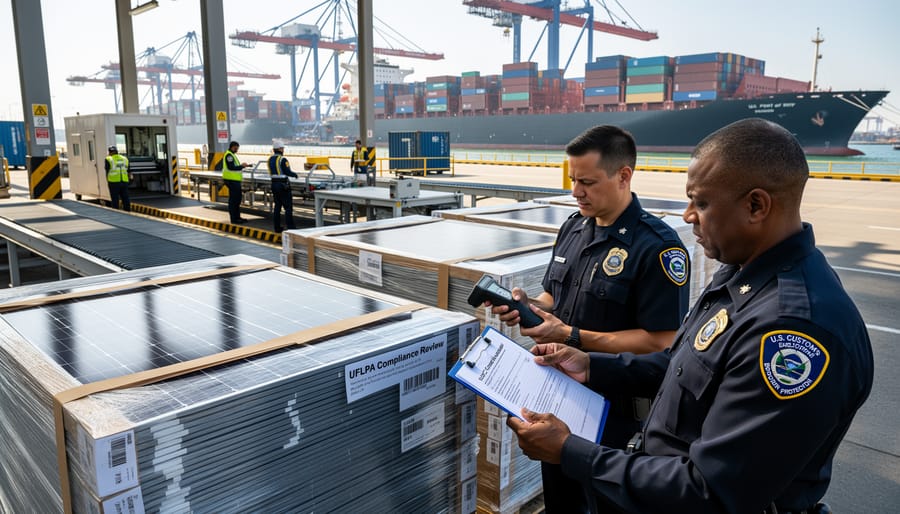
When U.S. Customs and Border Protection (CBP) identifies a shipment potentially violating forced labor laws, a structured enforcement process begins. Understanding this procedure is essential for photovoltaic industry stakeholders to prepare appropriate responses and minimize supply chain disruptions.
The process initiates when CBP issues either a Withhold Release Order (WRO) or formal detention notice. Upon identification of suspect merchandise, CBP detains the shipment and sends the importer a detention notice within five business days, specifying the legal basis and evidence supporting the action. Importers then have thirty days to respond with documentation proving the goods were not produced with forced labor. This documentation typically includes supplier declarations, audit reports, raw material traceability records, and payroll documentation from manufacturing facilities.
During this period, importers face three potential pathways. First, they may provide sufficient evidence demonstrating compliance, leading to shipment release. Second, if documentation proves inadequate, CBP may demand re-exportation of the goods within ninety days. Third, failure to respond or provide satisfactory evidence results in seizure and potential forfeiture of the merchandise.
For solar companies, the complexity increases with multi-tier supply chains common in polysilicon and wafer production. CBP increasingly requires comprehensive traceability documentation extending beyond direct suppliers to raw material origins. Detention periods create significant financial pressure through storage fees, production delays, and customer commitments. Companies should establish proactive documentation systems well before shipment, maintaining digital records of supplier audits, material flow maps, and independent certification reports. This preparation enables rapid response to CBP inquiries and demonstrates good-faith compliance efforts that may influence enforcement decisions.
Polysilicon Traceability: The Technical Challenge
Supply Chain Complexity in PV Manufacturing
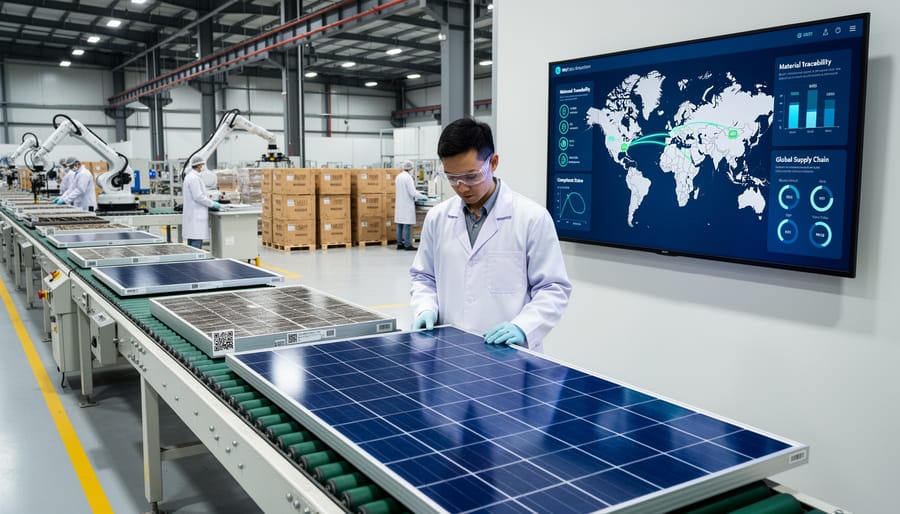
The photovoltaic manufacturing supply chain presents significant traceability challenges that complicate forced labor compliance efforts. The journey begins with polysilicon production, where metallurgical-grade silicon undergoes purification through energy-intensive processes. This raw material then travels to wafer manufacturers, who slice the polysilicon into thin wafers that form the foundation of solar cells.
These wafers proceed to cell manufacturers, where they undergo doping, coating, and electrical contact application to create photovoltaic cells. Subsequently, cell manufacturers ship their products to module assembly facilities, where cells are interconnected, encapsulated between protective layers, framed, and equipped with junction boxes. Each transfer point between these specialized manufacturers creates potential gaps in supply chain visibility.
The complexity intensifies because many polysilicon producers source from multiple mining operations, while module manufacturers often purchase cells from various suppliers to optimize costs and capacity. This multi-tiered structure, combined with the global distribution of manufacturing facilities across different regulatory environments, makes end-to-end traceability exceptionally difficult.
Critical vulnerability points include raw material sourcing regions, subcontractor networks in lower-tier supply chains, and the frequent use of intermediary trading companies that obscure original production sources. Without robust documentation systems and third-party verification protocols, compliance officers struggle to verify labor practices at every stage, particularly in polysilicon production where concentration in specific geographic regions raises heightened scrutiny from enforcement agencies.
Current Traceability Technologies and Methods
The solar industry has rapidly adopted several traceability technologies to address forced labor concerns in supply chains. Blockchain-based systems have emerged as promising tools, creating immutable digital records that track materials from polysilicon production through module assembly. These distributed ledgers enable real-time visibility across multiple supply chain tiers, though implementation challenges persist regarding data accuracy and universal adoption.
Isotopic analysis represents a scientific approach to verifying silicon origin. This method analyzes unique chemical signatures in polysilicon samples, comparing them against reference databases to confirm geographic source. While highly accurate, isotopic testing requires specialized laboratory equipment and expertise, making it more suitable for targeted verification rather than comprehensive screening.
Documentation systems form the backbone of most compliance programs, requiring suppliers to maintain detailed records of material sourcing, production locations, and labor practices. These paper trails, increasingly digitized, support customs declarations and regulatory filings. However, document authenticity remains a significant vulnerability without independent verification.
Third-party auditing has become standard practice, with specialized firms conducting on-site inspections of manufacturing facilities. These audits assess working conditions, interview employees, and verify documentation accuracy. Many universities now collaborate with industry stakeholders to develop more robust auditing methodologies and train the next generation of compliance professionals. Despite their value, audits face limitations including advance notice, language barriers, and restricted access in certain regions.
What Compliance Looks Like for Solar Manufacturers
Documentation Requirements and Record-Keeping
Maintaining comprehensive documentation represents a fundamental component of Forced Labor Prevention Act compliance within the photovoltaic supply chain. Companies must retain detailed records demonstrating due diligence efforts, including supplier declarations, certificates of origin, third-party audit reports, and communication logs with manufacturers. The U.S. Customs and Border Protection recommends retaining these records for a minimum of five years, though many industry experts suggest seven years to align with broader business record requirements.
Essential documentation includes complete bills of materials tracing polysilicon origins, manufacturing facility locations, independent social compliance audit reports with corrective action plans, and contracts explicitly prohibiting forced labor throughout the supply chain. For photovoltaic professionals, establishing digital documentation systems with blockchain-enabled traceability offers significant advantages over traditional paper-based approaches. These systems facilitate rapid information retrieval during CBP examinations while demonstrating proactive compliance efforts.
Organizations should implement standardized templates for supplier questionnaires and self-assessment tools to ensure consistency across procurement teams. Academic researchers studying renewable energy supply chains emphasize the importance of version control and regular documentation updates reflecting evolving supplier relationships. Additionally, companies should document training sessions provided to procurement staff regarding forced labor indicators and compliance protocols. This evidence-based approach not only satisfies regulatory requirements but strengthens organizational commitment to ethical sourcing principles fundamental to sustainable energy transition.

Supplier Auditing and Verification Programs
Establishing robust supplier auditing programs represents a fundamental compliance requirement under the Forced Labor Enforcement Task Force regulations. Companies should implement multi-tier verification systems that extend beyond first-tier suppliers to encompass the entire polysilicon supply chain, particularly for materials sourced from high-risk regions.
Third-party certification programs such as the Responsible Business Alliance’s initiatives and Ultra-Pure, Traceable (UPT) polysilicon standards provide independent verification of supply chain integrity. These certifications require documented traceability, on-site factory inspections, and worker interviews conducted in local languages without management presence. However, certification alone cannot replace ongoing due diligence efforts.
Effective monitoring programs should incorporate several critical elements. Regular announced and unannounced audits verify production processes and labor conditions. Document analysis examines payroll records, employment contracts, and material origin certificates for inconsistencies. Worker interviews conducted confidentially can reveal coercive practices often hidden from standard inspections.
Procurement teams must recognize key red flags including unusually low pricing that may indicate forced labor cost advantages, supplier reluctance to provide facility access, rapid workforce turnover, restricted worker movement, or wage deductions for housing and meals. Collaboration with universities and industry research institutions can enhance verification methodologies by developing advanced traceability technologies and sharing best practices across the photovoltaic sector. Academic partnerships also strengthen educational program offerings that train the next generation of compliance professionals in ethical sourcing principles.
Impact on the Solar Industry and Market Dynamics
Supply Chain Restructuring and Regional Shifts
The enforcement measures have catalyzed significant supply chain restructuring across the solar industry. Major manufacturers have accelerated diversification strategies, establishing production facilities in Southeast Asia, India, and other regions to mitigate compliance risks. Companies like First Solar and several European manufacturers have expanded domestic production capacity, though these transitions require substantial capital investment and typically span 18-36 months for full operational capacity.
Industry data indicates that polysilicon sourcing has shifted dramatically, with manufacturers developing partnerships with suppliers in South Korea, Germany, and emerging production centers in the United States. However, these alternative sources currently face capacity constraints and higher production costs, contributing to temporary supply pressures and price volatility in certain market segments.
For procurement managers and compliance officers, understanding these transition timelines is essential for strategic planning. Organizations should anticipate extended lead times during the restructuring period and engage in supplier diversification initiatives early. Academic researchers partnering with industry stakeholders have documented that companies implementing proactive supply chain mapping and developing relationships with verified alternative suppliers demonstrate greater resilience to enforcement-related disruptions. The restructuring represents both a compliance imperative and an opportunity to build more transparent, ethically sound supply chains that align with sustainability commitments.
Cost Implications and Market Pricing
The Uyghur Forced Labor Prevention Act has introduced measurable economic impacts across the solar supply chain. Industry analysis indicates that enhanced compliance requirements have added approximately 2-5% to project development costs, primarily through extended due diligence processes, alternative sourcing strategies, and documentation systems. Module pricing experienced volatility following UFLPA implementation, with some suppliers experiencing temporary price premiums of 10-15% as manufacturers shifted production capacity outside restricted regions.
Supply constraints emerged during the initial enforcement period as customs detentions created bottlenecks at U.S. ports of entry. Project timelines extended by an average of 4-8 weeks for developers lacking robust traceability documentation, translating to increased financing costs and delayed revenue recognition. However, market corrections occurred as manufacturers diversified their supply chains and established compliant sourcing networks.
For procurement managers and project developers, understanding these cost dynamics remains essential for accurate financial modeling. While compliance investments require upfront capital, they mitigate detention risks that can prove significantly more expensive. Organizations that proactively invested in supply chain transparency systems have demonstrated more stable project economics and competitive advantages in securing financing. As enforcement mechanisms mature, compliance costs are expected to normalize as industry-wide standards become established practice.
Building Ethical Supply Chains: Best Practices
Transparency as Competitive Advantage
Proactive transparency in supply chain ethics represents a powerful market differentiator as customers increasingly prioritize responsible sourcing. Organizations that implement robust traceability systems and voluntarily exceed compliance requirements can transform regulatory obligations into brand value. Third-party verification through independent audits and certifications provides credible validation of ethical sourcing claims, enabling companies to substantiate their commitments with documented evidence rather than unverified assertions.
Leading solar manufacturers now publish detailed supplier assessments, material origin documentation, and labor practice evaluations, recognizing that transparency builds stakeholder trust. This approach particularly resonates with institutional buyers, government procurement offices, and environmentally conscious consumers who scrutinize supply chain integrity. Academic institutions and industry research organizations increasingly collaborate with companies demonstrating verifiable ethical practices, creating opportunities for knowledge exchange and workforce development initiatives. By integrating transparency into core business strategy rather than treating it as mere compliance overhead, photovoltaic professionals position their organizations advantageously in markets where ethical sourcing considerations influence purchasing decisions and long-term partnerships.
Collaboration and Industry Standards
Industry-wide collaboration has emerged as a critical component in addressing forced labor concerns throughout photovoltaic supply chains. Trade associations like the Solar Energy Industries Association (SEIA) and Ultra Low Carbon Solar Alliance have developed shared frameworks that establish baseline compliance expectations for member companies. These collective initiatives help smaller manufacturers and installers access resources that might otherwise be cost-prohibitive, including due diligence templates and supplier audit protocols.
Shared traceability platforms represent another collaborative innovation, enabling multiple stakeholders to verify material origins through blockchain-enabled systems and centralized databases. These platforms allow participants to pool verification data while maintaining competitive confidentiality, reducing redundant auditing costs and improving supply chain transparency. Several pilot programs have demonstrated how collaborative technology solutions can track polysilicon from production through module assembly.
Academic partnerships further strengthen industry standards by providing independent research and workforce development programs. Universities contribute technical expertise in materials science and supply chain analytics while developing educational curricula that prepare future professionals to navigate complex compliance requirements. This multistakeholder approach elevates overall industry practices, creating competitive advantages for compliant companies while systematically raising the floor for acceptable sourcing standards across the renewable energy sector.
Educational Resources for PV Professionals
Developing expertise in forced labor compliance requires specialized knowledge that combines supply chain transparency, international labor law, and renewable energy sector dynamics. Several universities have established partnerships with industry leaders to create targeted curricula addressing ethical sourcing in photovoltaic manufacturing. These programs typically cover traceability protocols, risk assessment methodologies, and due diligence frameworks specific to solar supply chains.
The Clean Energy Education and Empowerment Initiative, a consortium of leading institutions, offers certificate programs focused on sustainable procurement practices. These courses examine the Uyghur Forced Labor Prevention Act’s implications for solar imports while providing practical training in documentation review and supplier verification. Students learn to identify red flags in supply chains and implement robust monitoring systems that satisfy customs requirements.
Professional development opportunities extend beyond traditional academic settings. Industry associations regularly host workshops on compliance best practices, featuring case studies from companies that successfully navigated enforcement challenges. These sessions emphasize real-world application, teaching participants how to conduct origin audits, evaluate polysilicon traceability claims, and establish supplier codes of conduct.
Online learning platforms have also expanded access to specialized training modules covering forced labor prevention strategies. These resources typically include interactive scenarios where learners practice responding to potential violations and developing corrective action plans. Many programs incorporate guest lectures from customs officials and compliance experts who share insights into evolving enforcement priorities.
For aspiring professionals, pursuing education in both renewable energy technology and supply chain ethics creates a valuable skill set increasingly sought by employers committed to responsible sourcing practices.
The Forced Labor Prevention Task Force represents a pivotal shift in global supply chain accountability, demanding that all participants in the solar industry—from manufacturers to installers—recognize compliance as both a moral obligation and strategic business requirement. For aspiring photovoltaic professionals and established stakeholders alike, understanding these enforcement mechanisms is no longer optional but essential to sustainable operations in an increasingly scrutinized marketplace.
The complexity of polysilicon sourcing and module manufacturing necessitates comprehensive traceability systems that extend beyond surface-level documentation. Companies that treat UFLPA compliance as a checkbox exercise risk significant operational disruptions, reputational damage, and legal consequences. Conversely, organizations that embrace robust supply chain transparency position themselves as industry leaders, attracting environmentally conscious consumers and institutional buyers who prioritize ethical sourcing.
Educational institutions and industry training programs play a crucial role in preparing the next generation of solar professionals to navigate these compliance challenges. Academic researchers contribute valuable insights into emerging traceability technologies, while collaboration between universities and industry practitioners ensures that theoretical knowledge translates into practical application.
The message is clear: proactive engagement with forced labor prevention measures strengthens rather than hinders the renewable energy transition. By investing in comprehensive supplier audits, blockchain-enabled tracking systems, and ongoing staff education, solar industry participants demonstrate that clean energy can be achieved through clean supply chains. The task force framework provides the structure; industry commitment provides the substance necessary for meaningful change.