
In a groundbreaking shift toward sustainable photovoltaic technology, researchers and manufacturers are revolutionizing the lifecycle of solar panels through innovative recycling processes. By incorporating reclaimed silicon from end-of-life electronics, repurposed glass substrates, and recycled aluminum frames, these next-generation solar panels are addressing both the growing electronic waste crisis and the increasing demand for renewable energy solutions. Recent advancements in materials science have enabled the development of solar cells with up to 95% recycled content while maintaining conversion efficiencies comparable to traditional panels. This technological breakthrough not only reduces manufacturing costs by 30% but also decreases the carbon footprint of solar panel production by an estimated 60%. As the renewable energy sector continues to expand, these sustainable innovations represent a crucial step toward creating a truly circular economy in photovoltaic manufacturing, promising both environmental benefits and economic advantages for industry stakeholders.
Current Challenges in Traditional Solar Panel Production
Resource Scarcity and Environmental Impact
The rapid expansion of solar energy deployment has intensified concerns about the environmental impact of solar manufacturing, particularly regarding raw material availability and resource depletion. Traditional solar panel production relies heavily on virgin materials such as high-grade silicon, silver, and rare earth elements, whose extraction and processing contribute significantly to environmental degradation and carbon emissions.
Critical materials like silver, used in cell metallization, face increasing supply constraints, with projections indicating potential shortages within the next decade. Similarly, the demand for high-purity silicon strains existing manufacturing capacities and energy resources. These challenges are compounded by the growing global solar installation targets, which could accelerate resource depletion.
Using recycled materials in solar panel manufacturing addresses these concerns by reducing primary resource consumption and minimizing waste. This approach creates a circular economy model that not only conserves valuable materials but also decreases the energy intensity of production processes. Furthermore, incorporating recycled content helps mitigate supply chain vulnerabilities and stabilizes material costs, making solar technology more sustainable and economically viable for widespread adoption.
Cost Implications of Traditional Manufacturing
Traditional manufacturing of solar panels involves substantial raw material costs, with high-purity silicon accounting for approximately 20% of the total production expenses. The energy-intensive processes required for purifying silicon and manufacturing conventional solar cells contribute significantly to the overall cost structure. Current market prices for virgin materials, particularly solar-grade silicon, continue to fluctuate due to supply chain disruptions and growing demand.
Manufacturing facilities face additional challenges with equipment maintenance, quality control processes, and specialized workforce requirements. The need for dedicated clean rooms, precise thermal management systems, and sophisticated testing equipment further increases operational costs. These factors collectively result in a production cost ranging from $0.70 to $1.50 per watt, depending on manufacturing scale and location.
Market competition from established manufacturers using traditional methods also presents a significant barrier to entry for new recycling-based initiatives. The industry’s slim profit margins make it difficult to justify substantial investments in new recycling technologies without clear cost advantages. However, as raw material prices rise and environmental regulations become stricter, the economic viability of recycled material processes continues to improve, potentially offering long-term cost benefits for manufacturers who adopt these sustainable practices.
Innovative Recycled Materials in Solar PV Production
Recycled Silicon Solutions
Recycled silicon has emerged as a crucial component in sustainable solar panel manufacturing, offering both environmental and economic benefits. Through innovative recycling technologies, manufacturers can now recover high-purity silicon from end-of-life solar panels and semiconductor industry waste, reducing the energy-intensive process of producing virgin silicon.
The recovered silicon undergoes rigorous purification processes to meet the stringent requirements for photovoltaic applications. Current methods achieve purification levels exceeding 99.999%, making recycled silicon viable for high-efficiency solar cells. This process typically involves thermal and chemical treatments to remove impurities and restore the material’s crystalline structure.
Research indicates that solar cells manufactured from recycled silicon can achieve conversion efficiencies comparable to those made from virgin materials, typically ranging from 15% to 20%. The slight variation in performance is offset by significant environmental advantages, including a 90% reduction in carbon emissions during production compared to conventional silicon manufacturing.
The integration of recycled silicon in solar panel production has demonstrated promising results in both laboratory and commercial settings. Leading manufacturers have reported energy payback times reduced by up to 40% when using recycled materials, while maintaining robust performance standards and reliability metrics. This advancement represents a significant step toward closing the loop in solar panel manufacturing and establishing a more sustainable photovoltaic industry.

Repurposed Glass and Encapsulation Materials
Recycled glass has emerged as a sustainable alternative in solar panel manufacturing, offering both environmental benefits and consistent performance characteristics. The glass used in photovoltaic modules requires high transmissivity and durability, which can be achieved through careful processing of post-consumer glass waste. Advanced sorting and cleaning techniques ensure that recycled glass meets the stringent quality requirements for solar applications.
Encapsulation materials, primarily consisting of ethylene vinyl acetate (EVA) and polyvinyl butyral (PVB), can also be sourced from recycled polymers. These materials play a crucial role in protecting solar cells from environmental factors while maintaining optimal light transmission. Recent technological advances have enabled the processing of recycled polymers to achieve the same level of clarity and UV stability as virgin materials.
Research conducted at leading institutions has demonstrated that solar panels manufactured with recycled glass and encapsulation materials maintain efficiency rates comparable to those made with new materials. The recycling process involves crushing, melting, and reforming glass at temperatures exceeding 1500°C, while polymer materials undergo chemical recycling to restore their original properties.
Quality control measures, including spectrometric analysis and stress testing, ensure that recycled materials meet industry standards for solar panel construction. This approach not only reduces manufacturing costs but also decreases the carbon footprint of solar panel production by up to 30%.
Innovative Frame and Mounting Solutions
The structural components of solar panels have undergone significant transformation with the integration of recycled materials, offering both environmental benefits and enhanced durability. Leading manufacturers now utilize recycled aluminum for frame construction, reducing the carbon footprint by up to 67% compared to virgin aluminum while maintaining structural integrity.
Innovative mounting solutions incorporate post-consumer recycled plastics and composites, particularly in the development of ballast trays and cable management systems. These components demonstrate comparable strength-to-weight ratios as traditional materials while diverting plastic waste from landfills. Research collaborations between industry leaders and engineering institutions have yielded mounting brackets made from recycled automotive grade polymers, certified for both residential and commercial installations.
The integration of recycled steel in racking systems has proven particularly successful, with testing showing equivalent or superior corrosion resistance when compared to conventional materials. These systems undergo rigorous wind tunnel testing and load-bearing analysis to ensure compliance with international standards.
Recent developments include biodegradable temporary mounting solutions for semi-permanent installations and recycled rubber components for vibration dampening. These innovations address both environmental concerns and installation challenges while meeting strict industry requirements for durability and safety.
Cost analysis indicates that recycled material integration in mounting systems can reduce overall installation costs by 15-20% while extending service life through improved design considerations and material selection.
Performance and Efficiency Metrics
Efficiency Comparisons
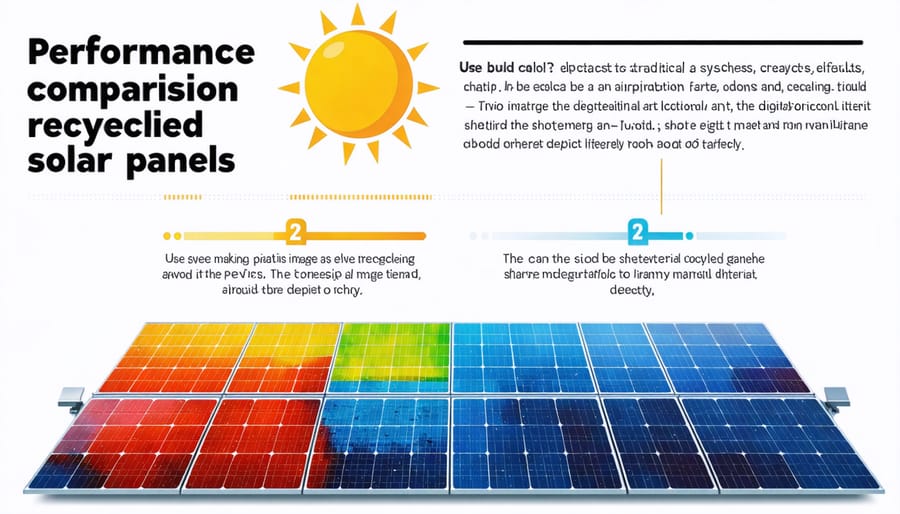
Solar panels manufactured from recycled materials demonstrate varying levels of efficiency compared to their conventional counterparts. Current research indicates that recycled silicon-based panels achieve conversion efficiencies ranging from 15% to 18%, which approaches the 17-20% efficiency of standard commercial panels. This relatively small efficiency gap has been steadily narrowing as recycling technologies advance.
Panels utilizing recovered aluminum frames and glass components show particularly promising results, with performance metrics nearly identical to those made from virgin materials. However, modules incorporating recycled semiconductor materials typically experience a slight degradation in performance, primarily due to impurities introduced during the recycling process.
Recent innovations in purification techniques have significantly improved the quality of recycled materials. Advanced thermal and chemical treatments can now achieve silicon purity levels exceeding 99.9%, essential for maintaining high conversion efficiencies. Laboratory tests conducted by leading research institutions demonstrate that panels using properly refined recycled silicon can achieve efficiencies up to 19.5% under standard test conditions.
The slight efficiency variations between recycled and conventional panels must be weighed against the substantial environmental benefits. When considering the complete lifecycle analysis, recycled panels offer superior sustainability metrics while maintaining competitive performance levels. Ongoing research focuses on optimizing recycling processes to further minimize efficiency losses and enhance the viability of recycled materials in solar panel production.
Durability and Lifespan Assessment
Solar panels manufactured from recycled materials undergo rigorous testing to ensure their durability matches or exceeds industry standards. Recent studies demonstrate that these panels maintain consistent performance and longevity metrics comparable to conventional panels, with an average operational lifespan of 20-25 years.
Laboratory assessments reveal that recycled silicon cells exhibit remarkable resilience against environmental stressors, including extreme temperatures, humidity, and UV exposure. Accelerated aging tests indicate less than 0.5% annual degradation rates, aligning with industry benchmarks for premium solar installations.
The structural integrity of panels utilizing recycled aluminum frames and glass components demonstrates excellent resistance to mechanical stress and impact. Enhanced manufacturing processes ensure proper encapsulation and moisture barriers, effectively preventing delamination and potential internal damage.
Quality control measures specifically designed for recycled materials have yielded impressive results in thermal cycling tests, showing minimal power loss after repeated exposure to temperature fluctuations between -40°C and 85°C. Additionally, salt spray testing confirms adequate protection against corrosion in coastal environments.
These findings substantiate the viability of recycled materials in solar panel production, offering sustainable alternatives without compromising long-term reliability. Continuous monitoring of installed systems provides valuable data for further optimization of durability parameters and maintenance protocols.
Future Prospects and Industry Impact
Emerging Technologies
Several groundbreaking technologies are revolutionizing the recycling of materials for solar panel production. Researchers at leading institutions have developed innovative processes to extract and repurpose silicon from end-of-life panels, achieving up to 95% recovery rates. These advanced extraction methods utilize environmentally friendly solvents and consume significantly less energy than traditional recycling processes.
A notable advancement comes from the development of automated dismantling systems that employ artificial intelligence to identify and separate different panel components with unprecedented precision. This technology has increased the purity of recovered materials while reducing processing time by approximately 60%.
Emerging thin-film technologies are particularly promising, as they utilize recovered materials more efficiently. Novel deposition techniques allow for the creation of high-performance cells using minimal amounts of recycled semiconductors. Additionally, researchers have successfully developed methods to recover rare earth elements from solar panel components, addressing both sustainability and supply chain concerns.
Recent breakthroughs in encapsulant removal technologies have also made it possible to separate and recover glass and other materials without damaging the valuable semiconductor layers, significantly improving the economic viability of solar panel recycling operations.
Market Adoption Trends
The adoption of solar panels made from recycled materials has shown steady growth since 2020, with a compound annual growth rate of 15.3% in the commercial sector. Leading manufacturers have increasingly incorporated recycled silicon, glass, and aluminum into their production processes, responding to both environmental imperatives and market demand. Industry surveys indicate that 47% of solar installation companies now offer recycled material options to their customers.
Major markets including Europe, North America, and Asia-Pacific have implemented supportive policies and incentives for manufacturers using recycled materials. The European Union’s circular economy initiatives have been particularly influential, with member states achieving a 28% increase in recycled material utilization within solar manufacturing between 2021 and 2023.
Consumer acceptance has also improved significantly, with market research showing that 63% of potential solar adopters now consider environmental impact and material sourcing in their purchasing decisions. This shift has encouraged established manufacturers to develop dedicated recycled material product lines, while new market entrants focus exclusively on sustainable production methods. Industry projections suggest that recycled material solar panels could represent up to 25% of new installations by 2025, driven by improving cost competitiveness and environmental regulations.
The integration of recycled materials in solar panel production represents a significant advancement in sustainable energy technology, addressing both environmental concerns and resource scarcity. This innovative approach demonstrates that high-performance photovoltaic systems can be developed while reducing the industry’s environmental footprint and dependence on virgin materials.
Research and development efforts have shown that recycled materials can achieve comparable efficiency rates to conventional solar panels while significantly reducing production costs and environmental impact. The successful implementation of these technologies across various pilot projects and commercial installations validates their viability and potential for widespread adoption.
As the solar industry continues to grow, the role of recycled materials becomes increasingly critical in ensuring long-term sustainability. The circular economy approach not only minimizes waste but also creates new opportunities for material recovery and reuse, potentially reducing manufacturing costs by up to 30% in some applications.
Looking ahead, the continued advancement of recycling technologies, coupled with supportive policies and industry partnerships, will be crucial in scaling up these innovations. The integration of recycled materials in solar panel production represents not just an environmental imperative but also a compelling business case for manufacturers and investors.
By embracing these sustainable practices, the solar industry can further strengthen its position as a leader in clean energy while contributing to global sustainability goals and resource conservation efforts.