
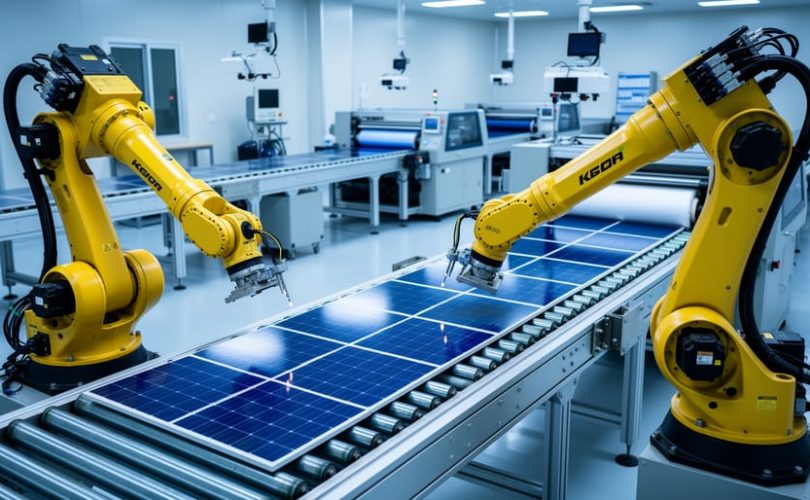
The transformation of silicon wafers into high-performance solar photovoltaic modules represents one of modern manufacturing’s most sophisticated achievements, blending precision engineering with automation technologies that determine the global renewable energy landscape. Today’s solar panel production facilities operate as integrated ecosystems where raw materials journey through twelve distinct stages—from silicon ingot casting to final electrical testing—with tolerances measured in micrometers and quality standards that reject modules showing even microscopic defects.
Understanding this manufacturing process has become essential for professionals entering the photovoltaic industry, particularly as automation reshapes traditional production roles into specialized technical positions. Modern facilities now deploy robotic systems for cell handling, machine vision for defect detection, and artificial intelligence for process optimization, creating demand for workers who comprehend both the underlying physics of solar energy conversion and the digital systems controlling production lines.
This comprehensive examination reveals how contemporary manufacturers achieve module efficiencies exceeding 22 percent while reducing production costs below $0.15 per watt. The analysis progresses through each manufacturing stage—wafer production, texturing, diffusion, anti-reflective coating, screen printing, testing, lamination, and framing—explaining the technical principles, equipment specifications, and automation technologies that distinguish industry leaders from competitors. For aspiring professionals, researchers, and industry stakeholders, this knowledge provides the foundation for understanding why automated manufacturing represents not merely a productivity enhancement but a fundamental requirement for competing in the global solar market, where quality consistency and production speed determine commercial viability.
The Complete Solar PV Module Manufacturing Journey
From Silicon Wafers to Solar Cells
The journey from raw silicon to finished solar modules involves several critical upstream stages that form the foundation of photovoltaic manufacturing. Understanding these processes is essential for professionals entering the renewable energy sector.
The process begins with producing high-purity polysilicon, refined to 99.9999% purity through chemical purification methods. This polysilicon is then melted and crystallized into ingots using either monocrystalline or multicrystalline growth techniques. Monocrystalline ingots, grown through the Czochralski process, yield higher efficiency cells, while multicrystalline ingots offer cost advantages. These cylindrical or block-shaped ingots are subsequently sliced into thin wafers, typically 180-200 micrometers thick, using diamond wire sawing technology.
The wafers then undergo the solar cell fabrication process, where they are transformed into functional photovoltaic cells. This involves surface texturing to reduce reflection, diffusion of phosphorus to create the p-n junction, application of anti-reflective coatings, and screen printing of metal contacts. Advanced cell technologies like PERC (Passivated Emitter and Rear Cell) and TOPCon (Tunnel Oxide Passivated Contact) add additional processing steps to enhance efficiency.
The transition point occurs when completed solar cells, each capable of generating approximately 5-6 watts, are tested, sorted by performance characteristics, and prepared for module assembly. This represents the critical handoff where individual cells become components in larger, market-ready photovoltaic modules designed for decades of reliable energy generation.
Module Assembly: Where Automation Shines
Module assembly represents the convergence point where individual components transform into complete solar panels, and it is precisely here that automation technologies demonstrate their most transformative impact on modern photovoltaic manufacturing. After cells are interconnected through stringing, the assembly stage integrates these cell strings with encapsulation materials, glass, backsheets, and junction boxes to create the finished PV module basics that power renewable energy installations worldwide.
The complexity of this stage demands exceptional precision and consistency. Each module comprises multiple layers that must align perfectly within tolerance ranges measured in fractions of millimeters. Manual assembly simply cannot achieve the speed, accuracy, and repeatability required for commercial-scale production while maintaining competitive pricing and quality standards.
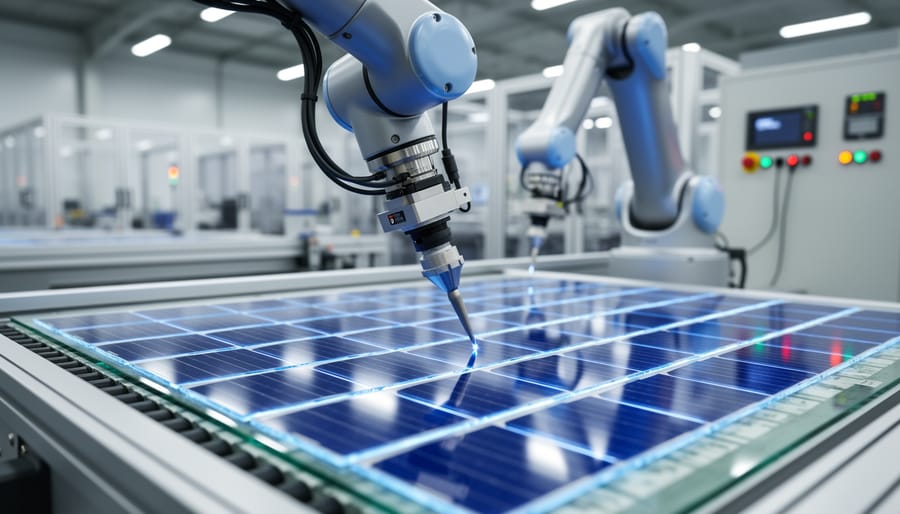
Automated systems excel in this environment through several critical advantages. Robotic handling eliminates human contact with sensitive surfaces, reducing contamination and microcrack formation. Vision inspection systems powered by artificial intelligence detect defects invisible to human operators, ensuring only flawless modules proceed through production. Automated lamination processes apply precise temperature and pressure profiles, creating optimal encapsulation bonds that protect cells for decades of outdoor exposure.
Furthermore, automation enables real-time quality monitoring and traceability. Every module receives documentation tracking its components, processing parameters, and inspection results, establishing accountability throughout its operational lifetime. This data-driven approach has elevated industry-wide quality standards while simultaneously increasing production throughput by factors of ten or more compared to manual methods.
Critical Automated Manufacturing Stages
Automated Cell Sorting and Testing
After solar cells complete the fabrication process, automated sorting and testing systems categorize them based on precise performance metrics to ensure each photovoltaic module achieves optimal efficiency. This critical quality control step prevents mismatched cells from reducing overall module output.
Modern manufacturing facilities employ two primary testing methodologies. Electroluminescence (EL) testing uses infrared cameras to detect microscopic defects invisible to the human eye. When electrical current passes through cells in a dark chamber, healthy silicon emits uniform infrared light, while cracks, impurities, or manufacturing defects appear as dark spots or lines. Automated systems analyze these images within seconds, identifying and rejecting defective cells before they enter the assembly line.
Current-voltage (I-V) curve testing provides quantitative performance data by measuring each cell’s electrical output under standardized conditions. Automated testers expose cells to controlled light intensity while measuring current flow at varying voltage levels. The resulting curve reveals crucial parameters including maximum power output, efficiency rating, and fill factor. High-speed machines process hundreds of cells per hour, generating detailed performance profiles for each unit.
Based on these measurements, sorting machines categorize cells into performance bins, typically ranging from premium to standard grades. This binning process ensures manufacturers match cells with similar electrical characteristics within individual modules. Pairing cells with comparable output prevents weaker cells from limiting stronger ones, a phenomenon that would significantly reduce module efficiency. Universities collaborating with industry leaders continue researching advanced sorting algorithms that further optimize cell matching, contributing to incremental efficiency gains that compound across large-scale production volumes.
Robotic String Assembly and Tabbing
After individual solar cells undergo quality inspection, precision robotic systems take over to assemble them into electrical strings through an automated soldering process. This critical manufacturing stage determines the electrical integrity and long-term performance of the finished photovoltaic module.
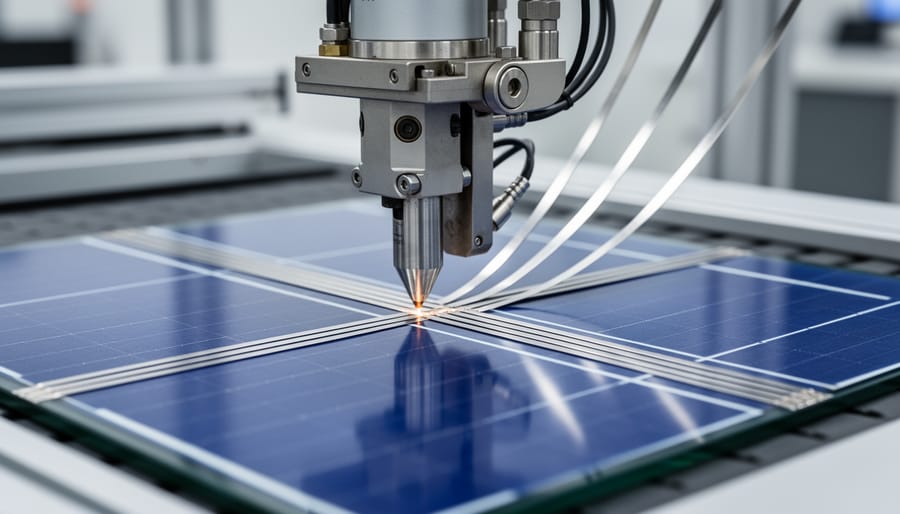
Robotic string assembly systems utilize advanced vision guidance technology to position tabbing ribbons with microscopic accuracy across solar cell busbars. These flat copper ribbons, typically coated with solder, serve as electrical connectors that link cells in series configuration. Modern robots achieve positioning tolerances within 0.1 millimeters, ensuring optimal electrical contact while minimizing mechanical stress on the fragile silicon wafers.
The soldering process itself relies on precisely controlled thermal management. Robots apply heat through infrared lamps or resistance heating elements, creating metallurgical bonds between the ribbon and cell surface in seconds. Temperature profiles must be carefully calibrated—too little heat produces weak connections prone to failure, while excessive heat can damage the cell’s semiconductor junctions or cause micro-cracks.
Contemporary manufacturing lines incorporate multi-point contact verification systems that test each solder joint immediately after formation. These quality control mechanisms detect inadequate connections, misalignments, or ribbon defects before cells progress further in the production sequence. Automated rejection systems remove defective strings, maintaining consistent output quality.
The automation advantages in this process extend beyond precision. Robotic systems sustain consistent production speeds of 1,800 to 2,500 cells per hour while eliminating human exposure to repetitive strain injuries and thermal hazards. For professionals entering the photovoltaic manufacturing sector, understanding robotic string assembly principles provides essential knowledge for equipment operation, process optimization, and quality assurance roles.
Automated Layup and Lamination
Automated layup and lamination represents a critical phase where individual solar cell components transform into integrated photovoltaic modules. This highly coordinated process requires precision positioning and environmental controls to ensure optimal performance and durability.
Modern manufacturing facilities employ automated layup systems that sequentially position each layer with micrometer-level accuracy. The process begins with placing tempered low-iron glass as the foundational substrate, chosen for its high light transmittance and structural integrity. Robotic arms then deposit a sheet of ethylene vinyl acetate (EVA), a thermoplastic encapsulant material that will eventually bond all layers together while protecting cells from moisture and mechanical stress.
The pre-strung solar cells, already interconnected through the tabbing and stringing stage, are carefully positioned onto the EVA layer. Advanced vision systems guide placement mechanisms, ensuring proper alignment and spacing between cells. A second EVA sheet is applied above the cells, followed by the backsheet—a polymer film that provides electrical insulation and environmental protection. Some manufacturers incorporate transparent backsheets to enable bifacial module configurations, capturing reflected light from installation surfaces.
Once layering is complete, the assembled stack moves to vacuum lamination chambers. These sophisticated systems create negative pressure environments while applying controlled heat, typically between 140-150 degrees Celsius. This process melts the EVA, allowing it to flow around cells and fill microscopic gaps, creating a hermetic seal. The vacuum removes trapped air bubbles that could cause delamination or reduce optical efficiency.
The lamination cycle typically requires 10-20 minutes, depending on module size and encapsulant materials. Temperature and pressure profiles are carefully monitored, as variations directly impact long-term reliability and power output consistency across production batches.
Junction Box Attachment and Wiring
The junction box attachment phase represents a critical milestone where the completed solar cells transition into functional modules capable of external electrical connection. Modern manufacturing facilities employ sophisticated automated systems to ensure precise placement and reliable electrical performance.
Automated adhesive dispensing robots apply specialized silicone-based compounds to predetermined locations on the module’s backsheet. These adhesives must withstand decades of thermal cycling, moisture exposure, and mechanical stress while maintaining electrical isolation. Precision dispensing systems control adhesive volume and pattern to within micron-level tolerances, ensuring consistent bond strength across thousands of daily production units.
Junction boxes themselves house essential electrical components, including bypass diodes that prevent power loss when individual cells experience shading or damage. Automated placement systems position these boxes with millimeter accuracy, using vision guidance technology to verify correct alignment before securing them to the module surface.
The wiring process involves robotic systems that strip cable insulation, crimp connectors, and establish electrical connections between the module’s internal circuitry and the junction box terminals. These robots perform continuity testing at each connection point, immediately flagging any resistance anomalies that could compromise long-term performance. Advanced systems can complete the entire wiring sequence in under 30 seconds per module.
Quality verification includes thermal imaging to detect connection irregularities and pull-testing to confirm mechanical integrity. This automation-intensive stage exemplifies how modern manufacturing combines speed with precision, producing modules that meet stringent international safety standards while maintaining the throughput necessary for competitive pricing in global markets.
Framing and Sealing Systems
Following lamination and quality verification, solar modules enter the framing and sealing phase, where automated systems transform fragile laminates into weatherproof, structurally robust products capable of withstanding decades of environmental exposure.
The process begins with automated corner key insertion, where pneumatic systems precisely position aluminum or stainless steel corner keys into pre-cut frame sections. These keys ensure rigid 90-degree joints that maintain dimensional accuracy throughout the module’s operational life. Modern framing stations employ vision systems to verify correct key placement before advancing to the next stage.
Frame pressing operations utilize hydraulic or servo-driven presses that apply controlled force to join frame sections around the laminate perimeter. Advanced systems monitor pressure distribution in real-time, ensuring uniform compression without damaging the underlying glass or cells. Typical pressing forces range from 2,000 to 5,000 Newtons per corner, calibrated according to frame profile and material specifications.
Automated silicone dispensing robots then apply weatherproof sealant along the frame-to-glass interface. These multi-axis systems follow programmed paths with repeatability within 0.1 millimeters, creating continuous gaskets that prevent moisture ingress and provide additional structural bonding. Two-component silicone formulations cure to form flexible, UV-resistant seals rated for temperature extremes from -40°C to +85°C.
This integrated framing approach significantly reduces labor requirements while improving consistency, directly impacting module durability and warranty compliance in field installations.
Final Testing and Quality Verification
Before modules leave the factory floor, they undergo rigorous quality verification to ensure performance and safety standards. This final testing phase represents the culmination of automated quality control measures implemented throughout production.
Automated flash testing serves as the primary performance verification method. Each module passes through a solar simulator that replicates standard test conditions, measuring critical electrical parameters including power output, voltage, current, and efficiency. Advanced systems capture this data within milliseconds, sorting modules into performance bins with precision accuracy. This process guarantees that every panel meets its rated specifications before shipment.
Insulation resistance testing follows, verifying the electrical safety of each module. Automated testers apply high voltage between the module’s electrical components and frame, measuring resistance values to ensure proper isolation. This critical safety check prevents potential electrical hazards during installation and operation.
Visual inspection systems equipped with AI-powered cameras represent the cutting edge of quality verification technology. These sophisticated systems detect micro-defects invisible to human inspectors, including cell cracks, discoloration, solder discontinuities, and encapsulation irregularities. Machine learning algorithms continuously improve detection accuracy, analyzing thousands of images to identify patterns associated with manufacturing defects. Universities collaborating with manufacturers have contributed significantly to developing these AI algorithms, advancing both production quality and educational research opportunities in the photovoltaic sector.
This comprehensive testing regime ensures only the highest-quality modules reach customers, protecting both manufacturers’ reputations and system performance expectations.
Advanced Technologies Driving Manufacturing Innovation
Machine Vision and AI Quality Control
Modern solar module manufacturing relies heavily on AI-powered quality control systems that surpass human inspection capabilities. These advanced computer vision systems utilize high-resolution cameras and machine learning algorithms to detect defects measured in micrometers, ensuring only flawless modules reach the market.
Electroluminescence imaging combined with artificial intelligence identifies micro-cracks in silicon cells that would otherwise remain invisible. These hairline fractures, often thinner than human hair, can significantly reduce module efficiency over time. The AI systems analyze thousands of images per hour, detecting anomalies in cell structure, busbar alignment, and solder joint integrity with 99.9% accuracy.
Machine vision platforms also monitor cell spacing and orientation during the stringing process, immediately flagging misalignments before they become permanent. Thermal imaging cameras integrated with AI algorithms detect hotspots and electrical irregularities that indicate potential failure points.
The integration of deep learning models enables these systems to continuously improve their detection capabilities. By analyzing historical defect data from manufacturing lines worldwide, the algorithms recognize emerging patterns and predict potential quality issues before they occur. This predictive capability transforms quality control from reactive inspection to proactive prevention, reducing waste and enhancing overall module reliability for long-term field performance.

Industry 4.0 Integration and Smart Factories
Modern solar PV module manufacturing facilities increasingly leverage Industry 4.0 technologies to enhance production efficiency and product quality. IoT sensors embedded throughout production lines continuously monitor critical parameters including temperature, humidity, pressure, and material flow rates, generating real-time data streams that enable immediate process adjustments.
Advanced data analytics platforms process this information to identify production bottlenecks, predict equipment failures before they occur, and optimize energy consumption across manufacturing operations. Predictive maintenance systems analyze equipment performance patterns, scheduling interventions during planned downtime rather than responding to unexpected breakdowns that halt production. This approach reduces unplanned downtime by up to 40 percent and extends machinery lifespan.
Machine learning algorithms optimize lamination temperatures, curing cycles, and material handling speeds based on environmental conditions and raw material variations. Digital twin technology creates virtual replicas of production lines, allowing engineers to simulate process changes and test optimization strategies without disrupting actual manufacturing.
Smart factories integrate enterprise resource planning systems with manufacturing execution systems, creating seamless information flow from raw material procurement through final product shipping. This integration enables manufacturers to respond rapidly to market demands while maintaining stringent quality standards, ultimately reducing production costs and improving module reliability for end users.
Collaborative Robots and Human-Machine Workflows
Collaborative robots, or cobots, represent a transformative approach in solar PV manufacturing by combining the precision of automation with human adaptability and problem-solving capabilities. Unlike traditional industrial robots that operate in isolation behind safety cages, cobots work alongside human operators in shared workspaces, creating a synergistic environment where each party contributes their strengths.
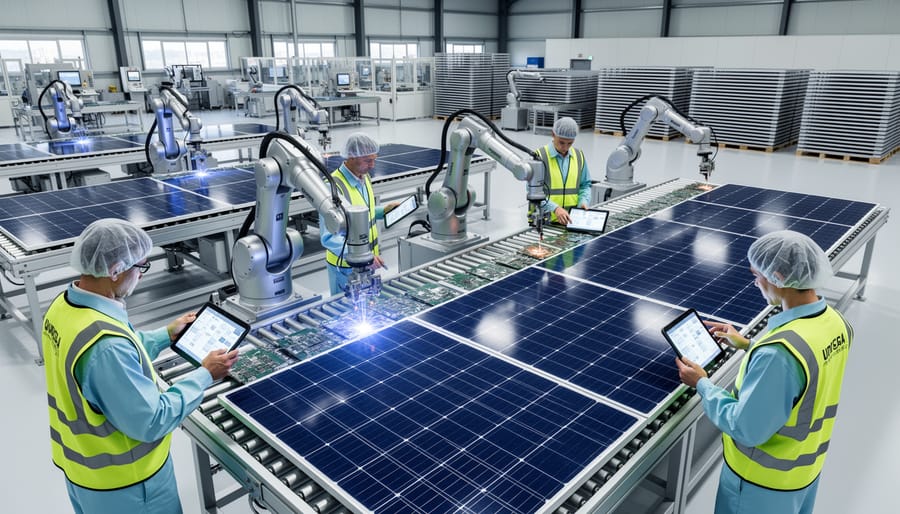
In modern solar facilities, cobots typically handle repetitive, precision-dependent tasks such as applying adhesives, positioning delicate components, or conducting quality inspections with machine vision systems. Human workers complement these systems by managing complex decision-making, addressing exceptions, performing final quality assessments, and overseeing multiple production lines simultaneously. This division of labor optimizes both productivity and quality while maintaining manufacturing flexibility.
The semi-automated workflow proves particularly valuable during new product introductions or customized manufacturing runs. Human expertise enables rapid adjustments to processes without extensive reprogramming, while cobots maintain consistency in critical operations. Many facilities are partnering with universities to develop training programs that prepare the next generation of technicians to work effectively in these hybrid environments, ensuring workers possess both traditional manufacturing knowledge and the technical skills to program, maintain, and troubleshoot robotic systems. This collaborative model reduces physical strain on workers while creating higher-value roles focused on supervision, optimization, and continuous improvement.
The Business Case for Manufacturing Automation
Cost Reduction and Scalability
Automation fundamentally transforms the economics of solar PV module manufacturing by dramatically reducing per-watt production costs. Smart factory automation eliminates labor-intensive manual processes, minimizes material waste through precise handling, and accelerates production cycles from days to hours. This efficiency translates directly to lower manufacturing costs, with leading facilities achieving production costs below $0.20 per watt.
Scalability represents another critical advantage. Automated production lines can operate continuously with minimal human intervention, enabling gigawatt-scale manufacturing capacities that were previously unattainable. Modern facilities can produce upwards of 10 gigawatts annually, meeting growing global demand while maintaining consistent quality standards across millions of modules.
The financial impact extends beyond production efficiency. Reduced defect rates, lower warranty claims, and decreased labor expenses significantly improve profit margins for manufacturers. These savings increasingly pass through to consumers, making solar energy more competitive with conventional power sources. For emerging markets and large-scale renewable energy projects, automation-driven cost reductions accelerate adoption timelines and enhance return on investment calculations, ultimately supporting the global transition to sustainable energy systems.
Quality Consistency and Warranty Confidence
Automated manufacturing processes directly influence product quality consistency, enabling manufacturers to offer extended warranty periods with greater confidence. Modern photovoltaic production lines achieve defect rates below 0.1% through continuous monitoring and real-time quality control, compared to 2-3% in manual operations. This precision stems from machine vision systems that inspect every cell and module at multiple production stages, identifying microscopic flaws invisible to human operators.
The reliability achieved through automation allows leading manufacturers to extend product warranties from the traditional 10-year coverage to 25-30 years for performance guarantees. Statistical process control algorithms track thousands of parameters simultaneously, ensuring each module meets stringent electrical and mechanical specifications. When deviations occur, automated systems immediately adjust production parameters or remove defective units, preventing entire batches from failing quality standards.
This consistency proves particularly valuable for large-scale solar installations, where even minor variations in module performance can significantly impact project economics. Research conducted through university collaborations demonstrates that automated production lines maintain coefficient of variation below 1.5% for power output, ensuring predictable energy generation across entire solar arrays. For professionals entering the photovoltaic industry, understanding this quality-warranty relationship provides crucial insight into manufacturer reputation and project risk assessment, essential knowledge covered in comprehensive educational programs focused on solar technology fundamentals.
Career Opportunities in Automated PV Manufacturing
Essential Skills for Modern PV Manufacturing
The transition to automated solar PV manufacturing demands a diverse skill set that combines traditional engineering knowledge with cutting-edge technological capabilities. Robotics expertise stands at the forefront, as professionals must understand programmable logic controllers, machine vision systems, and collaborative robotics to maintain and optimize automated production lines. Process engineering competencies remain critical, requiring deep knowledge of semiconductor physics, material science, and continuous improvement methodologies like Six Sigma to enhance manufacturing efficiency.
Quality control has evolved beyond manual inspection to encompass sophisticated measurement systems. Professionals need proficiency in non-destructive testing methods, electroluminescence imaging, and statistical process control to ensure panel performance and reliability. Data analytics capabilities have become indispensable, with manufacturers leveraging real-time monitoring systems, predictive maintenance algorithms, and machine learning to optimize production parameters and minimize downtime.
Many universities now collaborate with industry leaders to develop specialized training programs addressing these technical requirements. These educational partnerships provide hands-on experience with actual manufacturing equipment, bridging the gap between theoretical knowledge and practical application. Aspiring professionals should pursue interdisciplinary education combining electrical engineering, materials science, automation technology, and data science to position themselves for success in this rapidly advancing sector.
Educational Pathways and Training Programs
Developing expertise in solar PV module manufacturing requires specialized education that bridges theoretical knowledge with practical industry applications. Leading universities worldwide now offer dedicated photovoltaic engineering programs, combining materials science, semiconductor physics, and industrial automation coursework. These academic partnerships with manufacturers provide students hands-on experience with production equipment and quality control protocols used in modern facilities.
Industry-specific training programs have emerged to address the growing demand for skilled technicians and engineers. Mose Solar’s comprehensive online educational platform exemplifies this trend, offering structured courses covering the entire manufacturing process from silicon purification through final module testing. These programs typically include modules on automated production systems, quality assurance methodologies, and emerging technologies like PERC and bifacial cell manufacturing.
Professional development pathways vary from certificate programs for technicians to advanced degrees for research and development roles. Online learning platforms enable working professionals to acquire specialized knowledge while maintaining their current positions, making career transitions more accessible. Industry certifications in areas such as cleanroom protocols, equipment maintenance, and process optimization complement formal education, creating well-rounded professionals capable of driving innovation in this rapidly evolving sector.
Environmental and Sustainability Benefits
Automated manufacturing processes in solar PV production significantly amplify the environmental benefits that solar energy promises. By minimizing material waste through precision cutting and optimized layering techniques, modern automated facilities achieve material utilization rates exceeding 95%, compared to 85-90% in conventional manufacturing. This reduction directly translates to fewer raw materials extracted and less industrial waste requiring disposal.
Energy efficiency represents another critical advantage of automation. Advanced manufacturing systems consume substantially less energy per panel produced than manual operations, with some facilities reporting 30-40% reductions in energy consumption through optimized thermal management, intelligent scheduling, and recovery systems that capture and reuse heat generated during production processes. Many leading manufacturers now power their facilities with solar installations, creating a virtuous cycle where solar panels are manufactured using solar energy.
The integration of closed-loop manufacturing practices further enhances sustainability credentials. Automated systems enable precise tracking and recovery of materials like silicon wafers, silver paste, and aluminum frames, facilitating recycling and reuse within the production chain. Defective cells and manufacturing byproducts are systematically processed for material recovery rather than discarded.
Water conservation also benefits from automation, with closed-loop water systems and advanced filtration reducing freshwater consumption by up to 60% in some facilities. Real-time monitoring ensures chemical usage remains minimal while maintaining quality standards.
These environmental improvements align perfectly with solar energy’s core mission, ensuring that the manufacturing process itself reflects the clean energy values the final product delivers. For academic researchers and industry professionals, understanding these sustainability metrics is essential for evaluating the true lifecycle environmental impact of photovoltaic systems.
The automation revolution in solar PV module manufacturing represents far more than technological advancement—it stands as a critical enabler of the global energy transition. As we’ve explored throughout this examination of modern production processes, the integration of robotics, artificial intelligence, and precision engineering has fundamentally transformed how solar panels move from raw materials to rooftop installations. This manufacturing evolution directly accelerates solar adoption by reducing costs, improving quality consistency, and scaling production capacity to meet exponential demand growth.
The connection between advanced manufacturing capabilities and renewable energy accessibility cannot be overstated. Automated processes have contributed to an approximately 90% reduction in solar panel costs over the past decade, making clean energy economically viable across diverse markets and applications. This cost trajectory continues as manufacturers refine their automated systems, implement machine learning optimization, and achieve greater material efficiency.
For professionals entering or advancing within the photovoltaic industry, understanding these manufacturing processes provides essential foundation knowledge. The field offers diverse career pathways spanning engineering, quality assurance, process optimization, and sustainability management. Educational institutions and industry leaders increasingly recognize this skills gap, developing specialized programs that bridge theoretical knowledge with practical manufacturing expertise.
The solar industry’s continued expansion demands a workforce equipped with both technical proficiency and systems-level understanding of how automation drives quality and scalability. Engaging with educational opportunities in photovoltaic manufacturing positions professionals at the forefront of the clean energy revolution, contributing directly to climate solutions while building rewarding careers in this dynamic sector.


