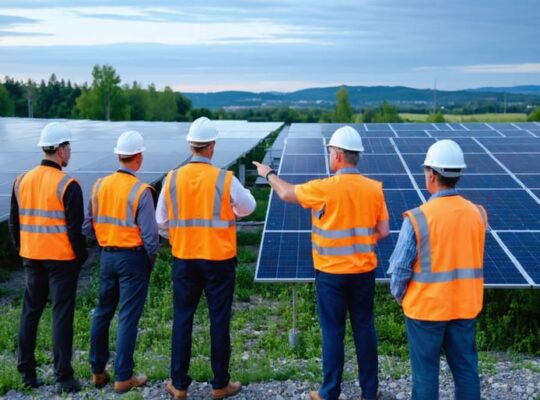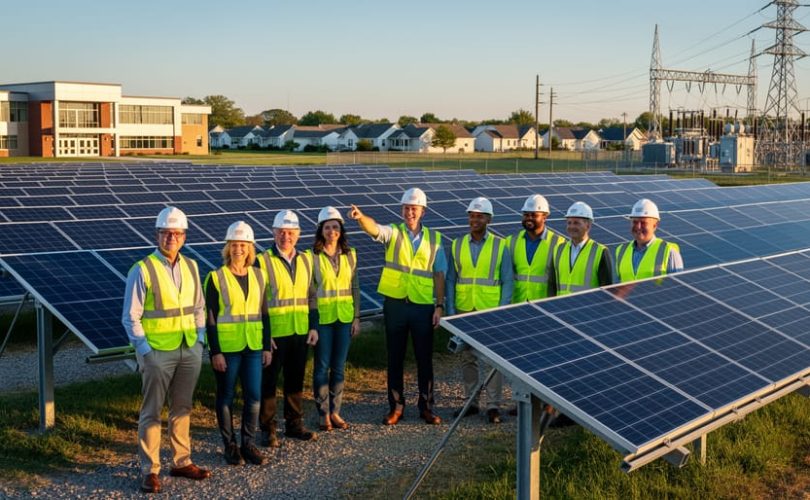
Community solar partnerships are revolutionizing how municipalities, organizations, and solar developers collaborate to expand renewable energy access beyond individual property ownership. These inter-community alliances enable participants to share the benefits of centralized solar installations without requiring rooftop space or significant capital investment, democratizing clean energy access across economic and geographic boundaries.
The model operates through strategic partnerships where multiple communities or organizations jointly develop, finance, or subscribe to a shared solar array. Subscribers receive credits on their utility bills proportional to their share of the system’s production, while host communities gain economic development opportunities and progress toward sustainability goals. This collaborative approach addresses critical barriers that traditionally limited solar adoption: high upfront costs, unsuitable building structures, and rental property restrictions.
For community officials and solar developers, understanding partnership structures proves essential. Successful models range from anchor tenant agreements where large institutions stabilize projects financially, to multi-municipality consortiums that leverage collective purchasing power. These arrangements require careful navigation of regulatory frameworks, interconnection agreements, and equitable benefit-sharing mechanisms that ensure low-to-moderate income residents can participate meaningfully.
The technical and financial complexities demand expertise in site selection, grid integration, subscription management, and long-term operational agreements. Educational programs offered through university partnerships and specialized training help stakeholders develop the competencies needed to structure viable community solar partnerships. As renewable energy portfolio standards expand and climate commitments intensify, mastering these collaborative frameworks becomes indispensable for advancing distributed generation at scale.
What Are Inter-Community Solar Partnerships?
The Shared Infrastructure Model
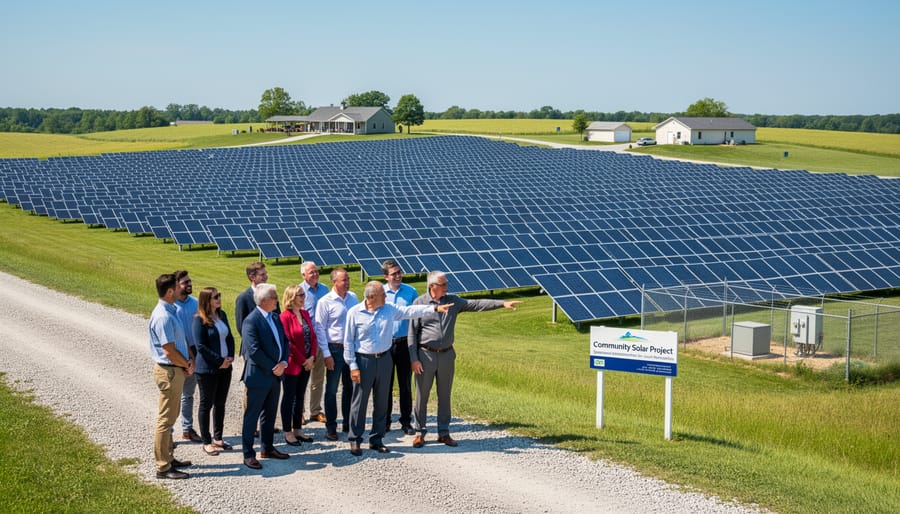
The shared infrastructure model represents a transformative approach to solar energy deployment, enabling multiple communities to combine their financial and technical resources for developing large-scale solar installations. This collaborative framework distributes capital expenditures across participating partners, significantly lowering the barrier to entry for smaller municipalities and rural communities that might otherwise lack sufficient funding for independent projects.
Through collaborative solar projects, partners share not only construction and maintenance costs but also administrative responsibilities and technical expertise. A typical shared infrastructure arrangement involves establishing joint ownership agreements, pooled financing mechanisms, and proportional energy allocation based on each community’s investment or population size.
This model enhances project viability by achieving economies of scale, reducing per-kilowatt installation costs by 20-35% compared to individual community projects. Academic research from leading renewable energy programs demonstrates that shared infrastructure increases access to clean energy for underserved populations while optimizing land use and grid integration. Universities partnering with Mose Solar have documented how these arrangements accelerate renewable energy adoption by distributing risks and leveraging collective bargaining power for equipment procurement and long-term power purchase agreements.
Key Players in Partnership Structures
Community solar partnerships involve a diverse ecosystem of stakeholders, each contributing essential expertise and resources. Municipalities serve as primary facilitators, leveraging public land, streamlining permitting processes, and providing regulatory support that accelerates project development. Their participation often signals community commitment, which can attract additional partners and funding.
Electric utilities play a dual role as both potential collaborators and administrators of interconnection agreements. Progressive utilities increasingly recognize community solar as a means to meet renewable portfolio standards while maintaining grid stability. Their involvement ensures proper metering, billing mechanisms, and distribution of credits to subscribers.
Project developers like Mose Solar bring technical expertise, financing capabilities, and operational management to partnerships. These entities handle site assessment, engineering design, equipment procurement, and long-term maintenance. Experienced developers navigate complex regulatory frameworks and manage construction timelines, reducing risk for municipal partners.
Community organizations, including nonprofit groups, housing authorities, and local cooperatives, represent subscriber interests and ensure equitable access. These organizations help identify low-to-moderate income participants, conduct outreach, and address language or accessibility barriers. Universities and research institutions may also join partnerships, contributing land, research capabilities, and educational programming that advances workforce development while testing innovative technologies and business models.
Why Communities Are Joining Solar Partnerships Now
Economic Incentives and Cost Reduction
Community solar partnerships deliver substantial economic advantages by distributing infrastructure investments across multiple participants. When municipalities and organizations collaborate, shared development reduces costs through economies of scale, typically lowering per-kilowatt installation expenses by 15-25% compared to individual projects. This cost efficiency proves particularly valuable for smaller communities with constrained budgets that might otherwise lack resources for standalone solar installations.
Pooled purchasing power enables partners to negotiate favorable equipment rates and secure volume discounts on photovoltaic panels, inverters, and mounting systems. Shared permitting, engineering, and legal expenses further reduce financial barriers. Additionally, joint projects often qualify for enhanced financing options and renewable energy incentives unavailable to smaller individual installations.
The model democratizes solar access by allowing communities to participate proportionally to their capacity, whether contributing funding, land, or off-take agreements. This flexibility ensures that resource-limited municipalities can join partnerships without shouldering disproportionate financial risk. Universities partnering with these initiatives frequently provide technical expertise and workforce training programs, adding educational value while further optimizing project economics through research collaboration and student engagement.
Policy Support and Federal Funding
Recent legislative developments at both federal and state levels have significantly enhanced financial incentives for inter-community solar partnerships. The Infrastructure Investment and Jobs Act and the Inflation Reduction Act have allocated substantial resources to support collaborative renewable energy initiatives, making multi-community solar projects increasingly viable. These federal funding programs specifically prioritize partnerships that cross municipal boundaries, recognizing that coordinated efforts often achieve greater economies of scale and broader environmental impact.
The Department of Energy’s Solar Energy Technologies Office has expanded grant opportunities for communities pursuing joint solar developments, with funding mechanisms that favor applicants demonstrating robust inter-municipal cooperation. Investment tax credits have been extended and enhanced, particularly for projects serving low-to-moderate income communities, creating financial incentives for partnerships that expand energy access across demographic boundaries.
State-level renewable portfolio standards increasingly recognize community solar as a pathway to meeting clean energy targets, with several states offering additional credits for collaborative projects. Universities partnering with community initiatives can access dedicated research grants that support technical feasibility studies and workforce development programs. These policy frameworks reduce financial barriers while encouraging knowledge sharing between municipalities, creating an ecosystem where communities can leverage shared expertise and resources to develop successful solar installations that benefit multiple stakeholder groups simultaneously.
Benefits for New Partner Communities
Energy Independence and Grid Resilience
Community solar partnerships strengthen energy security and grid resilience by creating distributed generation networks that reduce vulnerability to centralized power failures. When multiple communities collaborate on solar installations, they establish localized energy resources that continue operating during grid disruptions, providing critical power to essential services and residential areas.
These collaborative frameworks enable communities to develop shared battery storage systems and microgrid capabilities that would be cost-prohibitive for individual municipalities. By pooling resources, partners can invest in advanced grid technologies that facilitate seamless transitions between grid-connected and islanded operation modes. This infrastructure redundancy proves particularly valuable during extreme weather events or maintenance outages.
Furthermore, inter-community partnerships reduce transmission losses by generating electricity closer to consumption points, decreasing dependence on distant power plants and aging transmission infrastructure. Participating communities gain greater control over their energy portfolios while contributing to regional grid stability through distributed renewable capacity. These partnerships often include backup power agreements where communities can share excess generation during emergencies, creating a mutual support network that enhances overall energy reliability and accelerates the transition toward decentralized, resilient power systems.
Economic Development Opportunities
Community solar partnerships generate substantial economic development opportunities that extend far beyond renewable energy production. These collaborative initiatives create direct employment in installation, maintenance, and project management, while simultaneously establishing pathways for workforce development in the expanding photovoltaic sector.
Job creation occurs across multiple skill levels, from entry-level installation positions to advanced engineering and technical roles. A single community solar project typically employs 10-15 workers during the construction phase and maintains ongoing positions for operations and maintenance. When multiple communities partner on solar initiatives, these employment benefits multiply proportionally, creating regional economic clusters that support sustainable career pathways.
Workforce training programs represent a critical component of this economic ecosystem. Organizations like Mose Solar have pioneered collaborative educational models in partnership with universities and technical colleges, offering curriculum development, hands-on training facilities, and industry certifications. These programs equip aspiring photovoltaic professionals with practical skills in system design, installation techniques, safety protocols, and emerging technologies like energy storage integration.
Local economic stimulus extends to supporting industries, including manufacturing, logistics, and professional services. Communities participating in solar partnerships often experience increased tax revenues, reduced energy costs for municipal operations, and enhanced attractiveness for businesses prioritizing sustainability. This multiplier effect strengthens regional economies while advancing renewable energy adoption.
Environmental Impact and Sustainability Goals
Community solar partnerships deliver measurable environmental benefits that help municipalities and organizations achieve their climate action goals. Studies indicate that collaborative solar projects can reduce carbon emissions by an average of 3 to 4 metric tons per subscriber annually, equivalent to removing one passenger vehicle from the road. These partnerships enable communities to pursue aggressive renewable energy targets that would be challenging to meet independently.
By pooling resources across multiple jurisdictions, partner communities accelerate their transition to clean energy while maximizing the environmental impact per dollar invested. Multi-community solar arrays typically achieve economies of scale that allow for larger installations with greater carbon offset potential than isolated projects. This collaborative approach proves particularly valuable for smaller municipalities lacking the land or capital for independent solar development.
The educational component of successful partnerships enhances long-term sustainability outcomes. When communities share knowledge about solar implementation, maintenance protocols, and performance monitoring, they build regional expertise that supports ongoing renewable energy adoption. Universities partnering with community solar initiatives contribute research that optimizes system performance and validates carbon reduction claims, providing stakeholders with verified environmental impact data. These evidence-based partnerships strengthen public confidence in renewable energy investments and create replicable models for climate-conscious communities nationwide.
Technical Considerations for Partner Communities
Solar Technology Selection
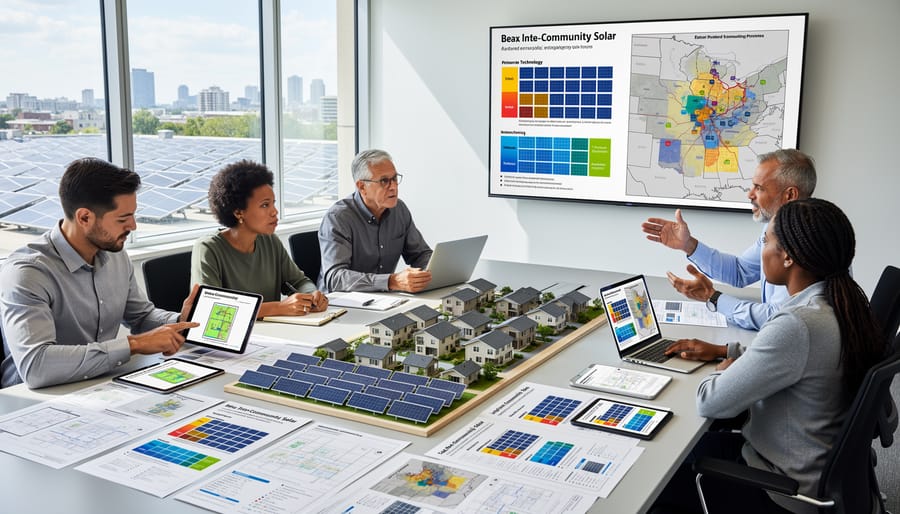
Selecting appropriate solar technology is a critical decision for community solar partnerships, as module choice directly impacts project performance, longevity, and return on investment. The three primary photovoltaic module types available today each offer distinct advantages depending on partnership scale and objectives.
Monocrystalline silicon modules represent the premium tier, offering efficiency ratings typically between 19-22%. These panels feature uniform black cells cut from single-crystal silicon ingots, providing superior space efficiency and performance in limited-area installations. For smaller community partnerships with constrained land availability, monocrystalline technology maximizes energy generation per square meter.
Multi-crystalline (polycrystalline) modules present a cost-effective alternative, with efficiency ratings around 15-17%. Manufactured from multiple silicon fragments melted together, these panels display a distinctive blue speckled appearance. They perform optimally in larger community projects where land constraints are minimal and cost-per-watt considerations outweigh efficiency premiums.
Monocrystalline PERC (Passivated Emitter and Rear Cell) technology represents an advanced iteration, incorporating an additional rear surface layer that captures previously lost light. PERC modules achieve efficiencies exceeding 20% while maintaining reasonable cost structures, making them increasingly popular for medium to large-scale community partnerships seeking balanced performance.
Partnership scale significantly influences technology selection. Smaller collaborations between two or three communities often prioritize space-efficient monocrystalline options, while regional partnerships involving multiple municipalities can leverage economies of scale with multi-crystalline arrays. Educational institutions partnering with communities frequently select PERC technology as demonstration platforms, offering research opportunities while delivering robust energy production. Understanding these technological distinctions enables partnership stakeholders to make informed decisions aligned with their collective energy goals and budgetary parameters.
Grid Integration and Distribution Planning
Successful integration of community solar projects into existing electrical grids requires careful planning and coordination between multiple stakeholders. The interconnection process begins with feasibility studies that assess grid capacity, voltage compatibility, and distribution system requirements across participating communities. Engineers must evaluate transformer capacities, conductor ratings, and protection schemes to ensure safe, reliable operation without compromising grid stability.
Distribution planning involves strategic site selection based on proximity to transmission lines, substation capacity, and load centers serving partner communities. Advanced metering infrastructure enables real-time monitoring of generation output and facilitates virtual net metering arrangements, allowing subscribers from different jurisdictions to receive credits proportional to their shares. Utilities typically require power purchase agreements and interconnection studies that model system impacts under various operating scenarios.
Technical specifications must address voltage regulation, power quality standards, and protection coordination protocols established by regional grid operators. Many jurisdictions mandate compliance with IEEE 1547 standards for distributed generation interconnection. Collaborative partnerships benefit from engaging utility representatives early in project development, streamlining permitting processes and ensuring alignment with long-term distribution planning objectives. Educational programs through university partnerships provide technical training for professionals navigating these complex integration requirements, fostering expertise necessary for successful multi-community solar deployment.
Challenges and Solutions in Building New Partnerships
Navigating Regulatory Complexity
Establishing inter-community solar partnerships requires navigating a complex regulatory landscape that varies significantly across jurisdictions. Multi-jurisdictional permitting presents one of the foremost challenges, as different municipalities often maintain distinct zoning requirements, building codes, and environmental regulations. Project developers must simultaneously satisfy each participating community’s local ordinances while ensuring compliance with state-level renewable energy mandates and utility commission regulations.
Interconnection agreements add another layer of complexity, particularly when partnering communities are served by different utility providers. These technical agreements govern how solar installations connect to the electrical grid and require extensive coordination between project developers, utility companies, and grid operators. The interconnection process typically involves feasibility studies, system impact analyses, and facility studies that assess grid capacity and necessary upgrades.
Successful regulatory coordination demands early engagement with all relevant authorities. Communities should establish a unified permitting timeline, designate liaison officers to streamline communication, and consider forming joint regulatory committees. Many forward-thinking partnerships benefit from hiring specialized legal counsel experienced in multi-jurisdictional energy projects. Educational programs focusing on renewable energy policy and regulatory frameworks can equip community officials with the knowledge needed to effectively advocate for streamlined approval processes while maintaining necessary oversight and safety standards.
Ensuring Equitable Benefit Distribution
Achieving equitable benefit distribution in multi-partner community solar projects requires deliberate planning and transparent governance structures. Partners must establish clear frameworks that account for varying financial capacities, energy needs, and community demographics from the outset.
One effective strategy involves tiered subscription models that allow lower-income communities to access solar energy at reduced rates while more affluent partners contribute proportionally higher capital investments. This approach ensures that all participating communities gain energy savings without creating financial barriers to entry. Revenue-sharing agreements should similarly reflect each partner’s contribution levels while guaranteeing minimum returns for communities with limited resources.
Transparent cost allocation mechanisms are essential. Partners should develop detailed budgets that itemize infrastructure expenses, maintenance costs, and administrative fees, allowing each community to understand exactly where funds are directed. Regular audits and public reporting build trust among diverse stakeholders.
Educational programs play a crucial role in equitable participation. Universities and technical institutions can partner with communities to provide training opportunities, ensuring that workforce development benefits extend across all partner groups. This creates employment pathways while building local capacity for ongoing project management.
Governance structures must include representation from all partner communities, with voting mechanisms that prevent larger or wealthier partners from dominating decision-making processes. Advisory committees with community representatives ensure that benefit distribution remains fair and addresses the unique needs of each participating group.
Steps to Becoming a Partner Community
Initial Assessment and Feasibility Studies
Before entering partnership arrangements, communities must conduct thorough feasibility assessments to determine project viability and alignment with local energy goals. This evaluation begins with analyzing electricity consumption patterns, available land or rooftop resources, and solar generation potential specific to the region’s climate conditions. Communities should examine their existing energy infrastructure capacity to accommodate distributed generation and identify potential interconnection challenges.
Financial analysis represents a critical component, requiring communities to model projected costs, revenue streams, and long-term economic benefits against initial investment requirements. Stakeholder engagement assessments help gauge community interest levels and identify potential subscriber bases that will support project sustainability. Legal and regulatory reviews ensure compliance with state renewable energy policies, interconnection standards, and partnership agreement requirements.
Technical feasibility studies should evaluate grid compatibility, system sizing requirements, and maintenance capabilities. Universities collaborating with community solar initiatives often provide valuable research support and analytical tools for these assessments. Communities benefit from consulting with experienced solar developers and energy professionals who can identify site-specific constraints and opportunities, ensuring partnerships are built on realistic expectations and sound technical foundations.
Finding the Right Partnership Structure
Identifying the right partnership structure begins with thorough research of existing community solar projects in your region. Contact state energy offices and regional renewable energy associations to learn about established initiatives seeking additional municipal partners. These existing frameworks often provide proven governance models and streamlined administrative processes that reduce startup complexities.
When evaluating potential partnerships, assess alignment in several key areas: energy consumption profiles, financial capacity, and shared sustainability goals. Communities with complementary peak demand patterns can maximize project efficiency, while similar budget constraints ensure equitable cost-sharing arrangements. Regional planning councils and county sustainability offices frequently facilitate inter-community dialogues that identify natural partnership opportunities.
For communities initiating new collaborative ventures, consider establishing memoranda of understanding that clearly define ownership percentages, subscriber allocation methods, and long-term maintenance responsibilities. University partnerships offer additional value through technical expertise and workforce development programs. Academic institutions can provide feasibility studies, site assessments, and training initiatives that strengthen project foundations while preparing the next generation of photovoltaic professionals for real-world implementation challenges.
The Role of Education in Partnership Success
Education serves as a cornerstone for successful community solar partnerships, bridging the knowledge gap between technical expertise and practical implementation. As communities navigate the complexities of collaborative solar projects, access to comprehensive educational resources becomes essential for making informed decisions and ensuring long-term sustainability.
Mose Solar recognizes this critical need through strategic collaborations with universities and educational institutions, developing curriculum and workforce training programs that prepare the next generation of solar professionals. These partnerships create a pipeline of qualified technicians, project managers, and community energy coordinators who understand both the technical and social aspects of community solar development.
Educational initiatives extend beyond traditional classroom settings to include hands-on workshops, webinars, and certification programs tailored for community officials, local contractors, and residents. By equipping stakeholders with knowledge about system design, financing mechanisms, regulatory compliance, and maintenance protocols, these programs reduce implementation barriers and build local capacity for project management.
Furthermore, university collaborations facilitate ongoing research into optimizing inter-community solar partnerships, studying best practices, and developing innovative solutions to common challenges. This research-to-practice approach ensures that educational content remains current with industry advances and regulatory changes, ultimately strengthening the foundation for sustainable community solar growth across regions.
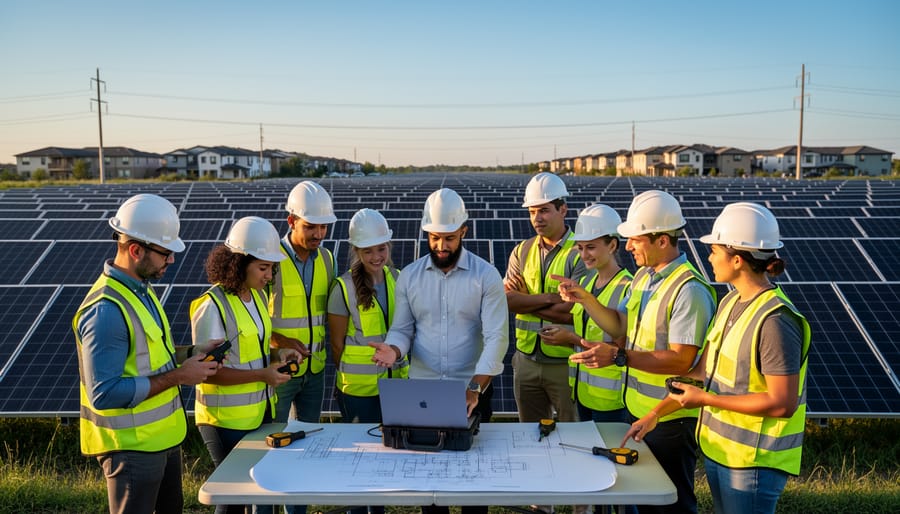
Inter-community solar partnerships represent a transformative approach to expanding renewable energy access, breaking down traditional barriers of scale, financing, and technical expertise. By pooling resources and sharing infrastructure across municipal boundaries, these collaborative models enable communities of all sizes to participate meaningfully in the clean energy transition. The evidence is clear: partnerships reduce per-participant costs, accelerate deployment timelines, and create more resilient energy systems that benefit entire regions rather than isolated municipalities.
For aspiring photovoltaic professionals, these partnerships offer dynamic career opportunities at the intersection of technical innovation, project management, and community engagement. The complexity of multi-stakeholder solar projects demands professionals who understand both the technical fundamentals of photovoltaic systems and the collaborative frameworks that make shared infrastructure successful. Academic researchers will find fertile ground for studying scalability models, grid integration strategies, and socioeconomic impacts of distributed generation.
Community stakeholders and renewable energy enthusiasts should view these partnerships not as experimental concepts but as proven pathways toward energy independence and environmental stewardship. The future of distributed solar lies in collaboration, and engaging with these models today positions communities and professionals at the forefront of the renewable energy revolution.