Offshore wind’s Levelized Cost of Energy (LCOE) has plummeted by nearly 70% over the past decade, transforming what was once an expensive renewable alternative into a competitive cornerstone of global energy transition strategies. Understanding LCOE—the average cost per unit of electricity generated over a project’s lifetime—is essential for anyone working in renewable energy, as this metric drives investment decisions, shapes offshore wind policy development, and determines which technologies receive government support.
For photovoltaic professionals and renewable energy stakeholders, offshore wind LCOE presents both a comparative benchmark and a collaborative opportunity. While solar energy has achieved remarkable cost reductions through manufacturing scale and technological innovation, offshore wind’s trajectory offers parallel insights into how policy frameworks, technological advancement, and market mechanisms can accelerate deployment. Current offshore wind LCOE ranges from $50 to $120 per megawatt-hour depending on location, water depth, and regulatory environment—figures that increasingly overlap with onshore renewables in favorable conditions.
This economic convergence matters because energy policy decisions are fundamentally cost-driven. Governments worldwide are establishing offshore wind targets not solely for environmental reasons, but because LCOE calculations demonstrate long-term economic viability. Tax incentives, streamlined permitting processes, grid connection guarantees, and auction mechanisms directly influence capital expenditures, operational costs, and project financing rates—the three primary components of LCOE calculations.
The following analysis examines how LCOE is calculated for offshore wind projects, which policy levers most significantly impact these costs, how technological innovations are driving continued reductions, and what solar professionals can learn from offshore wind’s economic evolution. Understanding these dynamics equips renewable energy professionals with cross-sector knowledge essential for navigating an increasingly integrated clean energy landscape.
Understanding Offshore Wind LCOE: The Fundamentals
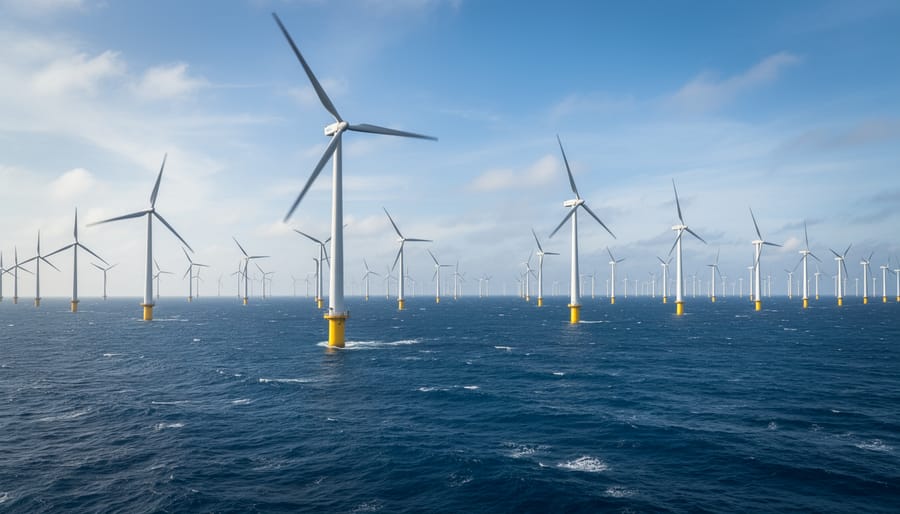
Capital Expenditure Components
Capital expenditure represents the largest component of offshore wind LCOE, typically accounting for 60-75% of lifetime costs. Understanding these upfront investments provides essential context for policy analysts and energy professionals evaluating deployment strategies and comparing economics across renewable technologies.
Turbine procurement constitutes the single largest expense, representing approximately 30-40% of total CAPEX. Modern offshore wind turbines range from 8-15 MW capacity, with larger units offering improved economies of scale. Unit costs have declined significantly, from roughly $1,500 per kilowatt in 2015 to approximately $1,100-1,300 per kilowatt currently, driven by manufacturing advances and competitive market dynamics.
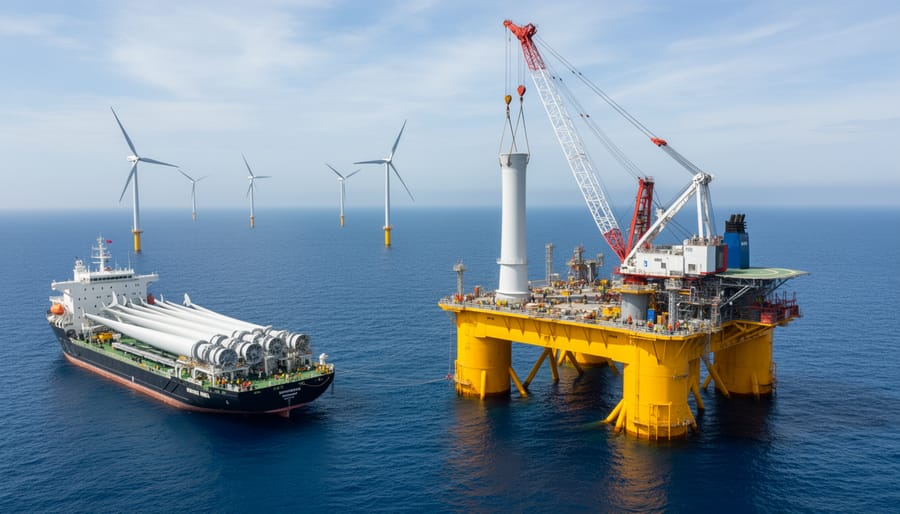
Foundation and installation costs account for 20-30% of CAPEX, varying substantially based on water depth, seabed conditions, and distance from shore. Monopile foundations dominate in shallow waters (less than 30 meters), while jacket structures and floating platforms serve deeper installations. Installation vessel availability and weather windows significantly impact these expenses, with specialized jack-up vessels commanding premium rates.
Subsea cabling and electrical infrastructure represent 15-20% of upfront costs. Array cables connecting individual turbines to offshore substations must withstand harsh marine environments, while export cables transmitting power to shore require careful route planning and seabed preparation. Grid connection infrastructure, including onshore substations and transmission upgrades, adds further complexity and expense, particularly in regions with limited coastal grid capacity.
These capital components demonstrate economies of scale, with larger projects achieving lower per-megawatt costs through optimized procurement and installation efficiencies.
Operational Expenditure and Maintenance Factors
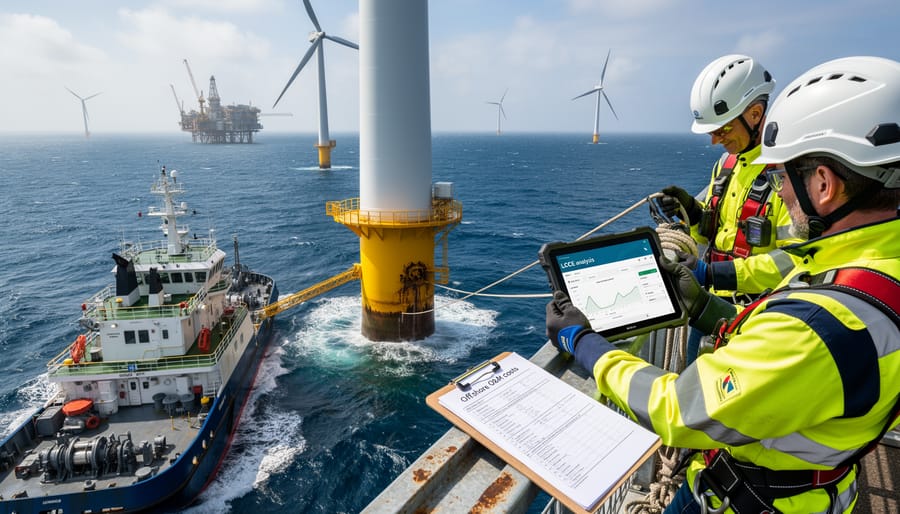
Operational expenditure represents a substantial component of offshore wind LCOE, often accounting for 25-30% of lifetime costs compared to 10-15% for onshore installations. These elevated expenses stem primarily from the challenging marine environment and logistical complexities inherent to offshore operations.
Vessel operations constitute the largest operational cost driver. Crew transfer vessels, which transport technicians to turbines, typically cost between $5,000-$15,000 per day depending on sea conditions and distance from shore. For major component replacements, specialized jack-up vessels or heavy-lift ships may exceed $200,000 daily. Project developers must maintain contracts with multiple vessel operators or invest in dedicated fleet assets, both representing significant ongoing expenditures.
Weather-dependent maintenance windows severely constrain operational efficiency. Offshore technicians can typically access turbines only when significant wave heights remain below 1.5 meters and wind speeds stay within safe limits. In the North Sea, for example, suitable weather windows occur approximately 60-70% of the year, forcing operators to maintain larger spare parts inventories and accept higher downtime rates than their onshore counterparts. This weather dependency necessitates sophisticated forecasting systems and flexible scheduling protocols.
Specialized workforce requirements further amplify costs. Offshore wind technicians must possess maritime safety certifications, including survival training and helicopter evacuation qualifications, beyond standard wind turbine credentials. These specialists command premium wages, with experienced offshore technicians earning 30-50% more than onshore equivalents. Additionally, remote monitoring systems and predictive maintenance technologies, while reducing some site visits, require substantial initial investment and ongoing software licensing fees. For professionals familiar with solar operations, these maintenance complexities represent a marked departure from terrestrial photovoltaic systems, where accessibility and weather constraints prove far less limiting.
Current Offshore Wind LCOE Trends and Benchmarks
Global LCOE Variations by Market
Offshore wind LCOE demonstrates significant geographic variation across global markets, driven by natural resource differences, regulatory frameworks, and market maturity. European markets, particularly in the North Sea region, have achieved the lowest LCOE figures globally, with recent projects in the Netherlands and Denmark reaching $40-50 per MWh through competitive auction mechanisms and streamlined permitting processes. The region’s established supply chains, favorable wind resources with capacity factors exceeding 50%, and supportive policy frameworks have created economies of scale that reduce project costs substantially.
Asian markets present a contrasting picture, with China leading deployment volumes but experiencing higher LCOE ranges of $70-90 per MWh due to developing supply chains and varied coastal wind conditions. Japan and Taiwan face even higher costs, often exceeding $100 per MWh, attributed to deeper water depths requiring floating foundations, typhoon-resistant designs, and complex seabed geology. However, these offshore wind markets are rapidly evolving with government-backed feed-in tariffs and technology localization initiatives.
North American LCOE remains elevated at $80-120 per MWh, reflecting nascent supply chain development and limited specialized infrastructure. The United States faces particular challenges from the Jones Act requirements affecting installation vessels and longer transmission distances to grid connection points. However, states implementing offshore wind mandates and federal tax incentives are beginning to drive cost reductions through project pipelines that justify domestic manufacturing investments and workforce development programs.
Historical Cost Decline Patterns
Offshore wind technology has experienced remarkable cost reductions over the past decade, with LCOE declining by approximately 60-70% in major markets between 2010 and 2023. In European waters, auction results have demonstrated this trajectory clearly, with strike prices falling from over €150/MWh in early 2010s projects to below €50/MWh in recent tenders, with some projects even achieving zero-subsidy status.
Several technological innovations have driven these improvements. Turbine capacity has increased dramatically from 3-4 MW units in 2010 to 12-15 MW models now entering commercial deployment. Larger rotors and taller towers capture more consistent wind resources, while improved capacity factors have risen from 35-40% to 45-50% in optimal locations. These advancements directly reduce the denominator in LCOE calculations by maximizing energy generation per installed megawatt.
Foundation and installation technologies have also evolved significantly. Specialized installation vessels now deploy turbines more efficiently, reducing weather-related delays and overall project timelines. Advanced foundation designs accommodate deeper waters and harsher conditions, expanding the viable deployment area while maintaining cost competitiveness.
The manufacturing supply chain has matured substantially, with economies of scale reducing component costs and improving quality control. Serial production of standardized components, coupled with competitive procurement processes in major markets, has compressed capital expenditure requirements per megawatt installed.
These cost decline patterns mirror trends observed earlier in solar photovoltaic deployment, where technological learning curves and manufacturing scale efficiencies produced similar exponential cost reductions. Understanding these historical patterns enables policymakers to project future cost trajectories and design support mechanisms that reflect improving economics while maintaining investor confidence during the transition to subsidy-free deployment.
Policy Mechanisms Shaping Offshore Wind Economics
Auction Design and Contract Structures
Auction design mechanisms have emerged as the dominant approach for allocating offshore wind capacity while driving down LCOE through competitive pressure. Government-organized auctions typically employ competitive bidding systems where developers submit their proposed strike prices, with contracts awarded to the lowest bidders. This process has proven remarkably effective, with European markets witnessing strike prices decline from over €150/MWh in early 2010s auctions to record lows approaching €40/MWh by 2020.
Contract-for-Difference schemes represent the prevailing contract structure in many jurisdictions, particularly throughout Europe and emerging Asian markets. Under CfD arrangements, developers receive the difference between their agreed strike price and the wholesale electricity price when market rates fall below the strike price, while paying back the difference when market prices exceed it. This mechanism provides revenue certainty for project financing while protecting consumers from excessive costs during high-price periods. The predictable revenue stream enables developers to secure competitive financing rates, directly reducing their weighted average cost of capital and consequently lowering overall LCOE.
Power Purchase Agreements offer an alternative framework, particularly prevalent in the United States offshore wind market. Corporate PPAs and utility-scale agreements establish long-term offtake certainty, typically spanning 20-25 years. These contracts transfer price risk from developers to purchasers, influencing bid strategies and financial modeling assumptions.
Auction design parameters significantly impact developer behavior and cost outcomes. Factors including lead time between auction and commissioning dates, minimum local content requirements, grid connection responsibility allocation, and seabed leasing terms all influence the risk premium developers incorporate into their bids, ultimately affecting the achievable LCOE for offshore wind projects.
Government Support Mechanisms and Risk Mitigation
Government intervention plays a pivotal role in reducing offshore wind LCOE through strategic financial instruments that lower capital barriers and minimize investor risk. Production tax credits and investment tax credits directly reduce project costs, while accelerated depreciation schedules improve cash flow positions during critical early operational years. These government support mechanisms mirror those successfully deployed in solar photovoltaic expansion, demonstrating cross-technology policy effectiveness.
Loan guarantee programs from development banks and export credit agencies substantially decrease financing costs by absorbing default risk, typically reducing interest rates by 100-200 basis points. This translates to LCOE reductions of $5-15 per MWh depending on project scale. Revenue stabilization instruments like Contracts for Difference and fixed feed-in tariffs eliminate merchant price risk, enabling developers to secure lower-cost debt financing with debt-to-equity ratios reaching 70:30 compared to 50:50 for unsubsidized projects.
Risk-sharing frameworks addressing grid connection delays, permitting uncertainties, and supply chain disruptions further enhance bankability. Several European markets have implemented government-backed insurance schemes covering seabed lease risks and transmission infrastructure gaps. These coordinated policy approaches demonstrate how strategic public sector engagement transforms offshore wind from high-risk ventures into attractive institutional investments, accelerating LCOE decline trajectories similar to those witnessed in mature solar markets.
Grid Integration and Infrastructure Investment Policies
Grid connection infrastructure represents one of the largest non-turbine cost components in offshore wind projects, with transmission expenses accounting for 15-25% of total capital expenditure. Proactive transmission planning policies that designate offshore zones with pre-approved grid connections can reduce LCOE by $5-15/MWh by eliminating developer uncertainty and enabling competitive procurement. Port infrastructure investment programs directly impact installation vessel availability and staging efficiency, with dedicated offshore wind ports reducing logistics costs by up to 20% compared to multipurpose facilities. Countries implementing comprehensive supply chain localization policies, such as domestic content requirements or manufacturing tax incentives, create economies of scale that lower component costs over time, though initial implementation may temporarily increase project expenses. The coordination between transmission system operators and offshore developers proves essential, as grid upgrade delays can add significant financing costs through extended development timelines. Regulatory frameworks that streamline environmental permitting for both generation assets and transmission corridors reduce soft costs substantially. These infrastructure policies demonstrate how government intervention beyond direct subsidies shapes project economics, with well-designed coordination mechanisms delivering persistent LCOE reductions across multiple project cycles.
Technology Advancements Driving LCOE Reduction
Turbine Scale and Efficiency Improvements
Turbine technology advances represent the most significant driver of offshore wind LCOE reduction over the past decade. Modern offshore turbines now feature rotor diameters exceeding 220 meters and hub heights approaching 150 meters, compared to 120-meter rotors and 90-meter hubs in 2010. These dimensional increases enable individual turbines to capture substantially more wind energy, with nameplate capacities reaching 15+ MW per unit.
The scaling effect delivers multiple economic benefits. Larger rotors sweep greater areas, accessing stronger and more consistent wind resources at higher altitudes where turbulence decreases. This translates directly into improved capacity factors—the ratio of actual energy production to theoretical maximum output. Leading offshore projects now achieve capacity factors between 50-60 percent, compared to 35-40 percent for earlier installations and 25-30 percent typical for onshore wind or ground-mounted solar facilities.
Higher capacity factors reduce LCOE by spreading fixed capital costs across more annual energy production. A project generating 5,000 MWh annually per MW of capacity achieves lower per-MWh costs than one producing 3,500 MWh, assuming comparable capital expenditure. Combined with economies of scale in manufacturing and installation, turbine scaling has contributed to offshore wind LCOE declining from approximately $150-200/MWh in 2015 to $50-80/MWh in competitive markets today.
Foundation and Installation Innovation
Foundation and installation costs represent 15-30% of offshore wind capital expenditure, making innovation in this domain critical for LCOE reduction. Floating platform technology has emerged as a transformative solution for deep-water deployments beyond 60 meters, where traditional fixed-bottom foundations become economically prohibitive. Semi-submersible, spar-buoy, and tension-leg platform designs enable access to vast offshore resources previously considered unfeasible, with floating foundations showing cost reduction trajectories of 40-50% by 2030 according to industry projections.
Specialized installation vessels equipped with dynamic positioning systems and increased lifting capacities now enable multi-turbine installations per voyage, substantially reducing weather-dependent delays and vessel day rates. These purpose-built vessels can handle next-generation 15+ MW turbines, accelerating construction schedules from 36 months to under 24 months for typical projects.
Construction methodology advances include pre-assembled component integration at onshore facilities, minimizing offshore assembly time and associated costs. Universities are collaborating with industry partners to develop digital twin simulations that optimize installation sequences and weather window utilization. These methodological improvements, combined with standardized foundation designs across projects, have contributed to foundation cost reductions exceeding 30% since 2015, directly translating to lower overall LCOE figures comparable to cost reduction patterns observed in the solar photovoltaic sector.
Comparative Analysis: Offshore Wind LCOE vs. Other Renewable Technologies
Understanding offshore wind’s competitive position requires examining its Levelized Cost of Energy against other renewable technologies and conventional generation sources. As of 2024, offshore wind LCOE typically ranges from $70-$120 per megawatt-hour (MWh), depending on project location, water depth, and policy support mechanisms. This positions offshore wind as increasingly competitive within the renewable energy portfolio, though regional variations significantly influence these benchmarks.
Solar photovoltaic technology continues to demonstrate the lowest LCOE among renewables, with utility-scale installations achieving costs between $30-$60 per MWh in optimal locations. This advantage stems from standardized manufacturing, minimal site preparation requirements, and rapid deployment timelines. Onshore wind occupies a middle ground at $30-$75 per MWh, benefiting from mature technology and lower installation complexity compared to offshore developments.
However, these direct cost comparisons require important context. Offshore wind delivers distinct advantages that justify its higher initial LCOE. Capacity factors for offshore installations frequently exceed 45-55 percent, substantially higher than solar’s 20-25 percent or onshore wind’s 30-40 percent. This translates to more consistent energy generation and improved grid stability, particularly valuable for baseload power requirements.
Compared to conventional generation, offshore wind has achieved remarkable progress. Combined-cycle natural gas plants typically operate at $40-$70 per MWh, though fuel price volatility introduces significant uncertainty. Coal-fired generation ranges from $60-$140 per MWh when environmental compliance costs are included. Crucially, offshore wind faces no fuel costs or carbon pricing exposure, providing long-term price stability that fossil alternatives cannot match.
For renewable energy professionals evaluating technology portfolios, offshore wind increasingly complements rather than competes with solar and onshore wind. Strategic deployment combining these technologies optimizes grid reliability while progressively reducing overall system costs, supporting comprehensive decarbonization objectives across diverse geographic and regulatory environments.
Educational Implications for Renewable Energy Professionals
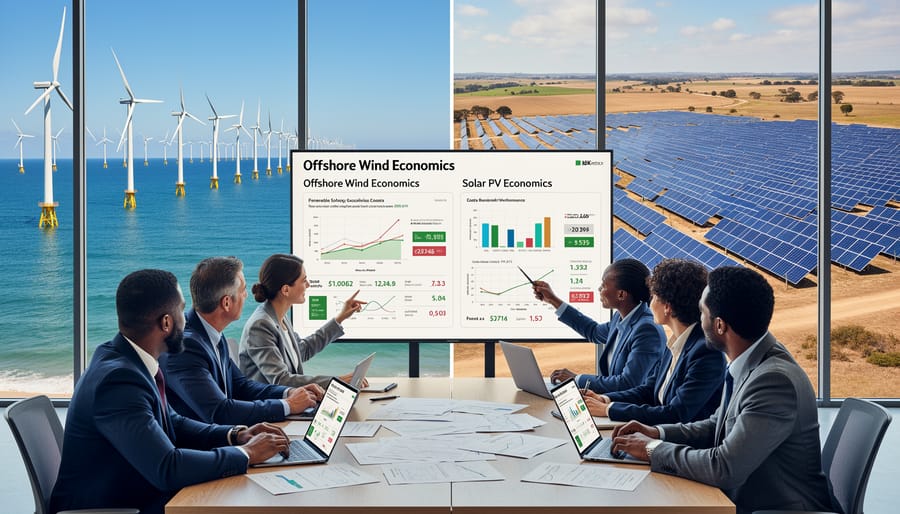
Understanding offshore wind LCOE represents a critical competency for renewable energy professionals across all technology domains, including those specializing in solar photovoltaics. The economic principles governing offshore wind deployment—capital allocation, risk assessment, financing structures, and policy sensitivity—directly translate to solar project development and evaluation. Professionals who comprehend the LCOE framework for offshore wind gain valuable comparative insights that enhance their ability to conduct technology assessments, participate in cross-sector discussions, and contribute meaningfully to integrated renewable energy planning.
For solar PV professionals, offshore wind economics provides essential context for understanding competitive dynamics in electricity markets and policy design. Many jurisdictions implement technology-neutral auctions where offshore wind and solar projects compete directly for contracts, making LCOE literacy across technologies indispensable for effective bidding strategies and market analysis. Furthermore, hybrid renewable energy systems increasingly combine offshore wind with floating solar installations, requiring professionals to evaluate combined economic performance.
Academic programs in renewable energy increasingly emphasize cross-technology competencies, recognizing that graduates must navigate a diversified energy landscape. Universities partnering with renewable energy organizations have developed curricula integrating offshore wind economics alongside solar fundamentals, preparing students for comprehensive roles in energy consulting, policy analysis, and project finance. This interdisciplinary approach ensures that emerging professionals understand how different renewable technologies complement each other technically and economically, fostering innovation in integrated energy solutions and grid management strategies essential for achieving decarbonization objectives.
The declining trajectory of offshore wind LCOE demonstrates how technological maturation, economies of scale, and supportive policy frameworks converge to transform renewable energy markets. As offshore wind costs have decreased by over 60% in the past decade, policymakers worldwide have responded with increasingly sophisticated mechanisms—from competitive auctions to hybrid support structures—that accelerate deployment while managing public expenditure. These developments mirror patterns observed across solar photovoltaic markets, underscoring universal principles of renewable energy economics that transcend specific technologies.
For professionals entering the renewable energy sector, understanding LCOE dynamics across multiple technologies has become essential. The interconnected nature of wind, solar, and energy storage systems in modern grid planning requires expertise that bridges traditional technology silos. Educational programs that integrate comprehensive renewable technology curricula—covering offshore wind economics alongside photovoltaic systems, policy analysis, and grid integration—are increasingly critical for preparing the next generation of energy professionals. These cross-disciplinary approaches equip graduates to navigate complex project development environments where renewable energy careers demand both technical depth and strategic breadth. As the global energy transition accelerates, professionals capable of synthesizing insights from diverse renewable technologies will drive innovation and implementation across the sector.