
The global solar industry generates approximately 250,000 metric tons of photovoltaic panel waste annually, with projections reaching 78 million metric tons by 2050. As this waste increasingly crosses international borders for recycling, refurbishment, or disposal, understanding transboundary movement regulations has become essential for compliance officers, solar professionals, and industry stakeholders navigating the complex intersection of renewable energy expansion and environmental protection.
The Basel Convention on the Control of Transboundary Movements of Hazardous Wastes governs how end-of-life solar panels move between countries, establishing strict protocols for notification, consent, and tracking. When photovoltaic modules containing hazardous materials like lead, cadmium, or selenium cross borders, they trigger regulatory requirements that many solar professionals encounter unexpectedly during decommissioning projects or when seeking cost-effective recycling solutions abroad.
Compliance failures result in substantial penalties, shipment rejections at borders, and reputational damage that can disrupt business operations. The regulatory framework distinguishes between hazardous and non-hazardous waste classifications, with significant implications for permitted destinations, required documentation, and approved transport methods. This classification complexity intensifies as different jurisdictions apply varying standards to identical photovoltaic technologies.
Understanding these regulations addresses three critical professional needs: comprehending the Basel Convention framework that governs international waste shipments, identifying specific compliance requirements for cross-border solar panel movements, and implementing practical procedures that satisfy regulatory obligations while optimizing solar panel waste disposal economics. This knowledge foundation enables photovoltaic professionals to develop compliant waste management strategies that support sustainable industry growth while meeting stringent environmental protection standards across jurisdictions.
Understanding Transboundary Movement of Waste
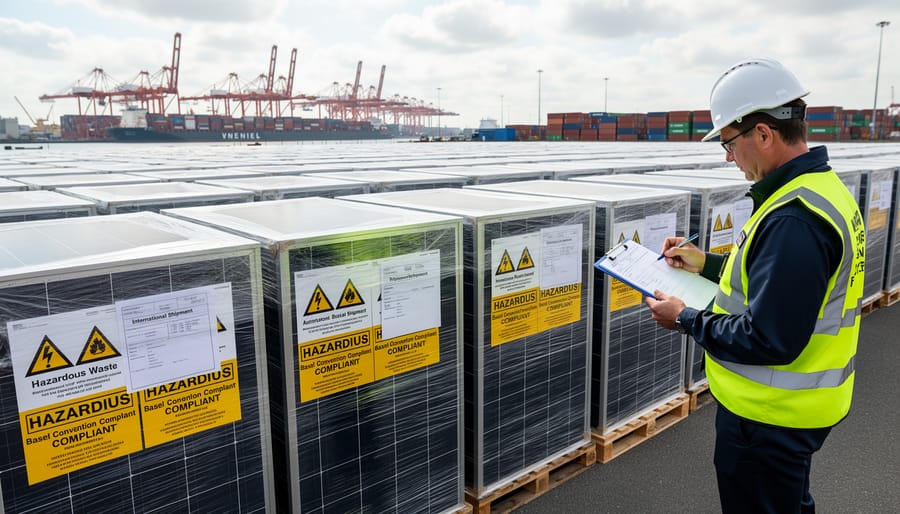
What Qualifies as Transboundary Movement
Transboundary movement of waste occurs when materials cross international borders with the intention of disposal, recovery, or recycling. Under the Basel Convention on the Control of Transboundary Movements of Hazardous Wastes and Their Disposal, this definition applies regardless of whether the materials retain economic value or recyclable components. The critical distinction lies not in market worth but in regulatory classification and intended use.
For photovoltaic materials, the transition from product to waste status depends on several legal thresholds. Decommissioned solar panels destined for dismantling, even when containing recoverable materials like silicon, glass, and precious metals, typically qualify as waste under international law. The Basel Convention requires advance written notification and consent from importing, exporting, and transit countries before movement can proceed. This Prior Informed Consent procedure ensures receiving nations understand the waste characteristics and possess adequate treatment infrastructure.
National regulations further complicate this landscape. The European Union’s Waste Shipment Regulation classifies end-of-life photovoltaic modules as electronic waste, triggering specific documentation requirements. Meanwhile, individual countries may impose stricter thresholds, classifying panels as hazardous waste if they contain lead, cadmium, or other restricted substances above prescribed limits.
Understanding these definitions proves essential for compliance officers and facility operators managing decommissioned solar installations. A panel removed from service becomes waste at the moment its owner discards it or intends disposal, regardless of remaining functionality. This legal framework prevents developed nations from exporting environmental burden under the guise of material recovery, protecting communities in receiving countries from inadequate waste management practices.
Why PV Waste Crosses International Borders
The international movement of photovoltaic waste stems from fundamental economic realities and technological disparities across global markets. Understanding these drivers is essential for professionals navigating the complexities of end-of-life solar panel management.
The primary economic factor propelling PV waste across borders is the uneven distribution of recycling infrastructure. Developed nations with mature solar markets generate substantial volumes of end-of-life panels, yet many lack the specialized facilities required for efficient processing. Countries like Germany and Japan, despite their advanced solar installations, face capacity constraints in domestic recycling operations. Conversely, regions with lower labor costs and established electronics recycling industries, particularly in parts of Asia, have developed expertise in recovering valuable materials from photovoltaic modules.
Cost differentials create powerful incentives for international transfers. Processing a single solar panel domestically can cost between 20 to 30 dollars, while shipping to countries with lower operational expenses may reduce total costs by 40 to 60 percent. These savings become substantial when managing large-scale decommissioning projects involving thousands of panels.
Regional technology specialization further drives transboundary movement. Certain facilities have invested heavily in proprietary processes for extracting high-purity silicon, silver, and rare earth elements from specific panel types. Crystalline silicon modules might be shipped to specialized European processors, while thin-film technologies containing cadmium telluride require facilities equipped with hazardous material handling capabilities.
The concentration of secondary material markets also influences waste flows. Refined silicon and recovered metals command higher prices in manufacturing hubs, making it economically rational to transport waste toward these demand centers. However, this economic logic must operate within the regulatory frameworks established by international agreements, creating tension between profit optimization and environmental protection obligations that compliance officers must carefully navigate.
The Basel Convention Framework
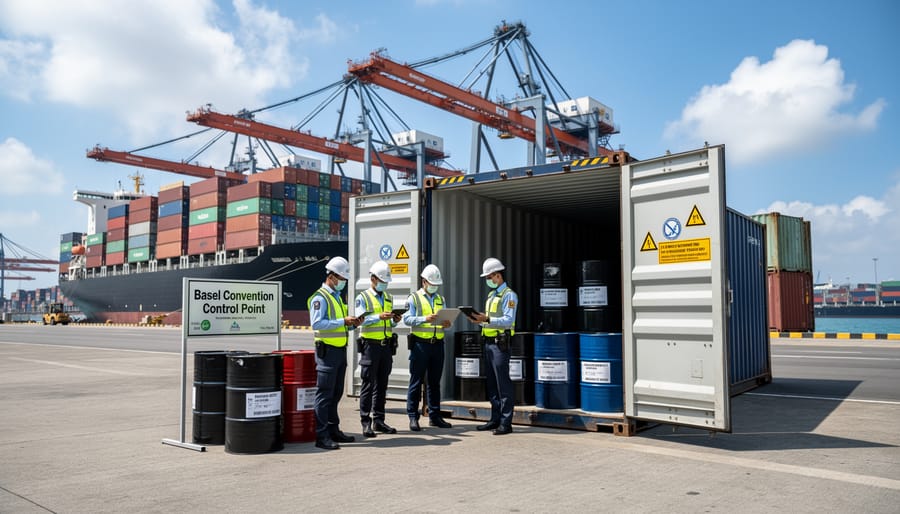
Core Principles and Objectives
The Basel Convention establishes three fundamental principles governing transboundary waste movements that directly impact end-of-life photovoltaic panel management. These core objectives balance international trade facilitation with robust environmental safeguards, creating a framework particularly relevant as global solar installations generate increasing volumes of retired modules.
The primary environmental protection goal mandates that hazardous waste movements minimize risks to human health and ecosystems. For photovoltaic professionals, this principle requires understanding that decommissioned panels containing hazardous substances fall under strict regulatory oversight when crossing international borders. The Convention explicitly aims to reduce waste generation at source and ensure disposal occurs as close to the point of origin as possible, challenging companies to develop domestic recycling infrastructure rather than defaulting to international transfers.
The prior informed consent mechanism represents the Convention’s operational cornerstone. This procedure requires waste exporters to notify and receive explicit authorization from importing and transit countries before shipment begins. Each party maintains sovereignty over accepting or rejecting proposed waste movements, with decisions based on technical capacity and environmental considerations. For solar industry stakeholders, this translates to comprehensive documentation requirements and advance planning timelines that can extend several months.
Environmentally sound management constitutes the third pillar, demanding that all handling, transport, and processing activities employ protective measures preventing releases to air, water, or soil. This principle establishes minimum standards regardless of location, ensuring that exported photovoltaic waste receives treatment comparable to domestic requirements. Compliance officers must verify that receiving facilities possess appropriate permits, technologies, and operational practices before initiating transboundary movements.
Classification of PV Waste Under Basel
The Basel Convention’s classification framework distinguishes photovoltaic waste based on the presence and concentration of hazardous substances, creating significantly different regulatory pathways for various PV technologies. This classification directly determines whether modules can move across borders as controlled hazardous waste or potentially less-restricted non-hazardous materials.
Silicon-based crystalline modules, which dominate approximately 95% of the global market, typically contain lead in solder connections and silver paste. When lead concentrations exceed regulatory thresholds—commonly 1,000 parts per million under many jurisdictions—these panels fall under hazardous waste classifications requiring stringent controls. However, newer lead-free soldering technologies increasingly enable manufacturers to produce silicon modules that may qualify as non-hazardous, substantially simplifying transboundary movement requirements.
Thin-film technologies present more complex classification challenges. Cadmium telluride (CdTe) modules contain cadmium, a highly toxic heavy metal explicitly listed in Basel Convention Annex I. Despite cadmium being encapsulated within the module structure, these panels generally receive hazardous waste classification when reaching end-of-life. Similarly, copper indium gallium selenide (CIGS) modules may contain selenium and other potentially hazardous materials warranting careful evaluation.
The classification implications extend beyond simple categorization. Hazardous designation triggers requirements for prior informed consent procedures, specialized packaging and labeling, restricted transport routes, and approved treatment facilities. Non-hazardous classification permits more flexible movement options, though destination country regulations still apply.
Determining accurate classification requires comprehensive material composition analysis and consideration of both origin and destination country criteria. Some nations apply more stringent classification standards than Basel baseline requirements, creating scenarios where modules classified as non-hazardous in exporting countries face hazardous designation upon import. Industry stakeholders must therefore conduct thorough due diligence, obtaining detailed material declarations from manufacturers and consulting regulatory authorities in both jurisdictions before initiating any transboundary movement.
Notification and Documentation Requirements
Legal transboundary shipment of photovoltaic waste requires strict adherence to notification and documentation protocols established under the Basel Convention framework. The exporting country must submit a written notification to competent authorities in both transit and importing nations, detailing waste characteristics, quantity, intended disposal method, and transportation route. This notification form must include technical specifications of the PV modules, hazardous material content assessments, and intended recycling or disposal facility information.
Movement documents must accompany shipments throughout transit, functioning as tracking mechanisms from generation point to final destination. These documents contain unique shipment identifiers, generator and receiver details, and certification of proper packaging according to international standards. The consent process requires explicit written approval from all involved countries before shipment commences, typically involving a 60-day review period for importing nations to assess environmental and technical capacity.
For photovoltaic professionals, maintaining comprehensive documentation records demonstrates regulatory compliance and facilitates auditing processes. Educational programs emphasizing these procedural requirements prepare industry stakeholders to navigate complex international regulations effectively, ensuring environmentally sound management of end-of-life solar panels across borders.
Basel Compliance Requirements for PV Industry Stakeholders
Manufacturer Responsibilities
Under the Basel Convention framework, photovoltaic manufacturers face growing accountability for end-of-life panel management across international borders. Extended Producer Responsibility (EPR) schemes increasingly require manufacturers to establish take-back programs and financing mechanisms for proper disposal, even when panels cross national boundaries as waste. These obligations mean manufacturers must track their products throughout the supply chain and maintain documentation demonstrating compliance with transboundary movement regulations.
Material disclosure requirements have become central to Basel compliance, particularly as panels transition from functional products to hazardous waste. Manufacturers must provide comprehensive information about panel composition, including potentially hazardous materials like lead, cadmium, and selenium compounds. This transparency enables receiving countries to assess whether imports qualify as hazardous waste under Annex I criteria and helps recycling facilities determine appropriate processing methods.
Design-for-recycling principles directly impact transboundary waste movement feasibility. Panels engineered for material recovery reduce classification disputes at borders and facilitate approval processes. Manufacturers adopting modular designs, standardized materials, and clear labeling create products more likely to gain acceptance for international movement to specialized recycling facilities. This proactive approach minimizes regulatory barriers while supporting circular economy objectives within the global photovoltaic industry.
Exporter and Importer Obligations
Companies engaged in the transboundary movement of photovoltaic waste must fulfill specific obligations under the Basel Convention framework to ensure legal compliance and environmental protection. The process begins with notification requirements, where exporters must submit detailed documentation to the competent authority in their country of origin at least 30 days before shipment. This notification must include comprehensive waste characterization data, intended disposal methods, and complete transportation routing information.
Prior informed consent represents a fundamental requirement, mandating that competent authorities in both transit and destination countries provide written approval before any waste movement occurs. Exporters must maintain continuous communication with these authorities throughout the approval process, which typically spans 60 to 90 days depending on jurisdictional complexity.
Contractual obligations form another critical component. Companies must establish legally binding agreements between exporters, importers, and disposal facilities that clearly delineate responsibilities for waste handling, specify environmentally sound management practices, and outline liability provisions in case of accidents or non-compliance. These contracts must demonstrate that receiving facilities possess appropriate permits and technical capabilities for processing photovoltaic waste.
Movement documentation accompanies each shipment, including the completed movement document that travels with the waste from origin to final destination. This document requires signatures from all parties involved in the chain of custody, creating an auditable trail that competent authorities can verify. Companies should maintain these records for at least three years to demonstrate compliance during regulatory audits and support continuous improvement in their waste management operations.
Recycler Certification and Standards
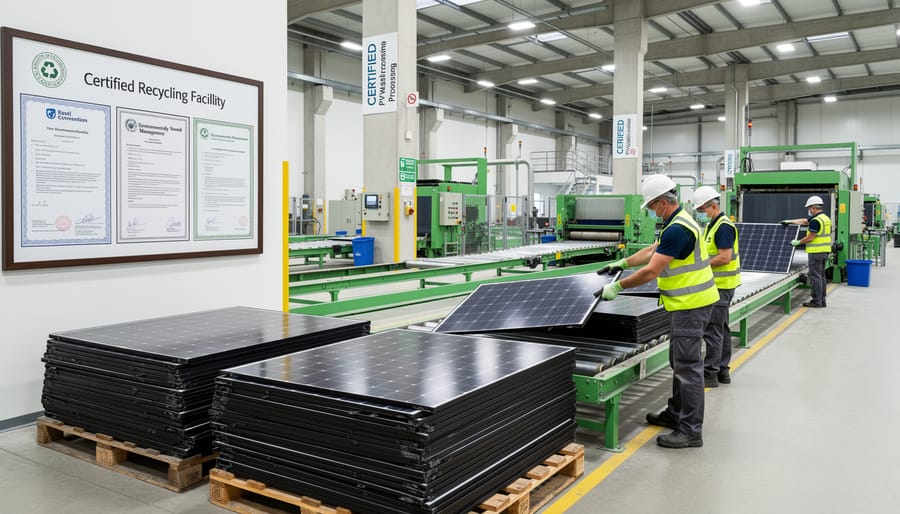
Environmentally sound management (ESM) of photovoltaic waste requires facilities to meet stringent technical and operational standards defined by the Basel Convention’s Technical Guidelines. These standards mandate proper infrastructure for handling hazardous materials, including specialized equipment for safely dismantling panels and recovering valuable materials like silicon, silver, and copper while preventing environmental contamination.
Certified recycling facilities must demonstrate compliance with several key requirements: adequate pollution control systems, worker safety protocols, documented waste tracking procedures, and proven material recovery rates. The Basel Convention influences national certification programs by establishing minimum benchmarks for emissions control, wastewater treatment, and residual waste disposal.
Importing countries typically require receiving facilities to hold recognized certifications such as ISO 14001 for environmental management or industry-specific accreditations like WEEEE compliance in Europe or R2 (Responsible Recycling) certification. Exporters must verify these credentials before initiating transboundary shipments, as Basel’s prior informed consent procedure requires documented proof that destination facilities operate under ESM principles. This verification process protects against waste trafficking to substandard operations that could cause environmental harm or unsafe labor conditions.
Regional Variations and Implementation Challenges
EU Waste Shipment Regulation
The EU Waste Shipment Regulation (Regulation (EC) No 1013/2006) serves as Europe’s primary mechanism for implementing Basel Convention principles while establishing stricter controls for PV waste movement. This regulation categorizes waste shipments into three distinct procedures: green-listed waste requiring minimal documentation, amber-listed waste necessitating prior notification and consent, and red-listed waste prohibited for export to non-OECD countries.
For photovoltaic waste, classification depends on composition and destination. End-of-life solar panels containing hazardous substances typically fall under amber-list procedures when exported outside the EU, requiring comprehensive documentation including waste descriptions, intended recovery operations, and financial guarantees. Intra-EU movements benefit from streamlined processes but still mandate proper notification to competent authorities in transit and destination countries.
The 2023 revision strengthens enforcement mechanisms and introduces digital tracking systems, significantly impacting PV recycling operations. Companies must demonstrate that receiving facilities possess appropriate permits and environmental standards equivalent to EU requirements, ensuring exported panels undergo proper recovery processes rather than contributing to environmental degradation in developing nations.
Implementation in Asia-Pacific Solar Markets
The Asia-Pacific region presents a complex landscape for Basel Convention compliance in photovoltaic waste management, given its dual role as the world’s dominant manufacturing hub and rapidly expanding installation market. China, responsible for over 80% of global solar panel production, ratified the Basel Convention in 1991 and has implemented comprehensive regulations through its Solid Waste Law amendments. However, enforcement varies significantly across provinces, with coastal manufacturing zones demonstrating stricter adherence to transboundary movement protocols than interior regions. The country’s 2021 updates specifically address end-of-life PV modules, requiring prior informed consent documentation for all exports.
India, having ratified Basel in 1992, incorporates transboundary waste provisions within its Hazardous and Other Wastes Management Rules. Despite regulatory frameworks, enforcement remains inconsistent, particularly regarding informal recycling sectors that handle imported crystalline silicon modules without proper authorization. Southeast Asian nations demonstrate even greater variation: while Singapore and Malaysia maintain robust Basel compliance mechanisms, emerging markets like Vietnam and Thailand face capacity challenges in tracking and controlling PV waste flows. This regulatory fragmentation creates compliance risks for international companies, necessitating country-specific due diligence before initiating any cross-border transfers of decommissioned solar equipment within the region.
North American Approach
North America presents a distinctive regulatory landscape for photovoltaic waste management. The United States signed but never ratified the Basel Convention, creating a complex situation where American entities exporting PV waste must comply with recipient country requirements without formal treaty obligations. This means U.S. solar companies shipping end-of-life panels to Basel signatory nations face stringent documentation and notification procedures despite their country’s non-participation status. Canada, conversely, ratified the Basel Convention in 1992 and implements comprehensive controls through the Export and Import of Hazardous Waste and Hazardous Recyclable Material Regulations. Canadian PV waste destined for international recycling requires Environment and Climate Change Canada permits and must meet classification standards under the Transportation of Dangerous Goods Act. The U.S.-Canada bilateral agreement facilitates some cross-border movements, yet differences in hazardous waste classification between the two nations create compliance challenges for solar asset managers operating throughout North America. Understanding these jurisdictional nuances proves essential for developing compliant end-of-life strategies in the region’s growing solar market.
Consequences of Non-Compliance
Legal and Financial Penalties
Violations of transboundary waste regulations carry substantial legal and financial consequences for organizations and individuals. Criminal liability may result in imprisonment for responsible parties, while civil penalties can reach millions of dollars depending on jurisdiction and violation severity. Under the Basel Convention framework, parties face enforcement actions for illegal trafficking, inadequate documentation, or improper notification procedures.
The European Union’s Waste Shipment Regulation imposes fines up to €500,000 per violation, with some member states implementing even stricter penalties. In 2019, Malaysian authorities returned 150 containers of improperly classified waste to originating countries, imposing penalties on shipping companies and exporters involved. Similarly, Indonesian authorities have prosecuted cases where photovoltaic modules were mislabeled as recyclable materials rather than hazardous waste requiring proper authorization.
Companies face reputational damage alongside financial penalties, potentially losing certifications and market access. Compliance officers bear personal liability in many jurisdictions, making thorough understanding of regulations essential. Recent enforcement trends show increased coordination between national environmental agencies and customs authorities, enhancing detection capabilities for illegal shipments. Organizations should implement robust compliance programs, conduct regular audits, and maintain comprehensive documentation to mitigate exposure. Legal counsel specializing in environmental law proves invaluable when navigating complex transboundary waste requirements, particularly as photovoltaic waste volumes continue expanding globally.
Reputational and Business Impacts
Non-compliance with transboundary waste regulations creates significant reputational vulnerabilities that extend far beyond regulatory penalties. Solar companies operating in international markets face heightened scrutiny from environmental, social, and governance (ESG) rating agencies that increasingly incorporate circular economy practices and waste management protocols into their assessments. A single violation of Basel Convention requirements can trigger downgrades in sustainability rankings, directly impacting access to green financing and investor confidence.
For photovoltaic professionals, understanding these business implications is essential for strategic decision-making. Major institutional investors now conduct due diligence on waste management practices before committing capital to renewable energy projects. Companies with documented Basel Convention violations often experience restricted market access in jurisdictions with stringent environmental procurement standards, particularly within the European Union and Japan where circular economy policies govern public sector purchasing decisions.
The renewable energy sector’s credibility depends on demonstrating environmental responsibility throughout product lifecycles. When panel manufacturers or project developers fail to properly document and manage end-of-life module exports, they undermine the industry’s sustainability narrative. This reputational damage proves particularly costly in competitive bidding processes where environmental compliance records increasingly influence contract awards, making proper transboundary waste management not merely a legal obligation but a fundamental business imperative.
Best Practices for Basel-Compliant PV Waste Management
Establishing Compliant Waste Tracking Systems
Establishing robust waste tracking systems forms the cornerstone of Basel Convention compliance for photovoltaic module movements. Proper documentation begins with comprehensive waste identification forms that classify materials according to Basel codes, specify hazardous components like lead or cadmium, and detail the physical and chemical properties of decommissioned panels. These foundational records must accompany shipments throughout their transboundary journey.
Digital tracking solutions have revolutionized chain-of-custody management for PV waste. Electronic manifest systems enable real-time monitoring of shipment locations, verify receipt at designated facilities, and create immutable audit trails. Many jurisdictions now require integration with national waste tracking databases, making digital platforms essential for maintaining transparency across international borders.
Chain-of-custody protocols demand sequential documentation at each transfer point. Generators must issue notification documents containing waste descriptions, quantities, and intended disposal methods. Transporters verify cargo integrity and maintain continuous records during transit. Receiving facilities confirm acceptance and document final processing methods. This unbroken documentation chain protects all parties from liability while demonstrating due diligence to regulatory authorities.
Universities partnering with industry stakeholders increasingly offer specialized training programs covering these documentation requirements, equipping the next generation of PV professionals with practical compliance skills essential for responsible end-of-life management.
Vetting International Recycling Partners
Selecting legitimate recycling partners requires rigorous due diligence to ensure Basel Convention compliance and environmental integrity. Begin by verifying that potential facilities hold appropriate environmental permits and certifications from recognized bodies such as R2 (Responsible Recycling) or e-Stewards. Request documentation demonstrating their legal authorization to import waste in the destination country, including any specific permits for photovoltaic module processing.
Conduct site assessments, either in-person or through third-party audits, to evaluate actual processing capabilities and environmental controls. Reputable facilities should willingly provide transparent information about their recycling processes, recovery rates, and final disposition methods for recovered materials. University research partnerships can offer valuable insights into evaluating technical capabilities of international facilities.
Avoid brokers who cannot provide clear documentation of the waste destination or who offer unusually low processing costs, as these often indicate improper disposal practices. Establish contractual agreements that explicitly require Basel-compliant handling and include provisions for auditing and documentation. Request quarterly reports detailing materials received, processed, and their final markets.
Maintain ongoing monitoring relationships rather than one-time transactions, as consistent partnerships enable better tracking and accountability throughout the recycling chain.

Integrating Compliance into Product Lifecycle Planning
Proactive compliance begins at the product specification stage, well before any physical waste stream emerges. Solar project developers and procurement managers should establish vendor qualification criteria that explicitly address Basel Convention obligations. Request suppliers provide documentation on material composition, hazardous substance content, and established take-back programs that comply with transboundary waste regulations. Installation contracts should clearly delineate responsibilities for decommissioning and waste management, specifying which party bears liability for Basel-compliant disposal or recycling.
Incorporating end-of-life planning from project inception enables more accurate lifetime cost projections and regulatory risk assessment. Financial models should account for potential export restrictions, treatment costs in compliant facilities, and required documentation procedures. Project timelines must accommodate the notification and consent processes mandated by the Basel Convention, which can extend several months depending on destination country requirements.
Educational institutions collaborating with industry can integrate lifecycle compliance frameworks into photovoltaic engineering curricula, preparing future professionals to navigate these regulatory complexities. Establishing standardized protocols for material tracking throughout the value chain ensures seamless compliance when panels eventually require transboundary movement for specialized recycling or disposal facilities.
The Future of Transboundary PV Waste Management
The photovoltaic industry stands at a critical juncture as global solar installations accelerate and early-generation panels approach end-of-life. Recent developments in international waste governance signal significant shifts in how PV waste will cross borders in coming decades.
The Basel Convention’s 2019 plastic waste amendments have intensified scrutiny of all electronic waste streams, including solar panels. Several member states are now advocating for specific PV waste classifications that would establish clearer protocols for transboundary movement. These proposed amendments aim to differentiate between functional panels eligible for reuse and genuinely hazardous waste requiring specialized treatment, reducing ambiguity that currently complicates international transfers.
Circular economy initiatives are reshaping traditional waste management paradigms. The European Union’s Circular Economy Action Plan and similar frameworks in Asia are promoting producer responsibility schemes that incentivize manufacturers to design panels for disassembly and material recovery. These policies encourage legitimate transboundary movement of PV waste to specialized recycling facilities rather than disposal sites, transforming waste into valuable secondary raw materials.
Technological innovations are fundamentally altering economic equations. Advanced automated recycling processes now recover up to 95% of materials from end-of-life panels, including high-purity silicon, silver, and rare metals. This enhanced recovery efficiency makes international transport economically viable, potentially creating specialized regional recycling hubs that serve multiple countries while maintaining Basel Convention compliance.
Blockchain-based tracking systems and digital waste passports are emerging as powerful tools for ensuring transparency throughout international waste streams. These technologies enable real-time monitoring of PV waste shipments, automated compliance verification, and tamper-proof documentation, addressing long-standing enforcement challenges in transboundary waste regulation.
The photovoltaic industry stands at a critical juncture where its environmental promise must extend beyond clean energy generation to encompass responsible end-of-life management. Basel Convention compliance is not merely a legal obligation but a fundamental pillar supporting solar energy’s environmental integrity. As the global installed PV capacity continues its exponential growth, the volume of panels reaching end-of-life will increase proportionally, making proper transboundary waste management an unavoidable priority for industry sustainability.
Education plays a pivotal role in building compliant practices across the solar sector. Universities and specialized training programs must integrate Basel Convention requirements into renewable energy curricula, ensuring that tomorrow’s PV professionals understand their legal responsibilities before entering the field. Current industry stakeholders benefit equally from ongoing professional development that addresses evolving regulatory frameworks and emerging best practices in international waste shipment protocols.
The pathway forward demands collective action from all photovoltaic professionals. Manufacturers must design panels with end-of-life considerations from inception, incorporating material tracking systems that facilitate compliant disposal. Installers and project developers should establish relationships with certified recyclers and document waste streams meticulously. Compliance officers must stay informed about bilateral and multilateral agreements that affect their specific operational jurisdictions.
Environmental integrity in the renewable energy sector cannot be compartmentalized. Every solar panel installed today represents a future waste management challenge that requires planning, investment, and expertise. By prioritizing Basel-compliant practices, maintaining transparent documentation, and committing to continuous education, PV professionals safeguard both regulatory standing and the environmental legitimacy that underpins public support for solar energy expansion. The time to act is now, before end-of-life volumes overwhelm unprepared systems.