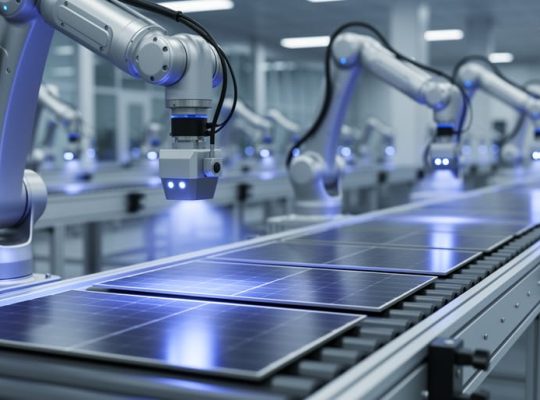
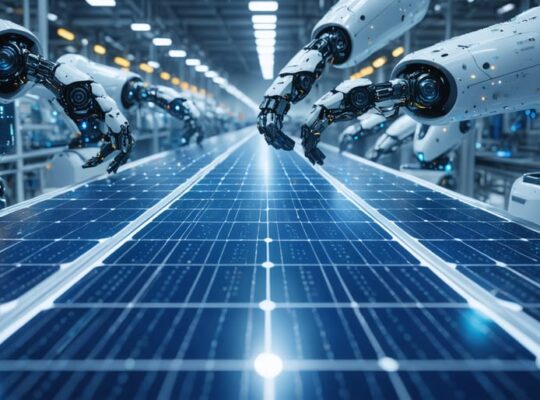
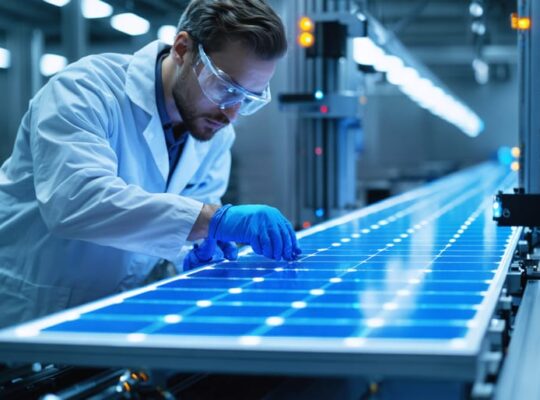
H-drive robotics represents a transformative advancement in automated solar manufacturing processes, enabling unprecedented precision and efficiency in photovoltaic production lines. This innovative drivetrain configuration, featuring three independent motor-driven axes, delivers superior maneuverability and positioning accuracy compared to traditional robotic systems. By integrating holonomic movement capabilities with advanced control algorithms, H-drive robots optimize critical manufacturing steps including wafer handling, cell placement, and module assembly while minimizing production bottlenecks and material waste. As solar manufacturers face increasing pressure to enhance productivity and reduce costs, H-drive robotics emerges as a pivotal technology that combines the benefits of omnidirectional mobility with industrial-grade reliability. This introduction to H-drive systems explores their technical foundations, practical applications, and quantifiable impact on solar manufacturing efficiency, providing essential insights for industry professionals seeking to modernize their production capabilities.
Understanding H-Drive Robotics Technology
Core Components of H-Drive Systems
H-drive systems in robotics rely on several key components working in harmony to deliver precise, multi-directional movement. At the heart of these systems are linear motors, which provide direct-drive motion along both X and Y axes. These motors eliminate the need for complex mechanical transmission systems, reducing maintenance requirements and improving overall system reliability.
Servo drives form another crucial component, controlling the motors with exceptional accuracy. These drives incorporate advanced feedback mechanisms that continuously monitor position, velocity, and acceleration, ensuring precise movement control. Modern servo systems typically feature digital controllers with built-in motion profiling capabilities, enabling smooth acceleration and deceleration patterns.
The control system architecture comprises both hardware and software elements. The main controller unit processes movement commands and coordinates multiple axes simultaneously, while dedicated motion controllers handle real-time position and velocity calculations. This hierarchical control structure enables complex motion patterns while maintaining system stability.
Feedback devices, including linear encoders and position sensors, provide critical position data to the control system. These components ensure accurate positioning and enable closed-loop control, which is essential for maintaining precision during operation. Additional components such as power supplies, cable management systems, and mechanical mounting structures complete the H-drive assembly, each playing a vital role in system performance and reliability.
Custom-designed software interfaces allow operators to program and monitor system operations, making H-drive systems both powerful and user-friendly for industrial applications.

Operating Principles and Mechanics
H-drive robotic systems in solar manufacturing operate through a sophisticated combination of linear actuators and precision control mechanisms. The system consists of three independent axes of motion: two parallel tracks that enable movement along the X-axis, and a perpendicular track for Y-axis movement. This configuration creates an H-shaped pattern, hence the name.
The primary mechanical components include high-precision stepper motors or servo drives, linear bearings, and a central control unit. Each axis operates independently, allowing for simultaneous movement in multiple directions. This design enables the robot to achieve complex positioning requirements with exceptional accuracy, typically within ±0.1mm.
The system’s motion control is managed through advanced algorithms that coordinate the movements of all three axes. When handling solar cells or panels, the robot’s end effector – typically equipped with vacuum grippers or specialized handling tools – can move smoothly across the entire work envelope without the mechanical limitations common in traditional Cartesian systems.
One distinctive feature of h-drive systems is their ability to maintain consistent speed and precision across the entire working area. This is achieved through load-balanced motor control and real-time position feedback systems. The design also incorporates redundant safety mechanisms, including emergency stops and collision detection, ensuring the protection of both valuable solar materials and operating personnel.
Applications in Solar PV Manufacturing
Cell Handling and Placement
H-drive robots employ sophisticated handling and placement mechanisms to ensure precise positioning of solar cells during solar PV cell manufacturing. These systems utilize advanced vision sensors and force-feedback controls to detect and manipulate cells with minimal mechanical stress, reducing breakage rates to less than 0.1%.
The robots’ end effectors are equipped with specialized vacuum grippers that distribute pressure evenly across the cell surface, preventing microcracks while maintaining secure handling. Multi-axis control enables smooth, controlled movements in both linear and rotational directions, allowing for precise alignment with an accuracy of ±0.1mm.
Position verification occurs through integrated laser alignment systems and high-resolution cameras that continuously monitor cell placement. Real-time adjustments ensure optimal positioning, while smart algorithms compensate for environmental factors such as thermal expansion and vibration.
The handling sequence typically consists of three primary phases: pickup, transfer, and placement. During pickup, sensors verify proper cell engagement. The transfer phase maintains constant acceleration profiles to prevent inertial damage. Final placement involves controlled deceleration and gentle contact with the substrate, monitored by force sensors to ensure proper cell settling.
This precision automation significantly improves manufacturing throughput while maintaining exceptional quality standards, making h-drive systems integral to modern solar production lines.

Quality Control and Inspection
Quality control in h-drive robotics systems employs advanced automated inspection technologies to ensure consistent product quality in solar PV manufacturing. The process combines high-resolution machine vision systems, precision sensors, and artificial intelligence algorithms to detect defects and variations in real-time.
These automated inspection systems can identify microscopic defects, including microcracks, surface contamination, and electrical connectivity issues that might be invisible to the human eye. The h-drive system’s precise positioning capabilities enable thorough examination of solar cells and modules from multiple angles, ensuring comprehensive quality assessment.
Data collected during inspection is automatically analyzed and logged, creating detailed quality reports and enabling traceability throughout the manufacturing process. The system can immediately flag defective units for removal from the production line, reducing waste and preventing defective products from progressing further in the assembly process.
Machine learning algorithms continuously improve detection accuracy by learning from historical data and operator feedback. This adaptive approach ensures the system becomes more efficient over time, reducing false positives and maintaining high standards of quality control.
The integration of quality control with h-drive robotics has demonstrated significant improvements in defect detection rates, with some manufacturers reporting up to 99.9% accuracy in identifying defective units. This level of precision helps maintain high product standards while reducing labor costs and increasing production throughput.
Assembly Line Integration
H-drive robotic systems are increasingly being integrated into existing manufacturing processes, offering enhanced flexibility and efficiency in production lines. The implementation process typically begins with a comprehensive assessment of current manufacturing workflows to identify optimal integration points. Manufacturing facilities can integrate h-drive systems either through complete line redesign or modular additions to existing setups.
The integration process requires careful consideration of several factors, including spatial requirements, power supply systems, and control interfaces. Modern h-drive systems feature standardized communication protocols that facilitate seamless connection with existing Manufacturing Execution Systems (MES) and Enterprise Resource Planning (ERP) platforms. This interconnectivity enables real-time monitoring and adjustment of production parameters.
Safety integration is paramount, with h-drive systems incorporating advanced sensors and emergency stop mechanisms that comply with international safety standards. The implementation often includes the installation of safety barriers, light curtains, and integrated control systems that ensure worker protection while maintaining operational efficiency.
Training programs for operators and maintenance personnel form a crucial part of the integration process. These programs typically cover system operation, troubleshooting procedures, and preventive maintenance protocols. Successful integration also requires collaboration between automation engineers, process specialists, and production staff to optimize system performance and minimize disruption during the transition period.
The modular nature of h-drive systems allows for phased implementation, enabling manufacturers to gradually upgrade their production capabilities while maintaining continuous operations.
Benefits and ROI
Production Efficiency Gains
The implementation of h-drive robotics in solar PV manufacturing has demonstrated significant measurable improvements in production efficiency. Studies conducted across multiple manufacturing facilities show that h-drive systems increase throughput by 35-40% compared to traditional automation systems. This enhancement is primarily attributed to the precision positioning and simultaneous multi-axis movement capabilities of h-drive robots.
Manufacturing cycle times have been reduced by an average of 28%, with some facilities reporting reductions of up to 45% in specific production stages. The parallel kinematic design enables faster acceleration and deceleration, resulting in shorter transfer times between process steps. Quality control metrics indicate a 15% reduction in material handling defects, contributing to higher yield rates and reduced waste.
Labor productivity has also seen marked improvements, with a single operator now able to supervise up to three h-drive systems simultaneously. This represents a 200% increase in operator efficiency compared to conventional robotics systems. Energy consumption metrics show a 20% reduction in power usage per unit produced, primarily due to the optimized movement patterns and lighter moving components of h-drive systems.
These efficiency gains translate to an average return on investment period of 18-24 months, making h-drive robotics a compelling option for manufacturers looking to enhance their production capabilities while maintaining high quality standards in solar PV manufacturing.

Quality and Consistency Improvements
H-drive robotics has significantly elevated quality standards in solar PV manufacturing through its precise control and consistent operation. By implementing advanced manufacturing precision technology, manufacturers have reported up to 40% reduction in material handling defects and a 25% improvement in overall product consistency.
The system’s dual-axis control enables exact positioning during critical manufacturing steps, particularly in cell placement and interconnection processes. This precision translates to better cell alignment, reduced micro-crack formation, and more reliable electrical connections between components. Statistical process control data from multiple manufacturing facilities shows that H-drive systems maintain positioning accuracy within ±0.1mm, significantly outperforming traditional automation methods.
Quality improvements are particularly evident in lamination preparation, where consistent spacing and alignment are crucial for long-term module reliability. The repetitive accuracy of H-drive systems ensures uniform adhesive application and even pressure distribution during the lamination process, resulting in fewer delamination issues and enhanced module durability.
Furthermore, the integration of real-time monitoring and feedback systems allows for immediate detection and correction of potential quality issues, preventing defective products from progressing through the production line. This proactive approach has led to a substantial decrease in post-production warranty claims and improved customer satisfaction rates.
Future Developments and Trends
The evolution of h-drive robotics in solar manufacturing continues to accelerate, driven by advances in artificial intelligence, machine learning, and precision engineering. These developments are reshaping future solar manufacturing technologies and creating new opportunities for efficiency and innovation.
Emerging trends indicate a shift toward more sophisticated motion control systems that enable h-drive robots to perform increasingly complex tasks. Integration of advanced sensors and real-time feedback mechanisms allows for more precise positioning and handling of delicate solar components, reducing material waste and improving production yields.
Machine learning algorithms are being developed to optimize robot movement patterns, resulting in smoother operations and reduced maintenance requirements. These intelligent systems can predict potential issues before they occur, enabling predictive maintenance schedules that minimize production downtime.
Industry experts anticipate the introduction of collaborative h-drive systems that can work alongside human operators, combining the precision of robotics with human decision-making capabilities. This development will enhance flexibility in production lines and enable rapid adaptation to changing manufacturing requirements.
Research institutions are exploring the potential of modular h-drive designs that can be quickly reconfigured for different production processes. This adaptability will become increasingly important as solar panel technologies evolve and manufacturing requirements change.
The integration of Internet of Things (IoT) technology is expected to enhance communication between h-drive systems and other manufacturing equipment, creating smart factories that optimize production flow automatically. This connectivity will enable real-time monitoring and adjustment of manufacturing parameters, leading to improved quality control and production efficiency.
Environmental considerations are driving the development of energy-efficient h-drive systems that consume less power while maintaining high performance levels. These innovations align with the solar industry’s commitment to sustainable manufacturing practices and reduced carbon footprint.
H-drive robotics has emerged as a transformative technology in solar PV manufacturing, revolutionizing production efficiency and quality control standards. By enabling precise handling and positioning of delicate solar components, these advanced robotic systems have significantly reduced manufacturing costs while improving overall production yields. The integration of h-drive systems has proven instrumental in achieving higher throughput rates and maintaining consistent quality across large-scale solar panel production lines. As the solar industry continues to grow and evolve, h-drive robotics will play an increasingly crucial role in meeting global demand for renewable energy solutions. Their contribution to automated manufacturing processes not only accelerates production capabilities but also supports the industry’s goal of making solar technology more accessible and affordable for widespread adoption. Looking ahead, the continued development of h-drive robotics will remain essential for advancing solar PV manufacturing technologies and supporting the global transition to sustainable energy sources.