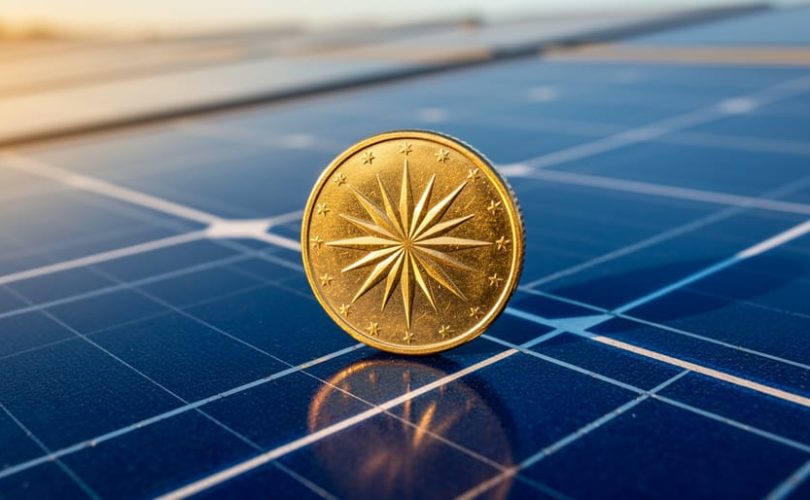
The blockchain revolution has introduced gold-backed stablecoins as a compelling bridge between traditional commodity investments and digital finance, offering price stability anchored to physical gold reserves. Each token represents a specific amount of gold—typically one gram or one troy ounce—stored in audited vaults, combining the tangible security of precious metals with the efficiency of cryptocurrency transactions.
This proven model of asset-backed tokenization now extends beyond precious metals into renewable energy infrastructure. The same blockchain mechanisms that verify gold reserves and enable fractional ownership can transform how solar photovoltaic projects attract capital and distribute returns. Understanding gold-backed stablecoins provides essential context for emerging solar asset tokenization platforms that democratize access to clean energy investments.
For photovoltaic professionals and renewable energy stakeholders, the parallels are striking: both systems convert physical assets into tradeable digital units, maintain transparent reserve verification, and reduce transaction friction compared to traditional markets. Gold-backed tokens have already demonstrated institutional acceptance, regulatory pathways, and market stability—lessons directly applicable to solar-backed financial instruments.
The transition from commodity-backed to energy-backed tokens represents more than technical innovation. It signals a fundamental shift in renewable energy finance, where distributed generation assets become liquid, divisible investment vehicles accessible to retail and institutional investors alike. As the photovoltaic industry scales globally, understanding these financing mechanisms becomes critical for professionals navigating the intersection of clean energy deployment and blockchain technology.
The Financial Gap Holding Solar Energy Back
Solar photovoltaic infrastructure presents a paradox: while technology costs have declined significantly over the past decade, the financing gap continues to impede widespread deployment. The barrier is not technological capability but rather the capital structure required to fund solar installations at scale.
The primary challenge lies in the substantial upfront investment solar projects demand. Commercial-scale PV installations typically require millions in initial capital, while even residential systems represent significant outlays for property owners. This front-loaded cost structure creates immediate liquidity pressures that traditional financing models often struggle to accommodate efficiently.
Return on investment timelines compound this difficulty. Solar assets generally require 7-15 years to achieve full payback, depending on installation size, geographic location, and energy pricing structures. While these assets deliver reliable long-term returns through predictable energy generation, the extended timeline creates misalignment with conventional investment vehicles that prioritize shorter liquidity cycles.
Furthermore, existing financing mechanisms effectively exclude small-scale investors from participating in solar infrastructure development. Institutional investment vehicles, project bonds, and commercial lending facilities establish minimum capital thresholds that place meaningful participation beyond reach for individual investors and community-level stakeholders. This exclusion represents both a missed opportunity for portfolio diversification and an untapped capital pool for renewable energy expansion.
The renewable energy sector’s financing needs diverge fundamentally from traditional infrastructure models in several key aspects. Solar projects generate fractional, distributed returns through daily energy production rather than single revenue events. They require mechanisms that can efficiently aggregate small investments, provide reasonable liquidity options, and maintain transparent valuation tied to tangible asset performance.
Academic research from renewable energy finance programs increasingly highlights this structural mismatch. Universities collaborating with industry stakeholders have documented how conventional debt and equity instruments fail to optimize capital allocation for distributed energy resources, creating artificial constraints on deployment velocity despite favorable project economics and environmental imperatives.
Gold-Backed Stablecoins: A Proven Model for Asset-Based Currency
How Commodity-Backed Cryptocurrencies Work
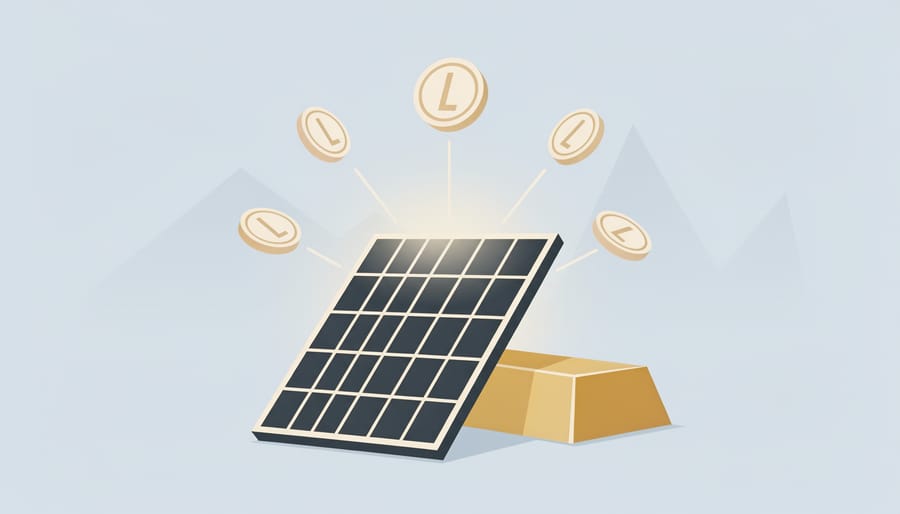
Commodity-backed cryptocurrencies operate through a transparent framework that links digital tokens to physical assets, with each token representing ownership of a specific quantity of the underlying commodity. In the case of gold-backed stablecoins, one token typically corresponds to a predetermined weight of physical gold, such as one gram or one troy ounce, held in secure vaults by custodian institutions.
The verification system forms the foundation of credibility for these digital assets. Independent third-party auditors conduct regular inspections of physical reserves to confirm that the amount of gold in storage matches the number of tokens in circulation. These verification reports are typically published quarterly or monthly, providing stakeholders with documented evidence of the one-to-one backing ratio. Academic institutions and financial research organizations have increasingly studied these mechanisms, validating their potential applications across various sectors including renewable energy finance.
Reserve auditing follows stringent protocols similar to traditional financial systems. Certified auditors examine vault contents, verify chain-of-custody documentation, and assess security measures protecting the physical assets. This process ensures transparency and builds investor confidence, principles equally applicable to blockchain energy trading platforms and other asset-backed digital instruments.
The redemption process allows token holders to exchange their digital assets for physical gold or its equivalent value. Users initiate redemption requests through the issuing platform, which then coordinates delivery or liquidation according to predetermined terms. Minimum redemption thresholds typically apply, with processing times ranging from several days to weeks depending on logistical requirements. This bidirectional convertibility between digital and physical forms establishes market confidence and price stability, creating a proven model that innovative financing mechanisms for renewable energy projects can adapt to support sustainable infrastructure development.
Why Gold Became the First Commodity Choice
Gold’s emergence as the first commodity backing stablecoins stems from millennia of trust in its monetary properties. Unlike fiat currencies subject to inflationary pressures, gold has maintained purchasing power across civilizations, making it an intuitive anchor for digital asset stability. This historical precedent provided cryptocurrency developers with a proven framework when seeking alternatives to volatile digital tokens.
The transition of gold into blockchain ecosystems occurred as innovators recognized that tokenization could address traditional gold investment limitations. Physical gold storage incurs significant costs and security concerns, while gold-backed tokens enable fractional ownership, instant global transfers, and transparent auditing through blockchain technology. Each token represents a specific quantity of physical gold held in secure vaults, with smart contracts ensuring redeemability.
Early gold-backed stablecoin projects established critical precedents for commodity tokenization. They demonstrated how third-party audits, regulatory compliance frameworks, and custodial arrangements could build investor confidence in asset-backed digital tokens. These projects proved that tangible assets could successfully bridge traditional commodity markets with decentralized finance.
For renewable energy professionals exploring solar-backed alternatives, gold’s pathway offers valuable lessons. The success of gold tokenization relied on standardized measurement units, verifiable reserves, and established market valuation mechanisms. Similarly, solar energy assets require clear metrics for energy production verification, transparent ownership records, and standardized valuation methodologies. Academic institutions collaborating with industry stakeholders continue researching these frameworks, developing educational programs that prepare photovoltaic professionals to implement next-generation financing models based on proven commodity-backed token principles.
Solar-Backed Stablecoins: Tokenizing Renewable Energy Production
What Backs a Solar Stablecoin?
Unlike gold-backed stablecoins that derive value from physical gold reserves, solar stablecoins require innovative backing mechanisms tied to renewable energy infrastructure and production. Understanding these diverse approaches reveals how tokenized solar assets create verifiable value in the digital economy.
The primary backing mechanism centers on installed solar capacity, measured in kilowatts (kW) or megawatts (MW). Each token represents ownership or rights to specific photovoltaic infrastructure, with values tied to the nameplate capacity of solar installations. This approach provides tangible, measurable backing similar to gold’s weight-based valuation.
Energy production backing offers another robust model. Tokens represent actual kilowatt-hours (kWh) generated by solar arrays over defined periods. This mechanism directly links token value to energy output, creating market-responsive pricing based on production efficiency, weather patterns, and operational performance. Advanced metering infrastructure and blockchain oracles ensure transparent, real-time verification of generation data.
Carbon credit backing presents a third alternative, where tokens derive value from verified emissions reductions or renewable energy certificates (RECs). As solar installations displace fossil fuel generation, they produce measurable environmental benefits quantified through established carbon accounting frameworks. These credits trade in regulated markets, providing liquid, internationally recognized value backing.
Physical infrastructure backing encompasses the most comprehensive approach, incorporating solar panels, inverters, mounting systems, and entire installations as collateral. This model mirrors gold-backed stablecoins most closely, with independent audits verifying the existence and condition of physical assets. Universities and research institutions increasingly validate these systems through collaborative verification programs, enhancing credibility and stakeholder confidence. Combined backing mechanisms utilizing multiple value sources offer enhanced stability and risk diversification for solar-backed digital currencies.
Measuring and Verifying Solar Assets
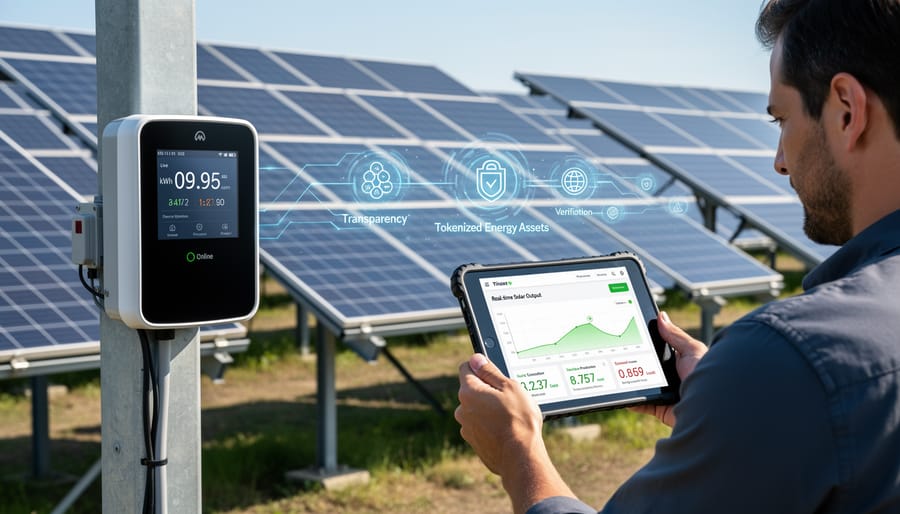
Establishing credible verification systems represents a fundamental requirement for solar-backed digital tokens, paralleling the rigorous auditing processes used in gold-backed stablecoins. The integration of Internet of Things sensors, smart meters, and blockchain oracles creates a transparent infrastructure that continuously validates energy production data.
IoT sensors installed at photovoltaic installations capture granular production metrics including irradiance levels, panel temperature, voltage output, and overall system performance. These devices transmit real-time data through secure communication protocols, creating an immutable record of actual energy generation. Smart meters complement this ecosystem by measuring electricity flow at critical junctures, providing independent verification that corroborates sensor readings and confirms energy delivery to the grid or storage systems.
Blockchain oracles serve as the critical bridge between physical solar assets and digital token platforms. These specialized software applications retrieve verified production data from IoT networks and smart meters, then relay this information to blockchain networks where tokens are issued and managed. Leading oracle solutions employ cryptographic signatures and multi-source validation to prevent data manipulation, ensuring that each token accurately represents a specific quantity of generated solar energy.
Universities collaborating on renewable energy research have contributed significantly to developing standardized verification protocols. Their academic rigor helps establish industry-wide benchmarks for measurement accuracy and data integrity. Educational programs now incorporate training on these verification technologies, preparing professionals to implement and maintain transparent solar asset monitoring systems.
The verification infrastructure must address temporal considerations inherent to solar generation. Unlike gold stored in vaults, solar energy production fluctuates with weather conditions and seasonal variations. Advanced verification systems therefore incorporate predictive analytics and historical performance data, enabling token issuers to maintain appropriate reserve ratios while maximizing capital efficiency. This continuous monitoring framework provides stakeholders with unprecedented transparency, fostering confidence in solar-backed financial instruments comparable to traditional commodity-backed stablecoins.
How Solar Stablecoins Transform Renewable Investment
Fractional Ownership of Solar Infrastructure
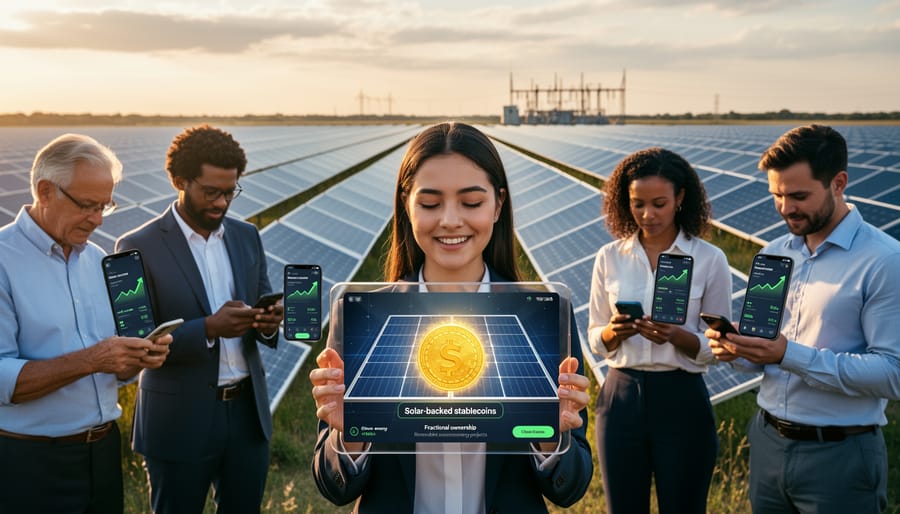
Tokenization technology fundamentally transforms access to solar infrastructure investments by enabling fractional ownership models that democratize participation in large-scale photovoltaic installations. Traditionally, utility-scale solar projects requiring millions in capital remained accessible only to institutional investors and high-net-worth individuals. Through blockchain-based tokenization, these substantial assets can be divided into smaller, tradeable units, allowing investors to purchase shares proportional to their budget—whether $100 or $100,000.
This fractional approach parallels peer-to-peer solar financing models while introducing enhanced liquidity and transparency through distributed ledger technology. Small investors gain exposure to professionally managed solar portfolios without assuming the full financial burden and technical complexity of ownership. Risk distribution across multiple investors and potentially diverse geographic locations reduces individual exposure to localized factors such as weather variability or regional policy changes.
The mechanism operates through security tokens representing ownership stakes in specific solar installations or pooled portfolios. Token holders receive proportional returns from electricity sales or renewable energy credits, with smart contracts automating dividend distributions and ensuring transparent accounting. This structure has attracted attention from academic institutions researching renewable energy finance innovation and from educational programs training the next generation of photovoltaic professionals in digital finance applications. By lowering minimum investment thresholds from hundreds of thousands to potentially hundreds of dollars, tokenized fractional ownership expands the investor base while channeling capital toward renewable energy infrastructure development.
Liquidity for Long-Term Energy Assets
Solar energy projects traditionally face significant liquidity challenges due to their long-term operational horizons spanning 20-25 years. Gold-backed stablecoins provide a proven framework for addressing this fundamental limitation in photovoltaic investments. By tokenizing solar assets on blockchain platforms, project developers can create fractional ownership opportunities that transform illiquid infrastructure into tradeable digital securities.
This tokenization model enables investors to exit their positions without waiting for complete project lifecycles or panel degradation curves to conclude. The mechanism works by dividing solar installations into digital tokens representing ownership shares, much like gold-backed stablecoins represent fractional claims on physical bullion reserves. Each token corresponds to specific energy generation capacity or revenue streams from power purchase agreements.
Secondary markets for these solar-backed tokens allow participants to trade positions based on real-time performance data, evolving solar ROI metrics, and changing market conditions. This liquidity premium reduces the risk premium traditionally required for renewable energy investments, potentially lowering the cost of capital for new projects.
Academic research collaborations are examining how token liquidity affects investment behavior in long-duration assets. Educational programs now incorporate blockchain-enabled financing structures, preparing the next generation of photovoltaic professionals to navigate these hybrid financial instruments. The enhanced liquidity ultimately democratizes access to solar investments while providing exit flexibility previously unavailable in conventional renewable energy financing structures.
Funding Solar Projects Through Token Sales
Solar developers traditionally rely on bank loans, venture capital, or project finance to fund installations—often facing lengthy approval processes and stringent collateral requirements. Token sales offer an alternative pathway by enabling developers to pre-sell future energy production as digital assets. Through this mechanism, investors purchase tokens representing future kilowatt-hours or renewable energy credits, providing upfront capital while the project is still under construction.
This approach democratizes access to solar financing, allowing smaller developers to tap into global capital markets without intermediaries. University research partnerships have demonstrated that tokenized energy sales can reduce financing costs by 15-30% compared to conventional debt instruments. Investors gain exposure to renewable energy assets with transparent, blockchain-verified production data, while developers secure funding without diluting equity ownership. The model parallels gold-backed stablecoins’ success in creating liquid, verifiable assets—applying similar principles to measurable solar energy output. Early adopters in emerging markets have successfully funded community-scale projects ranging from 500kW to 5MW installations using this innovative capital formation strategy.
Real-World Applications and Current Initiatives
The translation of commodity-backed token principles to renewable energy markets has progressed from theoretical frameworks to operational implementations. Several pioneering initiatives demonstrate how tokenization models, informed by gold-backed stablecoin mechanics, can facilitate solar energy financing and trading.
Power Ledger, an Australian energy technology company, has developed a blockchain-based platform enabling peer-to-peer renewable energy trading in multiple countries. Their system tokenizes energy production, allowing solar prosumers to trade excess electricity directly with consumers through verifiable digital tokens. Pilot programs in Western Australia and Thailand have successfully validated transaction scalability, processing thousands of energy trades while maintaining regulatory compliance.
The WePower platform has implemented energy tokenization across European markets, converting future renewable energy production into tradable digital assets. Energy producers can pre-sell electricity generation through tokens representing megawatt-hours, providing upfront capital for photovoltaic installations. This approach has facilitated financing for commercial-scale solar projects while offering buyers price stability through forward contracts executed via smart contracts.
In academic settings, the MIT Energy Initiative has partnered with industry stakeholders to research distributed ledger applications in renewable energy markets. Their collaborative research examines how asset-backed tokens can reduce transaction costs in renewable energy certificate markets and improve grid integration of distributed solar resources. These university partnerships are generating empirical data on tokenization efficiency and market adoption barriers.
The Brooklyn Microgrid project exemplifies community-scale implementation, utilizing blockchain technology to enable local solar energy trading among residential participants. This initiative demonstrates how tokenized energy systems can operate within existing regulatory frameworks while providing transparent, verifiable transactions.
Several European utilities are piloting energy attribute certificates on blockchain platforms, creating standardized digital representations of renewable energy generation. These certificates function similarly to commodity-backed tokens, maintaining verifiable links to physical energy production while enabling efficient trading and retirement processes.
Educational programs accompanying these initiatives are preparing professionals for evolving energy markets. Technical training modules address blockchain fundamentals, smart contract development, and regulatory compliance specific to tokenized renewable energy assets. These programs equip photovoltaic professionals with skills necessary to implement and manage next-generation financing mechanisms, ensuring the industry develops qualified expertise alongside technological infrastructure.
These real-world applications collectively establish proof of concept for energy-backed digital assets, demonstrating technical feasibility and market viability while identifying refinement opportunities for broader adoption.
Challenges and Considerations for the PV Industry
Regulatory Frameworks for Energy Tokens
The regulatory landscape for energy tokens remains fragmented across global jurisdictions, presenting both challenges and opportunities for renewable energy financing innovation. Unlike gold-backed stablecoins, which benefit from centuries of established commodity trading frameworks, tokenized energy assets occupy a regulatory gray area that requires careful navigation.
In the United States, the Securities and Exchange Commission has yet to provide definitive guidance on whether energy-backed tokens constitute securities, commodities, or a distinct asset class. This uncertainty affects how solar energy tokens can be marketed, traded, and utilized within investment portfolios. The European Union’s Markets in Crypto-Assets Regulation framework offers more clarity, potentially classifying energy tokens as asset-referenced tokens subject to specific reserve requirements and transparency standards.
Asian markets demonstrate varied approaches, with Singapore’s progressive stance through the Monetary Authority of Singapore contrasting with more restrictive positions elsewhere. Academic institutions, including leading universities collaborating on blockchain research, have advocated for harmonized international standards that recognize the unique characteristics of renewable energy assets.
The classification challenge centers on whether energy tokens represent ownership stakes, future energy production rights, or tradable environmental attributes. This distinction significantly impacts taxation, investor protection requirements, and cross-border transferability. Industry stakeholders emphasize the need for regulatory frameworks that balance innovation with consumer protection while acknowledging that energy assets possess fundamentally different characteristics than precious metals. Clear regulatory pathways will prove essential for scaling solar investment mechanisms and attracting institutional capital to renewable energy projects through tokenization models.
Standardization Across Solar Technologies
Establishing standardized valuation metrics for solar-backed digital assets presents significant technical challenges due to the heterogeneity of photovoltaic technologies and deployment contexts. Unlike gold, which maintains consistent purity standards globally, solar energy generation varies substantially based on panel technology, geographic location, and operational conditions.
Monocrystalline panels typically achieve 17-22% efficiency, while multi-crystalline variants range from 15-18%, and advanced Passivated Emitter and Rear Cell (PERC) technology can exceed 22% under optimal conditions. These efficiency differentials directly impact the energy output valuation that would underpin tokenization models. A stablecoin backed by monocrystalline installations in Arizona would inherently differ from one secured by multi-crystalline arrays in Germany due to both technology performance and solar irradiance levels.
Geographic variations compound this complexity. Regions with peak sun hours exceeding 6.0 kWh/m²/day generate substantially more value per installed watt than areas averaging 3.5 peak sun hours. This geographic disparity necessitates sophisticated normalization formulas that account for capacity factors, which typically range from 15-25% depending on location.
Industry stakeholders and academic researchers collaborating through university partnerships are developing standardized Performance Ratio metrics and capacity-weighted valuation frameworks. These initiatives aim to create transparent benchmarks similar to gold’s spot pricing mechanism, enabling investors to assess solar-backed tokens with confidence. However, achieving consensus across diverse technological platforms and climatic zones remains an ongoing challenge requiring continued interdisciplinary research and international coordination among renewable energy finance innovators.
What This Means for Photovoltaic Professionals
The convergence of blockchain-based financial instruments and renewable energy infrastructure is creating unprecedented career pathways for photovoltaic professionals. As solar-backed stablecoins emerge from the proven framework of commodity-backed digital currencies, PV experts who understand both energy systems and tokenization mechanics will become increasingly valuable to project developers, investment firms, and energy companies.
For aspiring professionals in the photovoltaic sector, this evolution demands expanded competencies beyond traditional solar engineering and installation expertise. Understanding how energy generation data translates into verifiable digital assets requires knowledge of metering systems, blockchain oracles, and smart contract functionality. Universities are beginning to incorporate these interdisciplinary topics into renewable energy programs, recognizing that tomorrow’s industry leaders must navigate both kilowatt-hours and cryptocurrency protocols.
Career opportunities are emerging across multiple domains. Energy asset managers now seek professionals who can quantify solar production for tokenization purposes, while blockchain development teams require PV specialists to ensure accurate representation of generation capacity. Regulatory compliance roles are expanding as governments establish frameworks for energy-backed digital assets, creating demand for experts who understand both renewable energy standards and financial regulations.
Educational institutions collaborating with industry partners are developing specialized programs that bridge this knowledge gap. These offerings combine photovoltaic system design, energy economics, and distributed ledger technology, preparing professionals to participate in innovative financing structures that could accelerate solar deployment globally.
For current PV professionals, pursuing continuing education in blockchain fundamentals and digital asset management positions you advantageously as these financing mechanisms mature. The integration of proven stablecoin models with solar infrastructure represents not merely a technological novelty, but a fundamental shift in how renewable energy projects achieve financial viability and scale.
The evolution from gold-backed stablecoins to solar-backed digital assets represents a significant paradigm shift in how we conceptualize value storage and environmental responsibility. While gold has served as humanity’s trusted store of value for millennia, renewable energy assets offer a compelling alternative that addresses both financial stability and climate imperatives. Solar-backed stablecoins leverage the same proven blockchain infrastructure and tokenization principles that have made precious metal-backed cryptocurrencies successful, but anchor their value to verifiable, income-generating photovoltaic installations rather than inert commodities.
This transition positions renewable energy not merely as an environmental necessity but as a legitimate financial asset class with measurable, predictable returns. For photovoltaic professionals, understanding these emerging financing mechanisms is no longer optional—it constitutes essential industry knowledge that intersects technical expertise with financial innovation. As institutional investors increasingly seek sustainable alternatives to traditional commodities, solar assets backed by transparent blockchain verification offer unprecedented opportunities for project financing and market expansion.
The integration of educational institutions in developing standardized frameworks for solar asset tokenization further validates this evolution, ensuring that emerging professionals enter the field equipped with comprehensive knowledge spanning both technical and financial domains. As the renewable energy sector continues its rapid growth, those who grasp the convergence of blockchain technology, commodity-backed finance models, and photovoltaic assets will be positioned at the forefront of industry innovation, driving the transition toward a sustainable energy economy built on transparent, accessible investment mechanisms.