BOS-5 certification represents the photovoltaic industry’s rigorous standard for Balance of System components—the critical yet often overlooked elements beyond solar panels that determine system longevity and financial performance. Developed through collaboration between component manufacturers, testing laboratories, and industry organizations, this qualification protocol subjects connectors, junction boxes, cables, and associated hardware to accelerated aging tests that simulate 25 years of field exposure in controlled laboratory conditions.
Understanding BOS-5 matters significantly for project stakeholders because component failures account for approximately 37% of all warranty claims in photovoltaic installations, directly impacting return on investment and system availability. When procurement specialists specify BOS-5 certified components, they establish a quantifiable risk mitigation strategy that insurance providers and financing institutions increasingly recognize during underwriting processes. The certification protocol evaluates thermal cycling resistance, UV degradation tolerance, humidity exposure performance, and mechanical stress endurance—factors that determine whether components maintain electrical integrity throughout their operational lifetime.
The financial implications extend beyond initial component cost considerations. Field data demonstrates that systems utilizing certified Balance of System components experience 42% fewer maintenance interventions compared to installations with non-certified alternatives, translating directly to reduced operational expenditure and improved energy production consistency. For renewable energy professionals navigating component selection decisions, BOS-5 certification provides an evidence-based framework that aligns technical specifications with bankability requirements, ensuring that every system element meets the performance standards necessary for long-term project success.
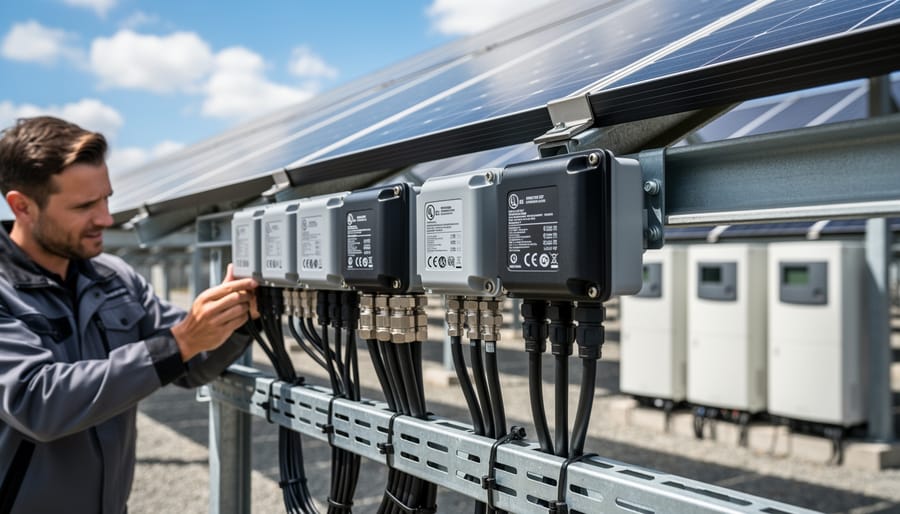
What BOS-5 Actually Measures in Solar Systems
The Five Critical Test Categories
BOS-5 standards evaluate solar balance-of-system components through five interconnected test categories, each designed to verify performance under conditions that mirror real-world operational challenges. Understanding these categories helps stakeholders assess whether components meet the rigorous demands of long-term photovoltaic installations.
Environmental stress testing forms the foundation, subjecting components to temperature cycling, humidity exposure, and UV radiation. These tests simulate decades of outdoor exposure, revealing how materials degrade when confronted with thermal expansion, moisture intrusion, and ultraviolet bombardment. Components must maintain structural integrity and performance specifications across temperature ranges from -40°C to +85°C, reflecting global deployment scenarios from Arctic installations to desert environments.
Electrical performance assessments verify that components maintain specified voltage ratings, current-carrying capacity, and insulation resistance throughout their operational lifespan. Testing protocols measure contact resistance, dielectric strength, and voltage drop under various load conditions, ensuring safe and efficient power transmission from arrays to inverters and grid connection points.
Mechanical durability evaluations examine physical robustness through vibration testing, impact resistance, and connector insertion-withdrawal cycles. These assessments confirm that components withstand installation stresses, wind loads, and maintenance activities without compromising electrical connections or protective enclosures.
Fire safety testing addresses critical risk mitigation, verifying flame resistance, arc fault containment, and thermal runaway prevention. Components must demonstrate compliance with international fire safety standards, preventing ignition sources and limiting fire propagation in fault conditions.
Long-term degradation assessments combine accelerated aging protocols with predictive modeling to estimate performance over 25-year operational periods. These tests identify failure mechanisms before they occur in field installations, providing confidence in warranty claims and financial projections. Together, these five categories create a comprehensive validation framework that supports informed procurement decisions and project bankability.
Why Bankability Depends on BOS Component Qualification
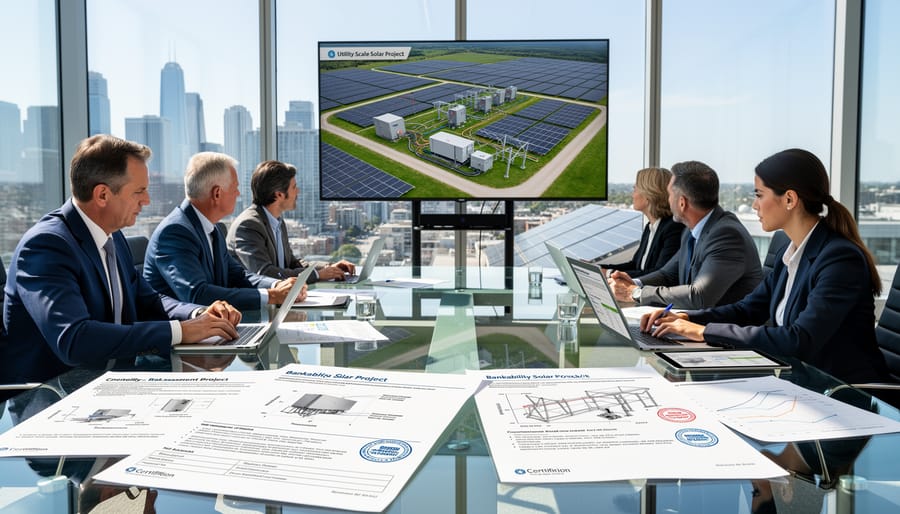
Risk Assessment from the Investor Perspective
Financial institutions and project investors place significant weight on BOS-5 certification when evaluating solar project bankability. This qualification standard serves as a critical risk mitigation tool, providing quantifiable evidence of component reliability that directly influences financing terms and project valuation.
Banks and institutional investors typically require comprehensive technical due diligence before committing capital to solar projects. BOS-5 certification streamlines this process by offering standardized performance data and failure rate predictions based on accelerated testing protocols. Components that pass BOS-5 testing demonstrate measurable resilience against environmental stressors, reducing the likelihood of premature failures that could compromise project revenue streams.
Warranty considerations represent another crucial dimension of investor risk assessment. Manufacturers offering BOS-5 certified components generally provide more favorable warranty terms, reflecting their confidence in product longevity. These extended warranties translate into reduced replacement costs and maintenance expenses over the project lifecycle, improving overall financial projections.
Investment committees scrutinize failure rate predictions derived from BOS-5 testing data to model long-term performance scenarios. Lower predicted failure rates enhance project net present value calculations and reduce contingency reserve requirements. This certification enables more accurate cash flow modeling, particularly for the critical 25-30 year operational period that defines solar project economics.
Furthermore, projects utilizing BOS-5 certified components often secure better insurance premiums and more competitive debt financing rates. The certification’s recognition among leading financial institutions has established it as a de facto requirement for achieving investment-grade project status in many markets.
Real-World Cost of Component Failures
The financial consequences of BOS component failures extend far beyond the initial purchase price, creating cascading costs that significantly impact project economics. Industry data reveals that inverter failures alone can result in downtime costs ranging from $500 to $2,000 per day for residential systems, while commercial installations may experience losses exceeding $10,000 daily due to lost energy production. A single combiner box failure in a utility-scale facility can affect multiple strings, potentially idling several megawatts of capacity.
Replacement costs compound these losses substantially. Non-certified components that fail prematurely require not only new equipment purchases but also labor costs for diagnosis, removal, and reinstallation. Field studies indicate that replacing failed inverters during the warranty period still incurs average costs of $1,200 to $3,500 per unit when accounting for technician dispatch, troubleshooting time, and system recommissioning.
Warranty claims present another financial dimension. Manufacturers of non-certified components face higher claim rates, often passing these costs to customers through reduced coverage periods or exclusions. One analysis of 5,000 residential systems found that projects using certified BOS components experienced 60% fewer warranty claims over five years compared to those with uncertified alternatives.
Lost energy production represents the most significant long-term impact. A system experiencing just 2% additional downtime annually due to component failures can lose $15,000 to $50,000 in revenue over a 25-year project lifetime, directly affecting investor returns and project bankability. These quantifiable risks underscore why certification standards serve as essential financial safeguards.
The Testing Process Behind BOS-5 Certification
Accelerated Aging and Environmental Simulation
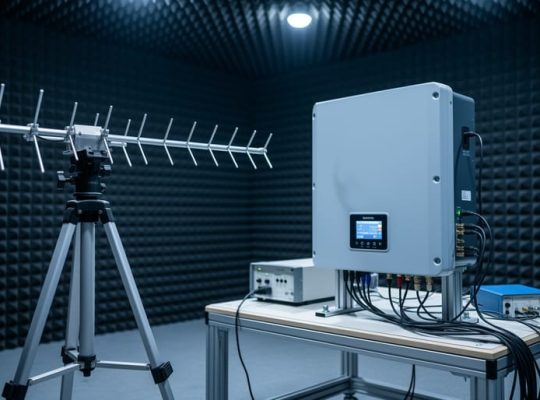
Accelerated aging protocols form the backbone of BOS-5 certification, compressing decades of real-world environmental exposure into months of intensive laboratory testing. These methodologies enable manufacturers and certifying bodies to predict long-term component reliability before products reach the field.
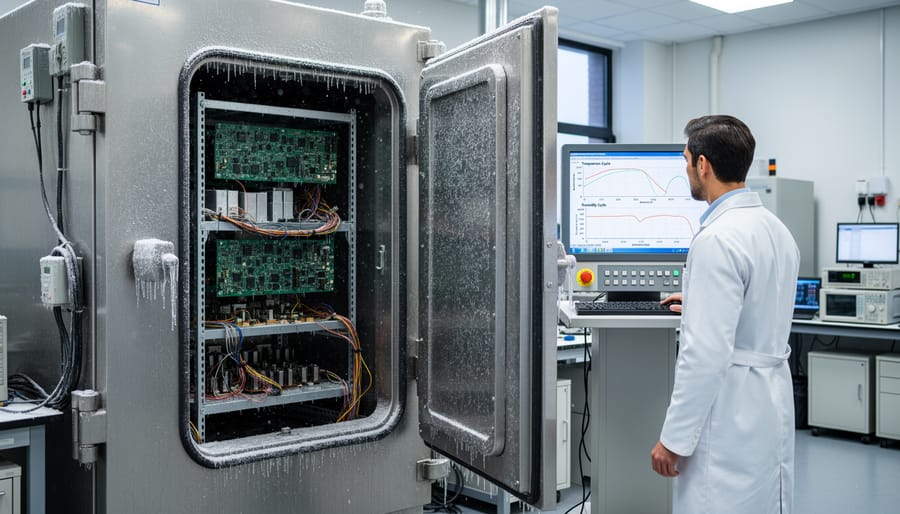
Thermal cycling represents one of the most rigorous tests, subjecting components to repeated temperature extremes typically ranging from -40°C to +85°C. Each cycle creates expansion and contraction stress on materials, solder joints, and encapsulation layers. Standard protocols require 200 to 600 cycles depending on component type, with each cycle lasting several hours. This process simulates the daily heating and cooling patterns that solar installations experience over 25-30 years of operation.
Humidity-freeze testing combines moisture penetration with thermal shock. Components undergo exposure to 85% relative humidity at elevated temperatures, followed by rapid freezing. This dual-stress approach identifies vulnerabilities to moisture ingress and subsequent ice formation, which can compromise electrical insulation and mechanical integrity in real-world installations across diverse climate zones.
UV exposure testing employs specialized chambers with calibrated radiation sources that replicate solar ultraviolet wavelengths. Components accumulate exposure doses equivalent to multiple decades of sunlight, revealing potential degradation in polymeric materials, encapsulants, and protective coatings. Combined with simultaneous heat and humidity exposure in some protocols, this testing predicts color fading, material embrittlement, and electrical performance degradation.
Additional accelerated aging procedures include salt spray testing for coastal environments, mechanical load cycling, and voltage stress testing. Together, these protocols provide comprehensive data that correlates laboratory performance with projected field longevity, giving stakeholders confidence in component durability.
Electrical Safety and Performance Benchmarks
Electrical safety represents a fundamental pillar of BOS-5 certification, ensuring that balance of system components perform reliably under real-world operating conditions while protecting personnel and equipment. The standard mandates a comprehensive suite of electrical performance tests that validate both safety margins and functional capabilities.
Voltage withstand testing, often called dielectric strength testing, subjects components to elevated voltages significantly higher than their rated operating voltage. This non-destructive test typically applies voltages at 1.5 to 2 times the maximum system voltage for specified durations, verifying that insulation systems can withstand transient overvoltages from lightning strikes, switching events, or grid disturbances without breakdown. Components must demonstrate no flashover, tracking, or insulation failure during these rigorous evaluations.
Insulation resistance measurements quantify the electrical integrity between current-carrying parts and grounded surfaces. BOS-5 requires minimum insulation resistance values, typically measured in megohms, to ensure adequate protection against leakage currents that could compromise safety or system performance. These measurements are conducted under various environmental conditions, including elevated temperatures and humidity levels that represent challenging operational scenarios.
Contact resistance evaluation examines the electrical interface quality at connection points, terminals, and conductor junctions. Excessive contact resistance generates heat dissipation, reducing efficiency and potentially creating fire hazards. The standard establishes maximum permissible resistance values based on current ratings and connection types.
Current-carrying capacity verification ensures components can continuously handle their rated currents without exceeding temperature limits. Temperature rise testing monitors conductor and terminal temperatures under sustained load conditions, confirming adequate thermal management. These benchmarks collectively ensure BOS components deliver safe, efficient performance throughout their operational lifetime, protecting both investment value and system integrity.
How BOS-5 Integrates with Overall System Reliability
BOS-5 certification operates as a critical link within the comprehensive Balance of System Component Reliability and Bankability Qualification framework, which encompasses multiple testing protocols designed to validate every non-module component in photovoltaic installations. While modules receive considerable attention through standards like IEC 61215, the supporting infrastructure—inverters, mounting structures, connectors, and monitoring systems—equally determines long-term system performance and financial viability.
The certification functions within an integrated hierarchy where each component’s reliability directly impacts adjacent systems. For instance, a BOS-5 qualified mounting system must maintain structural integrity under environmental stressors while protecting module frames and electrical connections. Similarly, certified junction boxes must interface seamlessly with properly rated cables and inverters to maintain electrical continuity throughout the array’s operational lifetime.
System-level reliability emerges from the interaction between certified components rather than individual component performance alone. A photovoltaic installation comprises interdependent subsystems: modules generate power, inverters convert it, mounting structures provide mechanical support, and monitoring systems track performance. When each component carries appropriate certification, including BOS-5 for applicable balance-of-system elements, the cumulative effect creates a verified chain of quality assurance.
Financial institutions and project developers increasingly recognize that system bankability requires comprehensive certification coverage. A project featuring certified modules but non-qualified mounting hardware or connectors introduces unknown risk variables that affect financing terms and insurance premiums. BOS-5 certification addresses this gap by providing standardized verification for critical support components.
Academic institutions collaborating with certification bodies continue researching how component interactions affect degradation rates and failure modes. These educational programs help professionals understand that system reliability transcends individual component specifications—it requires holistic design consideration where each certified element contributes to measurable performance guarantees and reduced operational risk throughout the installation’s 25-30 year design life.
Selecting BOS-5 Certified Components for Your Projects
For photovoltaic professionals developing new projects, selecting BOS-5 certified components requires a systematic approach to verification and procurement. The certification process establishes quality benchmarks that directly impact project performance, financing approval, and long-term operational reliability.
Begin by requesting certification documentation directly from manufacturers or authorized distributors. Authentic BOS-5 certification includes a formal certificate issued by an accredited testing laboratory, complete with the specific product model number, manufacturer details, testing date, and the laboratory’s accreditation credentials. Reputable manufacturers maintain publicly accessible certification databases where procurement teams can verify component eligibility independently.
Understanding certification marks is essential for proper component identification. BOS-5 certified products typically display standardized labels that reference the applicable standard, the testing laboratory, and certification validity periods. These marks should appear on product datasheets, packaging, and often on the components themselves. When reviewing documentation, verify that the certified model matches exactly with the product being procured, as manufacturers sometimes obtain certification for specific variants while marketing entire product lines.
Incorporating BOS-5 requirements into project specifications strengthens procurement outcomes and reduces compliance risks. Technical specifications should explicitly state that all balance-of-system components must hold current BOS-5 certification from recognized testing laboratories. Include requirements for suppliers to provide certification documents during the bidding process and incorporate certification verification as a standard quality control checkpoint before installation begins.
When evaluating suppliers, prioritize those who demonstrate comprehensive understanding of certification requirements and maintain updated documentation. Request copies of test reports alongside certificates, as these provide detailed performance data that supports engineering decisions and helps verify compatibility with specific project conditions.
For large-scale projects requiring financing, compile a complete certification package documenting all major BOS components. Financial institutions and insurance providers increasingly require this documentation as part of due diligence processes, recognizing that certified components reduce technical risk and enhance project bankability. This proactive approach to certification verification streamlines approval processes and demonstrates professional commitment to quality standards throughout the project lifecycle.
Understanding BOS-5 certification requirements is essential for anyone serious about building a career in the photovoltaic industry or making informed decisions about solar investments. This qualification standard serves as a critical benchmark for system reliability, directly impacting project bankability and long-term performance outcomes. For aspiring PV professionals, prioritizing components that meet recognized certification standards like BOS-5 demonstrates technical competence and commitment to quality that financiers, insurers, and clients increasingly demand.
As certification standards continue to evolve in response to technological advancements and field experience, staying informed about these requirements becomes a professional imperative. The distinction between qualified and non-qualified components can mean the difference between a successful, financeable project and one that faces operational challenges or funding obstacles.
At Mose Solar, we recognize that education forms the foundation of industry excellence. Our commitment to quality standards extends beyond our product offerings to include comprehensive educational resources that help professionals navigate the complex landscape of certification requirements. Through our collaboration with universities and structured educational programs, we empower the next generation of solar professionals with the knowledge needed to specify, evaluate, and implement systems that meet the highest industry standards for performance and reliability.