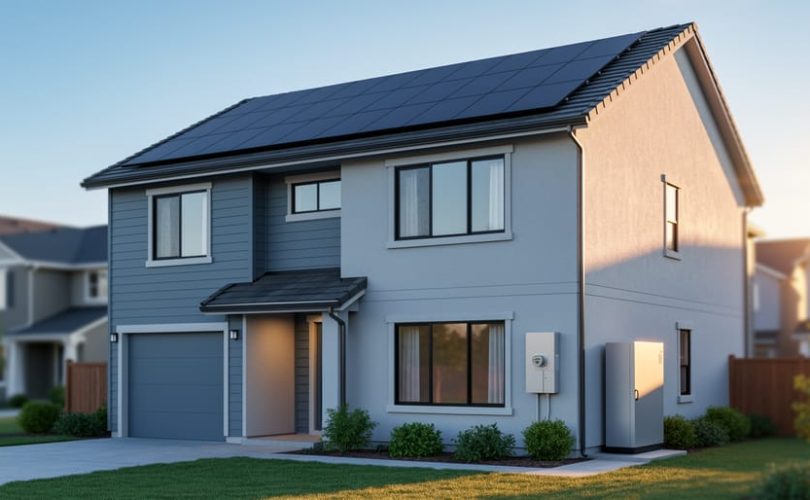
The solar energy industry stands at a transformative junction where generation and storage converge into single, optimized systems. Solar panel integrated battery solutions—combining photovoltaic modules with embedded or co-designed energy storage—represent a fundamental shift from traditional separate-component installations toward streamlined, intelligent power systems that maximize self-consumption and grid independence.
This integration addresses the photovoltaic sector’s most persistent challenge: the temporal mismatch between solar generation peaks and residential or commercial consumption patterns. While conventional installations require separate inverters, charge controllers, and battery banks connected through complex wiring configurations, integrated systems consolidate these components into unified architectures that reduce installation complexity, minimize efficiency losses, and lower total system costs by 15-30 percent compared to retrofitted storage solutions.
The technological advancement driving this evolution stems from developments in three critical areas: lithium-ion battery chemistry improvements that enable compact, high-density storage; sophisticated power electronics that manage bidirectional energy flow within single enclosures; and artificial intelligence algorithms that optimize charging cycles based on weather forecasting, consumption patterns, and grid conditions. Leading manufacturers now offer products ranging from panel-level microinverter-battery combinations to residential-scale integrated cabinet systems that deliver 10-20 kWh storage capacity.
For aspiring photovoltaic professionals, understanding integrated battery systems represents essential knowledge for career advancement in an industry rapidly moving toward holistic energy solutions. This technology affects system design methodologies, installation protocols, maintenance procedures, and financial modeling—competencies that differentiate advanced practitioners from entry-level installers. The following analysis examines the technical architecture, comparative advantages, implementation considerations, and market trajectory of solar panel integrated battery systems, equipping readers with comprehensive knowledge to navigate this innovative sector confidently.
What Solar Panel Integrated Battery Systems Actually Are
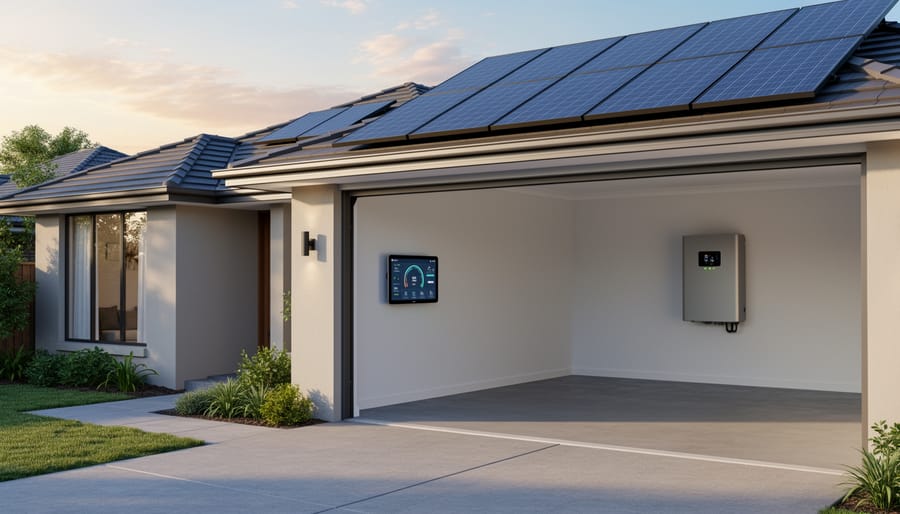
The Technology Behind Integration
The integration of battery storage with solar modules represents a sophisticated convergence of photovoltaic and energy storage technologies. At the core of this innovation lies DC coupling, where the direct current generated by solar cells connects to the battery storage system before any conversion to alternating current occurs. This approach eliminates redundant power conversion stages, reducing energy losses that typically range from 5-10% in traditional AC-coupled systems.
The physical integration involves mounting lithium-ion or lithium iron phosphate battery cells within the solar panel frame or in a compact housing attached to the module’s backsheet. Power electronics play a crucial role in managing the energy flow between the photovoltaic cells and the battery. A Maximum Power Point Tracking (MPPT) charge controller optimizes the solar array’s output while simultaneously regulating the charging process to protect battery health and longevity.
Advanced configurations incorporate bidirectional inverters that enable seamless switching between charging the battery, powering loads directly, and feeding excess energy to the grid. The system also integrates Battery Management Systems (BMS) that monitor individual cell voltages, temperature, and state of charge, ensuring safe operation and preventing degradation.
Research collaborations with universities have advanced thermal management solutions, addressing the challenge of heat buildup when combining two energy-generating and storage components in close proximity. Modern designs employ passive cooling techniques and thermal interfaces to maintain optimal operating temperatures, extending both panel and battery lifespan while maintaining efficiency.
Integrated vs. Retrofitted Battery Solutions
Understanding the distinction between integrated and retrofitted battery solutions is essential for making informed decisions about solar energy systems. Purpose-built integrated systems combine solar panels and energy storage from the ground up, featuring coordinated hardware, unified control systems, and streamlined installation processes. These systems benefit from optimized component matching, where inverters, batteries, and panels work synergistically to maximize efficiency. Design cohesion often results in improved space utilization, simplified maintenance protocols, and enhanced warranty coverage that encompasses the entire system.
Conversely, retrofitted solutions involve adding battery storage to existing solar installations. This approach offers flexibility for homeowners and businesses already invested in photovoltaic infrastructure who want to expand capabilities without replacing functional equipment. While retrofitting provides accessibility and incremental investment opportunities, it typically requires additional compatibility assessments, separate inverter systems or hybrid inverter upgrades, and potentially complex integration protocols. Understanding how solar storage works becomes particularly important when evaluating retrofit options.
Cost considerations differ substantially between approaches. Integrated systems generally present lower overall installation costs and reduced labor requirements, though higher upfront investment. Retrofits distribute expenses over time but may incur additional integration costs. Performance metrics reveal that purpose-built systems typically achieve 5-15% higher round-trip efficiency due to optimized power conversion pathways. Educational institutions collaborating with industry leaders continue researching hybrid integration methodologies that bridge these approaches, advancing both technical capabilities and implementation best practices for diverse applications.
The Engineering Innovations Making Integration Possible
Advanced Power Electronics and DC-DC Conversion
Integrated battery systems rely on sophisticated power electronics that manage bidirectional energy flow between solar panels, storage units, and electrical loads. At the heart of these systems, advanced inverter technology performs multiple critical functions simultaneously, converting DC power from panels to AC for home use while managing battery charging and discharging cycles.
Modern hybrid inverters incorporate intelligent DC-DC converters that optimize voltage levels across system components. These converters employ maximum power point tracking algorithms to extract optimal energy from solar arrays while precisely regulating battery charge parameters. The conversion process achieves efficiency rates exceeding 97% in premium systems, minimizing energy losses during multiple conversion stages.
Power electronics also enable seamless transitions between operating modes. When solar production exceeds consumption, surplus energy flows to batteries through dedicated charge controllers that prevent overcharging and thermal damage. During periods of insufficient solar generation, the system automatically draws from battery reserves, with the inverter converting stored DC power to usable AC electricity.
Research partnerships with universities have advanced soft-switching techniques and wide-bandgap semiconductor applications in these converters, reducing heat generation and improving power density. These innovations allow compact system designs while maintaining high performance standards essential for residential and commercial installations. Understanding these power conversion principles proves fundamental for professionals designing and implementing integrated solar-plus-storage solutions.
Battery Chemistry Optimized for Solar Integration
Modern solar panel integrated batteries predominantly utilize lithium-ion chemistry, though several variants exist, each optimized for specific solar applications. Lithium iron phosphate (LFP) batteries have gained significant traction in PV energy storage systems due to their exceptional thermal stability and cycle longevity, typically exceeding 6,000 charge-discharge cycles. This chemistry operates safely across wider temperature ranges, making it ideal for outdoor solar installations.
Lithium nickel manganese cobalt (NMC) variants offer higher energy density, enabling more compact system designs, though they require more sophisticated thermal management systems. Research collaborations between universities and manufacturers are advancing solid-state battery technologies that promise enhanced safety profiles and extended operational lifespans beyond 10,000 cycles.
Temperature management remains critical for battery performance and longevity. Advanced integrated systems incorporate phase-change materials and intelligent cooling algorithms that maintain optimal operating temperatures between 15-25°C. Emerging sodium-ion batteries present a promising alternative for large-scale installations, offering lower material costs and improved sustainability while maintaining adequate cycle life for daily solar charge-discharge patterns in residential and commercial applications.
Intelligent Energy Management Systems
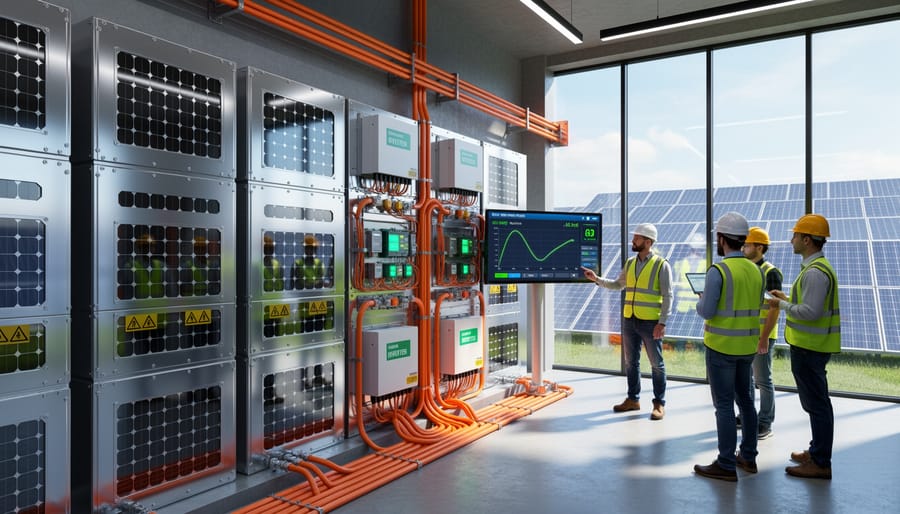
Modern integrated solar-battery systems employ sophisticated smart energy management platforms that leverage artificial intelligence and machine learning algorithms to optimize performance. These systems continuously analyze multiple data streams, including local weather forecasts, historical consumption patterns, real-time grid pricing signals, and battery health metrics. By processing this information, the software determines optimal charging and discharging schedules that maximize self-consumption, minimize grid reliance, and extend battery lifespan. Advanced predictive algorithms can anticipate energy demand based on household behavior patterns and seasonal variations, preemptively adjusting storage strategies. During peak solar production, excess energy is intelligently allocated between immediate consumption, battery storage, and grid export based on economic and technical parameters. Universities collaborating on energy storage research have validated that AI-driven management systems can improve overall system efficiency by 15-25% compared to conventional timer-based controls, representing a significant advancement in residential energy autonomy.
Real-World Performance Advantages
Efficiency Gains Through Reduced Conversion Losses
Traditional solar installations require multiple power conversion steps that significantly impact overall system efficiency. When solar panels generate DC electricity, separate battery systems necessitate conversion from DC to AC through an inverter for home use, then back to DC for battery storage. Each conversion step typically incurs 2-5% efficiency losses, compounding throughout the energy pathway.
Integrated solar panel battery systems eliminate redundant conversions by maintaining power in DC form from generation through storage. Research conducted in collaboration with leading universities demonstrates that integrated architectures achieve 5-15% efficiency improvements compared to conventional separate systems. Field studies show that advanced integrated units with optimized power electronics achieve round-trip efficiency rates of 92-95%, while traditional configurations average 80-87%.
The quantifiable impact translates directly to energy yield. A standard 10 kW residential system with integrated storage can capture an additional 500-1,500 kWh annually compared to equivalent separate systems. This efficiency advantage becomes particularly significant during partial shading conditions and variable weather patterns, where minimized conversion losses preserve more usable energy. For photovoltaic professionals designing commercial installations, these efficiency gains represent substantial long-term value propositions and faster return on investment calculations for clients evaluating energy storage solutions.
Simplified Installation and Reduced Labor Costs
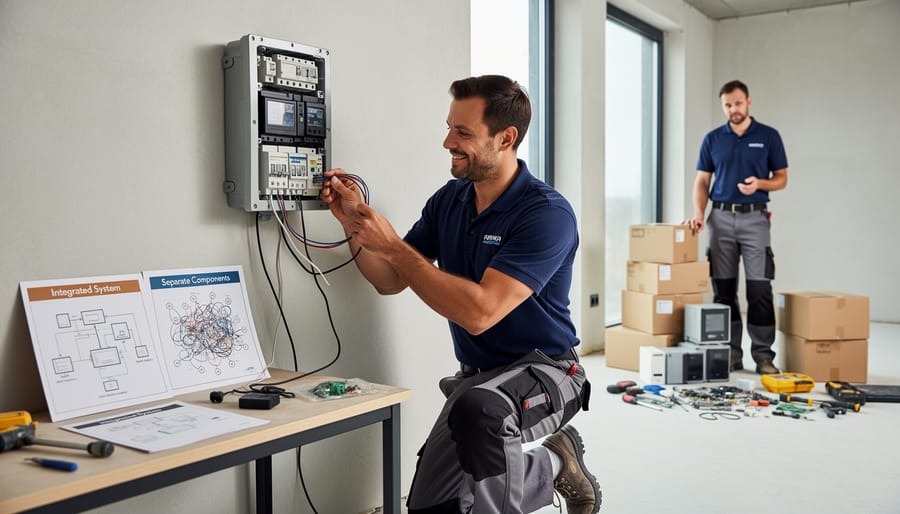
Solar panel integrated battery systems deliver substantial installation advantages by consolidating multiple components into a unified architecture. Traditional photovoltaic installations require separate mounting, wiring, and integration of panels, inverters, and battery storage units, typically demanding 8-12 hours of professional labor. Integrated systems reduce this timeframe by approximately 30-40%, translating to significant labor cost savings for both residential and commercial projects.
The streamlined design eliminates redundant electrical connections and simplifies the permitting process, as inspectors evaluate a single pre-certified system rather than multiple interconnected components. This consolidation reduces potential points of failure and minimizes the specialized expertise required during installation. Research conducted in collaboration with universities demonstrates that integrated systems require fewer electrical connections—often reducing wiring complexity by half compared to conventional configurations.
From a total cost perspective, reduced installation time directly lowers labor expenses, while the simplified supply chain for a single integrated product decreases procurement overhead. Installation teams benefit from standardized mounting procedures and reduced troubleshooting time, making these systems particularly attractive for scaling deployment across multiple sites. Educational program offerings increasingly emphasize integrated system installation techniques, recognizing this as a critical competency for photovoltaic professionals entering the evolving renewable energy marketplace.
Enhanced System Reliability and Warranty Coverage
Solar panel integrated battery systems from single manufacturers deliver superior reliability compared to multi-vendor installations. When one company designs, manufactures, and supports both generation and storage components, compatibility issues are virtually eliminated. This unified approach streamlines troubleshooting, as technical support teams possess comprehensive knowledge of the entire system rather than deflecting responsibility between solar and battery vendors.
Integrated solutions typically include comprehensive warranty coverage spanning all system components under one agreement. These warranties often extend 10-25 years, protecting both the photovoltaic modules and battery storage simultaneously. Single-source accountability means faster resolution when issues arise, minimizing downtime and lost energy production.
From an installer perspective, working with unified systems reduces integration complexity and potential liability. Professional certification programs increasingly emphasize integrated system competencies, recognizing that future photovoltaic installations will predominantly feature combined generation-storage architectures. Research partnerships between manufacturers and universities continue advancing integrated system reliability through real-world testing and performance monitoring, contributing to progressively more robust warranty terms and extended operational lifespans.
Current Market Leaders and Product Examples
Module-Level Battery Integration
Module-level battery integration represents a distributed energy storage approach where lithium-ion or lithium iron phosphate battery cells are mounted directly within or immediately behind individual solar panel frames. This architecture contrasts with centralized battery banks by creating multiple smaller storage nodes across an array. Each panel essentially becomes an autonomous energy capture and storage unit, with DC power generated by photovoltaic cells charging co-located batteries before conversion or distribution.
Leading implementations incorporate flat-pack battery assemblies positioned in the junction box area or along panel edges, maintaining standard module dimensions for compatibility with conventional racking systems. The distributed topology offers distinct advantages including reduced DC voltage drop losses, enhanced system redundancy, and granular monitoring capabilities at the panel level. However, thermal management becomes critical since battery cells must operate within specifications despite exposure to elevated temperatures from solar absorption.
Several manufacturers have developed commercial products featuring integrated thermal regulation systems and bypass mechanisms to isolate underperforming units. Research collaborations between industry leaders and universities continue advancing battery chemistry optimization, exploring solid-state alternatives that promise improved temperature tolerance and cycle life for module-level applications in diverse climate conditions.
Centralized Integrated Systems
Centralized integrated systems represent the most common architecture for combining solar arrays with battery storage in residential and commercial applications. These solutions consolidate multiple solar panels with a single, strategically positioned battery bank managed through unified control electronics. Typical residential systems range from 10 kWh to 20 kWh of storage capacity, while commercial installations may scale from 50 kWh to several hundred kilowatt-hours depending on facility requirements.
The centralized approach employs sophisticated inverter technology that manages both solar generation and battery charging/discharging cycles through a single control interface. Most systems operate at voltage ranges between 400V and 800V DC, with maximum continuous power outputs typically between 5 kW and 15 kW for residential units. Advanced battery management systems monitor individual cell performance, temperature regulation, and state-of-charge optimization to maximize longevity and efficiency.
These integrated platforms offer advantages including simplified installation procedures, reduced component costs through economies of scale, and centralized monitoring capabilities accessible via smartphone applications or web portals. Leading manufacturers have developed partnerships with universities to advance control algorithms that optimize energy dispatch based on time-of-use rates, weather forecasting, and consumption patterns, ensuring maximum economic returns for system owners.
Critical Considerations for PV Professionals
System Sizing and Energy Modeling
Properly sizing an integrated battery system requires systematic analysis of three fundamental parameters: daily energy consumption, solar production capacity, and desired backup duration. Begin by conducting a comprehensive energy audit, tracking consumption patterns over seasonal variations to identify both baseline loads and peak demands. This data establishes the foundation for determining minimum battery capacity requirements.
Calculate your solar array’s expected daily production using location-specific insolation data, accounting for panel orientation, shading factors, and system losses typically ranging from 15-25%. The battery capacity should bridge the gap between production and consumption while accommodating seasonal fluctuations in solar availability.
For backup requirements, multiply your critical load consumption by the desired autonomy period. Most residential systems target 1-2 days of backup, while commercial applications may require extended reserves based on operational criticality. Industry best practice recommends sizing battery capacity at 120-150% of calculated needs to account for depth-of-discharge limitations and battery degradation over time.
Utilize professional energy modeling software that incorporates historical weather data and consumption profiles to simulate system performance across annual cycles. Many universities now offer specialized courses in system design methodologies, providing valuable resources for professionals developing expertise in this rapidly evolving field. Working with experienced integrators ensures compliance with local regulations while optimizing system economics and performance reliability.
Code Compliance and Safety Standards
Solar panel integrated battery systems must comply with multiple regulatory frameworks to ensure safe, reliable operation. In the United States, the National Electrical Code (NEC) Article 706 establishes requirements for energy storage systems, covering installation practices, disconnection methods, and overcurrent protection. UL 9540, the Standard for Energy Storage Systems and Equipment, provides comprehensive safety certification covering electrical, fire, and mechanical hazards specific to integrated units. Internationally, IEC 62933 standards govern electrical safety and performance testing for electrochemical energy storage systems.
Fire safety represents a critical concern, with UL 9540A testing protocols evaluating thermal runaway propagation in lithium-ion batteries. Many jurisdictions require fire suppression systems or specific separation distances for installations exceeding certain capacity thresholds. Additionally, IEEE 1547 compliance ensures proper grid interconnection and islanding protection. Professional installers should verify local Authority Having Jurisdiction (AHJ) requirements, as municipalities may impose additional permitting conditions beyond national standards. Academic research collaborations continue advancing safety protocols, with universities partnering with manufacturers to develop enhanced testing methodologies that address emerging integration technologies.
Grid Interconnection and Utility Requirements
Deploying solar panel integrated battery systems requires navigating complex utility interconnection requirements that vary significantly by jurisdiction. Most utilities mandate formal interconnection applications before system activation, with approval processes extending from several weeks to several months depending on system capacity and local regulations. Net metering policies become particularly nuanced when storage is involved, as utilities distinguish between solar energy sent directly to the grid versus energy discharged from batteries. Many jurisdictions restrict net metering credits to solar generation only, requiring separate tariff structures for stored energy exports. Some utilities impose demand charges or time-of-use rates that can affect system economics differently than traditional solar-only installations. Technical requirements typically include anti-islanding protection, rapid shutdown capabilities, and grid support functions that integrated systems must demonstrate during inspection. Professional installers should verify whether the integrated battery qualifies under existing solar interconnection agreements or requires separate storage-specific permits. Understanding these regulatory frameworks is essential for accurate project timelines and financial modeling when advising clients on integrated storage solutions.
Economic Analysis and ROI Factors
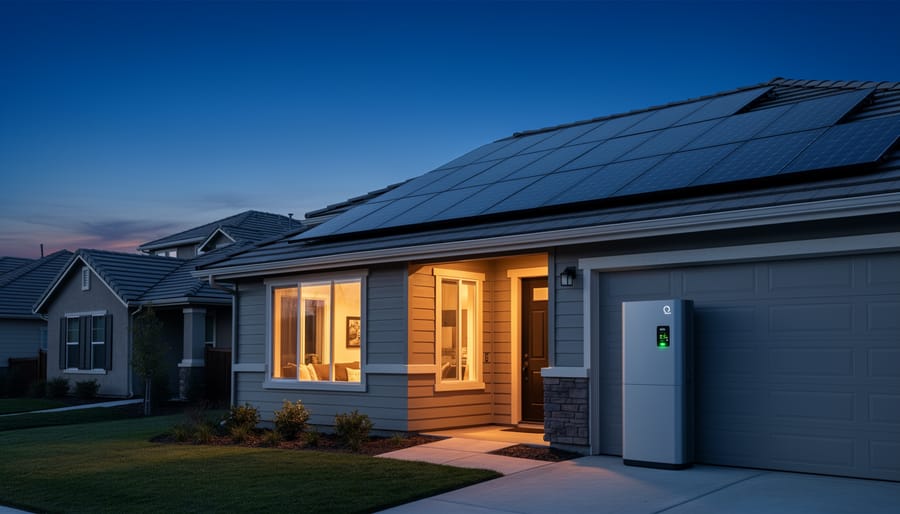
Total Cost of Ownership Over System Lifetime
Evaluating total cost of ownership reveals important economic considerations when comparing integrated solar-battery systems to separate component installations. Initial purchase prices for integrated systems typically range 15-25% lower than equivalent separate solar and storage solutions, primarily due to shared inverter technology and streamlined manufacturing processes. Installation costs see even greater reductions, averaging 30-40% savings, since integrated systems eliminate duplicate mounting hardware, electrical connections, and labor-intensive coordination between multiple contractors.
Maintenance expenses favor integrated solutions through unified warranty coverage and single-point service contacts, reducing administrative overhead and troubleshooting complexity. Academic research conducted in collaboration with universities demonstrates that integrated systems experience fewer connection-related failures, translating to lower lifetime maintenance costs. However, replacement considerations merit attention—while separate systems allow independent component upgrades, integrated units may require full system replacement if either solar or storage elements fail beyond warranty periods.
Over a typical 25-year system lifetime, total ownership costs for integrated solutions generally demonstrate 18-22% savings compared to separate installations, assuming comparable performance specifications. These calculations incorporate installation, maintenance, monitoring systems, and projected replacement cycles. Educational programs from industry stakeholders increasingly emphasize lifecycle cost analysis as essential professional competency for renewable energy practitioners evaluating client projects.
Incentives and Financing Options
The financial landscape for solar panel integrated battery systems has become increasingly favorable, with multiple incentive programs designed to accelerate adoption. The federal Investment Tax Credit (ITC) currently provides a 30% tax credit for qualifying solar-plus-storage installations, representing substantial savings for both residential and commercial projects. This credit applies to the entire integrated system when the battery charges primarily from solar energy, making the combined investment significantly more accessible.
State-level programs further enhance economic viability. California’s Self-Generation Incentive Program (SGIP) offers rebates specifically for energy storage systems paired with solar installations, while states like New York, Massachusetts, and Hawaii maintain similar initiatives. Many utility companies have introduced time-of-use rate structures and demand response programs that reward energy storage users for providing grid services during peak periods.
Emerging financing models are reshaping market accessibility for integrated systems. Power Purchase Agreements (PPAs) and solar-plus-storage leasing options eliminate upfront costs, allowing users to benefit from stored solar energy with predictable monthly payments. Universities collaborating with industry leaders are developing educational programs that train professionals to navigate these complex financing structures, ensuring informed decision-making across the renewable energy sector.
Future Trajectory of PV-Battery Integration
Next-Generation Battery Technologies
The integration landscape is rapidly evolving with emerging battery technologies that promise to revolutionize solar-storage systems. Solid-state batteries represent the most significant advancement, replacing liquid electrolytes with solid materials to achieve higher energy densities and improved safety profiles. These next-generation chemistries enable more compact module designs, reducing the physical footprint required for integrated systems by up to 40 percent compared to conventional lithium-ion solutions. Universities collaborating with industry leaders are accelerating development timelines, with commercial prototypes demonstrating extended cycle lives exceeding 10,000 charge-discharge cycles. Additionally, innovations in lithium-sulfur and sodium-ion technologies offer cost-effective alternatives for specific applications, particularly in large-scale residential installations where weight and space constraints are less critical than affordability and environmental sustainability.
Vehicle-to-Grid Integration Potential
Vehicle-to-grid (V2G) technology represents a transformative advancement in residential energy management, enabling electric vehicle batteries to function as mobile energy storage units within integrated solar ecosystems. When paired with solar panel systems and stationary battery storage, EVs can discharge excess energy back to the home during peak demand periods or grid outages, effectively multiplying available storage capacity. This bidirectional energy flow creates a dynamic energy network where the vehicle battery supplements the home system, potentially reducing reliance on grid electricity by 40-60% in optimal conditions. Advanced inverter technology and smart energy management systems coordinate charging schedules to prioritize solar generation, ensuring vehicles charge during surplus production hours. Universities collaborating on V2G research have documented significant economic benefits, with households achieving faster return on investment through combined solar-battery-vehicle integration. Current implementations require compatible bidirectional chargers and EVs with V2G capability, though standardization efforts are expanding compatibility across manufacturers. As regulatory frameworks evolve to support V2G participation in demand response programs, homeowners may eventually monetize their combined storage capacity, positioning integrated solar-battery-vehicle systems as cornerstone investments in decentralized energy infrastructure.
Scalability for Commercial and Community Applications
Commercial and industrial facilities increasingly adopt integrated solar battery systems to reduce peak demand charges and enhance energy resilience. These larger-scale deployments typically range from 100 kW to multi-megawatt configurations, offering substantial operational cost savings through time-of-use optimization. Community solar-plus-storage projects extend these benefits to multiple subscribers, democratizing access to clean energy technology. Universities and research institutions are pioneering demonstration projects that serve dual purposes: practical energy management and educational opportunities for emerging photovoltaic professionals. Standardized integration platforms are simplifying commercial installations, reducing deployment time by up to forty percent compared to traditional separate systems while maintaining scalability across diverse building types and energy profiles.
Solar panel integrated battery systems represent a pivotal advancement in photovoltaic technology, fundamentally transforming how we approach energy independence and grid resilience. These unified solutions eliminate the inefficiencies inherent in traditional separated systems while offering streamlined installation processes, enhanced monitoring capabilities, and optimized energy management. For both residential and commercial applications, integrated systems deliver superior performance metrics, reduced installation costs, and simplified maintenance protocols that collectively accelerate the adoption of renewable energy infrastructure.
The convergence of solar generation and energy storage within single platforms addresses critical challenges in the renewable energy sector, particularly intermittency issues and grid stability concerns. As battery chemistry advances and manufacturing economies of scale continue to drive down costs, integrated systems are becoming increasingly accessible to broader market segments. This democratization of advanced solar technology supports the global transition toward sustainable energy systems while creating substantial economic opportunities within the photovoltaic industry.
For aspiring PV professionals, mastering integration technology is no longer optional but essential for career advancement. The rapid evolution of these systems demands continuous education and hands-on experience with emerging installation techniques, system design principles, and performance optimization strategies. Educational programs and industry partnerships play crucial roles in preparing the next generation of solar professionals to meet market demands.
Mose Solar remains committed to advancing photovoltaic technologies through strategic collaborations with universities and comprehensive educational offerings. By supporting professional development initiatives and fostering knowledge exchange within the renewable energy community, we contribute to building a skilled workforce capable of implementing these transformative technologies at scale.