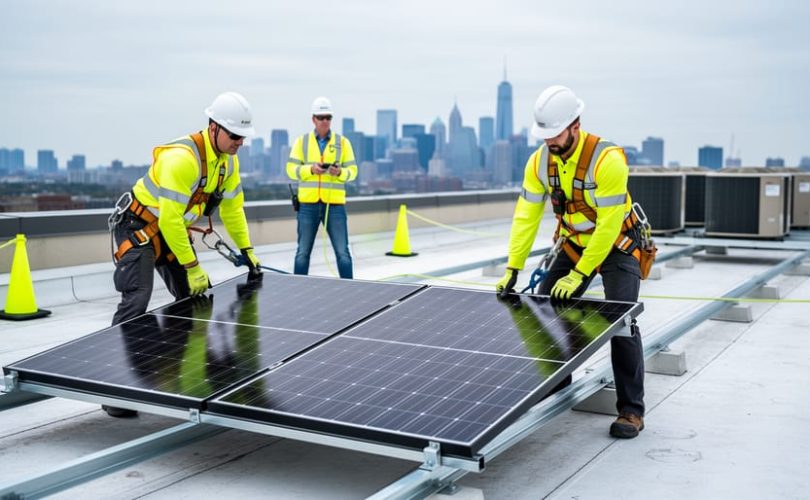
Establish guardrail systems along all exposed roof edges before any photovoltaic installation work begins, ensuring posts are anchored to structural members capable of supporting 200 pounds of force per worker. Install personal fall arrest systems with anchor points rated at 5,000 pounds minimum when working within six feet of roof edges, verifying that each harness, lanyard, and lifeline meets ANSI Z359 standards through documented inspection protocols. Implement warning line systems at least six feet from roof edges on low-slope installations, combining these passive barriers with designated safety monitor personnel who maintain constant visual surveillance of workers approaching hazardous zones.
The photovoltaic industry experiences one of construction’s highest rates of fall-related fatalities, with rooftop installations presenting unique challenges that demand specialized protection strategies. Unlike traditional construction sites, solar installations require workers to repeatedly access roof edges while maneuvering heavy panels and equipment, creating sustained exposure to fall hazards throughout project timelines that span weeks or months. OSHA regulations mandate fall protection at heights exceeding six feet in construction environments, yet compliance alone proves insufficient without understanding the biomechanics of falls, load distribution principles, and system integration methods specific to solar array installations.
Effective rooftop fall protection extends beyond regulatory checkbox compliance to encompass comprehensive risk assessment, proper equipment selection, worker training protocols, and rescue planning. Solar professionals must navigate diverse roof geometries, structural load limitations, weather conditions, and electrical hazards while maintaining continuous protection throughout installation phases. Following comprehensive installation safety precautions ensures projects proceed without incident while establishing professional credibility in an industry where safety performance increasingly influences contract awards and insurance premiums.
The Unique Fall Hazards of Rooftop Solar Installation
Structural Load Challenges During PV Array Installation
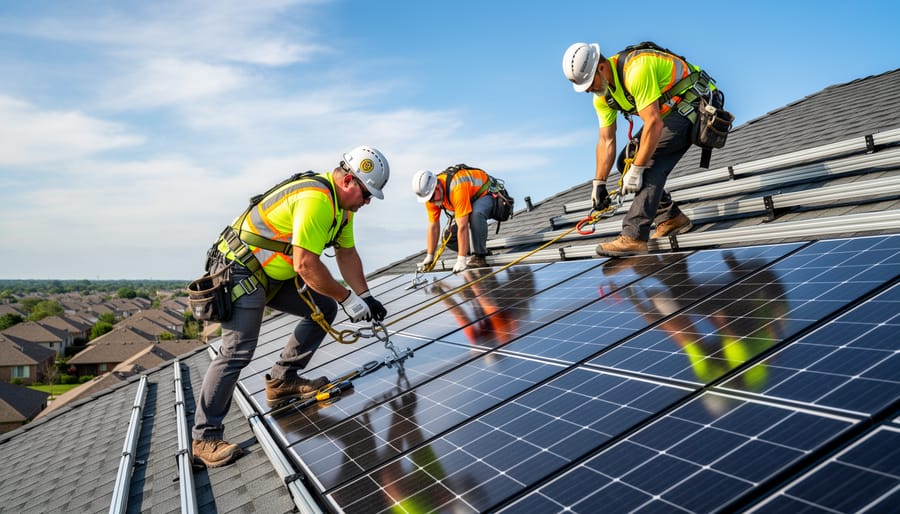
Rooftop PV installations introduce substantial concentrated loads that significantly impact structural integrity and fall protection requirements. Solar panels, mounting hardware, and racking systems create point loads that can exceed 10-15 pounds per square foot in specific areas, while workers and equipment add dynamic loads during installation. These combined forces may cause unexpected roof deflection, particularly on older structures or those with compromised decking.
The cumulative weight distribution becomes critical when multiple installers work simultaneously in confined spaces. As the roof surface deflects under load, guardrail systems and anchor points can shift from their designed positions, reducing their effectiveness and creating hazardous conditions. This structural movement can also weaken attachment points for personal fall arrest systems, potentially causing anchor failure during a fall event.
Pre-installation structural assessments must account for these load scenarios, incorporating safety factors that accommodate both static equipment weight and dynamic installation activities. Engineers should evaluate roof framing capacity, decking condition, and load path integrity before specifying fall protection systems. Installers must recognize warning signs of structural distress, including visible sagging, cracking sounds, or movement in mounting hardware. Proper load distribution techniques, including strategic staging of materials and limiting personnel density in vulnerable areas, help mitigate these risks while maintaining compliance with fall protection standards.
Environmental Factors That Increase Fall Risk
Photovoltaic installations present unique environmental challenges that significantly elevate fall risks beyond those encountered in conventional roofing work. Understanding these conditions is essential for implementing effective safety protocols.
Sun glare represents one of the most underestimated hazards during solar panel installation. Reflective surfaces on both the photovoltaic modules and surrounding metallic components can create intense light reflection, particularly during early morning and late afternoon hours when the sun’s angle is low. This phenomenon temporarily impairs vision, making it difficult to identify anchor points, detect surface irregularities, or maintain spatial awareness near roof edges.
Thermal expansion of roofing materials creates another critical concern. As temperatures fluctuate throughout the day, roofing substrates expand and contract, potentially loosening fasteners, creating unexpected gaps, and compromising the stability of walkways. Metal roofs are particularly susceptible, with expansion rates that can shift equipment placement and alter surface geometry between morning and afternoon work sessions.
Morning dew and frost formation create treacherous conditions during the preferred early-start schedules common in solar installation projects. Even light moisture on smooth module surfaces or painted metal roofs dramatically reduces coefficient of friction, transforming stable work areas into slip hazards. This risk intensifies on sloped applications where gravitational forces compound the loss of traction.
Seasonal weather variations demand adaptive safety strategies. Winter ice accumulation, spring rain patterns, summer heat stress, and autumn leaf debris each require specific considerations. Wind conditions also vary seasonally, affecting both worker stability and material handling safety, particularly when maneuvering large photovoltaic arrays at elevation.
Regulatory Requirements and Industry Standards
OSHA 1926 Subpart M: Fall Protection Mandates
The Occupational Safety and Health Administration established comprehensive requirements under 29 CFR 1926.501(b)(10) that specifically govern fall protection for rooftop construction activities, including photovoltaic installations. These OSHA guidelines for solar workers mandate that employers provide fall protection when employees work on roofs with unprotected sides or edges six feet or more above a lower level.
OSHA recognizes several acceptable fall protection methods for rooftop work. Guardrail systems remain the preferred primary protection, featuring top rails at 42 inches plus or minus 3 inches, midrails, and toeboards. Personal fall arrest systems, consisting of full-body harnesses, shock-absorbing lanyards, and secure anchor points rated for 5,000 pounds per worker, provide secondary protection when guardrails prove impractical. Safety monitoring systems may supplement other methods when installing PV arrays on low-slope roofs under specific conditions.
Subpart M also addresses designated areas and warning line systems for low-slope roofs less than 50 feet wide. Warning lines must stand between 34 and 39 inches high, positioned at least six feet from roof edges. However, PV installers working between warning lines and roof edges require guardrail systems, safety nets, or personal fall arrest systems.
Additionally, OSHA requires that competent persons inspect all fall protection equipment before each use and supervise installation activities. Employers must provide comprehensive training documenting each worker’s ability to recognize hazards and properly use protective equipment before permitting rooftop access.
State and Local Code Variations
While federal OSHA standards establish baseline fall protection requirements for photovoltaic installations, solar professionals must recognize that state and local jurisdictions often implement more stringent regulations. These variations significantly impact project planning, equipment selection, and compliance strategies across different markets.
Several states maintain their own occupational safety and health plans, approved by federal OSHA under Section 18(b) of the OSH Act. These State Plan states must meet or exceed federal standards but frequently adopt additional protective measures. California, a leading solar market, enforces Cal/OSHA regulations that include stricter fall protection requirements for certain roofing operations and mandate specific training documentation beyond federal requirements. Washington State has implemented comprehensive fall protection rules that require written fall protection plans for all residential construction activities, including solar installations on single-family homes where federal standards might be less prescriptive.
In major solar markets like New York and Massachusetts, state-specific building codes may require additional anchoring certifications or impose stricter weight load calculations for rooftop equipment. Some municipalities have adopted local ordinances requiring specific fall protection systems or additional safety inspections before solar project approval. Arizona and Nevada, with their substantial utility-scale solar development, have developed specialized guidelines addressing unique desert climate conditions that affect equipment performance and worker safety protocols.
Solar professionals operating across multiple jurisdictions must develop comprehensive compliance matrices that account for these variations. Understanding regional requirements is essential for accurate project costing, proper equipment procurement, and maintaining worker safety. Industry stakeholders should consult state labor departments and local building officials early in project planning to ensure full regulatory compliance and avoid costly modifications during installation phases.
Fall Protection Systems for PV Installation
Guardrail Systems and Passive Protection
Guardrail systems represent the first line of defense in passive fall protection for rooftop PV installations, eliminating fall hazards through physical barriers rather than personal restraint equipment. These systems create protected work zones where installers can move freely without connecting to anchorage points, significantly improving productivity while maintaining compliance with OSHA’s hierarchy of controls.
Permanent guardrail installations typically consist of top rails at 42 inches, mid-rails, and toe boards, constructed from durable materials like aluminum or galvanized steel that withstand environmental exposure. For PV projects, these systems must accommodate evolving roof layouts as solar arrays expand. Free-standing counterweighted guardrails offer flexibility for temporary installations, requiring no roof penetrations that could compromise waterproofing integrity. These non-penetrating systems use weighted bases to maintain stability and can be repositioned as work progresses across different roof sections.
Edge protection integration with PV workflows requires advance planning during site assessment. Mounting guardrails before material delivery ensures crews work within protected perimeters from the initial equipment staging through final module installation. Modular guardrail systems align particularly well with phased PV projects, allowing sections to be installed, relocated, or expanded as construction advances. Universities partnering with renewable energy programs increasingly emphasize passive protection strategies in their curriculum, recognizing that proper guardrail implementation reduces incident rates while accelerating installation timelines through unrestricted worker movement within protected zones.
Personal Fall Arrest Systems (PFAS)
Personal Fall Arrest Systems represent the final line of defense when working on rooftops during solar installations. These systems consist of three critical components that work together to prevent catastrophic falls: anchor points, body support, and connecting elements.
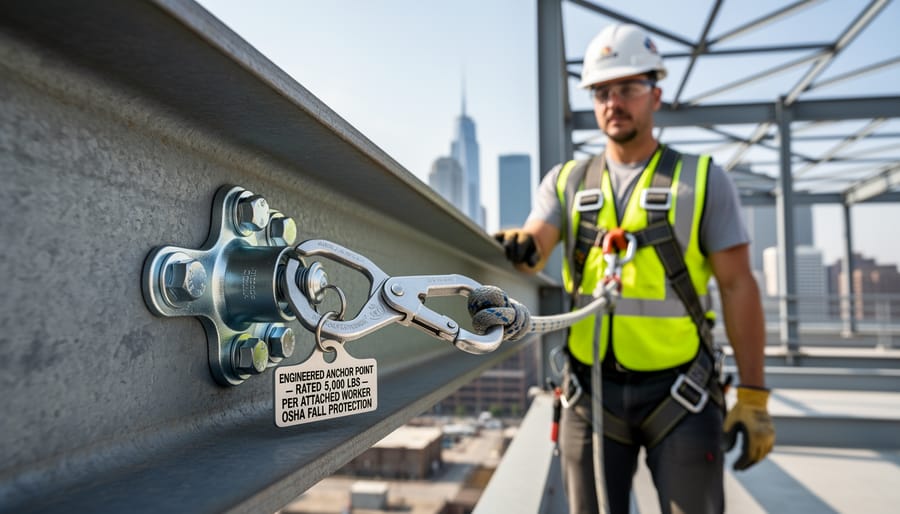
Anchor points must be engineered to withstand 5,000 pounds per attached worker or maintain a safety factor of two under supervision of a qualified person. For photovoltaic installations, common anchor solutions include roof-mounted permanent anchors, temporary beam anchors attached to structural members, and mobile anchor systems designed for standing seam metal roofs. Each anchor point requires certification and regular inspection to ensure structural integrity.
Full-body harnesses distribute fall arrest forces across the shoulders, thighs, and pelvis, significantly reducing injury potential compared to outdated body belts. Solar professionals should select harnesses with dorsal D-rings positioned between the shoulder blades for standard fall arrest applications. Additional side D-rings facilitate positioning during panel installations on sloped surfaces.
Connecting devices include shock-absorbing lanyards and self-retracting lifelines. Shock-absorbing lanyards limit fall arrest forces to 900 pounds through integrated energy absorbers, while self-retracting lifelines provide continuous hands-free protection with minimal free fall distance. For solar work requiring mobility across large roof sections, horizontal lifeline systems enable multiple workers to connect simultaneously while maintaining independent protection.
Proper connection technique demands that workers attach at or above shoulder level whenever possible, minimizing total fall distance and reducing clearance requirements. Understanding fall clearance calculations proves essential, as arrested falls require adequate distance below the work surface to prevent ground contact during deceleration.
Fall Restraint vs. Fall Arrest: Choosing the Right System
Understanding the distinction between fall restraint and fall arrest systems is fundamental for PV professionals selecting appropriate rooftop protection. Fall restraint systems prevent workers from reaching fall hazards entirely by limiting their range of motion through carefully calculated anchorage positioning and lanyard lengths. This passive prevention approach keeps installers in safe zones away from roof edges, eliminating fall risk rather than managing it. Workers remain connected to secure anchor points but physically cannot reach dangerous perimeters.
Conversely, fall arrest systems allow workers to access edge areas but are engineered to stop falls in progress. These active systems include shock-absorbing lanyards and self-retracting lifelines that arrest falls within specified distances, typically requiring greater clearance calculations to prevent ground contact during deceleration.
For photovoltaic installations, restraint systems prove ideal for centralized array work on large flat roofs where edge access is unnecessary. They offer simpler training requirements and eliminate arrest-related medical concerns. Fall arrest becomes necessary when installing perimeter modules, performing maintenance near edges, or working on complex roof geometries where movement restriction is impractical. Many commercial PV projects employ hybrid approaches, using restraint in interior zones and arrest systems for edge-critical tasks. Selection depends on roof configuration, array layout, anchor point availability, and specific task requirements throughout the installation lifecycle.
Rooftop Access and Egress Safety
Ladder Selection and Three-Point Contact Protocol
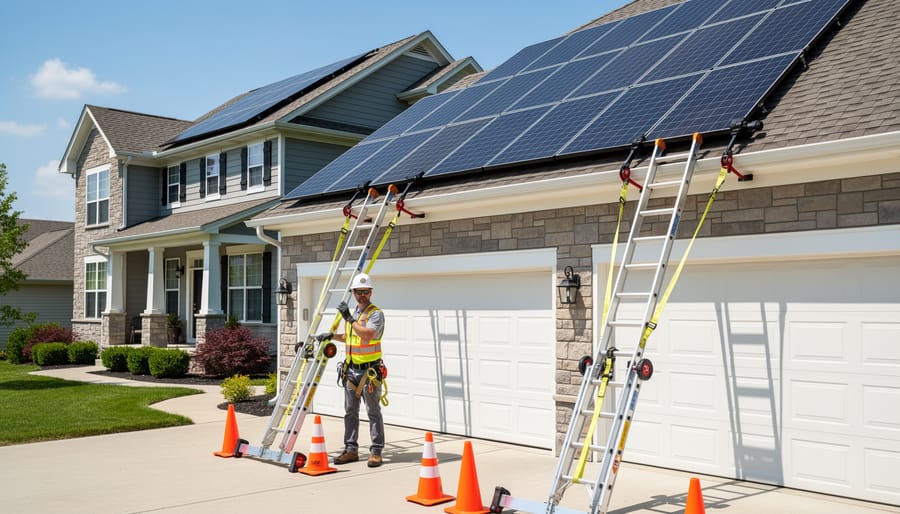
Selecting appropriate ladder equipment represents a critical first step in rooftop access safety for photovoltaic installations. Use fiberglass Type I or Type IA ladders rated for heavy-duty industrial applications, as these provide non-conductive properties essential when working near electrical systems. Extension ladders should extend at least three feet above the roof edge and be positioned at a 75-degree angle, maintaining the 4-to-1 rule where the base stands one foot away from the structure for every four feet of vertical height.
Secure ladders at both top and bottom points using ladder stabilizers or tie-offs to prevent lateral movement during ascent and descent. For installations requiring frequent roof access, consider semi-permanent ladder systems with integrated fall arrest anchor points.
The three-point contact protocol mandates maintaining either two hands and one foot, or two feet and one hand, in contact with ladder rungs at all times. When transporting tools and materials, use tool belts, shoulder slings, or material hoists rather than hand-carrying items during climbing. This technique reduces fall risk by 60 percent according to occupational safety data. Never attempt to reach laterally beyond the ladder rails, and descend to reposition rather than overextending your center of gravity during panel positioning or mounting tasks.
Material Hoisting and Roof-Level Staging
Transporting photovoltaic modules and racking components to the roof presents unique challenges that require careful planning to maintain fall protection integrity. PV modules typically weigh 40-50 pounds each, while racking materials add considerable bulk, making manual carrying impractical and unsafe near roof edges.
Mechanical hoisting systems provide the safest material transport solution. Ladder hoists, conveyor systems, and material lifts allow workers to remain away from roof perimeters during loading operations. These systems should be positioned to deliver materials directly to designated staging areas at least six feet from all roof edges, minimizing the need for workers to handle heavy loads in fall hazard zones.
Roof-level staging areas must be strategically located within the protected work zone, ideally near the center of the roof. These areas should be clearly marked and organized to prevent material spread toward unprotected edges. Installers should establish material flow patterns that keep workers moving away from perimeters during panel placement.
For projects without mechanical hoisting capability, manual material handling requires additional precautions. Workers transferring materials must remain tied off at all times, and hand-off points should be established well within protected zones. Never stage materials near roof edges where wind uplift or accidental contact could create falling object hazards. Proper material management directly supports both worker safety and installation efficiency throughout the project duration.
Anchor Point Engineering and Load Calculations
5,000-Pound Rule and Fall Force Dynamics
OSHA’s 5,000-pound rule establishes that each anchor point must support a minimum static load of 5,000 pounds per attached worker, or demonstrate a safety factor of at least two when engineered calculations verify capacity. This requirement exists because the forces generated during a fall significantly exceed a worker’s body weight due to fundamental physics principles.
When a worker falls, the sudden deceleration upon arrest creates dynamic forces that multiply the initial load. A 200-pound worker falling six feet can generate forces exceeding 1,200 pounds during arrest, depending on the fall arrest system components and configuration. Personal fall arrest systems incorporate energy-absorbing elements that extend deceleration time and distance, reducing peak arrest forces to approximately 900 pounds or less on the worker’s body. However, anchor points must account for worst-case scenarios including equipment degradation, improper use, and simultaneous loading conditions.
The 5,000-pound standard provides substantial margin above calculated forces to ensure reliability across diverse installation conditions common in photovoltaic work. For solar installers working on residential and commercial rooftops, understanding these dynamics informs proper anchor selection and system design. Professional training programs emphasize fall force calculations as essential knowledge for anyone specifying or installing rooftop protection systems, ensuring that theoretical requirements translate into practical safety measures during panel installation and maintenance operations.
Temporary vs. Permanent Anchor Solutions
Selecting between temporary and permanent anchor solutions depends primarily on the frequency of rooftop access and the installation phase. Temporary anchors, including portable designs and counterweighted systems, serve well during initial PV array installation when workers require flexible positioning across various roof sections. These solutions offer mobility without penetrating the roof membrane, reducing leak risks during short-term projects. However, temporary anchors demand careful setup verification before each use and may not withstand long-term environmental exposure.
Permanent anchor systems become economically justified for facilities requiring regular maintenance access to photovoltaic systems. These engineered solutions, professionally installed and certified by structural engineers, provide reliable attachment points for ongoing panel cleaning, inverter servicing, and system inspections. Permanent anchors integrate seamlessly with walkway systems and guardrails, creating comprehensive fall protection infrastructure. Their installation requires careful waterproofing to maintain roof integrity, but eliminates repeated setup time and verification procedures.
Installation professionals should evaluate project timelines and maintenance schedules when specifying anchor types. Many commercial solar facilities benefit from permanent solutions that support decades of operational maintenance, while residential installations with infrequent service needs may justify temporary anchor deployment. Educational programs emphasize proper selection criteria, helping emerging professionals match protection systems to specific project requirements and long-term facility management strategies.
Training and Competent Person Requirements
Rescue Planning and Self-Rescue Techniques
Before any rooftop PV installation work begins at height, OSHA and industry standards mandate a documented rescue plan. This critical requirement addresses scenarios where workers become suspended in fall arrest systems following an incident. Without prompt rescue, suspended workers face suspension trauma, a life-threatening condition where blood pools in the legs, potentially causing unconsciousness within 15 minutes and organ failure within 30 minutes.
Effective rescue planning requires site-specific evaluation of access points, equipment placement, and rescue team proximity. Employers must identify whether rescue will be performed by trained on-site personnel using descent devices and retrieval systems, or by summoning external emergency services. Self-rescue devices, including descent control systems that allow controlled lowering, provide immediate options when team rescue is delayed. These systems attach to anchor points and enable suspended workers to safely reach ground level independently.
Training programs must incorporate rescue drills alongside standard fall protection instruction, ensuring crews can execute procedures under stress. Integration with comprehensive emergency response protocols strengthens overall site safety management and regulatory compliance for solar installation operations.
Integrating Fall Protection with PV System Design
Modern PV system design increasingly integrates safety features from the conceptual phase rather than treating fall protection as an afterthought. This proactive approach begins with a comprehensive risk assessment that evaluates rooftop geometry, maintenance requirements, and access patterns before finalizing array layouts.
Strategic module placement creates natural maintenance corridors between array sections, typically 3-4 feet wide, allowing technicians to move safely without constantly attaching and detaching from anchor points. These pathways should align with permanent walkway systems and provide clear routes to critical equipment including inverters, combiner boxes, and monitoring devices.
Designers can specify permanent guardrail systems around roof perimeters and equipment areas during initial installation, eliminating the need for temporary protection during routine maintenance. Embedding certified anchor points at regular intervals throughout the array—typically every 30 feet—provides attachment options without interfering with module performance or drainage patterns.
Collaboration between structural engineers, safety professionals, and PV designers ensures adequate load-bearing capacity for safety equipment while optimizing electrical performance. Universities partnering with industry leaders are developing design software that automatically integrates fall protection requirements into layout algorithms, considering factors like cable management, shading analysis, and emergency egress routes simultaneously.
Forward-thinking specifications also address equipment selection, favoring lightweight modules and mounting systems that reduce installation time at height and minimize the physical demands on workers operating under fall protection constraints.
Rooftop fall protection represents far more than regulatory checkbox compliance—it embodies the professional responsibility every photovoltaic installer carries and serves as a critical business imperative in today’s competitive renewable energy landscape. Organizations that prioritize comprehensive safety protocols consistently demonstrate superior project outcomes, reduced insurance costs, and enhanced reputation among clients and partners.
Contrary to outdated perceptions, properly implemented fall protection systems enhance rather than impede installation efficiency. Well-trained crews equipped with appropriate safety equipment complete projects faster, with fewer interruptions from incidents or near-misses. The initial investment in quality fall protection infrastructure and training yields substantial returns through improved worker confidence, reduced liability exposure, and streamlined operations that meet project timelines reliably.
For aspiring photovoltaic professionals, developing safety expertise should rank among core competencies alongside technical installation skills and system design knowledge. The most respected industry professionals recognize that mastering fall protection principles distinguishes competent installers from exceptional ones. This expertise protects not only individual workers but entire project teams, contributing to the sustainable growth of the solar industry.
Mose Solar’s educational programs reflect this integrated approach, incorporating comprehensive safety training alongside technical instruction. By learning fall protection principles from the beginning of their professional journey, students develop habits and perspectives that serve them throughout their careers. This foundation enables emerging professionals to enter the workforce as safety-conscious contributors who elevate industry standards while advancing renewable energy adoption. Investing in safety knowledge today creates the experienced, reliable photovoltaic workforce essential for tomorrow’s clean energy transformation.