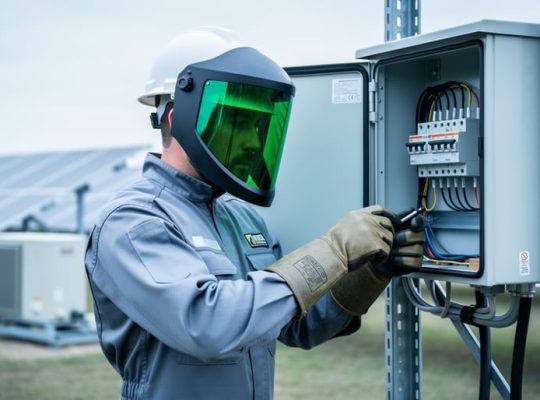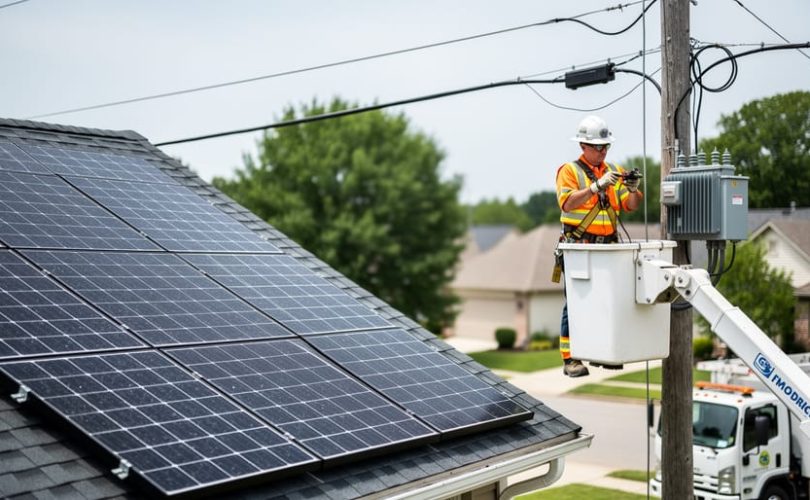
When a portion of the electrical grid loses connection to the main power supply but continues receiving electricity from distributed generators like solar photovoltaic systems, a dangerous condition called islanding occurs. This phenomenon transforms what should be a dead section of the grid into an energized island, creating severe hazards for utility workers performing repairs, damaging equipment, and degrading power quality for consumers who unknowingly remain connected.
Anti-islanding protection has become a fundamental requirement in grid-connected PV systems, mandated by standards such as IEEE 1547 and UL 1741. These safety mechanisms ensure that inverters detect grid disconnection within two seconds and immediately cease power injection, preventing the formation of unintended islands. The stakes are substantial: a utility worker expecting a de-energized line could face electrocution, while voltage and frequency fluctuations in an islanded network can destroy sensitive equipment and create fire hazards.
Understanding anti-islanding technology requires familiarity with both passive and active detection methods. Passive techniques monitor grid parameters like voltage, frequency, and phase, identifying abnormalities that signal grid disconnection. Active methods intentionally introduce small disturbances into the grid connection, observing how the system responds. Modern inverters combine multiple detection strategies to minimize the non-detection zone, the critical region where islanding conditions might escape identification.
For photovoltaic professionals entering the field, mastering anti-islanding concepts is essential. This knowledge directly impacts system design, equipment selection, commissioning procedures, and compliance verification. As distributed generation proliferates and grid architecture evolves toward greater decentralization, anti-islanding protection remains a cornerstone of safe, reliable renewable energy integration. This article examines the technical foundations, regulatory framework, detection methodologies, and practical implementation of anti-islanding protection in contemporary PV installations.
What Is Islanding in Solar PV Systems?
The Mechanics of Unintentional Islanding
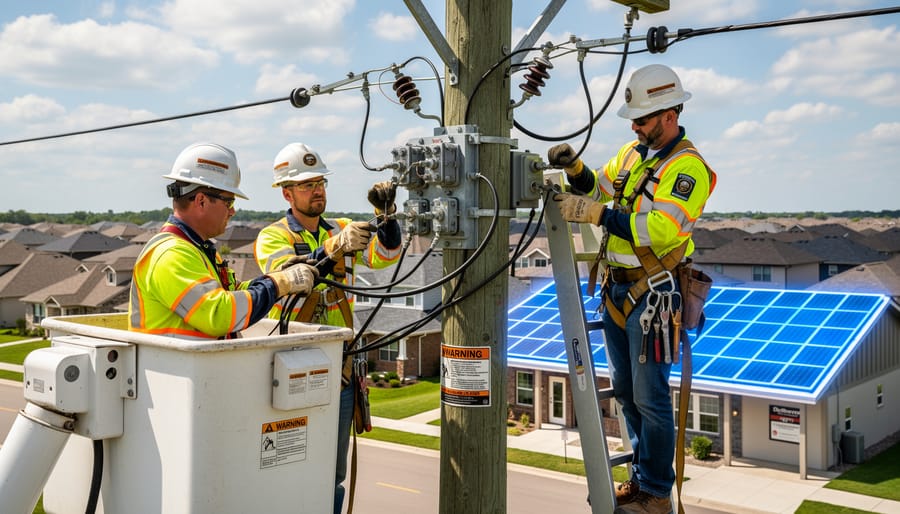
Unintentional islanding occurs when a distributed generation system, such as a solar photovoltaic array with its inverter, continues to energize a portion of the utility grid after that section has been electrically isolated from the main power supply. This phenomenon creates significant safety and operational risks that anti-islanding protection is designed to prevent.
The formation of an island requires a specific set of conditions. When the utility grid experiences a fault or planned disconnection, circuit breakers or other protective devices isolate the affected area. If a solar inverter within this isolated section continues generating power that closely matches the local load demand, it can sustain voltage and frequency within acceptable ranges, preventing the inverter from detecting the disconnection.
This load-generation balance is the critical factor enabling islands to persist. The inverter monitors grid parameters like voltage and frequency to maintain synchronization. When local generation precisely balances local consumption, these parameters remain stable despite grid separation. For instance, if a 10-kilowatt solar system supplies power to loads drawing exactly 10 kilowatts, the voltage and frequency may appear normal to the inverter’s monitoring systems.
The probability of perfect balance is relatively low in real-world conditions, as loads constantly fluctuate. However, even temporary matching can delay detection, creating hazardous situations. Modern anti-islanding detection methods address this challenge through active and passive techniques that intentionally disrupt this equilibrium, forcing rapid inverter shutdown when grid separation occurs.
Real-World Scenarios Where Islanding Occurs
Islanding scenarios emerge during several critical grid events that directly impact utility workers and distributed generation systems. During planned maintenance operations, utility crews must de-energize distribution lines for repairs or upgrades. If solar photovoltaic systems continue generating power after grid disconnection, they create energized islands that pose severe electrocution risks to maintenance personnel who expect dead lines. Similarly, when storms, equipment failures, or accidents cause unplanned grid outages, distributed generators may inadvertently sustain voltage on isolated circuit segments, complicating restoration efforts and endangering emergency responders.
Fault conditions present particularly hazardous islanding situations. When protective devices like circuit breakers isolate damaged grid sections, solar installations within the isolated area can mask fault locations by continuing to supply power. This prevents proper fault clearing and creates dangerous touch potentials. Emergency situations such as wildfires requiring immediate grid shutdown also demand rapid de-energization. Any delay caused by undetected islanding operations compromises public safety protocols. These real-world scenarios underscore why robust anti-islanding protection remains non-negotiable for grid-connected renewable energy systems, protecting both utility workers and the broader community.
The Safety Hazards of Islanding
Electrocution Risk to Utility Personnel
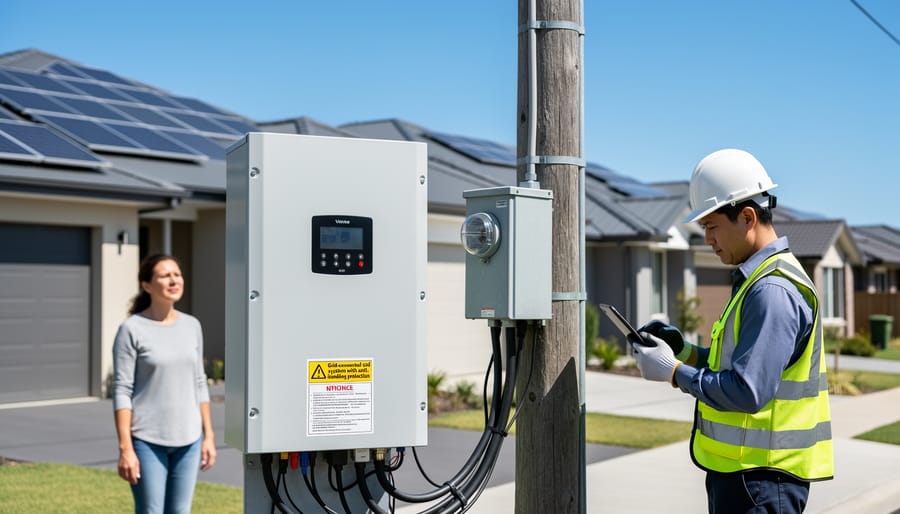
Utility lineworkers operate under strict safety protocols that assume power lines are de-energized during maintenance and repair operations. However, when islanding occurs, distributed generation systems like photovoltaic arrays can continue energizing supposedly dead lines, creating a deadly hazard. These workers may disconnect a line from the main grid, believing it safe to handle, only to encounter unexpected voltage from an islanded PV system still feeding power into that section.
This scenario presents a particularly insidious danger because conventional lockout-tagout procedures address grid-supplied power but may not account for distributed generation sources. A lineworker making physical contact with an energized conductor expects zero voltage based on established safety protocols, removing protective barriers and proper precautions. The resulting electrocution risk can be fatal, as personnel are caught completely off-guard by the presence of live voltage.
Furthermore, islanded systems may produce voltage levels that fluctuate unpredictably, making detection with standard testing equipment challenging. This unpredictability compounds the danger, as workers cannot rely on consistent electrical characteristics to identify hazardous conditions. The imperative for robust anti-islanding protection stems directly from protecting utility personnel who rightfully expect de-energized lines to remain safe during maintenance operations.
Equipment Damage and Grid Instability
Uncontrolled islanding creates dangerous voltage and frequency fluctuations that threaten both utility infrastructure and customer equipment. When a distributed generator continues operating independently from the grid, it rarely maintains the precise voltage and frequency control that grid-connected operation provides. These variations can damage sensitive electronic equipment, cause transformers to overheat due to abnormal operating conditions, and trigger premature failure of protective devices designed for stable grid parameters.
Customer equipment such as computers, medical devices, and industrial machinery typically operates within narrow voltage tolerances. Sustained operation outside these ranges during islanding conditions leads to equipment malfunction or permanent damage. Utility transformers experience increased losses and thermal stress when subjected to off-nominal frequencies, potentially shortening their operational lifespan significantly.
Perhaps the most hazardous scenario occurs when grid power restoration happens while an island remains energized. If the distributed generator and grid are out of phase during reconnection, the resulting synchronization mismatch creates severe voltage transients and mechanical stress on rotating equipment. This out-of-phase reclosure can generate damaging current surges exceeding ten times normal operating levels, potentially destroying inverters, transformers, and other connected equipment instantaneously. These risks underscore why anti-islanding protection serves as a fundamental safety requirement in modern photovoltaic installations.
Fire and Public Safety Concerns
Islanding poses critical hazards during emergency situations when first responders assume electrical systems are de-energized. When firefighters arrive at a burning building, standard protocols require utility companies to disconnect power at the service point. However, an islanded solar PV system can continue energizing circuits within the structure, creating life-threatening shock risks for personnel conducting rescue operations or suppression activities. This hidden power source contradicts established emergency response protocols that rely on complete electrical isolation. Additionally, energized conductors complicate ventilation procedures and roof operations essential to firefighting tactics. Anti-islanding protection ensures that distributed generation systems immediately cease operation when grid power fails, aligning with firefighter safety protocols and eliminating unexpected electrical hazards. This critical safety function protects not only emergency personnel but also utility workers who may be restoring power or performing repairs during disaster recovery operations.
How Anti-Islanding Protection Works
Passive Detection Methods
Passive detection methods form the first line of defense against islanding by continuously monitoring electrical parameters at the point of common coupling. These techniques rely on the natural deviation of voltage and frequency that occurs when the utility grid disconnects, as the isolated inverter struggles to maintain perfect balance with local loads.
Over/Under Voltage Protection (OVP/UVP) monitors grid voltage levels and triggers disconnection when measurements fall outside preset thresholds, typically ranging from 88% to 110% of nominal voltage. When the grid disconnects, load-generation imbalances often cause immediate voltage fluctuations that these protections can detect within milliseconds. Similarly, Over/Under Frequency Protection (OFP/UFP) tracks grid frequency deviations, with standard trip settings around 59.3-60.5 Hz for 60 Hz systems. Frequency shifts occur naturally during islanding as the inverter attempts to match power output with local demand without grid stabilization.
The primary advantage of passive methods lies in their simplicity and zero non-detection zone under significant power mismatches. However, these techniques face limitations in specific scenarios where local load closely matches generation output, creating a balanced island where voltage and frequency remain within normal ranges. This situation, known as the non-detection zone, represents the critical weakness of passive-only approaches, prompting many modern systems to incorporate active detection methods as complementary protection layers.
Active Detection Methods
Active detection methods take a proactive approach by deliberately introducing small disturbances into the system and monitoring the grid’s response. These techniques are particularly effective at detecting islanding conditions that passive methods might miss, especially when local load closely matches generation.
Frequency shift methods, including Active Frequency Drift (AFD) and Sandia Frequency Shift (SFS), intentionally create frequency deviations by modulating the inverter’s output. When connected to the utility grid, the grid’s strong voltage and frequency remain stable, absorbing these small perturbations. However, in an islanded condition, the frequency begins to drift outside normal limits, triggering rapid disconnect.
Impedance measurement techniques periodically inject current harmonics or signals at specific frequencies to measure the electrical impedance at the point of common coupling. A significant impedance change indicates separation from the low-impedance utility grid, signaling an island condition. This method proves especially valuable in university research programs studying complex grid interactions.
Harmonic injection methods introduce controlled harmonic distortions into the output current. The grid’s response to these harmonics differs substantially when islanded versus grid-connected, providing reliable detection. While highly effective, these active methods require careful calibration to minimize power quality impacts during normal operation. Educational programs now emphasize understanding the trade-offs between detection speed, reliability, and power quality when implementing active anti-islanding protection.
Shutdown Response and Reconnection Protocols
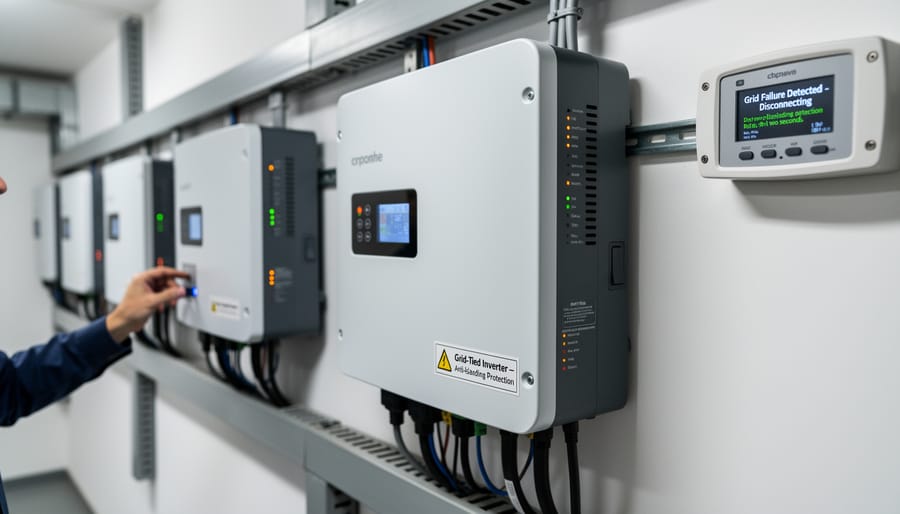
When islanding conditions are detected, inverters must execute rapid disconnection to protect utility workers and equipment. International standards, including IEEE 1547 and UL 1741, mandate that grid-tied inverters cease energizing the utility line within two seconds of detecting an abnormal grid condition. Modern inverters typically achieve disconnection in under one second through semiconductor-based switching mechanisms.
Following disconnection, inverters enter a mandatory waiting period before attempting reconnection. This delay, typically five minutes as specified by IEEE 1547, ensures grid stability has been restored and prevents repeated connection attempts during unstable conditions. The inverter continuously monitors grid parameters during this interval, verifying voltage and frequency remain within acceptable ranges for the full duration. This protocol works in coordination with rapid shutdown systems to create comprehensive safety measures. Only after confirming stable grid conditions does the inverter automatically restore normal operation, ensuring seamless integration without compromising safety or requiring manual intervention from system operators.
Regulatory Standards and Grid Interconnection Requirements
IEEE 1547 Standard for Interconnection
IEEE 1547, the cornerstone standard for distributed energy resource interconnection in North America, establishes comprehensive anti-islanding requirements to ensure grid safety and reliability. Originally published in 2003 and significantly updated in 2018, this standard mandates that grid-interactive inverters must detect and cease energizing the electrical power system within two seconds of island formation under normal operating conditions.
The standard specifies rigorous testing protocols that inverters must pass before receiving certification. These tests evaluate detection performance across various load conditions, including matched loads where active and reactive power are balanced—the most challenging scenario for detection systems. Testing must demonstrate consistent islanding detection across multiple quality factors, which represent different resonant circuit characteristics that can mask grid disconnection.
IEEE 1547-2018 introduced enhanced requirements addressing modern grid needs, including ride-through capabilities during voltage and frequency disturbances. This prevents nuisance tripping while maintaining robust anti-islanding protection. The standard also defines precise voltage and frequency trip settings that complement anti-islanding functions, creating multiple protective layers.
For photovoltaic professionals, understanding IEEE 1547 compliance is essential, as utilities require certified equipment meeting these specifications. Many universities now incorporate this standard into renewable energy curricula, preparing students for real-world interconnection challenges. The testing procedures outlined provide manufacturers and system designers with clear benchmarks for developing reliable anti-islanding protection systems.
UL 1741 Certification for Inverters
UL 1741 represents the cornerstone safety certification for grid-tied inverters in North America, establishing rigorous testing protocols that validate anti-islanding protection and overall grid safety performance. This standard, developed by Underwriters Laboratories, mandates that all solar inverters demonstrate reliable islanding detection capabilities before receiving market authorization. The certification process involves comprehensive laboratory testing under various grid conditions, simulating scenarios where utility power fails while the PV system continues generating electricity. Inverters must prove they can disconnect within two seconds of islanding detection, preventing hazardous energization of supposedly dead circuits. Beyond anti-islanding requirements, UL 1741 encompasses voltage and frequency ride-through specifications, power quality standards, and electromagnetic compatibility testing. The supplement UL 1741 SA addresses advanced inverter functions supporting modern grid stability, including reactive power control and smart grid communications. For solar professionals and installers, verifying UL 1741 certification ensures compliance with solar safety standards and local electrical codes. This certification ultimately protects utility workers, emergency responders, and system owners by guaranteeing that inverters meet independently verified safety benchmarks before deployment.
Utility Interconnection Agreements
Local utilities play a critical role in enforcing anti-islanding protection through their interconnection application processes. Before connecting a photovoltaic system to the grid, installers must submit detailed documentation demonstrating compliance with IEEE 1547 and regional safety standards. Utility providers review inverter specifications, anti-islanding features, and system designs to verify proper protection mechanisms are in place. The interconnection agreement legally binds system owners to maintain compliant equipment and may require witness testing of anti-islanding functions. Many utilities mandate specific inverter certifications from recognized testing laboratories before granting permission to operate. This regulatory framework ensures that distributed generation systems cannot compromise grid stability or worker safety during maintenance activities. Understanding your local utility’s specific requirements is essential for successful project deployment and avoiding costly compliance issues during installation.
Modern Inverter Technology and Anti-Islanding
Built-In Protection Features
Modern grid-tied inverters incorporate sophisticated multi-layered anti-islanding protection as a standard feature, meeting stringent safety requirements established by international standards. These systems employ both active and passive detection methods working simultaneously to identify grid disconnection events within milliseconds.
Passive detection monitors grid parameters continuously, measuring voltage amplitude, frequency deviations, and harmonic distortions. When these values drift outside predetermined thresholds—typically ±10% for voltage and ±0.5 Hz for frequency—the inverter recognizes potential islanding conditions. Active detection methods complement this approach by intentionally introducing small perturbations into the output current or frequency. Under normal grid conditions, the robust utility network absorbs these minor disturbances. However, during islanding, these perturbations cause measurable parameter shifts that trigger immediate detection.
Once an islanding condition is confirmed, rapid disconnect mechanisms activate within two seconds, as mandated by IEEE 1547 and IEC 62116 standards. Advanced inverters achieve disconnection in under 100 milliseconds, ensuring utility worker safety and preventing equipment damage. These protection features integrate seamlessly with broader installation safety precautions, creating comprehensive protection systems. Modern digital signal processors enable real-time analysis of multiple parameters simultaneously, significantly reducing nuisance tripping while maintaining high reliability in genuine islanding scenarios.
Smart Inverter Capabilities and Grid Support
Modern smart inverters represent a paradigm shift in grid-tied photovoltaic systems, seamlessly integrating anti-islanding protection with advanced grid support capabilities. Unlike conventional inverters that simply disconnect during disturbances, these intelligent devices actively contribute to grid stability through voltage regulation, frequency response, and reactive power support—functions collectively known as “grid-forming” or “grid-following” behaviors.
The challenge lies in distinguishing intentional grid support operations from genuine islanding conditions. Advanced algorithms continuously monitor grid parameters, enabling inverters to provide volt-var support and dynamic frequency response while maintaining vigilant anti-islanding protection. For example, when voltage sags occur, smart inverters can inject reactive power to support grid recovery rather than immediately tripping offline.
Universities collaborating with industry have developed sophisticated control strategies that prioritize safety without compromising functionality. These systems employ multi-layered protection schemes: active frequency drift methods operate during abnormal conditions, while passive monitoring ensures instantaneous disconnection when true islanding occurs. Educational programs now emphasize this dual-purpose design philosophy, preparing professionals to configure inverters that enhance both safety and grid resilience. This evolution reflects the industry’s transition toward distributed energy resources that act as active grid participants rather than passive generators.
Testing and Verification of Anti-Islanding Protection
Commissioning Tests
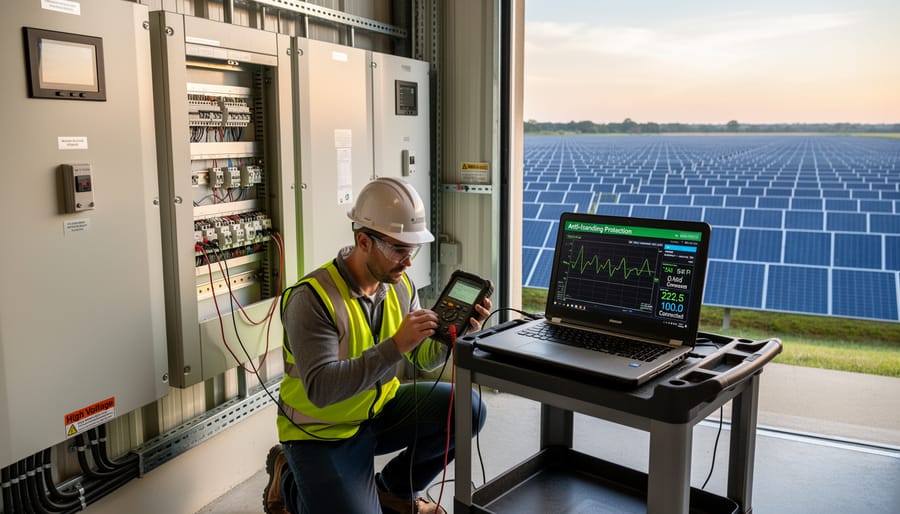
Proper commissioning tests validate that anti-islanding protection functions correctly before energizing grid-tied photovoltaic systems. These standardized procedures ensure compliance with IEEE 1547 and UL 1741 requirements while safeguarding utility workers and equipment.
The primary test involves simulating an islanding condition by disconnecting the utility supply while the inverter operates under varying load conditions. Qualified technicians monitor the system’s response time, which must not exceed two seconds from islanding detection to complete inverter shutdown. Testing typically includes scenarios at matched load conditions, where power generation equals consumption, representing the most challenging detection environment.
Additional verification procedures examine frequency and voltage trip thresholds, confirming the inverter ceases exporting power when grid parameters deviate beyond acceptable ranges. Technicians document all test results, including clearing times and operational parameters, creating permanent records for regulatory compliance and future reference.
Many educational institutions collaborate with industry partners to develop comprehensive training programs that teach proper commissioning protocols. These programs emphasize hands-on experience with testing equipment and real-world scenarios, preparing technicians to perform reliable safety verifications. Regular commissioning ensures ongoing system safety and maintains adherence to evolving grid interconnection standards throughout the installation’s operational lifetime.
Ongoing Monitoring and Maintenance
Maintaining reliable anti-islanding protection requires systematic oversight throughout your photovoltaic system’s lifespan. Schedule annual inspections by qualified technicians to verify that protection functions remain operational and compliant with current IEEE 1547 and UL 1741 standards. These assessments should include functional testing of inverter response times and trip settings to confirm they meet manufacturer specifications.
Firmware updates represent a critical maintenance component, as manufacturers periodically release improvements to detection algorithms and grid support functions. Establish a protocol for tracking and installing these updates promptly to ensure optimal performance. Document all maintenance activities, test results, and component replacements to maintain comprehensive system records for regulatory compliance and troubleshooting purposes.
Monitor system performance data regularly through inverter interfaces or monitoring platforms to identify anomalies that might indicate degraded protection capabilities. Any unexpected behavior, alarm conditions, or communication errors warrant immediate professional evaluation. Many educational programs now emphasize preventive maintenance strategies, and collaboration with universities has yielded valuable research on long-term protection system reliability. Implementing these evidence-based practices ensures your anti-islanding safeguards continue protecting utility workers and equipment effectively.
Anti-islanding protection stands as a non-negotiable safety feature in modern photovoltaic systems, serving as the critical safeguard that protects utility workers, emergency responders, and the broader electrical infrastructure from potentially fatal hazards. The consequences of islanding extend beyond immediate safety concerns—they encompass equipment damage, grid instability, and liability issues that can undermine the credibility of solar installations. As the renewable energy sector continues its rapid expansion, the implementation of robust anti-islanding mechanisms becomes increasingly vital to maintaining safe and reliable grid operations.
For aspiring photovoltaic professionals, a comprehensive understanding of anti-islanding requirements is essential to career advancement and project success. This knowledge encompasses not only the technical aspects of detection methods and standards compliance but also the practical considerations of system design, inverter selection, and proper installation procedures. The integration of IEEE 1547 requirements, UL 1741 certification, and local utility interconnection protocols demands precision and expertise that can only be developed through dedicated study and hands-on experience.
Proper system design begins with selecting certified equipment and implementing appropriate detection algorithms, but it extends to thorough commissioning and regular maintenance practices. Installation quality directly impacts the reliability of anti-islanding protection, making adherence to best practices and industry standards paramount.
Mose Solar recognizes the critical importance of educating the next generation of solar professionals in grid interconnection safety. Through collaborative programs with universities and comprehensive educational resources, we provide aspiring professionals with the technical foundation and practical insights needed to design, install, and maintain safe, compliant photovoltaic systems that contribute to a sustainable energy future.