
The solar photovoltaic industry has undergone a fundamental transformation, evolving from labor-intensive assembly processes to sophisticated automated production lines where precision meets scale. Modern PV manufacturing facilities now operate with inline metrology systems that measure critical parameters in real-time, detecting defects measured in micrometers while panels move at speeds exceeding one unit per minute. This integration of Process Analytical Technology (PAT) automation has reduced manufacturing defects by up to 40% while simultaneously increasing throughput, fundamentally changing quality assurance from reactive inspection to proactive process control.
Automated production lines in PV manufacturing combine robotic handling systems with advanced sensor networks that continuously monitor cell efficiency, wafer thickness, encapsulation quality, and electrical performance. These systems generate thousands of data points per panel, feeding machine learning algorithms that predict potential failures before they occur. The convergence of inline metrology and PAT automation addresses the industry’s most pressing challenge: maintaining rigorous quality standards while scaling production to meet exponential demand for renewable energy solutions.
Understanding how these technologies integrate into production workflows is essential for professionals entering the solar industry. This comprehensive examination explores the technical foundations of inline metrology, practical PAT implementation strategies, the business case for automation investment, and emerging trends that will define next-generation solar manufacturing capabilities.
Understanding Automated Production Lines in PV Manufacturing
The PV Manufacturing Process Flow
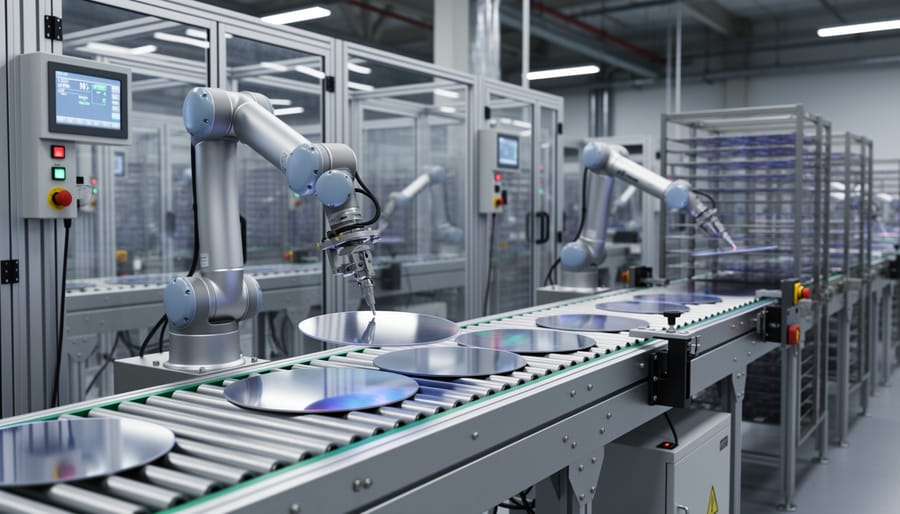
Solar panel production involves a carefully orchestrated sequence of manufacturing stages, each presenting opportunities for automation and quality control integration. The solar PV cell manufacturing process begins with silicon wafer processing, where crystalline silicon ingots are sliced into thin wafers and subjected to surface texturing and cleaning operations. These wafers then progress through cell fabrication stages including diffusion to create the p-n junction, anti-reflective coating application, and screen printing of metallic contacts.
Following cell production, the manufacturing flow transitions to module assembly, where cells are interconnected through tabbing and stringing operations. These cell strings are then laminated between protective layers of glass, encapsulant materials, and backsheets to form complete solar modules. Finally, junction boxes are attached, and modules undergo framing before final testing and packaging.
Throughout this production flow, automation serves multiple critical functions. Automated handling systems transport delicate wafers and cells between process stations while minimizing breakage risks. Robotic systems ensure precise alignment during printing and assembly operations. Most significantly, automated inline metrology systems continuously monitor product quality at each stage, measuring parameters such as wafer thickness, cell efficiency, and string integrity without interrupting production flow. This integration of Process Analytical Technology enables real-time adjustments, ensuring consistent output quality while maximizing throughput efficiency in modern photovoltaic manufacturing facilities.
Why Automation Matters for Solar Manufacturing
The photovoltaic industry faces unprecedented demand for solar panels as global markets accelerate renewable energy adoption. Meeting this demand requires production capabilities that manual processes simply cannot deliver. Automation addresses several critical business imperatives simultaneously.
Throughput represents the primary driver for smart factory automation in solar manufacturing. Modern facilities must produce thousands of modules daily while maintaining competitive pricing. Automated production lines operate continuously with minimal downtime, achieving output rates that exceed manual assembly by orders of magnitude.
Consistency in photovoltaic products directly impacts long-term performance and warranty obligations. Automated systems eliminate human variability in critical processes such as cell alignment, soldering connections, and lamination pressure. This precision ensures every module meets identical specifications, reducing field failures and enhancing brand reputation.
Cost reduction through automation extends beyond labor savings. Automated lines minimize material waste through precise dispensing and positioning systems, optimize energy consumption through synchronized operations, and reduce quality-related rework expenses. These factors compound to significantly lower the levelized cost of energy for end customers.
Quality imperatives in photovoltaic manufacturing demand real-time monitoring and correction capabilities that only automated systems with integrated metrology can provide, ensuring compliance with international standards and customer expectations.
Inline Metrology: Real-Time Quality Control on the Production Floor
What is Inline Metrology?
Inline metrology represents a transformative approach to quality control in photovoltaic manufacturing, where measurements occur directly within the production line rather than in separate testing facilities. Unlike traditional offline testing, which requires removing samples from production for laboratory analysis, inline metrology systems continuously monitor product characteristics as components move through each manufacturing stage. This real-time measurement capability enables immediate detection of defects or deviations from specifications, allowing manufacturers to address issues before they propagate downstream.
The technology primarily employs non-destructive testing methods, meaning products can be inspected without damage or alteration. Common inline metrology techniques in solar panel production include optical imaging systems that detect micro-cracks, electroluminescence testing for electrical defect identification, and thickness gauges that verify material layers meet precise tolerances. These automated systems collect data at production speeds, often measuring 100 percent of manufactured units rather than relying on statistical sampling approaches used in offline testing.
By integrating metrology directly into automated production lines, manufacturers achieve superior process control, reduce waste from undetected defects, and maintain consistent product quality throughout high-volume operations. This integration represents a fundamental shift from reactive quality management to proactive process optimization.
Critical Parameters Measured in PV Production
Automated production lines in photovoltaic manufacturing rely on sophisticated inline metrology systems to monitor several critical parameters that determine solar cell and module quality. Understanding these measurements is essential for maintaining production efficiency and ensuring optimal performance of finished products.
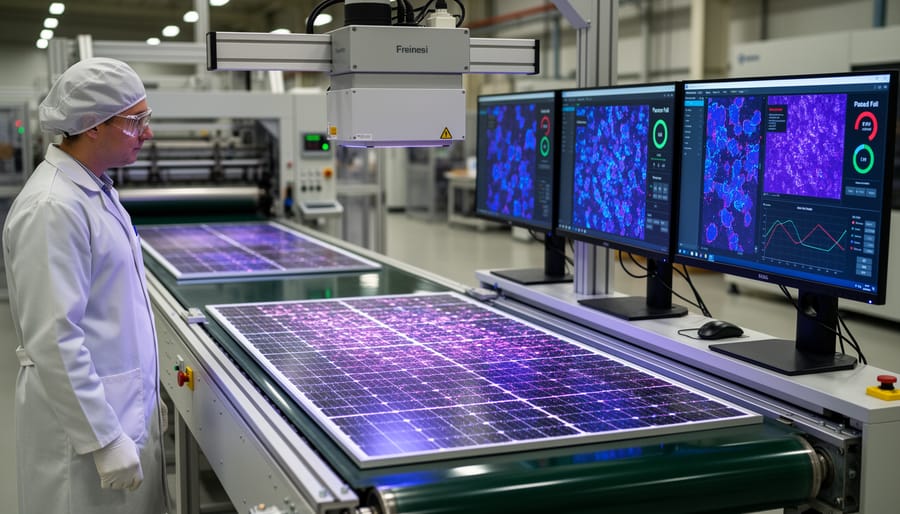
Cell efficiency represents the primary quality indicator, measuring how effectively a solar cell converts sunlight into electricity. Inline systems utilize non-contact methods such as photoluminescence imaging and electroluminescence testing to assess efficiency without disrupting production flow. These measurements occur at multiple stages, enabling immediate identification of performance degradation.
Thickness uniformity proves crucial for both silicon wafers and thin-film layers. Advanced optical sensors measure variations down to nanometer precision, ensuring consistent material distribution that directly impacts electrical characteristics. Deviations in thickness can create localized efficiency losses and potential reliability issues in the field.
Resistivity measurements verify the electrical properties of doped silicon, confirming proper concentration of charge carriers throughout the material. Four-point probe systems and eddy current sensors provide rapid, non-destructive assessment of sheet resistance across entire wafer surfaces.
Defect detection capabilities have evolved dramatically with machine vision and artificial intelligence integration. High-resolution cameras identify microcracks, inclusions, surface contamination, and structural irregularities that could compromise long-term durability. Modern systems can detect defects smaller than 50 micrometers while processing hundreds of wafers per hour.
Layer composition analysis ensures proper deposition of anti-reflective coatings, passivation layers, and metallization contacts. Spectroscopic techniques verify chemical composition and bonding characteristics, maintaining the complex material stacks that optimize light absorption and electrical conductivity.
Optical property measurements, including reflectance and transmittance, confirm that surface treatments effectively minimize light loss and maximize photon capture throughout the solar spectrum.
Technologies Enabling Inline Measurement
Modern photovoltaic manufacturing relies on an integrated suite of advanced measurement technologies that enable real-time quality assessment without disrupting production flow. These systems form the backbone of inline metrology, providing manufacturers with instant feedback on product quality and process performance.
Spectroscopy techniques, particularly photoluminescence and electroluminescence imaging, have become foundational tools in automated production lines. Photoluminescence systems use laser excitation to detect material defects, impurities, and crystal structure variations in silicon wafers before cell processing begins. This non-contact method identifies issues such as grain boundaries and contamination that could compromise cell efficiency. Electroluminescence imaging, applied after cell fabrication, injects current through the completed cells to visualize electrical defects, micro-cracks, and contact problems that would otherwise remain hidden until field deployment.
Laser scanning technologies complement these optical methods by providing high-resolution dimensional measurements and surface topography analysis. These systems verify wafer thickness uniformity, edge quality, and surface texture characteristics that directly impact light absorption and conversion efficiency.
Machine vision systems represent the integration point for multiple measurement modalities. Equipped with advanced cameras and artificial intelligence algorithms, these platforms perform rapid defect classification, pattern recognition, and automated decision-making. They can simultaneously track multiple quality parameters across thousands of cells per hour, correlating measurement data with production variables to enable predictive quality control.
Together, these technologies create a comprehensive measurement ecosystem that transforms raw data into actionable insights, ensuring consistent product quality while maintaining the high throughput demands of modern photovoltaic manufacturing.
Process Analytical Technology (PAT) in Solar Manufacturing
PAT Fundamentals and the Quality-by-Design Approach
Process Analytical Technology, or PAT, originated in the pharmaceutical industry as a framework for ensuring product quality through real-time measurement and control. This systematic approach emphasizes understanding and controlling manufacturing processes through timely measurements during production, rather than relying solely on end-product testing. The U.S. Food and Drug Administration introduced PAT guidelines in 2004 as part of a broader Quality-by-Design initiative, fundamentally shifting quality assurance from reactive to proactive methodologies.
In photovoltaic manufacturing, PAT principles have been adapted to address the unique challenges of solar cell and module production. The core philosophy revolves around three interconnected concepts: design for quality, understand the process, and control the process. Rather than inspecting quality into products after manufacturing, PAT enables manufacturers to build quality into every production step through continuous process verification and real-time adjustments.
This approach proves particularly valuable in PV production, where subtle variations in cell thickness, doping concentration, or surface texture can significantly impact conversion efficiency. By integrating inline sensors and analytical instruments directly into production lines, manufacturers gain immediate visibility into critical process parameters. This real-time data enables rapid identification of deviations from optimal conditions, allowing corrective actions before defective products accumulate.
The Quality-by-Design framework within PAT encourages manufacturers to establish a comprehensive understanding of how process variables influence product attributes. Through systematic experimentation and data analysis, production teams identify critical quality attributes and establish acceptable operating ranges. This knowledge-driven approach reduces waste, improves yield consistency, and supports continuous improvement initiatives essential for competitive PV manufacturing operations.
Data Analytics and Predictive Quality Control
Process Analytical Technology systems leverage sophisticated data analytics to transform raw production data into actionable intelligence. Through statistical process control (SPC), these systems continuously monitor critical quality attributes such as cell efficiency, layer thickness, and electrical parameters, establishing control limits that trigger alerts when deviations occur. This proactive approach enables manufacturers to identify trends and address potential issues before defective modules reach final production stages.
Machine learning algorithms enhance this capability by analyzing historical production data to recognize patterns invisible to traditional monitoring methods. These algorithms correlate process variables—temperature profiles, deposition rates, chemical concentrations—with quality outcomes, enabling precise parameter adjustments that optimize yield. For instance, neural networks can predict how slight variations in firing furnace temperatures might affect cell efficiency hours before actual measurement occurs.
Predictive analytics represents the most advanced application of PAT data systems. By integrating real-time sensor data with historical performance metrics, these tools forecast equipment maintenance needs, anticipate material quality variations, and predict batch-level defect probabilities. This capability significantly reduces scrap rates and improves overall equipment effectiveness.
Modern AI-powered quality control platforms further enhance predictive capabilities through deep learning models that continuously improve accuracy as more production data becomes available. Universities collaborating with manufacturers are developing increasingly sophisticated algorithms that can identify complex multivariate relationships between dozens of process parameters and final module performance, enabling unprecedented levels of quality assurance and process optimization in photovoltaic manufacturing environments.
Closed-Loop Process Control
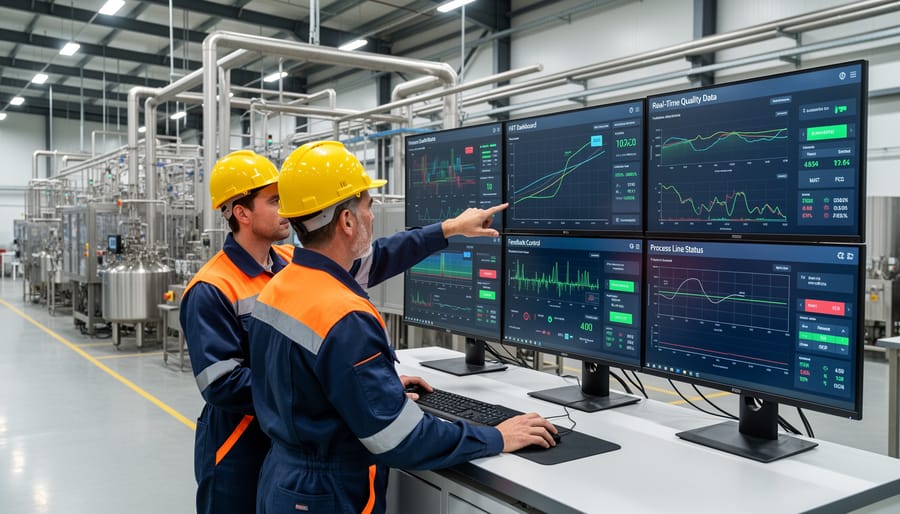
Process Analytical Technology transforms traditional production lines into intelligent, self-regulating systems through closed-loop feedback mechanisms. When inline metrology equipment detects deviations in cell thickness, electrical performance, or coating uniformity, the data flows directly into control algorithms that automatically adjust process parameters. For example, if sensors identify decreased efficiency in solar cells, the system can immediately modify deposition temperatures, optimize material flow rates, or adjust laser scribing parameters without human intervention. This real-time response capability minimizes defect propagation and maintains consistent product quality across production batches. The closed-loop approach reduces waste by catching issues within milliseconds rather than discovering problems through end-of-line testing. Manufacturing facilities implementing these automated feedback systems report improved yield rates and reduced energy consumption, as processes operate within optimal parameters continuously. Academic collaborations have enhanced these control algorithms, incorporating machine learning models that predict potential issues before they manifest, further advancing the self-correcting capabilities of modern photovoltaic production lines.
Integration Challenges and Solutions
Technical Integration Hurdles
Integrating inline metrology and process analytical technology into photovoltaic manufacturing environments presents several technical challenges that require careful planning and execution. Compatibility issues frequently emerge when connecting new measurement systems with existing robotic automation systems and production line controllers. Different communication protocols, data formats, and software platforms can create integration barriers that demand custom interface solutions or middleware applications to enable seamless data exchange.
Measurement speed requirements pose another significant hurdle in high-throughput production environments. Inline metrology systems must capture accurate measurements without slowing production rates, which typically range from 6,000 to 12,000 wafers per hour in modern facilities. This demands sophisticated sensor technology and ultra-fast data processing capabilities that can keep pace with rapid material movement.
Environmental factors on the production floor considerably impact measurement accuracy and equipment performance. Temperature fluctuations, humidity variations, vibrations from machinery, and airborne particulates can interfere with sensitive optical and electrical measurement systems. Manufacturing facilities must implement environmental controls and protective enclosures while ensuring adequate ventilation for equipment cooling.
Calibration maintenance represents an ongoing operational challenge. Measurement instruments require regular calibration to maintain accuracy, but traditional methods involve production line stoppages. Advanced PAT systems increasingly incorporate automated calibration routines and self-diagnostic capabilities, reducing downtime while ensuring measurement reliability. However, establishing robust calibration protocols and training personnel to recognize drift indicators remains essential for sustained measurement integrity across all production shifts.
Workforce Training and Change Management
Successfully implementing automated production lines in photovoltaic manufacturing requires more than technological investment—it demands a fundamental shift in workforce capabilities and organizational culture. As production processes become increasingly sophisticated, the human element remains critical to maximizing automation benefits and maintaining operational excellence.
Modern automated PV manufacturing lines require operators and technicians with fundamentally different skill sets than traditional production environments. Employees must possess strong analytical capabilities to interpret real-time data from inline metrology systems, understand statistical process control principles, and respond appropriately to automated alerts. Technical staff need proficiency in programming logic controllers, sensor calibration, and diagnostic troubleshooting of complex integrated systems. This evolution transforms manufacturing roles from manual labor positions into knowledge-intensive technical positions requiring ongoing education and development.
Recognizing these workforce development challenges, progressive manufacturers are establishing strategic partnerships with universities and technical institutions. These collaborations create structured pathways for developing the next generation of automation-capable professionals through specialized curricula, hands-on training programs, and industry-sponsored research initiatives. Such educational programs typically cover automation fundamentals, quality management systems, data analytics, and PV-specific manufacturing processes, ensuring graduates enter the workforce with relevant, applicable skills.
Effective change management proves equally essential during automation transitions. Organizations must communicate transparently about technology implementation timelines, provide comprehensive training programs for existing staff, and create clear career progression pathways within the automated environment. Resistance to change diminishes when employees understand how automation enhances rather than replaces their contributions, positioning them as skilled technicians overseeing advanced production systems rather than manual laborers facing obsolescence.
Business Impact and ROI of Advanced Automation
Yield Improvement and Defect Reduction
Automated production lines equipped with inline metrology and process analytical technology deliver substantial yield improvements in photovoltaic manufacturing. Industry data demonstrates that advanced automation systems can reduce scrap rates by 30-50% compared to manual inspection methods, translating to significant material cost savings in silicon wafer and cell production. First-pass yield typically increases from 85-90% in semi-automated facilities to 95-98% in fully automated lines, reducing the need for rework and minimizing production bottlenecks.
The economic impact becomes particularly evident when considering early defect detection. Real-time monitoring systems identify non-conforming products immediately after the defect-causing process step, preventing further value addition to compromised materials. This capability eliminates unnecessary processing time and chemical consumption on cells that would ultimately fail quality standards. For example, detecting metallization defects before lamination prevents costly module assembly on defective cells, saving both materials and labor hours.
Manufacturing facilities implementing comprehensive inline metrology systems report overall equipment effectiveness improvements of 15-25%, with downtime reduction of up to 40% through predictive maintenance capabilities. These quantifiable benefits contribute directly to lower levelized cost of energy, supporting the broader adoption of solar technology while maintaining stringent quality standards essential for long-term module reliability and customer satisfaction.
Throughput and Efficiency Gains
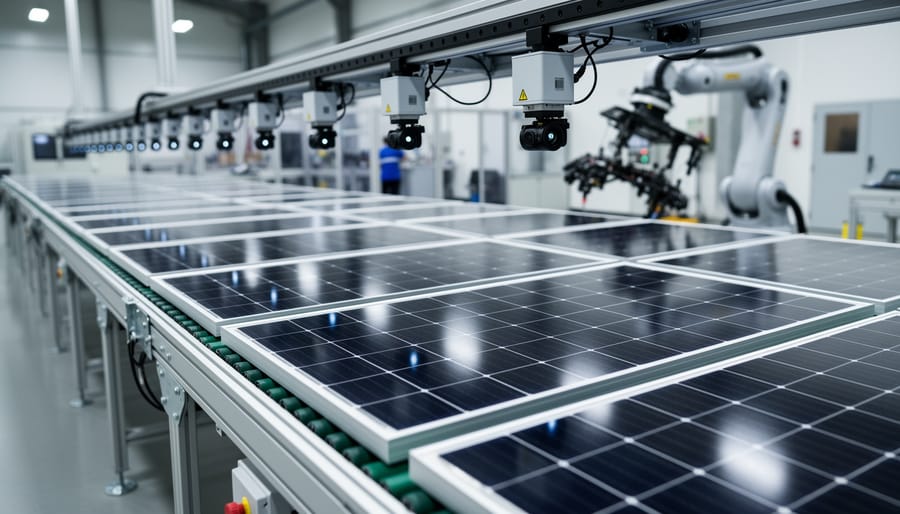
Automated production lines deliver substantial throughput improvements over manual inspection methods in photovoltaic manufacturing. Modern inline metrology systems can inspect cells and modules at speeds exceeding 2,000 wafers per hour, compared to manual inspection rates of approximately 100-200 wafers per hour. This fivefold to twentyfold increase in processing speed directly translates to higher production capacity without proportional increases in labor costs.
Equipment utilization rates improve significantly through continuous automated operation. Unlike manual inspection requiring breaks and shift changes, automated systems maintain consistent performance across extended production runs, often achieving uptime rates above 95% with proper maintenance protocols. Process Analytical Technology implementations further enhance efficiency by enabling real-time adjustments that minimize product rejections and reduce the need for rework cycles.
Downtime reduction represents another critical advantage. Automated systems equipped with predictive maintenance capabilities can identify potential equipment failures before they occur, allowing scheduled maintenance during planned downtime rather than unexpected production stops. Manufacturing facilities implementing comprehensive automation report production efficiency gains of 25-40% compared to traditional manual inspection approaches, while simultaneously improving quality control accuracy and reducing labor-intensive bottlenecks throughout the production workflow.
Future Trends in PV Production Automation
Artificial Intelligence and Advanced Analytics
Artificial intelligence and deep learning algorithms are revolutionizing inline metrology and PAT automation by enabling unprecedented predictive capabilities in photovoltaic manufacturing. Modern AI systems analyze vast datasets from multiple inspection points simultaneously, identifying subtle patterns and correlations that traditional statistical methods might overlook. These advanced analytics platforms can predict equipment degradation, forecast quality deviations before they occur, and recommend optimal process adjustments in real-time.
Machine learning models trained on historical production data continuously improve their accuracy, learning from millions of measurement cycles to distinguish between normal process variation and genuine quality concerns. This reduces false rejection rates while maintaining stringent quality standards. Deep learning-based computer vision systems excel at detecting complex defects such as microcracks, busbar misalignment, and subtle color variations across solar cells with accuracy exceeding human inspection capabilities.
Integration with digital twin technology allows manufacturers to simulate process changes virtually before implementation, minimizing production disruptions. Universities collaborating with industry leaders are developing next-generation AI algorithms specifically designed for photovoltaic applications, focusing on explainable AI that provides transparent decision-making rationale. These educational initiatives ensure the workforce gains expertise in deploying and maintaining intelligent automation systems, positioning the industry for continued technological advancement in quality assurance and process optimization.
Industry 4.0 and Smart Manufacturing
Photovoltaic manufacturing automation exemplifies the transformative potential of Industry 4.0 principles in renewable energy production. Modern PV facilities integrate digital twin technology to create virtual replicas of production lines, enabling real-time simulation, predictive maintenance, and process optimization before physical implementation. These digital models continuously synchronize with actual equipment performance, allowing engineers to test modifications and troubleshoot issues without disrupting operations.
Internet of Things sensors embedded throughout automated production lines collect vast datasets from every manufacturing stage, from silicon ingot cutting to final module assembly. This connectivity creates a smart factory ecosystem where machines communicate autonomously, adjusting parameters based on upstream quality data and downstream requirements. Advanced analytics platforms process this information to identify efficiency opportunities and quality trends invisible to traditional monitoring methods.
The convergence of inline metrology, process analytical technology, and Industry 4.0 infrastructure enables truly autonomous manufacturing environments. These systems leverage artificial intelligence and machine learning algorithms to make split-second adjustments, maintaining optimal production conditions while minimizing human intervention. Educational partnerships between manufacturers and universities help develop the next generation of professionals capable of managing these sophisticated cyber-physical systems.
The integration of inline metrology and Process Analytical Technology represents a fundamental transformation in photovoltaic manufacturing, establishing new benchmarks for production efficiency, quality assurance, and competitive advantage. As solar energy continues its trajectory toward becoming the dominant global energy source, manufacturers who embrace these advanced automation technologies position themselves at the forefront of industry innovation. The data-driven precision enabled by real-time monitoring systems reduces material waste, optimizes throughput, and ensures consistent product quality that meets increasingly stringent performance standards.
For aspiring photovoltaic professionals, developing expertise in inline metrology and PAT automation is no longer optional but essential for career advancement in this rapidly evolving sector. These technologies represent the convergence of materials science, data analytics, process engineering, and quality control—skill sets that define the modern solar manufacturing environment. Educational institutions and industry training programs increasingly recognize this necessity, with many universities now offering specialized coursework in advanced manufacturing automation and photovoltaic production systems. Hands-on experience through internships, cooperative education programs, and industry collaborations provides invaluable practical knowledge that complements theoretical understanding.
The future of competitive PV manufacturing depends on professionals who can navigate the intersection of automation technology and renewable energy production. By pursuing targeted educational opportunities and actively engaging with these transformative technologies, the next generation of solar industry leaders will drive continued innovation, cost reduction, and global accessibility of clean energy solutions.