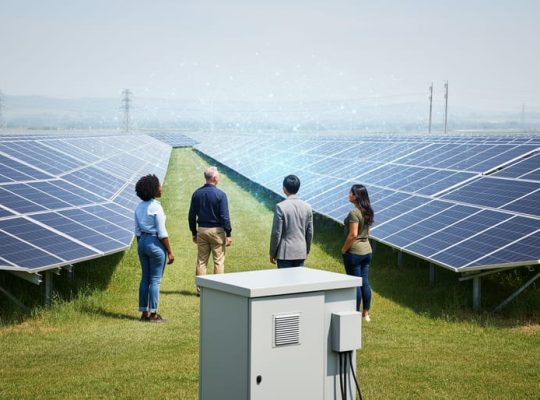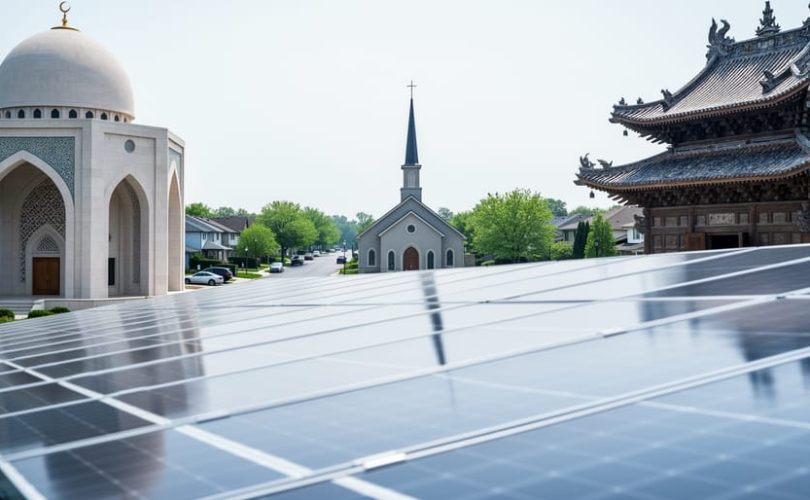
Interfaith solar refers to collaborative renewable energy projects in which religious congregations from different faith traditions pool resources, share infrastructure, or jointly develop photovoltaic systems to reduce energy costs, demonstrate environmental stewardship, and strengthen community bonds. These partnerships take multiple forms: a shared community solar array subscribed by mosques, churches, and temples; bulk purchasing agreements negotiated across denominational lines; or co-located installations on adjacent properties that benefit from economies of scale.
The model matters because houses of worship face distinct financial and operational challenges when pursuing solar adoption. Many congregations occupy aging facilities with limited discretionary capital, irregular weekday electricity demand, and volunteer-driven decision-making structures that slow project timelines. By combining their purchasing power and technical expertise, interfaith coalitions unlock financing mechanisms unavailable to individual institutions, negotiate volume discounts on equipment and installation, and spread soft costs across multiple beneficiaries. A 2025 National Religious Partnership for the Environment survey found that interfaith solar participants achieved an average 18 percent cost reduction compared to standalone congregational projects, while completing installations 22 percent faster.
Beyond economics, interfaith solar advances broader goals within the renewable energy transition. These projects model cross-cultural collaboration on climate action, provide visible demonstrations of solar technology in residential neighborhoods, and engage faith-based networks that reach audiences often underserved by conventional clean energy outreach. Universities and workforce development programs increasingly study interfaith solar as a template for community-scale deployment, examining how trust networks and shared values can accelerate technology adoption where market forces alone prove insufficient.
This article explains how interfaith solar partnerships function, the project architectures they employ, practical applications across urban and rural settings, and the operational challenges coordinators must address to sustain multi-stakeholder collaborations over 25-year system lifespans.
What Interfaith Solar Means
Interfaith solar is a partnership model that unites multiple faith communities, churches, mosques, synagogues, temples, gurdwaras, and other houses of worship, to collectively invest in, develop, and benefit from shared solar energy infrastructure. Rather than each congregation acting alone, interfaith solar pools resources, expertise, and purchasing power across denominational lines to create renewable energy projects that serve all participating communities. These collaborations can take many forms, from coordinated rooftop installations across multiple worship sites to joint ownership of a ground-mounted solar array that distributes energy credits among member organizations and their congregants.
Unlike single-congregation solar installations, where one faith community finances and manages its own system, interfaith solar leverages economies of scale and shared risk. A single church installing panels on its roof faces the full burden of upfront costs, permitting, and maintenance. An interfaith coalition, by contrast, negotiates better pricing through bulk procurement, shares technical and legal expertise, and spreads financial exposure across many partners. This collective approach makes solar accessible to smaller or budget-constrained congregations that could not afford a standalone project. It also broadens community impact: benefits extend beyond one building to multiple neighborhoods and diverse populations.
The interfaith component matters for technical feasibility and social reach. By aggregating demand, coalitions achieve the project scale necessary to attract favorable financing, secure competitive installation bids, and justify sophisticated energy management systems. Socially, interfaith solar embodies shared values around environmental stewardship, economic justice, and community resilience. When congregations from different traditions collaborate on renewable energy, they model interfaith cooperation, amplify their collective voice on climate policy, and create pathways for underserved households to access clean power, particularly through community solar explained subscription models that open participation beyond direct property ownership.
- Interfaith Solar
- A partnership model where multiple faith communities from different traditions collaborate to develop and share solar energy infrastructure, pooling resources and distributing benefits across member organizations.
- Community Solar
- A solar installation that serves multiple subscribers or participants, allowing households and organizations to benefit from solar power without installing panels on their own property.
- Faith-Based Solar Partnership
- A renewable energy collaboration anchored by religious organizations, leveraging shared values and collective capacity to advance environmental and social goals.
- Collective Purchasing Power
- The combined buying strength of multiple organizations negotiating together, enabling better pricing, terms, and service than any single participant could secure alone.
- Shared Renewable Energy Infrastructure
- Solar arrays, inverters, and grid connections owned or subscribed to jointly by multiple stakeholders, with energy production or financial benefits distributed among participants.
This framework transforms solar development from an isolated capital project into a collaborative movement, aligning moral conviction with practical energy solutions and extending clean power access across entire communities.
How Interfaith Solar Partnerships Work
Coalition Formation and Project Planning
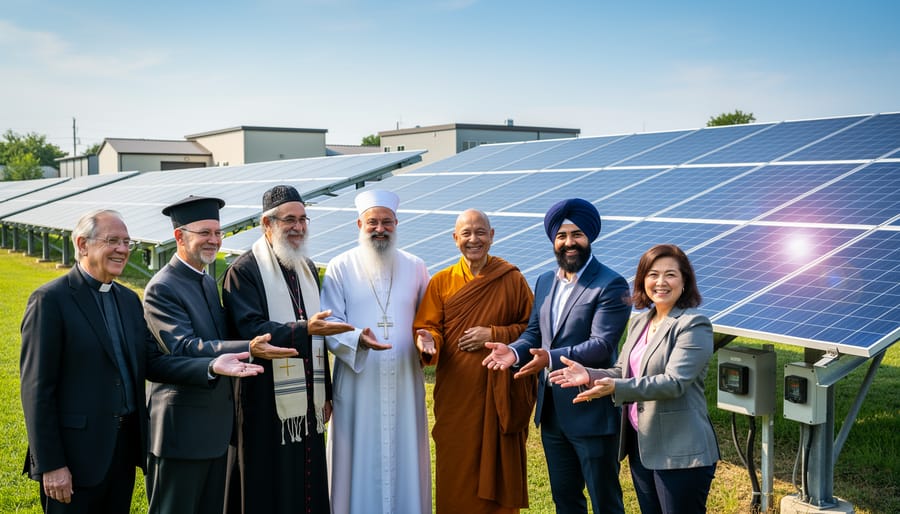
Interfaith solar partnerships typically begin when two or more faith communities recognize their shared commitment to environmental stewardship and energy cost reduction. Initial coalition formation often starts through existing ecumenical networks, climate action groups, or community organizing efforts that bring religious leaders together around sustainability goals. These conversations establish mutual trust and clarify each participant’s motivations, capacity constraints, and expectations for project outcomes.
Once a working group forms, participants develop a governance framework that ensures equitable decision-making across diverse traditions. Most successful coalitions establish a steering committee with representatives from each participating congregation, supplemented by working groups focused on finance, technical planning, and community engagement. Written partnership agreements define roles, responsibilities, voting procedures, and protocols for resolving disagreements, critical groundwork for maintaining cohesion through complex multi-year projects.
Neutral convening organizations play a vital role in facilitating these partnerships. Regional interfaith councils, nonprofit solar advocacy groups, and community development corporations often provide meeting space, mediate discussions, and share best practices from similar initiatives. These intermediaries help prevent any single congregation from dominating the process while ensuring smaller or less-resourced communities have equal voice.
Site selection follows governance establishment. Coalitions evaluate rooftop structural capacity at member buildings, assess parking areas for canopy installations, or explore land acquisition for community solar gardens. Technical advisors, solar developers, engineers, or university partners, conduct preliminary feasibility studies examining solar resource availability, electrical infrastructure, zoning compliance, and interconnection requirements. These assessments generate realistic cost estimates and energy production forecasts that inform the coalition’s decision to proceed.
Financing Models and Cost Sharing
Interfaith solar partnerships typically leverage several financial structures to make solar accessible across diverse congregations with varying budgets. Collective purchasing agreements allow multiple faith communities to combine their buying power, negotiating volume discounts on equipment and installation, similar to how solar co-ops achieve cost reductions for residential members. By procuring panels, inverters, and balance-of-system components as a unified block, participants often save 15-30% compared to individual installations.
Shared ownership models split the capital investment proportionally among partner congregations. Each participant contributes based on their expected energy consumption or available capital, then receives a corresponding share of energy production or financial savings. This structure works well when all partners have upfront funds or can secure low-interest green loans collectively.
Power purchase agreements (PPAs) eliminate upfront costs entirely. A third-party developer finances, owns, and maintains the system, selling electricity to the interfaith coalition at a fixed rate below utility prices. Congregations pay only for the energy consumed, making solar accessible even for organizations with limited capital reserves.
Subscription models function like community solar, where congregations and their members purchase shares or subscribe to a portion of a larger solar array. Subscribers receive monthly bill credits proportional to their share, enabling renters and those with unsuitable rooftops to benefit from solar.
Pooled capital from member dues, fundraising campaigns, or impact investors creates a shared fund that finances projects across multiple sites, distributing costs and benefits equitably while building long-term energy resilience.
Installation and Energy Distribution
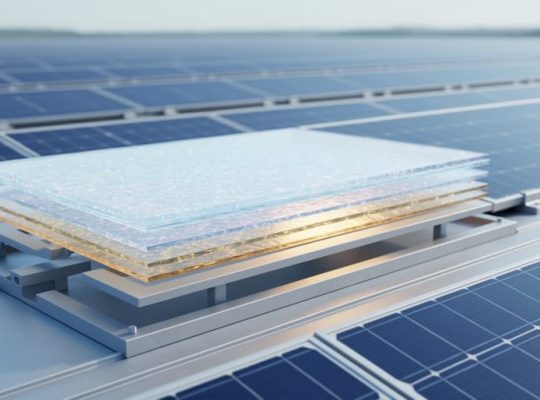
Once coalition partners secure financing and select project sites, the technical work begins with system design tailored to collective needs. Engineers size the array based on aggregated energy consumption across all participating congregations, choosing between monocrystalline panels for space-constrained rooftops, multi-crystalline modules for cost-sensitive ground mounts, or mono PERC panels when efficiency gains justify the premium. Structural assessments confirm roof load capacity or foundation requirements, while electrical designs specify inverter configurations and metering infrastructure.
Permitting follows local codes and utility interconnection protocols. Most jurisdictions require building permits, electrical permits, and utility approval before installation crews mount racking systems, wire module strings, and connect inverters. Grid interconnection agreements formalize how the system feeds power into the distribution network and establish net metering or virtual net metering arrangements.
Energy distribution varies by project structure. In rooftop networks, each congregation receives credits for the power their site generates. Community solar gardens allocate credits proportionally based on subscription shares, enabling solar power sharing among members who lack suitable roofs. Anchor-tenant models use virtual net metering to apply credits from a single large array across multiple utility accounts. Specialized software tracks generation, allocates credits monthly, and provides transparency so all partners see their environmental and economic returns.
Forms of Interfaith Solar Collaboration
Multi-Site Rooftop Networks
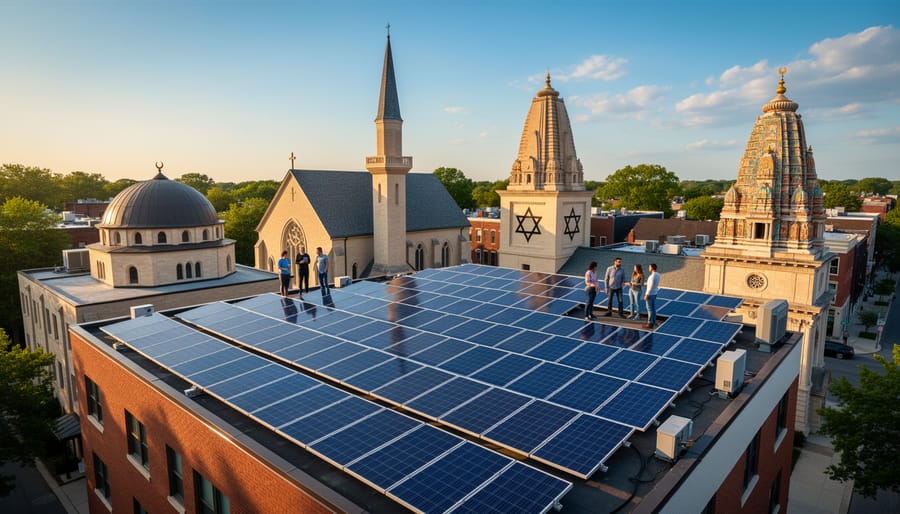
Multi-site rooftop networks distribute solar installations across the physical rooftops of participating congregations, transforming each house of worship into an active node in a larger clean energy grid. Rather than pooling resources into a single centralized array, each faith community hosts monocrystalline or multi-crystalline photovoltaic panels on its own sanctuary, fellowship hall, or administrative building. The interfaith partnership coordinates bulk procurement to negotiate volume discounts on equipment and installation labor, standardizes system design to simplify permitting and reduce engineering costs, and establishes shared maintenance contracts to keep operating expenses low.
This decentralized approach suits urban and suburban settings where congregations own suitable roof space but lack the land for ground-mounted arrays. It also preserves institutional autonomy: each partner retains ownership and direct energy benefits from its system while contributing to collective purchasing power and shared technical expertise. Coordinated educational outreach, such as tours, workshops, and signage, amplifies community visibility and demonstrates interfaith commitment to environmental stewardship across neighborhoods.
Shared Community Solar Gardens
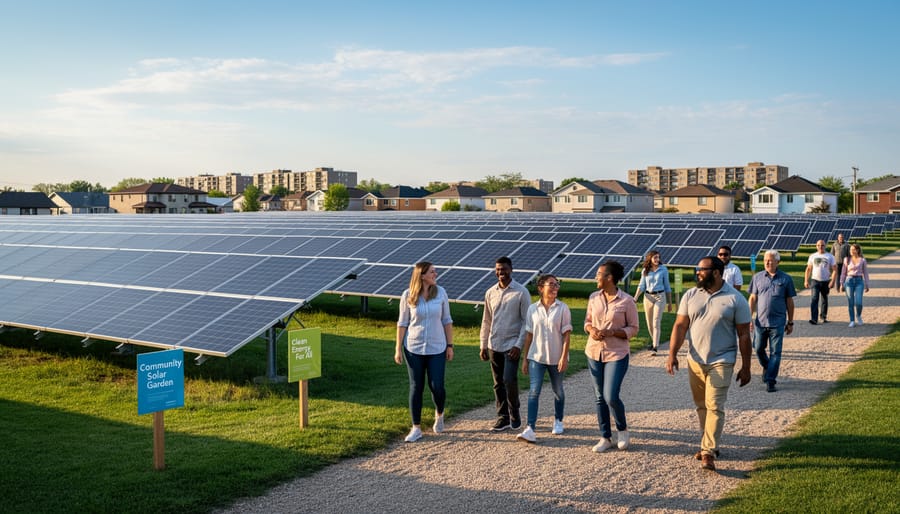
Shared community solar gardens represent the most accessible form of interfaith solar partnership, removing property barriers that often exclude renters, apartment dwellers, and homeowners with shaded or unsuitable roofs. In this model, participating faith communities jointly acquire or lease a parcel of land, often agricultural property, brownfield sites, or unused institutional grounds, and develop a ground-mounted photovoltaic array sized to serve multiple stakeholders. Subscribers purchase or lease a portion of the system’s capacity, receiving monthly credits on their electricity bills proportional to their share of the solar generation.
This subscription structure democratizes solar benefits: a mosque congregant living in a rental apartment can subscribe to the same community solar garden as a church member who owns a home but lacks suitable roof orientation. The interfaith coalition manages the solar garden collectively, sharing operation and maintenance costs while local utilities handle energy distribution through virtual net metering. By pooling demand across diverse faith communities, these projects achieve economies of scale that reduce per-kilowatt-hour costs below what any single congregation could negotiate independently.
Anchor-Tenant Models
In the anchor-tenant model, a single large institution with ample roof or land capacity, such as a cathedral, mosque complex, synagogue, or interfaith community center, hosts an installation sized well beyond its own consumption needs. The excess generation is allocated to smaller partner congregations that lack suitable space or capital for standalone systems. This arrangement leverages virtual net metering policies, which allow the host site to share energy credits across utility accounts serving multiple locations, effectively treating the coalition as a single customer for billing purposes.
The anchor tenant typically owns or leases the installation, coordinating procurement, permitting, and maintenance while partner congregations subscribe for a share of the output, often paying a fixed monthly fee or per-kilowatt-hour credit rate lower than retail electricity prices. This model concentrates technical complexity and administrative overhead in one place, reducing transaction costs for smaller participants and accelerating deployment timelines. It works best where state or utility rules support credit transfers and where the anchor institution has stable finances and long-term site control.
Low-Income Community Benefit Projects
One of the most impactful forms of interfaith solar focuses explicitly on serving households that have historically been excluded from the solar market. These community benefit projects pool resources from multiple congregations to install solar arrays whose energy credits or reduced electricity rates are directed primarily to low-income families, often including both congregants and neighbors outside the faith community. Because low-income households typically face barriers like poor credit, lack of suitable rooftops, or rental status, interfaith coalitions structure projects around community solar subscriptions that require no upfront payment and no home modifications. Many programs pair solar deployment with weatherization services, LED lighting retrofits, and energy literacy workshops, addressing both supply and demand sides of the energy equation. By embedding solar access for everyone within a framework of holistic community support, these interfaith initiatives deliver measurable bill savings while strengthening social cohesion across economic divides.
Where Interfaith Solar Is Applied
Environmental Stewardship and Climate Action
Interfaith solar partnerships translate theological commitments to creation care into tangible climate action. Across Christian, Jewish, Islamic, Buddhist, and Hindu traditions, scripture and teaching emphasize stewardship of the natural world and responsibility to future generations. When congregations collaborate on solar projects, they move beyond symbolic gestures to deploy clean energy infrastructure that displaces fossil fuel generation. A typical interfaith solar array serving five mid-sized congregations can offset 30-50 metric tons of CO₂ annually, equivalent to removing six to ten passenger vehicles from the road.
These projects also advance environmental justice by prioritizing low-income neighborhoods disproportionately affected by air pollution and energy burden. Inter-community partnerships often direct energy credits to households facing the highest utility costs, reducing economic vulnerability while shrinking the community’s carbon footprint. By combining moral witness with quantifiable emissions reductions, interfaith solar demonstrates that spiritual values and technical solutions reinforce rather than contradict one another.
Economic Development and Energy Equity
Interfaith solar partnerships deliver direct economic relief to congregations operating on tight budgets. By pooling purchasing power across multiple faith communities, these collaborations reduce upfront capital costs per participant by 15-30% compared to individual installations. Locked-in electricity rates through power purchase agreements shield houses of worship from volatile utility pricing, redirecting savings toward mission-critical programs like food banks, youth services, and housing assistance.
Beyond institutional savings, interfaith solar projects stimulate local economic development. Installation and maintenance generate construction jobs, electrical contracting work, and ongoing operations roles that stay within the community. When coalitions prioritize hiring from disadvantaged neighborhoods or partner with workforce training programs, these projects become pathways to stable careers in the renewable energy sector.
The equity dimension proves equally significant. Virtual net metering and community solar subscription models allow low-income households, particularly renters and residents of multifamily housing who cannot install rooftop systems, to access solar savings without upfront costs. When faith communities designate subscription slots for income-qualified neighbors, they democratize solar benefits that market-rate programs typically exclude. This structure transforms solar from a privilege of homeownership into a community resource accessible across economic lines.
Education and Workforce Development
Interfaith solar installations serve as living laboratories where theoretical knowledge meets real-world application. Faith communities partnering with universities create practicum sites where engineering and environmental science students gain direct experience with PV system design, installation, and performance monitoring. These partnerships transform houses of worship into accessible teaching facilities, allowing students to work on projects that serve genuine community needs rather than hypothetical scenarios.
Online photovoltaic professional training programs extend this educational mission beyond campus boundaries. Aspiring technicians and solar professionals can study installation techniques, electrical codes, and system optimization through coursework that references interfaith projects as case studies in community-scale deployment. Many programs incorporate virtual walkthroughs of actual interfaith installations, demonstrating how multi-site coordination and community engagement shape technical decisions.
Workforce development initiatives tied to interfaith solar often prioritize recruiting from the communities being served. Faith organizations run apprenticeship programs that combine classroom instruction with paid on-site training, creating pathways into renewable energy careers for individuals who might otherwise lack access to technical education. This model addresses two challenges simultaneously: the solar industry’s growing need for qualified installers and communities’ need for stable, well-paying employment opportunities that align with their values.
Benefits and Challenges of Interfaith Solar Partnerships
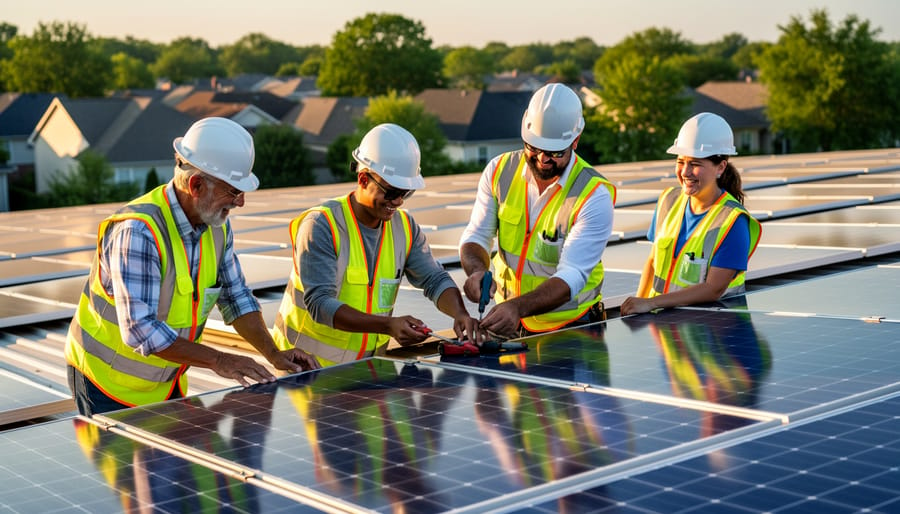
Interfaith solar partnerships deliver advantages that extend well beyond the technical performance of photovoltaic modules. By pooling resources across multiple congregations, these collaborations achieve economies of scale that lower per-kilowatt installation costs, often by 15-25% compared to solo projects, making solar accessible to smaller houses of worship that couldn’t otherwise afford it. Shared procurement, permitting, and maintenance reduce administrative burden and create negotiating leverage with installers and equipment suppliers.
The coalition structure itself amplifies community impact. When a mosque, church, and synagogue jointly announce a solar project, the visible demonstration of interfaith cooperation strengthens social cohesion and sends a powerful public message about shared environmental values. This moral authority often accelerates local policy support for renewable energy incentives and can inspire adjacent neighborhoods to pursue their own clean energy transitions. Educational programming tied to interfaith solar installations, workshops on energy efficiency, student field trips, partnerships with online PV professional training courses, multiplies the knowledge dividend across diverse audiences.
Financial resilience improves for participating congregations. Stable, predictable energy costs protect budgets from utility rate volatility, freeing funds for core mission work. For low-income community benefit models, the partnerships channel tangible economic relief to vulnerable households while building local capacity for green job creation and workforce development.
However, interfaith solar isn’t without friction points. Coordinating schedules, decision-making processes, and financial commitments across organizations with different governance styles, theological priorities, and risk tolerances demands patience and skilled facilitation. A single congregation’s delayed approval or budget shortfall can stall the entire project if the coalition structure isn’t designed with contingencies.
Upfront capital requirements remain substantial even when shared. Securing grants, low-interest loans, or arranging power purchase agreements requires financial sophistication that many volunteer-led congregations lack, necessitating external technical advisors or non-profit intermediaries, adding cost and complexity. Theological differences around environmental stewardship or technology adoption can surface during planning, requiring diplomatic navigation to maintain unity of purpose without diluting the project’s ambition.
Site suitability varies. Not every partner may have appropriate roof orientation, structural capacity, or land availability, potentially creating imbalances in contribution versus benefit. Virtual net metering and subscription models address this technically, but navigating utility tariffs and regulatory frameworks introduces administrative overhead. Long-term maintenance and equipment replacement agreements must be negotiated clearly at the outset to prevent disputes when inverters fail or panels degrade after fifteen years.
Despite these hurdles, thousands of interfaith coalitions have demonstrated that intentional design, transparent communication, and commitment to equitable participation turn these challenges into manageable trade-offs rather than deal-breakers.
Frequently Asked Questions About Interfaith Solar
Faith leaders and community members often share similar concerns when considering an interfaith solar partnership. The following questions address the most common practical, financial, and theological considerations that arise during early-stage coalition conversations.
How much does participation typically cost for a congregation?
Costs vary widely based on project structure and scale, but interfaith partnerships typically reduce per-participant expenses through bulk purchasing and shared development costs. Some congregations contribute as little as a few thousand dollars for subscription shares in a community solar garden, while others invest tens of thousands for rooftop installations, often financing through low-interest green loans or grants designed for houses of worship.
Do all partner congregations need to share the same environmental theology?
No. Successful interfaith solar coalitions unite around shared practical goals, reducing energy costs, serving vulnerable neighbors, building community resilience, while respecting diverse theological frameworks for creation care. Partners typically focus on common values like stewardship and justice rather than requiring doctrinal alignment.
Can renters and people without suitable roofs benefit from interfaith solar?
Yes, especially through community solar garden models. Renters, apartment dwellers, and homeowners with shaded or structurally unsuitable roofs can subscribe to receive energy credits from a shared off-site array, making solar accessible regardless of housing type.
What happens if one congregation needs to withdraw from the partnership?
Well-drafted partnership agreements establish exit procedures, buyout provisions, and mechanisms for transferring shares to new participants or absorbing capacity among remaining partners. Early governance planning prevents disruption when individual congregations face financial or leadership transitions.
How long does it take to develop an interfaith solar project from idea to operation?
Timeline depends on project complexity, but most interfaith solar initiatives move from initial coalition meetings to energized systems within 12 to 24 months. Larger community solar gardens or projects requiring zoning variances may take longer, while straightforward multi-rooftop networks can complete faster.
What technical expertise do congregations need to participate?
Participating congregations don’t need in-house solar expertise. Coalitions typically engage experienced developers, engineering consultants, and legal advisors to handle technical design, permitting, and installation, while faith leaders focus on stakeholder engagement, fundraising, and aligning the project with community values.
Beyond these logistics, prospective partners often wonder how to navigate denominational differences during decision-making. Experience shows that establishing clear governance from the start, voting structures, dispute resolution protocols, and transparent financial reporting, builds trust across traditions. Designating a neutral facilitator, whether a local nonprofit or a coalition member trained in consensus-building, helps groups move from concept to action without getting mired in theological debate unrelated to the technical work.
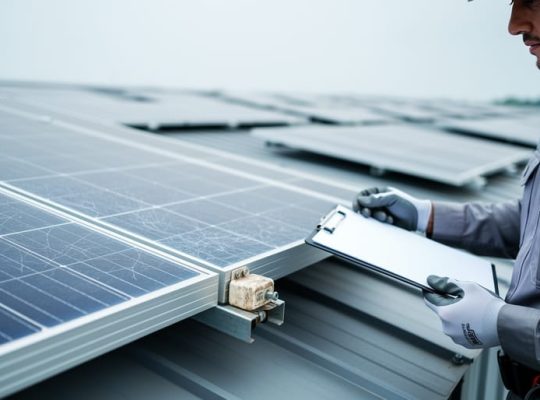
Another frequent question concerns maintenance responsibility. Most interfaith solar agreements assign ongoing operations and maintenance either to the original installer under a service contract or to a designated coalition member with appropriate insurance and technical support. Photovoltaic systems require minimal intervention, occasional panel cleaning, inverter monitoring, and performance tracking, so the maintenance burden remains manageable even for volunteer-led coalitions. Clear assignment of these duties in the partnership agreement prevents confusion and ensures system longevity.
Interfaith solar partnerships demonstrate that renewable energy transitions need not be solitary ventures. By pooling resources, expertise, and moral commitment across denominational lines, faith communities create solar infrastructure that scales beyond what any single congregation could achieve alone. This collaborative model transforms scattered ambitions into coordinated action, delivering measurable carbon reductions, stable energy costs, and expanded access to clean power for congregants and neighboring residents alike.
The alignment runs deeper than technical feasibility. When mosques, churches, synagogues, and temples unite around shared photovoltaic projects, they translate centuries-old stewardship principles into tangible climate solutions. These partnerships affirm that environmental responsibility transcends doctrine, offering a practical framework where ethical imperatives meet engineering reality. The resulting installations serve as visible testimony to collective values, anchoring local decarbonization efforts in trust networks that already exist within communities.
Realizing this potential requires more than conviction. It demands skilled professionals who understand both the technical intricacies of PV systems and the collaborative dynamics of multi-stakeholder projects. Educational programs, including those developed by Mose Solar in partnership with universities, equip aspiring renewable energy specialists with the competencies needed to design, finance, and manage interfaith solar initiatives. These training pathways ensure that the next generation of PV professionals can guide faith communities through every phase, from initial feasibility assessments through long-term operations.
For faith leaders, environmental advocates, and community organizers, interfaith solar represents both moral imperative and practical strategy. It offers a pathway to energy independence rooted in cooperation rather than competition, advancing climate goals while strengthening the social fabric that makes resilient communities possible.