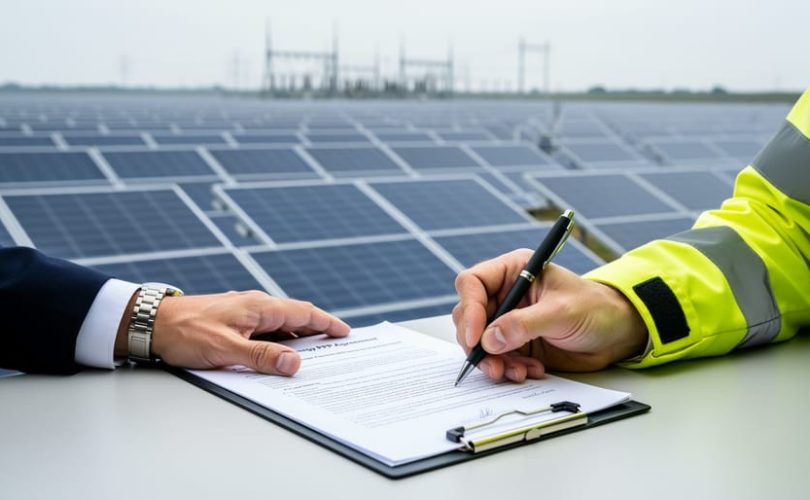
Solar public-private partnerships (PPPs) are contractual agreements where government entities and private companies collaborate to finance, design, build, and operate solar energy infrastructure, sharing both investment costs and long-term benefits. These PPP models solve a persistent challenge: how to deploy utility-scale solar installations when public budgets are constrained and private developers need stable, long-term offtake commitments.
The mechanism works through risk-sharing. Governments typically provide land access, regulatory streamlining, and power purchase guarantees, while private partners deliver technical expertise, construction capital, and operational management. The result is accelerated deployment of renewable capacity without the upfront burden falling entirely on taxpayers or the market uncertainty resting solely with developers.
Solar PPPs have matured considerably since their early adoption in India and Chile during the 2010s. By 2026, these arrangements account for a substantial share of grid-connected solar capacity in emerging markets, where financing gaps between infrastructure needs and available public funds are widest. Unlike traditional procurement, where governments simply purchase solar electricity, PPPs transfer performance risk and technological obsolescence to the private sector while ensuring public accountability through structured contract terms.
Understanding solar PPPs requires clarity on three dimensions: what makes them distinct from conventional power purchase agreements, who qualifies to participate on each side, and how the partnership process unfolds from initial feasibility through commercial operation. For aspiring photovoltaic professionals, these frameworks represent career opportunities spanning project development, regulatory compliance, and financial structuring. For government officials, they offer a proven pathway to meet renewable energy targets without overextending fiscal capacity.
This article provides a comprehensive guide to solar PPP fundamentals, eligibility criteria, procedural steps, contractual rights and obligations, and resources for stakeholders seeking to engage with these partnerships effectively.
What Is a Solar PPP and How Does It Work?
Common Solar PPP Models
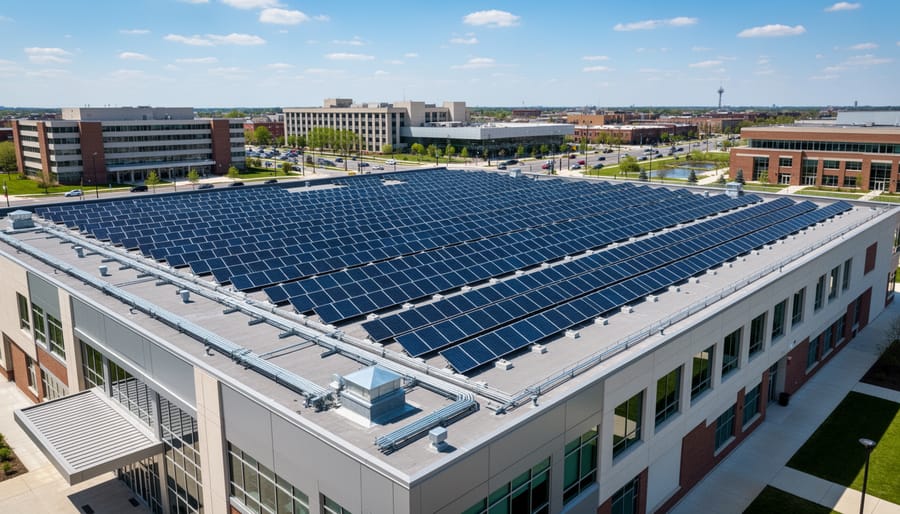
Solar PPPs take several forms, each distributing risk, ownership, and operational responsibility differently. Understanding these models helps public agencies select the right structure for their needs and enables private developers to tailor proposals effectively.
Build-Own-Operate-Transfer (BOOT) arrangements have the private partner finance, construct, own, and operate the solar facility for a contracted period, typically 15 to 30 years. During this time, the private entity collects revenue through power sales or capacity payments, recovering its investment and earning returns. At contract end, ownership transfers to the public partner at minimal or no cost. This model suits governments seeking infrastructure without upfront capital while benefiting from private sector efficiency in construction and operation.
Build-Operate-Transfer (BOT) structures are similar, but ownership transfers immediately upon completion of construction rather than after the operating period. The private partner retains operational rights and revenue collection for the contract duration, then hands over a functioning asset. BOT models reduce long-term private ownership concerns while maintaining operational incentives through the performance period.
Build-Own-Operate (BOO) models involve permanent private ownership. The developer builds, owns, and operates the solar facility indefinitely, selling power to the public partner or grid under a long-term power purchase agreement. This approach works well when governments want to avoid eventual asset management responsibilities or when private partners require permanent ownership for financing purposes.
| PPP Model | Ownership Transfer | Primary Risk Bearer | Typical Application |
|---|---|---|---|
| BOOT | After 15-30 years | Private (operational); Public (long-term) | Large utility-scale projects with eventual public asset needs |
| BOT | At project completion | Private (performance); Public (asset) | Infrastructure where public ownership matters from start |
| BOO | Never (permanent private) | Private (all phases) | Independent power production with long-term PPAs |
| Hybrid | Negotiated terms | Shared per agreement | Complex projects needing customized risk allocation |
Hybrid models blend elements from these core structures, customizing how PPP works for specific contexts. A government might retain land ownership while the private partner owns equipment, or partners might co-invest with proportional revenue sharing. These arrangements accommodate unique regulatory environments, financing constraints, or political considerations that standard models can’t address. The choice depends on each party’s risk tolerance, capital availability, technical capabilities, and strategic objectives for the solar project.
Eligibility Requirements for Solar PPP Participation

Public Sector Eligibility and Prerequisites
Government entities must meet several foundational criteria before entering into solar public-private partnerships. Legal authority stands first: agencies, municipalities, or utilities need explicit statutory power to contract with private partners for long-term infrastructure projects. This typically requires legislative approval or mandate demonstrating that the jurisdiction permits PPP arrangements for renewable energy development.
Financial authorization follows legal clearance. Public entities must secure budgetary approval for their contractual obligations, whether upfront capital contributions, payment commitments under power purchase agreements, or guarantees. Finance departments and legislative bodies scrutinize these commitments to ensure they align with fiscal policies and don’t create unsustainable liabilities.
Core prerequisites for public sector participation typically include:
- Legal authorization to enter multi-year PPP contracts and dispose of or lease public assets
- Documented site control or land rights for the proposed solar installation
- Completed environmental impact assessments and regulatory clearances from relevant agencies
- Stakeholder and community approval processes, including public consultations where required
- Demonstrated technical capacity to oversee and monitor project performance
Environmental compliance represents a substantial hurdle. Public entities must obtain or facilitate permits related to land use, water resources, wildlife protection, and grid interconnection before issuing RFPs. Many jurisdictions require completed environmental studies as part of project feasibility documentation.
Universities and educational institutions occupy a unique position within public sector eligibility. Institutions partnering with firms like Mose Solar to advance solar research or install campus systems often qualify under educational PPP frameworks. These arrangements combine infrastructure development with workforce training objectives, allowing universities to leverage private technical expertise while fulfilling renewable energy commitments and providing students hands-on photovoltaic experience.
Private Sector Qualification Criteria
Private entities seeking to participate in solar PPPs face rigorous qualification criteria designed to ensure project success and protect public investment. Government agencies evaluate potential partners across multiple dimensions, recognizing that solar infrastructure represents long-term commitments requiring both technical excellence and financial stability.
Financial capacity stands as the primary gatekeeper. Prospective partners must demonstrate substantial net worth, typically ranging from 20% to 30% of the total project cost, along with audited financial statements showing consistent profitability over three to five years. Banks and financial institutions require letters of credit or performance bonds, often valued at 5% to 10% of contract value, to guarantee completion obligations. Credit ratings from recognized agencies provide additional validation of fiscal health and repayment capacity.
Technical capabilities in photovoltaic technologies form the operational backbone of qualification assessments. Private partners must prove expertise across the solar value chain, from module selection and inverter configuration to installation practices and grid integration. Many jurisdictions require prior completion of utility-scale solar projects within specific capacity thresholds, such as 10 MW minimum for large PPP tenders. Engineering teams need demonstrated competency in site assessment, energy yield modeling, and performance optimization for local climate conditions.
Common qualification requirements typically include:
- Minimum three to five years of experience developing or operating solar projects above specified capacity thresholds
- Audited financial statements demonstrating net worth of 20% to 30% of projected project costs
- ISO 9001 quality management and ISO 14001 environmental management certifications
- Electrical contractor licenses and safety certifications such as OSHA compliance or equivalent national standards
- Manufacturer certifications for major equipment brands and installation warranties
- Demonstrated partnerships with accredited testing laboratories for quality assurance
Safety and quality certifications carry significant weight in the evaluation process. International standards like IEC 61215 for module performance and IEC 62446 for installation requirements verify technical competence. Occupational health and safety records, including lost-time injury frequency rates, demonstrate commitment to workforce protection during construction and operation phases.
Local content and workforce development requirements increasingly shape private sector qualifications. Many governments mandate minimum percentages of domestic materials, labor, or subcontractor participation to stimulate local economies. Private partners may need commitments to hire and train local workers, collaborate with technical colleges or universities on curriculum development, or establish apprenticeship programs that build regional solar expertise for future projects.
How to Apply and Complete the Solar PPP Process
Pre-Qualification and Request for Proposals (RFP)
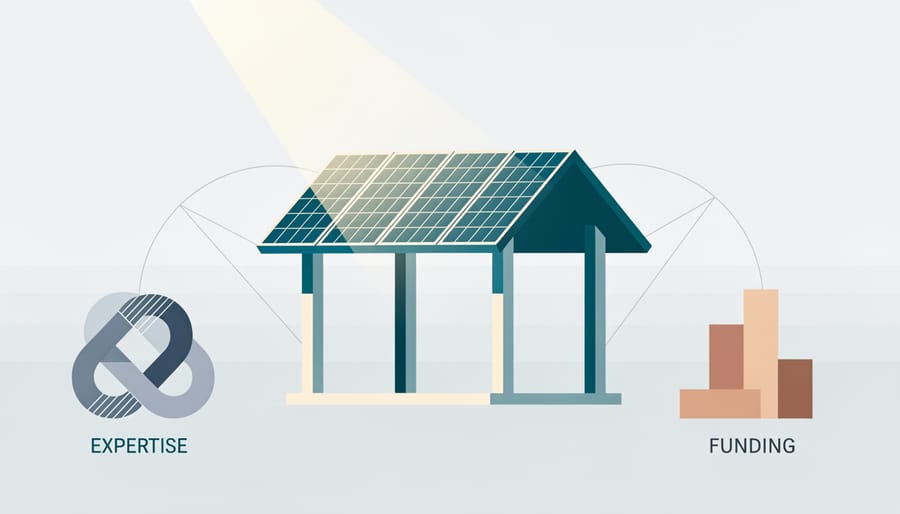
Responding to a solar PPP request for proposals requires methodical preparation and comprehensive documentation. Government entities typically issue RFPs through official procurement portals, trade publications, or renewable energy agencies, setting clear submission deadlines, often 60 to 90 days from announcement.
Your response package must address multiple evaluation criteria simultaneously. The technical proposal forms the core, detailing your solar system design, equipment specifications (module efficiency, inverter topology, mounting structures), installation methodology, and grid interconnection approach. Include electrical diagrams, site layouts, and performance modeling that demonstrates expected energy output under local irradiance conditions.
Financial documentation proves project viability. Prepare detailed cost breakdowns covering capital expenditure, operational expenses over the contract term, maintenance reserves, and insurance requirements. Your financial model should project cash flows, demonstrate debt serviceability if leveraging third-party financing, and clearly state your proposed tariff or payment structure. Many RFPs require levelized cost of energy calculations to enable direct comparison between bidders.
Project timelines need realistic milestones: procurement lead times, construction duration (accounting for seasonal weather constraints), testing and commissioning phases, and commercial operation dates. Governments penalize overly optimistic schedules that bidders cannot meet.
Environmental compliance documentation includes impact assessments covering land use, water resources, wildlife habitat, visual impacts, and noise during construction. Detail your mitigation measures and stakeholder consultation process.
Community engagement plans demonstrate how you’ll involve local residents, create employment opportunities, and address concerns. Specify workforce development commitments, local content percentages if required, and communication strategies throughout the project lifecycle. Strong community relations often differentiate winning bids in competitive evaluations.
Proposal Evaluation and Partner Selection
Public entities evaluating solar PPP proposals employ multi-criteria assessment frameworks to select partners capable of delivering technically sound, financially viable projects. Evaluation typically occurs in two stages: an initial compliance check verifying that submissions meet minimum technical and financial thresholds, followed by detailed scoring against weighted criteria.
The scoring methodology balances several dimensions. Technical merit examines proposed system design, equipment specifications, installation methodology, operational plans, and the bidder’s track record with comparable projects. Financial viability assesses the proposed cost structure, financing arrangements, revenue projections, and overall value for money to the public sector. Risk mitigation strategies evaluate how thoroughly the bidder has identified project risks, construction delays, technology performance shortfalls, regulatory changes, and proposed contractual safeguards, insurance coverage, and contingency plans. Local economic impact considers job creation, workforce development commitments, local content requirements, and community benefit provisions. Alignment with renewable energy goals measures how the proposal supports specific policy targets such as carbon reduction, energy independence, or rural electrification.
| Evaluation Criterion | Typical Weight | Key Assessment Factors |
|---|---|---|
| Technical Merit | 30-35% | System design, equipment quality, installation plan, performance guarantees |
| Financial Viability | 25-30% | Cost structure, financing plan, tariff proposal, value for money |
| Risk Mitigation | 15-20% | Risk allocation, insurance, contingency planning, dispute resolution |
| Local Impact | 10-15% | Job creation, training programs, local content, community benefits |
| Policy Alignment | 10-15% | Renewable energy targets, carbon reduction, energy access goals |
Transparency requirements mandate that scoring methodologies and evaluation criteria appear in the RFP documentation before proposals are submitted. Many jurisdictions require evaluation committees to document their scoring rationale and provide debriefing opportunities for unsuccessful bidders, ensuring fairness and allowing continuous improvement in future submissions.
Contract Negotiation and Financial Close
Once partners are selected, contract negotiation determines the project’s viability and risk distribution. Performance guarantees typically require private partners to maintain minimum energy output levels, often 85-90% of projected generation, with financial penalties for sustained underperformance. Payment mechanisms form the contract’s financial core: feed-in tariffs lock in fixed per-kilowatt-hour rates for 15-25 years, power purchase agreements establish long-term offtake commitments at predetermined prices, and capacity payments compensate developers for available generation regardless of dispatch.
Dispute resolution clauses specify arbitration procedures, governing law, and escalation pathways before litigation. Financing arrangements during this phase prove critical, as lenders conduct extensive due diligence reviewing technical specifications, grid interconnection agreements, insurance coverage, and regulatory approvals. Private developers often secure project financing through combinations of commercial debt, energy conservation bondsgreen bonds and equity contributions.
Legal teams review contract terms, environmental permits, land use rights, and workforce requirements. Financial close occurs when all conditions precedent are satisfied, permits secured, financing committed, insurance bound, and construction contractors engaged. This milestone triggers the transition from negotiation to implementation, with both parties legally bound to their obligations. The negotiation phase typically spans six to eighteen months depending on project complexity and jurisdictional requirements.
Rights and Obligations of Each Party
Public Sector Rights and Responsibilities
The public sector in a solar PPP bears specific obligations that enable project success while retaining oversight and enforcement powers throughout the agreement term. These responsibilities and rights balance the need to support private investment with accountability for public resources.
Core Public Sector Obligations
Government entities must provide secure land access or site control for the agreed project duration, ensuring clear title and resolving any land disputes before construction begins. They’re responsible for timely permit issuance across relevant agencies, building permits, grid connection approvals, environmental clearances, and maintaining a stable regulatory framework that doesn’t arbitrarily change project economics mid-term.
Payment commitments form the financial backbone. Whether through power purchase agreements, capacity payments, or availability fees, the public partner must honor contractual payment schedules punctually. Many agreements require establishing dedicated payment accounts or sovereign guarantees to assure private partners of revenue certainty. Regular monitoring and reporting obligations include tracking energy output, reviewing operational performance against benchmarks, and conducting periodic technical audits.
Enforcement and Transfer Rights
Public entities retain significant rights despite private operation. Performance enforcement mechanisms let them impose penalties for underperformance, mandate corrective actions when output falls below guarantees, or in extreme cases, terminate agreements for persistent contract breaches. Full audit access allows government representatives to inspect financial records, operational data, and compliance documentation at reasonable intervals.
In BOT and BOOT models, the government ultimately receives asset ownership. Transfer typically occurs after 15-25 years, with the facility handed over in agreed working condition, complete with documentation, training for public operators, and remaining equipment warranties intact.
Private Partner Rights and Responsibilities
Private developers and investors entering solar PPPs assume comprehensive obligations that span the entire project lifecycle. Design responsibility requires creating systems that meet specified technical standards, output targets, and grid integration requirements, often with third-party engineering validation before construction begins. During the build phase, partners must deliver projects on schedule and within budget while maintaining quality benchmarks, conducting safety protocols, and meeting local content or workforce participation requirements where mandated.
Operational obligations extend throughout the contract term, typically 15 to 30 years. Developers handle all aspects of plant management: routine maintenance, equipment replacement, performance monitoring, and rapid response to system failures. Most agreements include strict performance guarantees, committing to minimum annual energy production levels, often 85 to 90 percent of projected output. Falling short triggers financial penalties or compensation payments to the public partner.
Workforce development represents an increasingly critical obligation. Contracts may require hiring local technicians, providing apprenticeship programs, or collaborating with educational institutions to build regional solar expertise. These partnerships strengthen community benefit and address the industry’s growing need for qualified PV professionals.
In return, private partners secure defined revenue rights, collecting payments through agreed tariff structures, power purchase rates, or capacity payments for the contract duration. They retain intellectual property over proprietary technologies and system designs. Most agreements protect against regulatory changes that would materially harm project economics, providing investment stability. Partners typically hold the right to refinance debt, transfer assets with approval, and claim tax incentives or renewable energy certificates generated by the facility.
Where to Get Help and Support Resources
Government and Regulatory Support
Government entities and development finance institutions offer essential technical assistance and funding support for solar PPP initiatives. National renewable energy offices typically provide standardized PPP frameworks, model contracts, and feasibility study templates that reduce transaction costs and accelerate project development timelines.
Development banks such as the World Bank, Asian Development Bank, and regional infrastructure financing facilities offer concessional loans, risk guarantees, and capacity-building programs specifically designed for renewable energy PPPs. These institutions frequently publish sector-specific guidance documents, host training workshops for government procurement teams, and maintain databases of successfully implemented solar projects that serve as replicable models.
Regulatory bodies including public utility commissions and environmental agencies streamline permitting processes through dedicated renewable energy desks and expedited review procedures for PPP applications. Many jurisdictions have established PPP units within finance or infrastructure ministries that provide free advisory services covering legal structuring, financial modeling, and contract negotiation.
Technical assistance programs funded by international climate finance mechanisms help governments develop bankable solar PPP projects through expert consulting, market assessments, and stakeholder engagement facilitation. These resources prove particularly valuable for municipalities and smaller government agencies entering the solar PPP market for the first time.
Industry Networks and Educational Programs
Industry associations provide critical networking and capacity-building resources for solar PPP stakeholders. Organizations such as the Solar Energy Industries Association (SEIA), International Solar Alliance (ISA), and regional renewable energy councils offer technical workshops, policy updates, and matchmaking events connecting public agencies with qualified private partners. These networks serve as valuable platforms where to get support and exchange best practices.
Educational institutions play an increasingly important role in preparing professionals for solar PPP work. Mose Solar’s collaboration with universities exemplifies this approach, combining academic rigor with industry expertise to develop practical skills in photovoltaic technologies, project finance, and partnership management. These programs produce graduates equipped to navigate the technical and contractual complexities of solar partnerships.
- Professional solar certifications (NABCEP, IRENA-accredited programs) that validate technical competence
- Online learning platforms offering solar PPP finance and procurement courses
- Industry conferences and trade shows facilitating direct engagement between sectors
- Technical assistance centers providing project development guidance and feasibility tools
- Peer-to-peer forums connecting practitioners across jurisdictions to share implementation experiences
Many programs specifically address emerging professionals’ needs, offering scholarships, mentorship opportunities, and pathways into solar careers. Leveraging these resources accelerates your understanding of partnership structures while building the professional credibility essential for effective participation in solar PPP initiatives.
Frequently Asked Questions About Solar PPPs
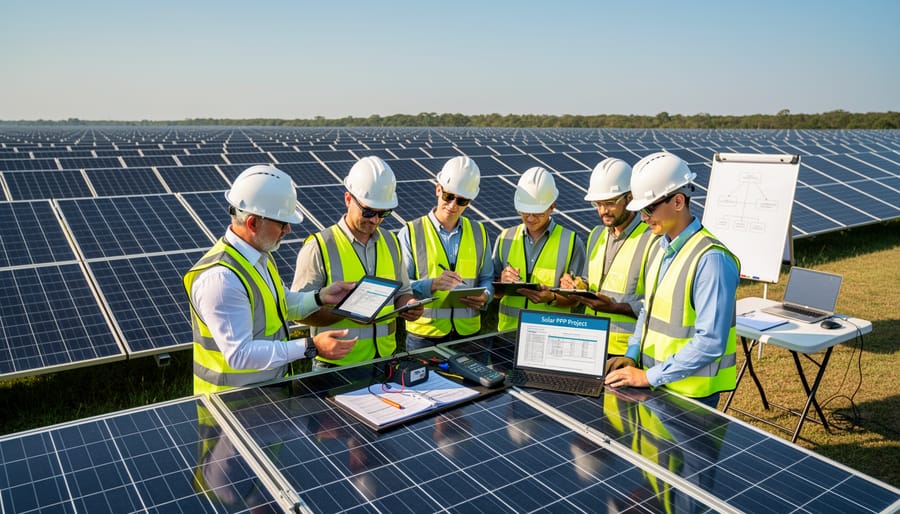
Solar PPPs raise questions across the spectrum, from government officials evaluating partnership viability to private developers assessing entry barriers. Understanding the answers to frequently asked concerns helps demystify these arrangements and clarifies what prospective participants can expect.
How long do solar PPP projects typically last?
Most solar PPP contracts span 15 to 30 years, with 20-25 years being most common. This duration aligns with solar panel warranties and allows sufficient time for private partners to recover investments while providing long-term energy security to the public sector.
What financing options are available for solar PPPs?
Financing typically combines project debt (60-80% of capital), developer equity, and sometimes development finance institution support or climate funds. Revenue streams from power purchase agreements or capacity payments provide repayment security for lenders.
Can small developers participate in solar PPPs, or are they limited to large corporations?
While large-scale projects favor established developers, many governments structure smaller PPPs for community-scale installations or allow consortiums where small developers partner with experienced firms. Regional programs increasingly include set-asides for local or minority-owned businesses.
How is project performance measured and enforced?
Performance is tracked through guaranteed capacity factors, energy output thresholds, and uptime metrics. Contracts include liquidated damages for underperformance, while metering systems and third-party verification ensure transparent monitoring throughout the operating period.
Technology selection often concerns public entities unfamiliar with PV specifics. Governments typically specify minimum efficiency standards, warranty requirements, and proven performance records rather than mandating specific manufacturers. This approach balances quality assurance with competitive procurement while allowing private partners to leverage their technical expertise and supply chain relationships. Private developers select components based on lifecycle value, local climate conditions, and maintenance accessibility, subject to meeting contractual performance guarantees.
Risk mitigation strategies form another frequent area of inquiry. Well-structured solar PPPs distribute risks according to which party can best manage them: construction risk sits with the developer, regulatory or policy changes remain government responsibility, and force majeure events trigger shared contingency protocols. Insurance coverage, performance bonds, and escrow accounts provide financial backstops. Technical complexity concerns smaller public entities especially, but many jurisdictions now offer standardized PPP templates, technical advisory services through development agencies, and capacity-building programs that reduce the learning curve. Engaging experienced legal and financial advisors during procurement stages helps even resource-limited governments structure viable partnerships without requiring in-house solar expertise.
Solar public-private partnerships represent a critical mechanism for accelerating renewable energy deployment in 2026 and beyond. These collaborative frameworks enable governments to leverage private sector expertise, capital, and innovation while maintaining public oversight and alignment with climate goals. For aspiring photovoltaic professionals, understanding solar PPP structures, eligibility requirements, and procedural pathways provides essential knowledge for navigating this expanding sector.
Success in solar PPPs requires more than theoretical understanding. Participants must navigate complex regulatory environments, meet stringent technical and financial qualifications, and fulfill specific contractual obligations throughout multi-decade project lifecycles. The detailed processes outlined, from pre-qualification through contract negotiation to operational performance, demand specialized expertise that spans engineering, finance, policy, and project management.
Educational institutions play a vital role in building this capacity. Through partnerships with industry leaders, universities equip the next generation of solar professionals with practical skills in PV system design, performance optimization, and project development. Mose Solar’s collaboration with academic institutions exemplifies this model, combining research-driven innovation with hands-on training that prepares students for real-world challenges in solar development and PPP implementation.
The resources available, from government technical assistance programs to industry networks and professional development opportunities, provide essential support for both public entities seeking partners and private developers pursuing opportunities. By engaging with these support mechanisms and investing in continuous learning, stakeholders position themselves to contribute meaningfully to the renewable energy transition through effective solar PPP participation.