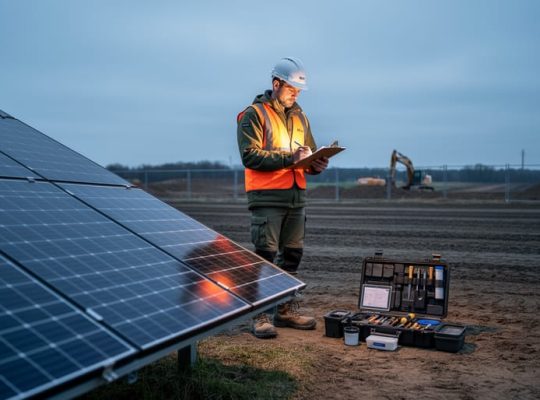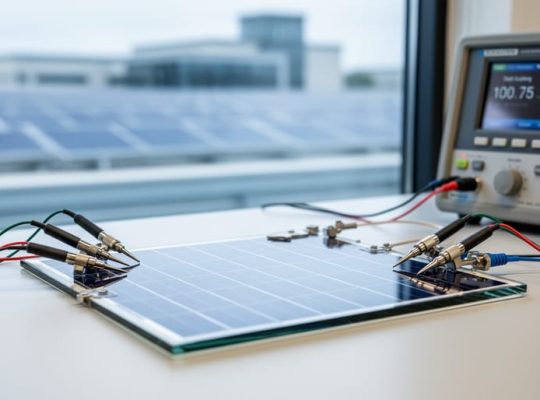
Wildfire smoke particle size refers to the diameter of aerosol particles suspended in smoke plumes, typically measured in micrometers (µm) or nanometers (nm), with the majority ranging from 0.1 to 2.5 µm. These fine and ultrafine particles matter profoundly for photovoltaic professionals because they determine how wildfire smoke scatters and absorbs solar radiation, directly impacting power generation forecasts and system performance across fire-prone regions.
Understanding particle size distribution is no longer optional for solar energy planning. Between 2020 and 2025, wildfire events across North America, Australia, and Mediterranean Europe repeatedly demonstrated that smoke from distant fires can reduce irradiance by 20 to 60 percent hundreds of kilometers downwind. The culprit isn’t just smoke density but the specific size range of particles present. Smaller particles (under 1 µm) scatter short-wavelength light more efficiently, while larger ash particles absorb across the spectrum. This size-dependent behavior creates wavelength-selective attenuation that conventional forecasting models often miss.
For PV professionals conducting resource assessment or managing operational risk, particle size data offers actionable insights. It helps distinguish between temporary smoke events that pass in hours and persistent haze conditions that linger for weeks. It informs aerosol optical depth (AOD) measurements used in satellite-based irradiance models. It clarifies why two smoke events with similar visual opacity can produce vastly different energy losses.
This article examines the physics of particle size effects on solar radiation, categorizes the particle types found in wildfire smoke, reviews measurement techniques available to industry practitioners, and demonstrates how to integrate particle size information into practical wildfire risks assessment protocols. Through collaborative research with university partners and practical case studies, we provide the framework solar professionals need to quantify and mitigate smoke-related performance uncertainty.
What Wildfire Smoke Particle Size Means
Wildfire smoke particle size refers to the physical diameter of individual solid and liquid particles suspended in smoke plumes, typically measured in micrometers (one millionth of a meter). These particles, collectively known as particulate matter (PM), range from ultrafine particles smaller than 0.1 micrometers to coarse ash fragments exceeding 10 micrometers. The size of these particles fundamentally determines how they scatter and absorb sunlight as it travels through the atmosphere toward ground-level solar panels.
The most commonly referenced size categories use the PM10 and PM2.5 diameter cutoffs established by air quality researchers. PM10 includes all particles with aerodynamic diameters of 10 micrometers or smaller, while PM2.5 represents the fine fraction under 2.5 micrometers. Wildfire smoke is dominated by PM2.5 particles, which form during the incomplete combustion of organic materials and remain suspended in the atmosphere for days or weeks, traveling hundreds to thousands of kilometers from the source fire.
- PM2.5
- Fine particulate matter with aerodynamic diameter smaller than 2.5 micrometers, representing the dominant fraction in wildfire smoke plumes. These particles scatter sunlight most efficiently and remain airborne for extended periods.
- PM10
- Particulate matter with aerodynamic diameter of 10 micrometers or smaller, including both fine and coarse fractions. This category encompasses the full range of combustion products and mechanically generated ash.
- Ultrafine Particles
- Extremely small particles with diameters below 0.1 micrometers, formed during high-temperature combustion. They rapidly coagulate into larger particles or contribute to secondary aerosol formation.
- Aerodynamic Diameter
- The diameter of a spherical particle with unit density that would have the same settling velocity as the actual particle. This standardized measurement accounts for shape and density variations in real-world particles.
Aerodynamic diameter provides a standardized way to classify irregularly shaped particles by how they behave in air rather than their true geometric size. A flat ash flake and a spherical droplet with the same aerodynamic diameter will settle at the same rate, though their actual dimensions differ.
Wildfire smoke particles differ from other atmospheric aerosols in both composition and concentration. Unlike desert dust (mostly coarse mode), sea salt spray (bimodal but different chemistry), or urban pollution (continuous emissions), wildfire smoke arrives in discrete, high-concentration plumes with characteristic size distributions shaped by combustion conditions. The particle size distribution in these plumes directly controls how efficiently each layer of smoke reduces solar irradiance reaching PV arrays below.
How Wildfire Smoke Particle Size Affects Solar Radiation
Light Scattering and Absorption Mechanisms
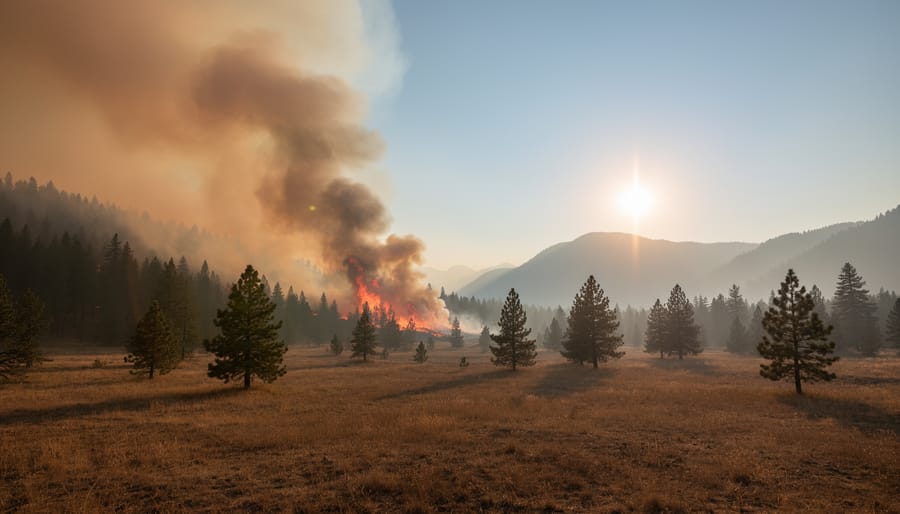
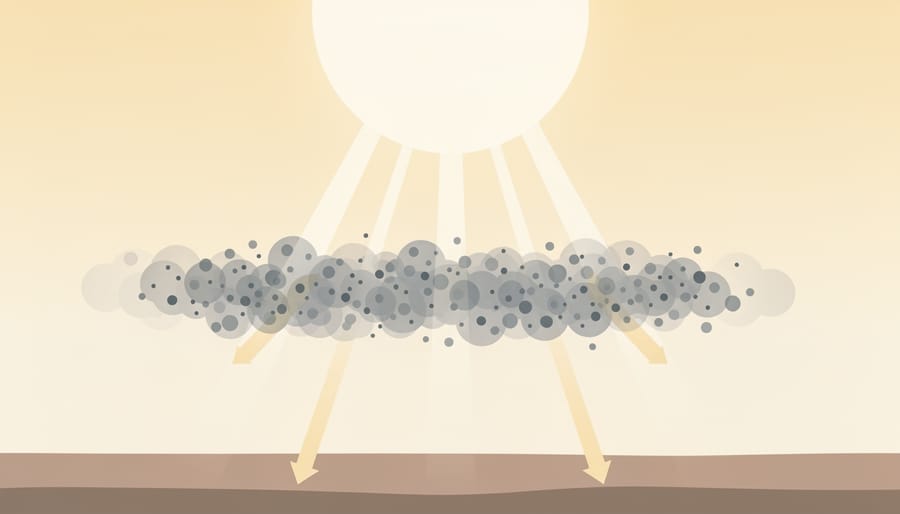
When a photon encounters a wildfire smoke particle, what happens next depends critically on the ratio between the particle’s diameter and the light’s wavelength. This size-wavelength relationship governs whether radiation scatters, absorbs, or passes through largely unaffected.
Particles much smaller than the wavelength of incoming light, typically under 0.1 micrometers, produce Rayleigh scattering, redirecting short wavelengths (blue light) more efficiently than long wavelengths. As particle diameter approaches the wavelength of visible and near-infrared solar radiation (roughly 0.4 to 1 micrometer), Mie scattering dominates. These accumulation-mode particles scatter light with high efficiency across all solar wavelengths, creating the characteristic dense haze that blocks direct beam radiation.
Mie scattering exhibits a strong forward bias: most scattered photons continue in nearly the same direction as the incident beam rather than reflecting backward. This asymmetry means that while smoke reduces direct normal irradiance reaching PV arrays, some forward-scattered radiation still contributes to diffuse horizontal irradiance on tilted modules.
Black carbon particles embedded in smoke plumes absorb rather than scatter radiation. Absorption efficiency peaks when particle diameter matches specific wavelengths, converting photon energy to heat instead of redirecting it. This absorbed energy warms the smoke layer, altering atmospheric stability and plume dynamics.
Larger coarse-mode particles above 2.5 micrometers scatter less efficiently per unit mass and contribute proportionally less to total optical depth, though they can dominate near active fire fronts before settling out.
Impact on Direct and Diffuse Irradiance
Wildfire smoke fundamentally alters the ratio of direct to diffuse irradiance reaching solar panels, and particle size determines the magnitude of this shift. When smoke particles scatter incoming sunlight, they preferentially redirect photons away from the direct beam, converting what would have been direct normal irradiance (DNI) into diffuse horizontal irradiance (DHI). Fine-mode particles between 0.1 and 1.0 micrometers are particularly efficient at this conversion because their size closely matches visible light wavelengths, maximizing forward and sideways scattering while maintaining relatively high total irradiance transmission.
The practical consequence is that smoke events dramatically reduce DNI, often by 30 to 70 percent during moderate smoke conditions, while simultaneously increasing the diffuse fraction of total horizontal irradiance. A typical clear-sky DNI-to-DHI ratio might be 85:15, but heavy smoke can invert this to 40:60 or worse, depending on particle concentration and size distribution.
This shift matters because different PV technologies respond differently to changes in the direct-to-diffuse ratio. Crystalline silicon modules, which dominate utility-scale installations, experience performance losses roughly proportional to total irradiance reduction but show slightly better relative efficiency under diffuse conditions compared to direct light. The loss is still substantial, reduced irradiance means reduced output, but the technology handles diffuse light reasonably well.
Thin-film technologies, particularly cadmium telluride (CdTe) and some amorphous silicon designs, exhibit a distinct advantage under smoke conditions. These materials demonstrate higher relative efficiency under diffuse illumination compared to crystalline silicon, meaning they lose slightly less performance when smoke converts direct radiation to diffuse. For projects in wildfire-prone regions, this spectral response difference can influence technology selection, though total irradiance reduction remains the dominant factor affecting energy yield during smoke events.
Particle Size Categories in Wildfire Smoke
Fine Mode Particles (PM2.5)
Fine mode particles, those measuring 2.5 micrometers or smaller, constitute the dominant fraction of wildfire smoke by both mass and number concentration. These particles originate primarily from incomplete combustion processes in the flaming and smoldering phases of fires, forming when volatile organic compounds condense into liquid droplets or coagulate into solid aggregates as temperatures drop in the rising smoke plume.
PM2.5 particles exert disproportionate optical effects compared to their mass. Their diameter sits in a range that efficiently scatters visible and near-infrared wavelengths, maximizing interaction with the solar spectrum critical for photovoltaic generation. A single microgram of PM2.5 per cubic meter can reduce direct normal irradiance by 1-3% depending on atmospheric conditions, far exceeding the per-unit-mass impact of coarse particles.
These fine particles remain suspended for days to weeks, traveling hundreds or thousands of kilometers from source fires. Their longevity and scattering efficiency make PM2.5 the primary driver of irradiance losses in distant smoke plumes. For PV resource assessment, PM2.5 concentration serves as the single most predictive variable when modeling smoke-related generation impacts during regional wildfire events.
Coarse Mode Particles (PM10)
Coarse mode particles in wildfire smoke include those between 2.5 and 10 micrometers in aerodynamic diameter, collectively termed PM10. Unlike the fine particles produced through combustion chemistry, coarse particles originate primarily from mechanical processes during fire activity. Wind-driven ash fragments, soil dust kicked up by turbulent air near the fire front, and larger char particles from incompletely burned vegetation make up this fraction. In active crown fires, particularly those burning through forests with substantial fuel loads, coarse particle concentrations can spike sharply as firebrands and ash fragments become airborne.
These larger particles settle out of the atmosphere much faster than fine mode smoke. Gravitational settling increases exponentially with particle diameter, meaning PM10 typically deposits within hours to a few days rather than persisting for weeks. This shorter residence time limits their contribution to long-range smoke transport that affects distant solar installations.
From an optical perspective, coarse particles scatter light differently than smaller aerosols. Their size falls within the geometric optics regime for visible and near-infrared wavelengths, producing less efficient scattering per unit mass compared to the accumulation mode. Consequently, while coarse particles dominate by mass near wildfire sources, they contribute proportionally less to the irradiance attenuation that matters for PV forecasting beyond the immediate fire zone.
Ultrafine and Accumulation Mode
Ultrafine particles below 0.1 micrometers form immediately during combustion through gas-to-particle conversion as hot smoke plumes cool. These particles consist primarily of organic carbon compounds and black carbon nuclei from incomplete fuel burning. Within minutes to hours, ultrafine particles rapidly coagulate with each other and accumulate condensable vapors, growing into the accumulation mode range (0.1 to 1 micrometer). This growth process concentrates particles in the size range most efficient at scattering visible light, maximizing their optical impact per unit mass. Ultrafine particles also serve as nuclei for secondary aerosol formation when smoke plumes age and atmospheric oxidation converts volatile organic compounds into condensable species that coat existing particles. While ultrafine particles represent a small fraction of total smoke mass, their abundance in fresh plumes and rapid transformation into optically significant accumulation mode particles make them important drivers of near-source irradiance losses during the critical first hours after emission.
Measuring and Monitoring Smoke Particle Size
Scientists and solar forecasters rely on three complementary approaches to characterize wildfire smoke particle size: ground-based instruments that measure plumes directly, satellite sensors that map smoke properties from space, and numerical models that estimate size distributions based on fire and atmospheric conditions. Each method provides different spatial and temporal coverage with distinct trade-offs between precision and geographic scope.
Ground-based networks like AERONET (Aerosol Robotic Network) operate sun photometers at hundreds of sites globally, measuring how smoke attenuates sunlight at multiple wavelengths. By analyzing this spectral extinction, the instruments derive column-integrated size distributions and distinguish fine-mode from coarse-mode particles. The data is freely available and updated in near real-time, making it valuable for validating smoke impact forecasts in regions with nearby stations. Optical particle counters (OPCs) at air quality monitoring sites measure size distributions in discrete size bins by detecting light scattered as individual particles pass through a laser beam, providing surface-level concentrations directly relevant to human health but representing only ground conditions rather than the full atmospheric column. Research-grade scanning mobility particle sizers (SMPS) and aerosol mass spectrometers offer the highest resolution for ultrafine and accumulation-mode particles but operate primarily at university field campaigns and intensive measurement sites rather than in permanent monitoring networks.
Satellite remote sensing provides the spatial coverage essential for tracking smoke plumes over large geographic areas. The MODIS and VIIRS instruments on polar-orbiting satellites retrieve aerosol optical depth (AOD) and derive coarse estimates of particle size through spectral algorithms, with global coverage every one to two days but limited ability to resolve fine size distribution details. The CALIPSO satellite’s lidar system penetrates smoke layers vertically, revealing plume height and providing vertical profiles of aerosol properties including size-dependent backscatter, though its narrow ground track samples only a thin slice of the atmosphere on each overpass.
Key measurement technologies and data sources for PV professionals include:
- AERONET sun photometer retrievals for column-integrated size distributions at fixed monitoring sites
- MODIS and VIIRS satellite products for daily AOD and coarse size parameters across wildfire regions
- CALIPSO vertical profiles for plume height and layer-resolved optical properties
- EPA air quality monitors with OPCs for surface PM2.5 and PM10 concentrations
- Chemical transport models (HRRR-Smoke, NOAA’s aerosol forecasts) for near-term size distribution predictions
For PV siting applications, the primary limitation is sparse ground-based coverage in remote areas where large solar projects are often proposed. Satellite data fills geographic gaps but provides only daily snapshots and struggles to retrieve accurate size distributions under optically thick smoke or when clouds contaminate pixels. Model-based estimates can extend coverage spatially and temporally, but they depend on accurate emissions inventories and atmospheric transport calculations, introducing uncertainty that compounds over forecast horizons beyond 48 hours. Combining multiple data sources through data fusion approaches offers the most robust characterization for quantifying long-term smoke risk at prospective project sites.
Applications in PV Siting and Resource Assessment

Improving Smoke Impact Models
Particle size distribution data significantly improves the accuracy of models that translate satellite-observed aerosol optical depth into ground-level irradiance losses. Standard AOD-to-irradiance conversion algorithms often assume fixed aerosol properties, but wildfire smoke’s optical behavior varies dramatically with particle size. When models incorporate actual size distributions, they can calculate wavelength-specific scattering and absorption coefficients rather than applying generic values that may overestimate or underestimate attenuation by 15-30%.
The improvement comes from better representing the Ångström exponent, a parameter derived from particle size that describes how AOD changes with wavelength. Smoke dominated by fine-mode particles (0.1-1.0 micrometers) produces different spectral attenuation patterns than smoke containing larger ash particles. Models using size-resolved data can distinguish between optically thick smoke that primarily scatters light forward (reducing DNI but increasing DHI) and smoke that absorbs more strongly across all wavelengths.
This refinement matters most for short-term PV performance forecasts during active wildfire seasons. Forecasters using satellite AOD products with size distribution overlays can predict hourly irradiance losses with 20-25% lower root mean square error compared to size-agnostic approaches. The enhanced accuracy helps grid operators anticipate generation drops and supports real-time curtailment decisions for solar facilities in smoke-affected regions.
Research collaborations between solar energy companies and atmospheric science departments at universities continue advancing these models by validating size-distribution algorithms against ground measurements during actual smoke events.
Long-Term Resource Assessment
Historical particle size data transforms P50/P90 energy estimates from generic assumptions into calibrated predictions grounded in local atmospheric conditions. When conducting energy yield screening for projects in fire-prone regions, incorporating multi-year particle size distributions reveals seasonal patterns that fixed aerosol models miss entirely. Summer months typically show higher concentrations of fine-mode particles from active fire seasons, while shoulder months may present coarser distributions from transported smoke or different combustion conditions.
This seasonal resolution matters because fine-mode dominance causes greater DNI attenuation per unit AOD, directly affecting energy output predictions. Projects relying on average annual AOD values without size-resolved data often underestimate losses during peak fire months by 15-30%, compromising bankability assessments. Quantifying interannual variability requires at least five years of particle size observations to capture the range from light fire years to extreme smoke events.
Financial models gain precision when P90 exceedance scenarios incorporate the actual particle size distributions observed during historical worst-case smoke years, not just elevated AOD numbers. This approach reduces uncertainty bands and supports more accurate insurance pricing, ultimately strengthening investor confidence in regions where smoke risk previously seemed too ambiguous to model reliably.
Integrating Particle Size Data into Forecasting Workflows
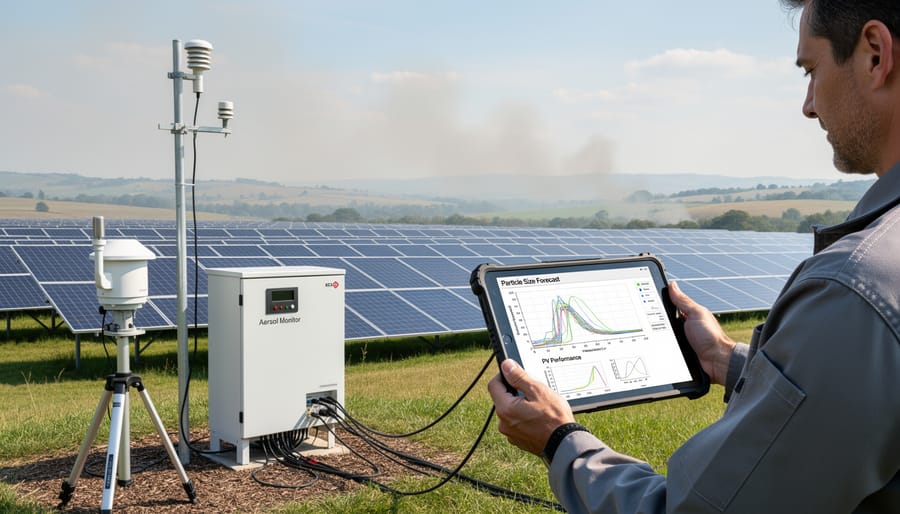
Incorporating particle size data into PV resource assessment requires bridging atmospheric science with energy modeling workflows. Start by identifying accessible data streams: NASA’s AERONET network provides size distribution retrievals from sun photometers at sites worldwide, typically reporting fine and coarse mode fractions with optical properties. NOAA’s HRRR-Smoke and NCEP models output aerosol size parameters that feed into radiative transfer calculations. For project-specific assessments, regional air quality monitoring networks often publish PM2.5 and PM10 concentrations that, while not full size distributions, constrain the fine-to-coarse ratio during smoke episodes.
Collaboration with university atmospheric science programs strengthens data interpretation. Academic researchers often maintain specialized instrumentation or run high-resolution plume models that resolve size evolution downwind from fire sources. These partnerships provide context for translating raw size distributions into irradiance loss estimates and help validate whether satellite-derived size parameters match ground conditions at your site. Many universities also archive historical smoke events with detailed size characterization, invaluable for long-term resource assessments.
Integration with meteorological forecasts anchors particle size data in operational planning. Modern smoke forecasting systems couple wildfire emissions models with atmospheric transport, tracking how size distributions shift as plumes age and particles coagulate. Linking these forecasts to your energy yield models allows dynamic adjustment of expected losses based on predicted plume characteristics, not just generic optical depth values.
Best practices include establishing size-to-AOD conversion factors specific to your region’s dominant fire types, since particle size distributions from boreal forest smoke differ markedly from chaparral or agricultural burns. Document seasonal patterns in size distributions to refine P50/P90 scenarios. When particle size data gaps exist, apply conservative assumptions that bracket the range between fine-dominated (higher scattering efficiency) and coarse-dominated (lower optical impact per unit mass) distributions.
This particle size integration complements broader weather-proof PV strategies and informs land feasibility screening in fire-prone regions, ultimately enhancing weather resilience planning across your portfolio.
How Wildfire Smoke Particle Size Works
Wildfire smoke particles form through a sequence of combustion and atmospheric processes that determine their final size and optical behavior. When organic material burns, it releases gases and tiny nuclei, molecular clusters just nanometers across. These nuclei immediately begin condensing and coagulating as the plume cools, clumping together to form larger particles in the accumulation mode, typically between 0.1 and 1 micrometer.
The dominant mechanism controlling particle growth is coagulation: smaller particles collide and stick together, driven by Brownian motion and turbulence within the smoke plume. This process continues as the plume ages and disperses downwind. Fresh smoke near the fire source contains more ultrafine particles. Within hours, these aggregate into the fine mode that dominates mature plumes.
Meanwhile, the combustion stage influences what emerges. Smoldering fires with incomplete combustion produce more fine carbonaceous particles rich in organic compounds. Flaming combustion generates coarser ash fragments through mechanical breakup of fuel structures. Wind and fire intensity also lift soil dust and larger debris, adding coarse-mode particles to the mix.
Once suspended, particle size governs atmospheric residence time. Fine particles remain aloft for days or weeks, transported across continents. Coarse particles settle within hours to days. This size-dependent settling explains why distant solar sites experience primarily fine-mode smoke, which scatters sunlight most efficiently and causes the greatest irradiance reductions.
Frequently Asked Questions
Professionals working on solar site selection and resource assessment often need to clarify technical details about wildfire smoke particle characteristics before applying this knowledge to project planning. The following questions address practical concerns about measurement, variability, and forecasting requirements.
What particle sizes dominate wildfire smoke plumes?
Fresh wildfire smoke is dominated by fine particles between 0.1 and 1.0 micrometers in diameter, with peak concentrations typically in the 0.3-0.5 micrometer range. These accumulation-mode particles account for most of the optical effects on solar irradiance.
How does particle size change as smoke travels downwind?
As smoke plumes age and travel, particles undergo coagulation and condensation, generally shifting the distribution toward slightly larger sizes (0.4-0.6 micrometers). Larger coarse-mode particles settle out more quickly, so distant plumes contain proportionally more fine particles with longer atmospheric residence times.
Does fuel type affect the particle size distribution?
Yes, combustion of different vegetation types produces distinct size distributions. Grass fires tend to generate smaller particles during flaming combustion, while smoldering woody fuels produce more coarse ash and larger particles, though fine-mode particles still dominate the optical effects.
How rapidly can particle size distributions shift during a smoke event?
Size distributions can change within hours as fires transition between flaming and smoldering phases or as meteorological conditions alter plume dynamics. Rapid shifts are most common near active fire zones, while downwind plumes show more stable distributions over timeframes of 12-24 hours.
What level of particle size detail is needed for basic impact forecasting?
For initial risk screening, knowing whether smoke is dominated by fine particles (PM2.5) versus coarse particles provides sufficient context. Advanced forecasting that aims to predict spectral irradiance changes or differentiate impacts on various PV technologies requires size-resolved distributions across multiple size bins.
Where can PV professionals access particle size data for project sites?
AERONET sun photometer networks provide size distribution retrievals at select locations, while satellite products like MODIS offer column-integrated size parameters. Collaboration with atmospheric science programs at universities can provide access to research-grade datasets and modeling tools for regions lacking direct measurements.
Understanding these practical aspects helps determine when simplified assumptions suffice and when detailed size-resolved analysis justifies the additional effort. For projects in highly fire-prone regions or those requiring tight performance guarantees, investing in higher-resolution particle size data improves the accuracy of smoke impact predictions and reduces financial risk.
The answers above reflect current measurement capabilities and typical plume characteristics observed across various wildfire-affected regions. As monitoring networks expand and remote sensing techniques improve, access to real-time particle size information will become more routine in PV resource assessment workflows, particularly for sites where wildfire smoke represents a material uncertainty in energy yield projections.
Understanding wildfire smoke particle size is no longer optional for solar professionals working in fire-prone regions, it’s essential for accurate resource assessment and defensible project finance. Particle size determines how smoke interacts with solar radiation, dictating whether a plume scatters light efficiently or lets most of it pass through. Fine mode particles under 2.5 micrometers drive the greatest irradiance losses per unit mass, while coarse particles and size distribution shifts during transport change the direct-to-diffuse ratio in ways that affect different PV technologies differently.
Size-resolved data transforms rough aerosol optical depth estimates into precise irradiance forecasts. It reduces uncertainty in energy yield models, sharpens geographic risk assessments, and strengthens the financial case for projects that must account for smoke seasonality. As wildfire frequency and intensity increase across solar-rich regions, incorporating particle size distributions into siting workflows separates rigorous analysis from guesswork.
Mose Solar remains committed to advancing industry understanding of these complex atmospheric processes. Through educational programs developed in collaboration with leading universities, we equip the next generation of photovoltaic professionals with the skills to navigate wildfire smoke challenges confidently. Whether you’re conducting preliminary site screening or refining bankable P50/P90 estimates, particle size data offers a clear path to better decisions and more resilient solar portfolios.