Community solar in Georgia is currently accessible through Georgia Power’s existing subscription program and will expand significantly by January 1, 2027, when state utilities must launch new programs under the Georgia Homegrown Solar Act of 2025. If you’re a Georgia Power customer today, you can subscribe to a portion of a local solar farm for $24.00 per kilowatt block monthly as a residential customer or $25.00 per block as a small business owner, receiving variable energy credits based on actual production from your subscribed solar capacity.
This dual landscape reflects Georgia’s transition from limited utility-controlled options to a broader framework that will enable customers to aggregate demand across multiple locations and subscribe to off-site solar facilities. The forthcoming legislative requirements mandate nondiscriminatory interconnection standards, creating pathways for community solar development beyond existing investor-owned utility programs.
For renters, homeowners with shaded properties, and businesses unable to install on-site systems, community solar eliminates the barriers of roof ownership, upfront capital costs, and site-specific limitations. The model shifts solar access from a property asset to a subscription service, allowing participants to support local renewable generation while reducing electricity costs through production-based credits.
The timing is particularly relevant for professionals entering the photovoltaic sector and stakeholders planning distributed energy projects. Understanding both current participation mechanics and the regulatory framework taking effect in 2027 positions you to advise clients, structure community solar ventures, or evaluate subscription opportunities as Georgia’s market matures. The state’s approach balances immediate utility-managed programs with legislative momentum toward expanded consumer choice and decentralized generation models.
Understanding Community Solar in Georgia
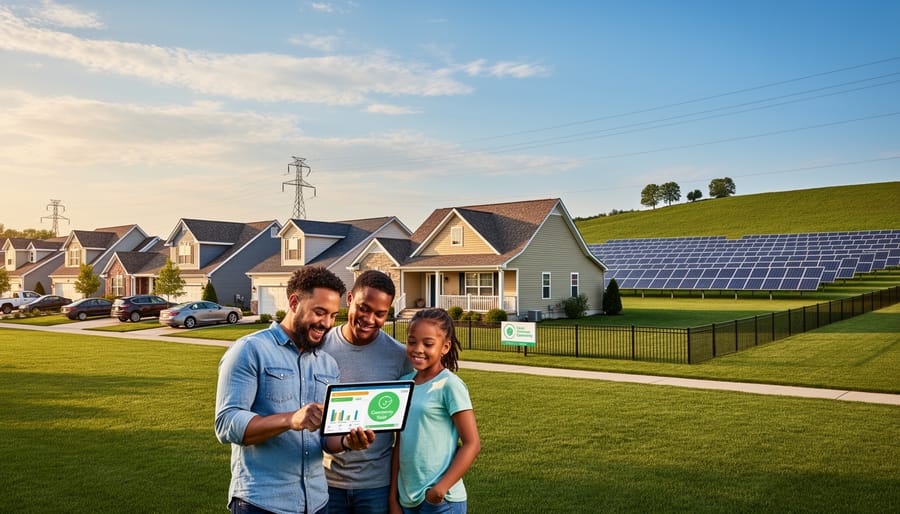
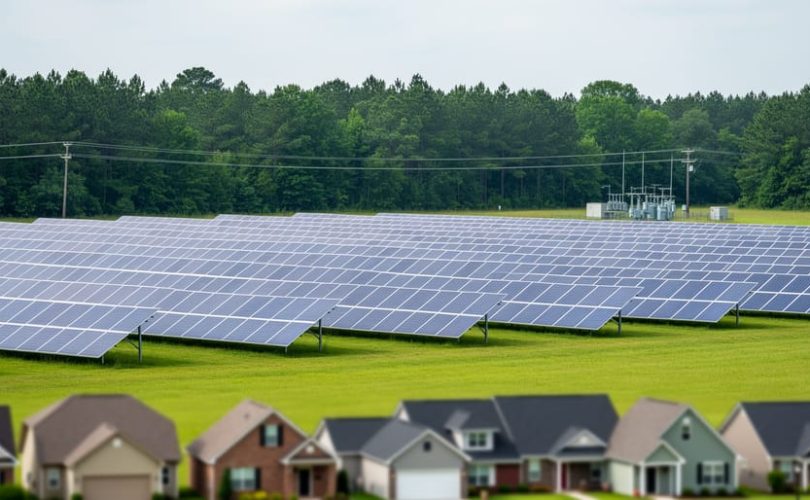
Community solar operates on a straightforward premise: a single solar installation serves multiple subscribers who share in its energy production. In Georgia, this model takes the form of utility-scale or mid-scale solar farms where residents and businesses purchase subscriptions rather than owning physical panels. Each subscriber claims a portion of the farm’s output, receiving credits on their monthly utility bill based on their subscribed capacity and the farm’s actual generation.
The subscription model works through kilowatt blocks. A subscriber might purchase one or several blocks representing a specific generation capacity, similar to buying shares in the solar farm’s output. When the farm produces energy, that production gets allocated proportionally across all subscribers. The utility then applies credits to each subscriber’s bill based on their share of the month’s generation. Production varies seasonally, so credit amounts fluctuate with actual output.
This differs fundamentally from rooftop solar ownership. With rooftop systems, you own the equipment, handle maintenance, and need suitable property. Community solar requires none of that. You rent generation capacity, the program operator maintains the farm, and you can participate regardless of whether you rent, own a shaded property, or live in a multi-unit building. There’s no roof evaluation, no permitting process, and no equipment installation at your location.
The shared solar farm model also scales differently. A single ground-mounted installation can serve dozens or hundreds of subscribers, achieving economies of scale that individual rooftop systems cannot match. For Georgia ratepayers without viable rooftop options, this subscription approach represents the most practical path to renewable energy participation.
Georgia’s Community Solar Legislative Framework
Key Provisions of the Homegrown Solar Act
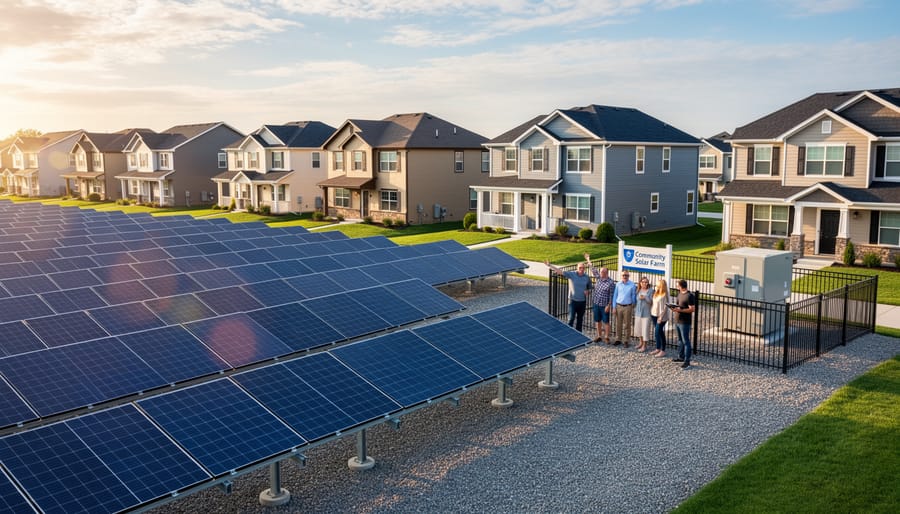
The Homegrown Solar Act provisions establish three foundational mechanisms that distinguish Georgia’s approach from single-site solar installations. Demand aggregation allows customers to combine electricity needs from multiple locations under a single community solar subscription, enabling businesses with several facilities or property owners with multiple meters to participate as unified subscribers rather than managing separate arrangements for each address. This multi-location capability addresses a practical barrier that limited community solar participation in many early state programs.
The Act mandates nondiscriminatory grid interconnection for community solar facilities, requiring utilities to connect qualifying projects under the same technical standards applied to other distributed generation resources. This provision removes administrative discretion that could delay or deny project approvals, creating predictable pathways for developers and ensuring fair treatment compared to utility-owned generation. By codifying these interconnection rights within the legislation, Georgia’s framework aligns with successful PV adoption policies from states where standardized processes accelerated deployment. Together, these provisions create scalable participation structures and technical certainty, forming the regulatory foundation for utility program implementation by January 2027.
Implementation Timeline and Utility Obligations
The Homegrown Solar Act sets January 1, 2027 as the community solar deadline when all electric utilities in Georgia must establish operational community solar programs. This mandate applies state-wide, requiring utilities beyond Georgia Power to develop subscription frameworks and interconnection procedures for shared solar facilities.
The two-year implementation window from the bill’s 2025 passage allows utilities to design program structures, establish billing systems for energy credit distribution, and build administrative capacity for managing subscriber enrollments. Utilities must create mechanisms that accommodate demand aggregation across multiple customer locations and provide nondiscriminatory interconnection for community solar projects.
This deadline represents a significant expansion point for Georgia’s community solar landscape. While Georgia Power’s existing program currently serves as the primary access point, the 2027 requirement will open community solar participation to customers of municipal utilities, electric membership corporations, and other providers across the state. The timeline gives utilities adequate preparation while establishing a firm commitment date for program availability, ensuring Georgia residents and businesses state-wide gain practical access to shared solar within a defined timeframe.
Georgia Power’s Community Solar Program
Subscription Structure and Pricing
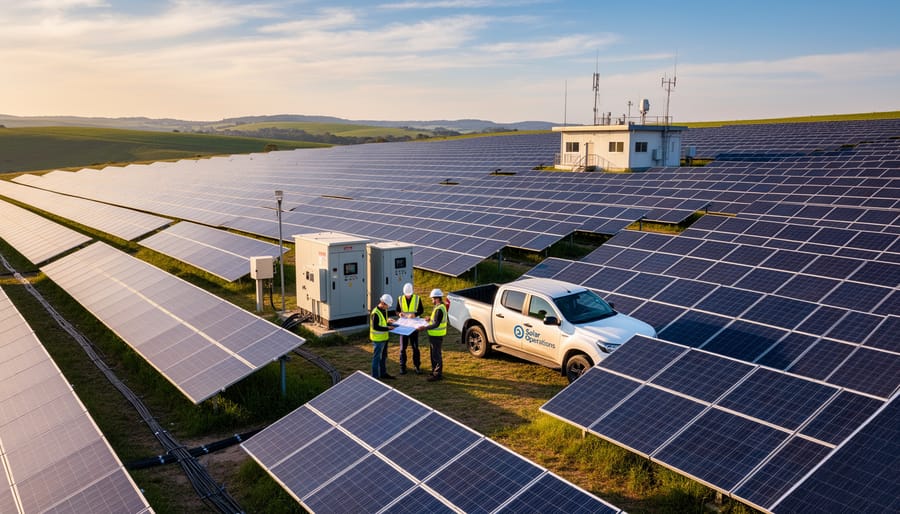
Georgia Power structures its community solar program around a straightforward kilowatt block subscription model. Each block represents 1 kilowatt of solar capacity from a shared solar farm, and subscribers purchase access to one or more blocks through a monthly fee. This creates a scalable entry point where participants can match their subscription size to their energy goals and budget.
| Customer Type | Monthly Cost per 1 kW Block | Subscription Model |
|---|---|---|
| Residential | $24.00 | Block-based, scalable |
| Small Business | $25.00 | Block-based, scalable |
The kilowatt block functions as your allocated share of the solar farm’s total capacity. If you subscribe to three blocks, you own the rights to the energy generated by 3 kilowatts of solar panels in the array. The monthly subscription fee covers your participation and proportional claim to the electricity produced. This differs from purchasing solar panels outright since you’re paying for access rather than ownership, and the utility maintains the physical infrastructure. Subscribers can typically adjust their block allocation to align with their actual energy consumption patterns, though specific terms govern changes to subscription levels once enrolled.
Energy Credits and Monthly Bill Impact
Subscribers receive monthly energy credits that reflect the actual electricity production from their allocated kilowatt blocks at the solar farm. These credits appear as line items on the Georgia Power utility bill, reducing the amount owed for that billing period. The credit calculation ties directly to generation output: when the solar farm produces more electricity, typically during long, sunny summer months, subscribers see larger credits. Conversely, shorter winter days with less intense sunlight yield smaller credits.
This production variability means subscribers cannot predict exact monthly savings in advance. A 1 kW block might generate 130-150 kilowatt-hours in peak summer conditions but only 80-100 kilowatt-hours during winter months, translating to different dollar amounts credited each cycle. The credit rate per kilowatt-hour matches the utility’s avoided generation costs, not necessarily the full retail rate customers pay for consumed electricity.
Georgia Power calculates these credits automatically based on metered output from the subscribed solar facility. Subscribers do not need to track production themselves or submit paperwork to claim credits. The credit reduces the current bill’s electricity charges; any excess credit typically does not roll over as a cash refund but may carry forward as a billing credit, depending on program terms.
Benefits for Local Energy Autonomy
Community solar addresses a fundamental barrier to renewable energy adoption: the requirement for property ownership and suitable installation conditions. By pooling participants around shared solar facilities, these programs extend renewable generation benefits to renters, apartment dwellers, and homeowners with shaded roofs or structural limitations. This democratization shifts solar access from a property-dependent privilege to a subscription-based choice available across income levels and housing types.
The model strengthens local energy autonomy by keeping generation assets within communities rather than concentrating them in distant utility-scale developments. When residents subscribe to nearby solar farms, energy production remains tied to local demand patterns and community investment. This geographic proximity creates stakeholder relationships between participants and generation infrastructure, fostering broader understanding of energy systems and renewable capacity.
Economic benefits distribute more equitably than traditional rooftop installations. While conventional solar requires substantial upfront capital and homeownership, community solar operates on monthly subscriptions. Georgia Power’s program, for instance, allows residential participation at $24.00 per kilowatt block monthly, eliminating the financing barriers that exclude many households from renewable energy savings. Small businesses face similar accessibility, subscribing at $25.00 per block without rooftop installation costs or long-term equipment maintenance.
This shared approach also builds community-level energy literacy. As subscribers receive monthly energy credits based on actual solar production, they develop direct experience with generation variability and renewable energy economics. That hands-on education creates informed stakeholders who better understand local energy systems and the infrastructure decisions that affect their communities, strengthening the foundation for sustained energy autonomy beyond individual program participation.
How to Participate in Georgia Community Solar
Participating in Georgia’s community solar programs requires careful evaluation of your current energy situation and future plans. Start by checking if you’re in a participating utility’s service territory. As of 2026, Georgia Power offers an active program, and broader availability is expected once utilities implement programs by early 2027 under state legislative mandates.
Before subscribing, analyze your typical monthly electricity usage. Community solar subscriptions are measured in kilowatt blocks, so understanding your consumption patterns helps determine an appropriate subscription size. Oversizing means you pay for generation capacity beyond what offsets your bills; undersizing leaves potential savings on the table.
Review the subscription pricing structure carefully. Georgia Power charges residential customers $24.00 per kilowatt block monthly, while small businesses pay $25.00 per block. Compare this fixed monthly cost against the variable energy credits you’ll receive based on actual solar farm production. The credit amount fluctuates with generation, meaning your net benefit varies seasonally and with weather patterns.
Contract terms deserve close attention. Understand the minimum subscription period, cancellation policies, and what happens if you move within or outside the service territory. Some programs allow subscription transfers to a new address; others may not.
Consider your property situation. Community solar makes particular sense if you rent, lack suitable roof space or orientation, face homeowner association restrictions, or simply prefer not to install rooftop panels. It provides solar access without property modifications or upfront capital investment.
Finally, recognize that current program availability is limited. If interested, joining a waitlist or monitoring utility announcements positions you for participation as programs expand under the 2027 implementation timeline. The evaluation process remains similar regardless of which utility eventually serves your location.
Educational Resources and Industry Development
Georgia’s evolving community solar landscape creates growing demand for professionals who understand both the technical aspects of photovoltaic systems and the policy frameworks that enable shared solar programs. As utilities prepare to implement programs under the 2027 mandate, the industry needs experts capable of navigating regulatory requirements, evaluating project economics, and designing subscription models that balance LCOE and savings for diverse customer segments.
Mose Solar addresses this need through educational programs developed in collaboration with universities, equipping aspiring photovoltaic professionals with practical knowledge of community solar policy implementation. These resources cover interconnection standards, demand aggregation mechanics, and the regulatory considerations unique to multi-subscriber solar facilities. The curriculum emphasizes real-world application of Georgia’s Homegrown Solar Act provisions, preparing professionals to participate in program development as the state’s community solar market expands beyond Georgia Power’s existing offering into the mandated utility programs launching in 2027.
Common Questions About Georgia Community Solar
Who can subscribe to Georgia’s community solar programs? Do you need to own your home? What happens if you move or cancel? These practical questions matter when deciding whether community solar fits your situation.
Who is eligible to subscribe to community solar in Georgia?
Georgia Power’s Community Solar program is available to residential customers and small business customers within the utility’s service territory. You do not need to own property or have a suitable roof for solar panels to participate.
What happens if I move while subscribed to a community solar program?
Subscription terms vary by program, so review contract conditions before signing. Most community solar programs allow you to transfer your subscription to a new address within the same utility service area or cancel according to the terms outlined in your agreement.
How do community solar credits differ from owning rooftop solar panels?
With community solar, you receive energy credits on your utility bill based on your subscribed portion’s generation, but you don’t own the equipment or receive renewable energy certificates. Rooftop solar involves equipment ownership, maintenance responsibility, and typically higher upfront costs but can deliver greater long-term savings.
When will more community solar programs become available in Georgia?
The Georgia Homegrown Solar Act of 2025 requires electric utilities to establish community solar programs by January 1, 2027. This mandate will expand options beyond Georgia Power’s current offering, though specific program details from other utilities have not yet been announced.
Another common concern is cost structure. Georgia Power’s program charges a monthly subscription fee of $24.00 per kilowatt block for residential customers and $25.00 for small businesses. The actual financial benefit depends on how much energy your subscribed blocks produce each month, which varies seasonally and with weather conditions. Unlike purchasing rooftop solar, you avoid equipment costs, installation, and maintenance, but your savings potential is generally more modest.
Contract terms deserve attention. Review cancellation policies, subscription duration commitments, and what happens if the solar farm underperforms or goes offline. Understanding these details prevents surprises and ensures the program aligns with your energy goals and financial expectations.
Georgia stands at a pivotal moment in community solar development, bridging the gap between legislative ambition and practical implementation. The state’s current landscape reflects this transition: Georgia Power’s established community solar program demonstrates proven operational viability, while the Homegrown Solar Act of 2025 sets a clear path toward statewide expansion by January 1, 2027. This dual reality, immediate access for Georgia Power customers alongside mandated utility program creation across the state, positions Georgia to significantly expand shared solar participation over the next year.
Community solar’s role extends beyond renewable energy adoption to fundamentally reshape local energy autonomy. By decoupling solar access from property ownership and removing rooftop suitability barriers, these programs distribute clean energy benefits across diverse economic and housing situations. The subscription model creates pathways for renters, multi-unit residents, and businesses to participate in solar generation previously unavailable to them.
As utilities prepare their 2027 program launches, Georgia’s community solar infrastructure will mature from a single-utility offering into a broader ecosystem of shared renewable resources. This expansion represents not just increased solar capacity, but a structural shift toward community-level energy participation that strengthens local control over power generation and accelerates the state’s clean energy transition.