Solar energy transforms more than photons into electricity. Three fundamental principles shape how photovoltaic systems perform in real-world installations: the photovoltaic effect’s quantum mechanics govern conversion efficiency limits, geographic insolation patterns determine site-specific power generation potential, and temperature coefficients reveal why cooler climates sometimes outperform desert installations. These facts carry direct implications for system design, equipment selection, and long-term performance forecasting.
Understanding these principles bridges the gap between theoretical solar physics and practical installation outcomes. The photovoltaic effect, first observed in 1839, operates through semiconductor band gaps that dictate maximum achievable efficiency for different cell technologies. Geographic variations in solar radiation, measured in kilowatt-hours per square meter, create performance differences of 40% or more between optimal and suboptimal locations. Temperature’s inverse relationship with voltage output means that a crystalline silicon panel rated at 400 watts under standard test conditions may produce substantially different power outputs in Phoenix versus Oslo, despite expectations.
For professionals entering the solar industry, these insights inform critical decisions about technology selection, site assessment protocols, and customer expectations. Academic collaboration between research institutions and industry practitioners continues to refine our understanding of these foundational principles, translating laboratory discoveries into field-proven installation practices that maximize energy yield and return on investment.
How We Selected These Facts
Our selection process for these three solar energy facts reflects Mose Solar’s commitment to bridging academic research with practical installation expertise. Rather than simply presenting interesting trivia, we collaborated with our university partners to identify insights that fundamentally improve how professionals approach photovoltaic installations and how consumers understand their solar investments.
Each fact was evaluated against specific criteria developed through our educational program:
- Immediate relevance to installation decision-making and system design choices
- Measurable impact on consumer satisfaction and realistic performance expectations
- Alignment with university-backed curriculum for professional development
- Validated through peer-reviewed research and field installation data
This rigorous approach ensures every fact presented translates directly into actionable installation practices. We excluded commonly repeated solar trivia that, while interesting, offers no practical value to professionals designing real systems or homeowners evaluating installation proposals.
The collaboration between Mose Solar’s technical team and academic researchers creates a unique perspective that distinguishes genuinely useful knowledge from superficial facts. Each selected insight has been tested in actual installation scenarios, incorporated into training modules, and validated by professionals who have applied the knowledge to improve outcomes. This methodology guarantees that what you learn here extends beyond general education to specific installation improvements you can implement immediately.
1. Solar Panels Generate Power Before Peak Sunlight

Modern photovoltaic modules start generating electricity well before the sun reaches its peak intensity, a characteristic that fundamentally changes how installers approach system design. Monocrystalline and mono PERC technologies demonstrate particular sensitivity in diffuse light conditions, converting ambient radiation into usable power as early as dawn and continuing production until dusk. This extended generation window means panels can produce meaningful output at light levels as low as 200 W/m², roughly equivalent to the illumination present during early morning hours or under overcast skies.
The low-light performance of contemporary PV modules directly impacts installation positioning strategies. Rather than optimizing exclusively for midday sun angles, experienced installers now consider the full arc of daily generation potential. Eastern-facing arrays capture valuable morning production when grid electricity rates often peak in commercial settings, while western orientations maximize late-afternoon output during residential demand surges. Split-array configurations that balance east-west exposure can actually outperform purely south-facing installations in markets with time-of-use rate structures, despite generating less power at solar noon.
Customer education becomes critical when explaining this performance characteristic. Homeowners expecting dramatic power spikes only during bright sunshine often misunderstand their system’s value proposition. Installers who explain the consistent baseline generation throughout daylight hours, supported by monitoring data showing production curves, set realistic expectations and reduce post-installation confusion. This technical knowledge translates directly into customer satisfaction, as clients recognize their investment working across more hours than initially assumed.
The practical installation implications extend to shading analysis as well. Partial shading from nearby trees or structures affects peak-hour production less dramatically when installers account for extended low-light generation periods. A panel partially shaded at solar noon might still contribute substantial output during unshaded morning and evening hours, changing the cost-benefit calculation for tree removal or alternative placement. This nuanced understanding, developed through hands-on experience and technical training, separates intuitive installations from purely theoretical designs that ignore real-world performance characteristics across the full generation spectrum.
2. Temperature Actually Reduces Solar Panel Efficiency
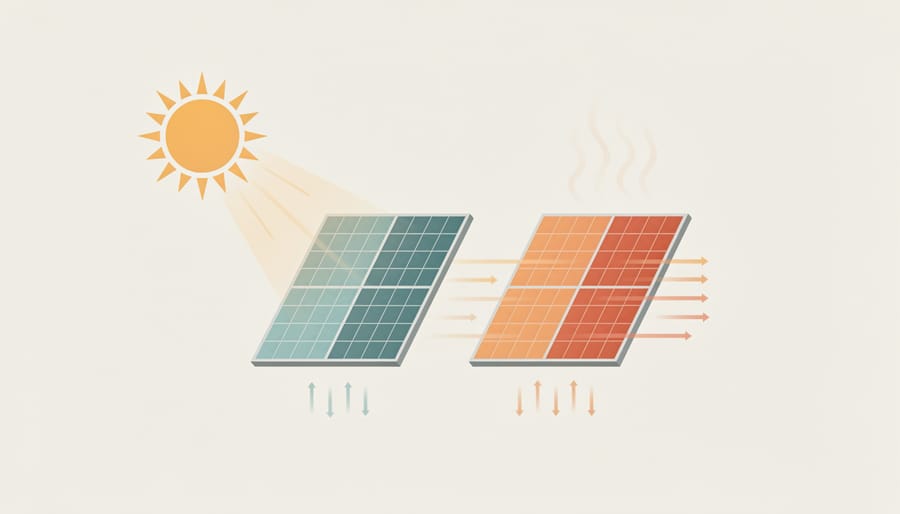
While solar panels need sunlight to generate electricity, they actually perform worse in hot conditions. Most photovoltaic cells lose about 0.5% efficiency for every degree Celsius above their rated temperature of 25°C (77°F). On a scorching summer day when roof surfaces exceed 65°C (149°F), a panel operating at that temperature could lose 20% of its potential output compared to the same panel on a cool spring morning with identical sunlight.
This temperature sensitivity varies by panel technology. Monocrystalline modules typically have temperature coefficients around -0.35% to -0.40% per degree Celsius, making them more resilient to heat than multi-crystalline panels, which often range from -0.40% to -0.50%. That seemingly small difference compounds over thousands of hot hours annually, influencing long-term energy yield calculations and return-on-investment projections.
Smart installation design mitigates heat impact through several proven techniques. Elevated racking systems create airflow channels beneath panels, allowing heat to dissipate naturally. Light-colored roofing materials reflect rather than absorb infrared radiation, keeping the entire assembly cooler. In commercial applications, installers sometimes incorporate deliberate gaps between panel rows to enhance cross-ventilation, trading a small amount of array density for significant efficiency gains during peak temperature hours.
Material selection matters beyond just the cells themselves. Aluminum frames dissipate heat more effectively than steel alternatives. Racking systems with standoffs create ventilation pathways that prevent heat accumulation. Some installers orient panels to catch prevailing winds, turning natural air movement into a passive cooling mechanism.
Understanding these thermal dynamics shapes how Mose Solar structures its educational program curriculum. The training emphasizes site assessment that accounts for local temperature patterns, roof material thermal properties, and microclimate effects from nearby structures or vegetation. Students learn to calculate real-world performance accounting for temperature losses, producing more accurate energy forecasts that strengthen client relationships and prevent over-promising system output.
3. Solar Tile and Shingle Integration Improves Structural Performance
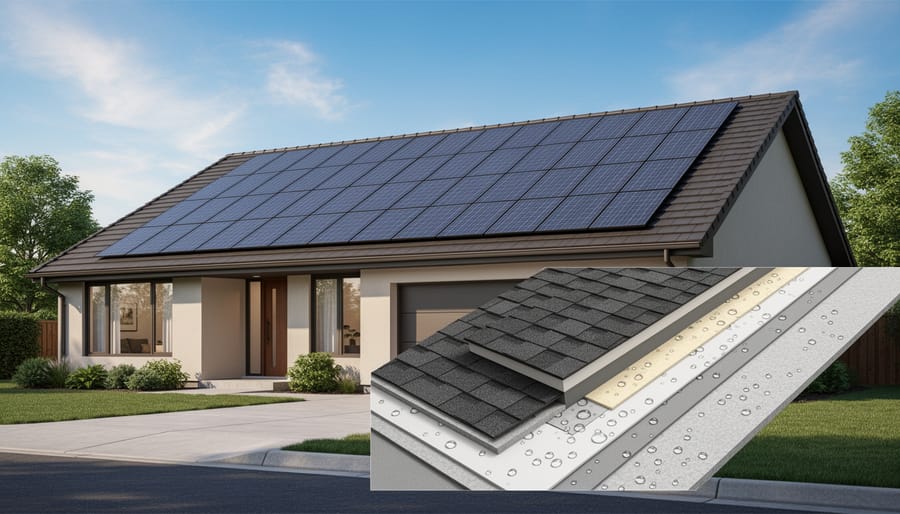
Recent field studies from building science departments reveal a surprising dual benefit: integrated solar tiles and shingles don’t just generate electricity, they actively improve roof structural integrity compared to bare roofing materials. Unlike rack-mounted systems that create penetration points and potential leak pathways, photovoltaic tiles function as premium roofing components that happen to produce power. This changes the installation conversation entirely, shifting solar from an add-on technology to a structural enhancement that protects the building envelope.
The structural advantages stem from engineering fundamentals rather than marketing claims. Building-integrated photovoltaics distribute weight uniformly across roof decking, eliminating the concentrated stress points created by traditional racking systems. Laboratory testing shows properly installed solar tiles provide superior wind uplift resistance, with interlocking designs that perform better than standard asphalt shingles in hurricane-force conditions. The waterproofing layer inherent to quality solar tiles creates redundant weather protection, addressing one of the primary installation secrets experienced professionals rely on for long-term system durability.
Key structural and installation benefits include:
- Continuous weather barrier eliminating traditional flashing complexity around rack penetrations
- 70-80% fewer roof attachments compared to conventional mounting systems, reducing leak risk
- Uniform load distribution preventing localized stress and potential rafter damage
- Streamlined aesthetic integration meeting HOA requirements without variance requests
These advantages create more intuitive installation workflows for professionals entering the field. Those pursuing their first solar job find integrated products simplify the learning curve, installation follows familiar roofing protocols rather than requiring specialized PV racking knowledge. Building inspectors respond positively because solar tiles comply with roofing codes by design, eliminating the hybrid approval process traditional systems require.
The dual-function approach also addresses consumer hesitation around system complexity. Homeowners understand roof replacement; explaining that solar tiles serve as both power generation and premium roofing creates immediate comprehension. This represents better solar UX at the conceptual level, removing psychological barriers that derail conventional PV projects during the decision phase.
Applying These Insights to Your Installation Practice
Understanding these three solar energy facts transforms you from someone who simply mounts panels to a professional who designs intelligent systems. When you can explain to clients why positioning matters even before dawn, why cooler installations outperform despite sunny heat, and how integrated products serve dual structural purposes, you build trust that sets you apart from competitors who treat installations as mechanical tasks.
This technical knowledge directly improves your system design accuracy. Accounting for low-light performance when calculating array orientation, planning racking systems that prioritize airflow over aesthetics, and recommending integrated solutions where structural benefits align with client needs, these decisions stem from understanding the science, not just following standard procedures.
How do I communicate low-light performance benefits to clients?
Show them how their system generates power during morning coffee hours and evening activities, not just midday when they’re often away. This reframes solar as an all-day resource rather than a noon-only technology.
What installation adjustments address heat-related efficiency loss?
Increase racking height to improve airflow beneath panels, use light-colored roofing materials where possible, and select module technologies with better temperature coefficients. Small spacing changes yield measurable performance gains.
When should I recommend solar tiles over traditional panels?
Consider integrated products for new construction, roof replacement projects, or situations where aesthetics and structural performance matter as much as energy output. The dual benefits justify premium costs in specific applications.
Mose Solar’s online educational program deepens this foundation through university-backed curriculum that connects physics principles to field applications. Structured learning transforms interesting facts into professional expertise that clients recognize and value, positioning you as an advisor rather than simply an installer.
These three solar energy facts reveal a fundamental truth: superior installation work flows from scientific understanding, not just technical skill. Recognizing that panels produce power before peak sunlight, that temperature reduces efficiency, and that integrated systems enhance structural performance separates competent installers from exceptional ones.
The distinction matters in every customer interaction. When you explain why panel positioning captures early-morning generation, why proper ventilation spacing protects investment returns, or how solar tiles strengthen rather than compromise roof integrity, you transform technical installations into educational experiences. Clients gain confidence. Projects proceed smoothly. Your professional reputation strengthens.
This knowledge depth doesn’t develop from random article reading. Structured education provides the systematic foundation that connects isolated facts into coherent expertise. Mose Solar’s university-developed educational program offers exactly this progression, building comprehensive understanding through collaboration with academic partners who research these phenomena.
The solar industry rewards those who invest in learning. Every installation becomes more intuitive when you grasp the underlying principles. Every client conversation becomes more compelling when you speak from genuine expertise rather than memorized specifications.
Your next installation experience depends on the knowledge you build today. Pursue structured learning that transforms interesting facts into practical mastery.