A solar PPA suits most buyers who want lower, performance-linked energy costs with no upfront spend, while a lease is the better fit for those who value a fixed monthly payment and don’t want their bill to move with production. The deciding factor is how you prefer to carry risk. Under a power purchase agreement (PPA), you pay a set rate for each kilowatt-hour the system generates, so cost tracks output. Under a solar lease, you pay a flat monthly amount to use the equipment, regardless of how much electricity it produces.
Both structures put a third party in ownership of the system, which is why they open the door to solar without a large capital outlay. They differ sharply, though, in cost predictability, who absorbs underperformance, how tax benefits are handled, contract length, and what happens when you sell your property. Those differences matter more than any headline savings claim.
This comparison is for homeowners, facility managers, and students of the field who want the mechanics, not the marketing. As more capital flows into solar PV infrastructure understanding these contracts has become a core professional skill. Through our university collaborations and educational programs, Mose Solar trains aspiring PV professionals to read these agreements with the same rigor they apply to system design.
Solar PPA vs. Lease at a Glance

The core differences between a solar power purchase agreement and a solar lease come down to what you pay for and who carries the risk. The table below summarizes the essentials, and the sections that follow explain each point in more depth.
| Feature | Solar PPA | Solar Lease |
|---|---|---|
| Payment structure | Per kilowatt-hour of electricity the system produces | Fixed monthly payment for use of the equipment |
| System ownership | Developer or financier owns, operates, and maintains it | Lessor owns it; the customer pays to use it |
| Performance risk | Largely borne by the owner, since you pay only for energy delivered | Largely borne by the customer, unless a production guarantee is included |
| Typical term | Long-term, commonly in the range of 10 to 25 years | Long-term, commonly in the range of 10 to 25 years |
| Escalator clauses | Often applied to the per-kWh rate | May apply to the monthly payment |
| End-of-term options | Renew, buy out the system, or have it removed | Renew, buy out the system, or have it removed |
| Best-fit customer type | Those who want pricing tied to actual production | Those who want a fixed, predictable payment |
Because the two structures overlap on term length and end-of-term choices, the real separation shows up in payment basis and risk allocation. A PPA ties your cost to output, while a lease ties it to a flat schedule regardless of how much the system generates.
Contract details vary by provider, jurisdiction, and customer type, so treat the ranges above as general patterns rather than quotes. Always confirm specific terms, including escalator rates and buyout provisions, with qualified providers before committing.
How Each Financing Structure Works
What a Solar Power Purchase Agreement Is
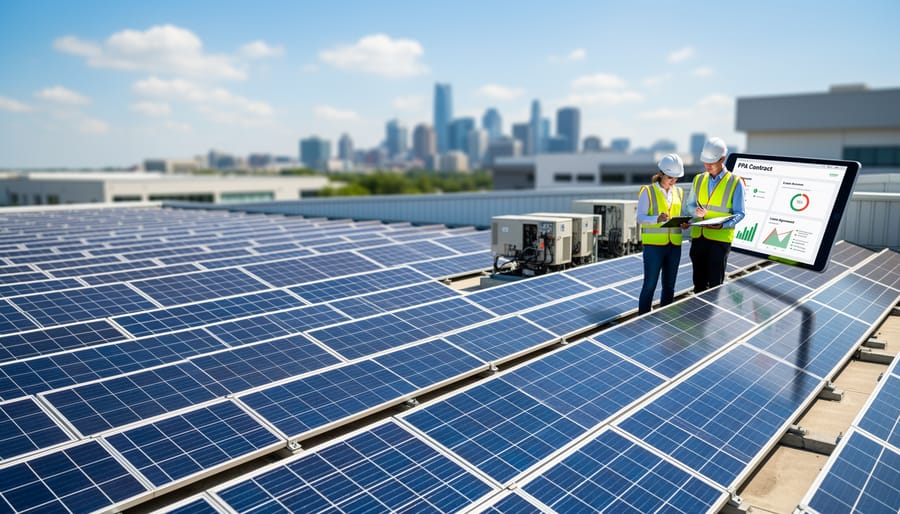
In a solar power purchase agreement, a third-party developer finances, installs, owns, operates, and maintains the solar system on the customer’s property. The customer does not buy the equipment. Instead, they agree to purchase the electricity it produces at a contracted price per kilowatt-hour. That rate is typically set below what the local utility charges, which is how the arrangement delivers savings without any upfront capital.
Because billing follows production, the customer pays only for power the system actually generates. If output falls short, the bill falls with it. Most agreements include an annual escalator that raises the rate by a fixed percentage over the term, so the long-term math depends heavily on how that clause is written.
The structure adapts to different customer types:
– Residential: Homeowners usually sign a long-term contract for a rooftop system, with the developer handling monitoring and repairs.
– Commercial and industrial: Businesses often host larger rooftop or ground-mounted systems, and the agreement may be tailored around facility load, operating hours, and sustainability targets.
– Public sector and nonprofits: Schools, municipalities, and other tax-exempt organizations commonly use PPAs because they cannot claim federal tax incentives directly. The developer captures those benefits and can reflect them in a lower contracted rate.
In every case, the developer carries the operational responsibility. The customer’s role is to provide site access and buy the output, which makes the PPA a service contract as much as an energy purchase.
What a Solar Lease Is
In a solar lease, the customer pays a fixed monthly fee for the right to use a solar system that someone else owns. The lessor, usually a developer or financier working with an installer, buys the equipment, has it installed on the customer’s roof or property, and keeps title to it for the full term. The customer never takes ownership during that period.
The defining feature is that the payment is set in advance. Whether the array has a banner production year or a cloudy one, the bill from the lessor stays the same. Many leases include an annual escalator, so the fixed fee may step up on a schedule written into the contract. That makes budgeting simple, but it also means the customer’s savings depend on how the lease payment compares with the utility bills it offsets, not on how many kilowatt-hours the system actually delivers.
Because the lessor owns the asset, it typically takes responsibility for maintenance, repairs, and system monitoring. Many lessors also claim the available tax incentives and depreciation, then reflect that benefit in the monthly price. Customers should still read the agreement closely, since the scope of coverage varies. Look for whether the lease includes inverter replacement, how quickly the lessor must respond to faults, and whether any production guarantee exists.
The customer’s main duties usually include keeping the system accessible and unshaded, carrying appropriate insurance, and making every payment on time. If the property is sold during the term, the lease generally has to be transferred or bought out, which is a point worth checking before signing.
Comparing Cost, Risk, and Control Dimension by Dimension
Payment Structure and Cost Predictability
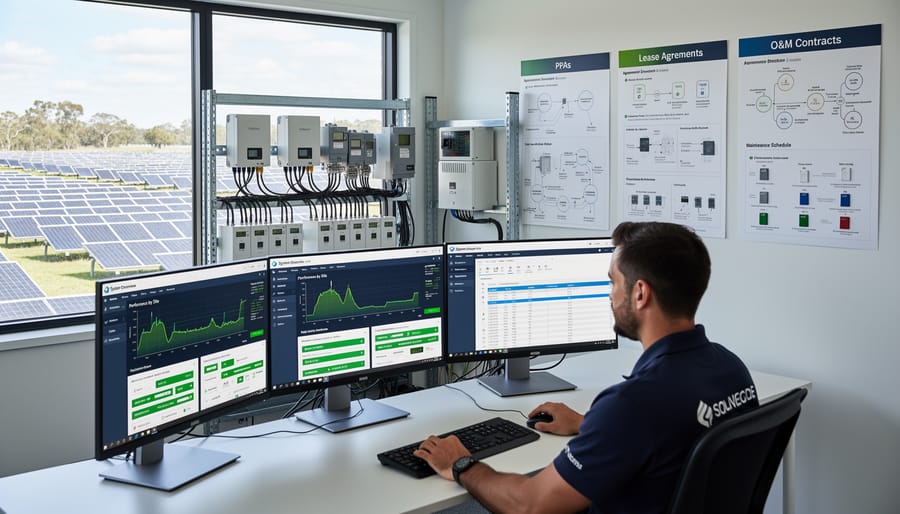
Under a PPA, your bill follows the meter. You pay a contracted rate for every kilowatt-hour the system produces, so a sunny month costs more in total than a cloudy one, though you’re also getting more electricity to offset utility purchases. The cost per unit is known; the monthly total is not. That variability is usually modest and tends to track your actual solar benefit.
A lease flips this. You pay the same fixed amount each month whether the system produces a lot, a little, or nothing at all. Budgeting is simpler, but the payment is disconnected from output. If the system underperforms because of shading, soiling, or a fault, your payment doesn’t shrink unless the contract includes a production guarantee.
Escalator clauses deserve close attention in both structures. An escalator raises the PPA rate or the lease payment by a set percentage each year. A small annual increase compounds over a 20-year or longer term. A PPA that starts well below the utility rate can lose that advantage if the escalator outpaces utility price growth, which no one can predict with certainty. A flat, non-escalating payment is easier to forecast.
When comparing offers, model the full-term cost under each escalator scenario rather than judging by the first-year price alone.
Performance and Production Risk
Production risk is one of the clearest dividing lines between the two structures. Under a PPA, the customer pays only for electricity the system actually delivers. If panels underperform, shading worsens, or an inverter fails and output drops, the developer loses revenue while the customer’s bill falls with it. That alignment is why developers tend to stress careful site assessment and ongoing monitoring before they commit.
A lease works differently. The fixed payment is owed whether the system produces at its projected level or well below it. Without a protection clause, a customer can end up paying full price for reduced output and still buy utility power to cover the gap.
Guarantees can change this balance. Many lessors offer a minimum production guarantee, with a credit or refund if output falls short, and some PPAs include similar performance floors. Look closely at how output is measured, how long a fault may last before remedies apply, and who must pay for repairs.
Ownership, Tax Incentives, and Accounting Treatment
In both a PPA and a lease, the third-party owner typically holds title to the system, so that party, not the customer, usually claims the federal tax incentives and depreciation tied to it. Those benefits are a core part of how the deal is priced. Developers and financiers factor them into the per-kWh rate or the fixed lease payment, which is how they can offer lower customer costs without any upfront investment. Other project funding mechanisms can also shape those economics, but tax benefits remain the most common lever.
Incentive rules change over time, and eligibility can depend on the customer’s type, the system’s size and the date it enters service. Treat any quoted savings as a snapshot and confirm current eligibility with a qualified tax professional before signing.
For commercial customers, accounting treatment deserves early attention. Depending on the contract’s terms, a lease may be classified as an operating or finance lease under applicable accounting standards, which affects how obligations appear on the balance sheet. A PPA may also contain an embedded lease depending on how control of the system is structured. Your finance team or auditor should review the classification before execution.
Contract Term, Maintenance, and End-of-Term Options
Both PPAs and leases usually run long: terms of 20 to 25 years are common, though shorter and longer contracts exist, so confirm the exact length in the agreement. Over that span, the system owner (the developer or lessor) typically takes responsibility for maintenance, monitoring, and repairs, and often carries insurance on the equipment. Customers should still verify who covers inverter replacement, roof-related work, and liability for damage to the property, since these details vary by provider.
When the term ends, the usual choices fall into three groups. You can renew or extend the contract, often at a reduced rate or payment. You can buy out the system, generally at fair market value, which becomes a real consideration for customers who want to own the equipment. Or you can have the system removed, in which case the agreement should specify who pays for removal and roof restoration. Reviewing these provisions before signing prevents costly surprises later.
Property Sale, Transferability, and Financing Implications
Selling or refinancing a property with a third-party-owned system adds a step. Under both a PPA and a lease, the buyer usually has to assume the contract, which means qualifying with the provider and accepting the remaining term and any escalators. Some providers also allow the owner to prepay or buy out the agreement before closing.
Lenders review these agreements too. They may ask about payment obligations, and some providers file a fixture filing or UCC-1 notice against the property, which can complicate title work or a refinance. Check the transfer and assignment clauses before you sign.
Who Should Choose a PPA and Who Should Choose a Lease
The right structure depends less on the technology than on what the customer values most: savings tied to output, payment certainty, or the ability to monetize incentives. Think of it as matching a contract to a situation, not picking a winner.
- Choose a PPA if you want your cost to track actual production and prefer the owner to carry performance risk.
- Choose a lease if you want a fixed, budgetable monthly payment that does not move with weather or output.
- Lean toward a PPA if your site has good, unshaded exposure and you are comfortable with a per-kWh escalator.
- Lean toward a lease if you value simple, predictable billing and can accept responsibility for underperformance unless a guarantee is written in.
For homeowners, the choice often comes down to temperament. Those who dislike surprises tend to favor a lease, while those who want to pay only for electricity actually delivered often prefer a PPA. Either way, confirm how the agreement transfers if you sell the home, since a buyer and their lender must be willing to accept it.
Commercial and industrial customers have more to weigh. A facility with steady daytime load may benefit from production-linked pricing, while a business that prioritizes stable operating expenses may favor fixed payments. Accounting treatment can differ between the two, so involve your finance team early.
Public and nonprofit organizations are a distinct case. Because they generally cannot use federal tax credits directly, third-party ownership lets a private developer capture those benefits and pass part of the value back through pricing. These customers can also combine third-party agreements with other funding, including nonprofit solar grants and some projects are structured through public-private partnerships that spread cost and risk across parties.
Because incentive rules and market terms change, verify current eligibility with a qualified tax professional and compare multiple offers before committing.
Questions to Ask Before You Sign a Solar Agreement
Before you sign anything, read the contract as closely as the proposal. Start with the escalator: is the annual increase fixed, and does the cumulative cost still beat projected utility rates over the full term? Ask for a year-by-year payment schedule, not just the first-year price.
Next, look at performance. A PPA should state a guaranteed production level and spell out the remedy if output falls short. A lease may place that risk on you, so find out what monitoring is included and who pays for repairs when equipment fails.
Then examine the exit terms. Request the buyout pricing formula, the process for assigning the contract to a future property buyer, and any lien or fixture filing placed on your property. Confirm who carries insurance and who is responsible, and at whose cost, for removing the system at the end of the term or during a roof replacement.
Finally, compare the offer against alternatives. Price the same system as a cash purchase and as a loan, including financing routes such as bridge construction loans for developers bridging project costs, so you can see what third-party ownership truly costs in exchange for no upfront capital.
Evaluating these contracts is a learnable skill. Mose Solar’s online educational program, developed in collaboration with universities, helps aspiring PV professionals build the knowledge to assess and structure these agreements with confidence.
Solar PPA and Lease FAQs
Most readers arrive with the same handful of practical questions, so here are straightforward answers that hold true across most markets. Specific terms vary by provider and region, so treat these as starting points for your own due diligence.
Which option usually has the lower upfront cost?
Both are typically structured with little or no money down, since a third party owns and finances the system. The more useful comparison is lifetime cost, which depends on the escalator rate, the lease payment, and how much electricity the system actually produces.
Who maintains the system?
In most PPAs and leases, the owner or lessor handles maintenance, monitoring, and repairs, though the scope varies by contract. Confirm in writing who covers inverter replacement, insurance, and roof-related work before signing.
Can I buy the system at the end of the term?
Many agreements offer a renewal, a buyout, or removal at the end of the term. Buyout pricing is often set at fair market value, so ask how that value is determined and whether a fixed purchase option is available.
Who receives the tax incentives?
Because the third party owns the system, it generally claims the available incentives and depreciation, and ideally reflects that value in your pricing. Incentive rules change, so confirm current eligibility with a qualified tax professional.
Two follow-up points come up often. First, a sale or refinance deserves early attention, since a buyer or lender may need to review and accept an assignment of the agreement. Second, availability differs by region, because some jurisdictions restrict or regulate third-party ownership, so check what is permitted where your property is located. Contract language drives the real outcome in each of these cases, which is why reading the fine print matters more than the label on the financing.
The choice between a solar PPA and a lease comes down to what you want to be certain about. A PPA ties your cost to the electricity the system actually produces and keeps most performance risk with the system owner. A lease gives you a fixed, predictable payment, but you carry more of the production risk unless the contract includes a guarantee.
Neither structure is better in the abstract. The real value sits in the contract: escalator rates, performance guarantees, buyout pricing, transfer terms, and removal obligations all shape what you pay and what you can do later. Read those clauses closely, and have a qualified tax or legal professional review them before you sign.
Remember, too, that PPAs and leases are only two options. Buying with cash or a loan remains a serious alternative, and it deserves a side-by-side comparison. To build the skills to evaluate and structure these agreements yourself, explore Mose Solar’s online educational program, developed in collaboration with universities.