If your search for “q car insurance” comes from a construction or energy project, you almost certainly need Contractors’ All Risks (CAR) cover, and the real decision is whether CAR alone is enough or whether you also need Erection All Risks (EAR) and Delay in Start-Up (DSU) protection. The deciding factor is the type of work. CAR fits civil and building projects, EAR fits the installation of plant and machinery such as inverters, trackers and transformers, and DSU covers the income lost when either type of damage pushes back commissioning. Searchers looking for motor insurance will find a different product entirely, since a CAR policy insures a project site and not a vehicle.
For solar developers, EPC contractors, lenders and asset owners, the three covers work best as a structured program, not a single policy. Each one answers a different question: what is damaged, who owns the risk, and what the delay costs. Getting that structure wrong can leave a gap between physical damage and financial loss, and that gap is usually where disputes begin.
This article defines each cover, compares them dimension by dimension, and closes with role-based guidance. It reflects the same educational mission behind Mose Solar’s university collaborations and training programs, which equip aspiring photovoltaic professionals to read a risk program as confidently as a single-line diagram.
Motor Cover or Project Cover? A Side-by-Side Snapshot
The quickest way to separate these covers is to look at what each one actually insures. A motor policy follows a vehicle on the road. CAR, EAR and DSU follow a construction project from the first works through commissioning. The table below sets them side by side.
| Cover Type | What It Protects | Typical Policyholder | Cover Period | Typical Claim Trigger |
|---|---|---|---|---|
| Motor insurance | A vehicle and the policyholder’s legal liability to third parties | Vehicle owner or driver | Policy term, usually renewed annually | Collision, theft, or damage involving the insured vehicle |
| CAR (Contractors’ All Risks) | Civil works and materials during construction | Project owner or main contractor | From start of works to handover, sometimes with a maintenance period | Sudden physical loss or damage to the insured works |
| EAR (Erection All Risks) | Installation of plant and equipment such as PV arrays, inverters and transformers | Project owner, EPC contractor or equipment supplier | From delivery or erection through testing and commissioning | Physical damage during erection, testing or commissioning |
| DSU (Delay in Start-Up) | Financial loss from a late start to operations | Project owner, often with lenders named | Linked to the construction schedule and an agreed indemnity period | A delay caused by an insured physical damage event under CAR or EAR |
Two points stand out. First, motor cover is built around a person and a vehicle, while the other three are built around a project and its schedule. Second, DSU is not a standalone product in the usual sense. It depends on a covered physical loss, so it only responds when a CAR or EAR claim has already caused the delay.
This is why a motor policy cannot stand in for project cover. The insured interest, the policyholder and the claim trigger all differ, and the sections that follow explain each difference in more detail.
What Each Cover Actually Is: Motor, CAR, EAR and DSU Defined
Why a Motor Policy Does Not Cover a Solar Construction Site
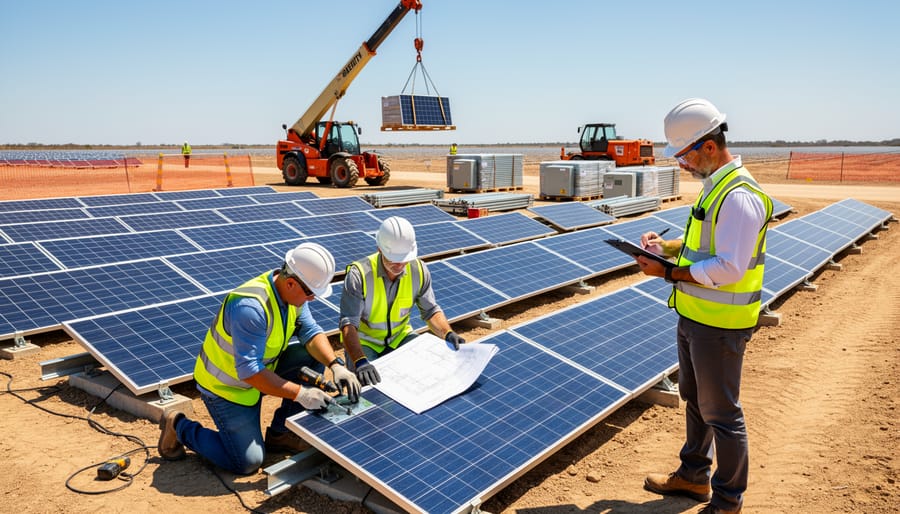
A motor policy insures a vehicle and the legal liability that arises from driving it. That is its whole purpose. A solar construction site is a different kind of exposure, because the thing at risk is the works themselves: the modules, the mounting structures, the cabling, the inverters and the rest of the electrical balance-of-system as they are delivered, stored and installed.
Site vehicles such as pickups, telehandlers and delivery trucks may well need motor cover, particularly when they travel on public roads. Heavy plant like piling rigs, excavators and cranes usually sits under a separate contractor’s plant and equipment policy. Both protect the contractor’s own machinery. Neither responds when a hailstorm cracks a pallet of modules or when a fire damages a half-wired combiner box.
That loss belongs to project works cover, meaning CAR/EAR. It insures the permanent works and materials destined to become part of the finished plant, usually for the owner and the other parties with an interest in the build. The distinction is practical: one policy protects the tools used to build the plant, the other protects the plant being built. Treating a motor or equipment policy as a substitute for works cover leaves the most valuable assets on site uninsured against physical damage.
How CAR, EAR and DSU Fit Together in One Program
On a solar project, CAR and EAR rarely sit in separate policies. Because a build involves both civil works and the erection of plant, insurers commonly combine them into a single construction and erection policy. Civil elements such as foundations, access roads, trenching and fencing fall on the CAR side, while the installation of modules, mounting structures, inverters and transformers falls on the EAR side. One combined wording avoids gaps and disputes about where one type of works ends and the other begins.
DSU then attaches as an extension to that policy rather than standing on its own. Its trigger is dependent: the delay in commissioning must stem from physical loss or damage that is itself covered under the CAR/EAR section. If a storm damages stored modules and the damage is an insured event, the resulting postponement of grid connection may give rise to a DSU claim. If the underlying damage is excluded, the delay loss typically falls away with it. For that reason, the property wording and the DSU wording need to be read together when the program is structured.
Cover of this kind usually names more than one party. Typical named insureds include the project owner, the EPC contractor, lenders or financing parties, and subcontractors working on site, each with an interest in the works. Lenders often care most about DSU, since a delayed start-up affects the revenue that services the debt. Exact terms, interests and conditions vary by project and insurer, so they should be confirmed with a qualified broker.
Dimension-by-Dimension: Where Motor, CAR/EAR and DSU Diverge
Structuring DSU Around the Commissioning Timeline
Delay in start-up (DSU) cover only works if it mirrors the real commissioning timeline, so structuring begins with the project schedule. Three elements carry most of the design weight: the indemnity period, the waiting period and the link to financing terms.
The indemnity period is the length of time the policy pays after a covered physical damage event delays commissioning. It should reflect how long it would realistically take to repair or replace critical components and return to the original energy-delivery date. Long-lead items matter here. Transformers, switchgear and grid-connection equipment often take far longer to replace than modules, which is why work such as utility-scale substation design can shape the exposure as much as the array itself.
The waiting period is the initial stretch of delay that the insured absorbs before indemnity begins. A shorter wait generally means broader protection, while a longer one lowers the cost of cover. The right balance depends on how much slippage the project’s cash flow can tolerate without strain.
Both periods should align with the financing terms. Lenders typically care about debt service obligations that begin once the plant is operating, so the cover should protect the revenue and fixed costs those obligations depend on.
That is why accurate projections matter. DSU is only as sound as the figures behind it. If projected revenue or fixed costs are understated, the insured may be underprotected after a loss. If they are overstated, the program may be mispriced or disputed at claim time. Build the projections with the owner, lender and broker, and revisit them as the schedule changes.
Who Should Choose Which: Matching Cover to Your Role
If you searched “q car insurance” looking for a motor policy, the answer depends on what you are actually protecting. A motor policy is the right tool for road vehicles and the third-party liability that comes with driving them. It will not respond to damage to modules, trackers or inverters during installation.
Project owners generally need a combined CAR/EAR program, because it covers physical loss or damage to the works and the installed equipment from the start of construction through commissioning. DSU belongs on top when a delay in start-up would cause real financial harm, for example when revenue projections or debt service depend on a fixed energy-on date. The DSU extension only pays when the delay follows an insured physical damage event, so the underlying CAR/EAR cover has to be sound first.
EPC contractors should look at who is named on the policy, how subcontractors are included, and how their own plant and equipment sit outside the project works cover. They should also understand where a manufacturer defect warranty takes over once components are installed, since warranty terms and construction cover answer different questions. Lenders typically want to see that the program matches the financing structure, with the right interests noted and cover that runs through commissioning. Some also weigh related protections such as trade credit insurance against contractor failure, which addresses counterparty risk rather than physical damage.
Technical safeguards matter too. Good bonding protection reduces the likelihood of the equipment damage that insurers are asked to pay for, which can inform how risks are presented and discussed.
Whatever your role, program design should be confirmed with a qualified broker or insurer, since terms, exclusions and sums insured vary by project. For professionals who want to understand these structures before sitting across the table, Mose Solar’s online program, developed with universities, builds that foundation.
Common Questions About Q Car Insurance and Solar Project Cover
Readers who arrive searching for “q car insurance” often leave with a handful of practical questions. The answers below separate the two meanings and keep to points that hold across most project structures.
Is CAR the same as car insurance?
No. CAR stands for Contractors’ All Risks, a construction cover for physical loss or damage to works under construction. A motor policy insures vehicles and related liability, so the two address entirely different risks despite the similar wording.
Does a motor policy cover solar panels during installation?
Generally not. Damage to modules, mounting structures and electrical balance-of-system during installation is the territory of CAR/EAR, while a motor policy responds to vehicle-related events.
What is the difference between CAR and EAR?
CAR is aimed at civil works and construction, while EAR is aimed at the erection and installation of plant and equipment such as PV arrays, inverters and transformers. On a solar project the two are often combined in a single policy.
When does DSU respond?
DSU responds to financial loss caused by a delay in commissioning, but only when that delay results from an insured physical damage event under the underlying CAR/EAR cover. It does not respond to delays from causes the main policy excludes.
Two further points come up often. The named insured on a solar project program is usually the project owner, with the EPC contractor, subcontractors and lenders added as insureds or noted interests, though the exact arrangement depends on the contracts and the insurer’s terms. And because program design varies between projects, it should always be confirmed with a qualified broker or insurer.
For professionals who want a firmer grounding in PV project risk, Mose Solar’s online program, developed in collaboration with universities, covers the technical and commercial foundations behind these decisions.
A motor policy and a CAR/EAR program with DSU cover are built for different risks, and treating them as interchangeable is where confusion starts. Car insurance protects vehicles and the liability that comes with driving them. CAR/EAR protects the physical works during construction and installation, while DSU protects the revenue timeline if an insured loss pushes back commissioning.
For a solar build, the practical lesson is to structure the program early. Decisions about insured parties, sums insured, deductibles and the indemnity period are far easier to make before ground is broken than after a loss. They also tend to shape what lenders will accept, so getting them right protects both the physical asset and the date on which it starts earning.
If you’re building a career in the photovoltaic industry, understanding how project risk is transferred is a skill worth developing. Mose Solar’s online education program, developed in collaboration with universities, is designed to help aspiring professionals build exactly that kind of foundation.