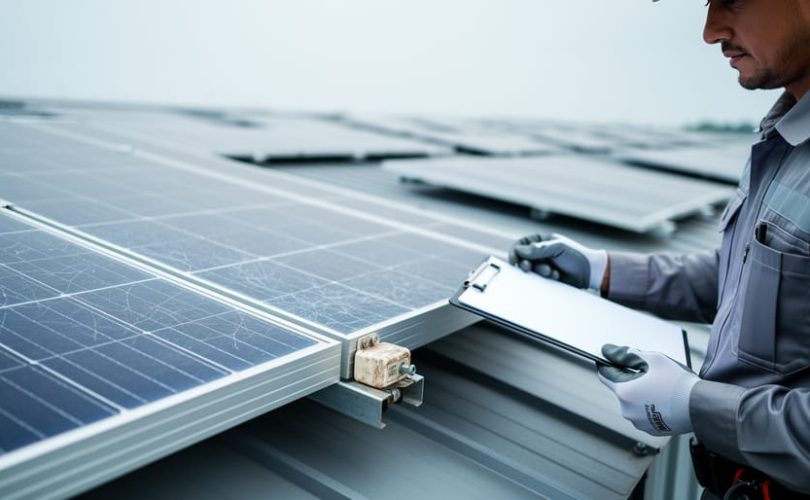
A manufacturer defect warranty protects solar module buyers against premature failures caused by factory flaws in materials or workmanship, typically covering 10 to 12 years from installation and obligating the manufacturer to repair, replace, or refund defective panels at no cost to the system owner. This warranty stands separate from performance guarantees and becomes enforceable the moment you discover physical defects like delamination, corrosion, junction box failures, or cell cracks that originated during production rather than from external damage or improper installation.
For photovoltaic professionals advising clients and system owners navigating claims, understanding manufacturer defect warranty mechanics proves essential. The coverage scope varies significantly between brands, with premium manufacturers offering comprehensive protection including labor costs and shipping, while budget-tier suppliers often limit liability to module replacement alone. Enforcement depends entirely on maintaining proper documentation, following prescribed claim procedures, and verifying the manufacturer’s financial stability before problems arise.
The distinction between covered manufacturing defects and excluded damages frequently determines whether a claim succeeds or fails. Hairline microcracks discovered during routine inspection may qualify if traceable to cell handling during assembly, while similar damage from hail impact or mounting pressure would fall outside warranty protection. Serial Defect Insurance has emerged as a critical supplement to standard warranties, providing coverage when widespread manufacturing flaws affect entire production batches and the original warranty proves inadequate or the manufacturer becomes insolvent.
At Mose Solar, our partnerships with leading research universities and commitment to educating renewable energy professionals inform our approach to warranty education. This article equips you with the knowledge to evaluate warranty quality during procurement, verify coverage authenticity, and execute successful claims when module defects emerge. Whether you’re specifying components for a new installation or managing warranty issues on existing systems, understanding these protections directly impacts long-term system reliability and your clients’ financial security.
Understanding Manufacturer Defect Warranties in Solar PV
What Qualifies as a Manufacturing Defect
Manufacturing defects are physical flaws or material failures that originate during the production process, not from external damage or wear. These defects compromise the module’s structural integrity or electrical performance in ways that shouldn’t occur under normal operating conditions.
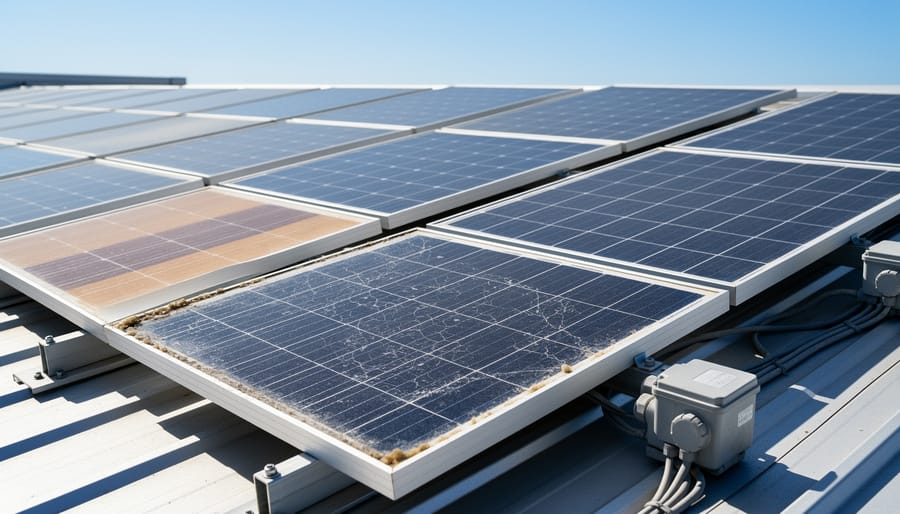
Delamination ranks among the most common manufacturing defects. This occurs when the layers of the module, typically the encapsulant separating the glass from the solar cells, begin to separate. You’ll see bubbles, cloudiness, or visible gaps between layers. Delamination allows moisture penetration, which accelerates performance loss and can lead to complete module failure.
Encapsulant discoloration presents as yellowing or browning of the transparent material surrounding the cells. While slight discoloration might be cosmetic, significant browning reduces light transmission to the cells, directly cutting power output. This defect stems from improper curing during manufacturing or substandard encapsulant materials.
Junction box failures include loose connections, inadequate sealing that allows water intrusion, or faulty bypass diodes. These manufacturing shortcuts create hot spots and safety hazards. A properly manufactured junction box should remain weathertight and maintain secure electrical connections throughout the warranty period.
Frame defects encompass poor welds, inadequate drainage holes, or frames that don’t properly secure the glass. These structural flaws can allow water accumulation or create stress points that crack the module.
Cell cracks present at delivery represent clear manufacturing or handling defects during production. Micro-cracks that appear before installation, detectable through electroluminescence imaging, qualify for warranty coverage, unlike cracks caused by installation mishandling or hail after deployment.
What’s Not Covered
Manufacturer defect warranties protect against flaws originating in the factory, but they explicitly exclude damage arising after modules leave production. Understanding these exclusions prevents claim denials and clarifies where responsibility shifts from manufacturer to installer or owner.
Installation damage represents the most common exclusion. Cracked cells from improper handling, frame bending during mounting, or junction box strain from cable management errors fall outside warranty coverage. The manufacturer’s obligation ends when undamaged modules ship; subsequent physical damage, even if discovered weeks later, becomes the installer’s responsibility. This is why installation workmanship directly impacts your practical warranty protection.
Improper maintenance voids coverage as well. Manufacturers specify cleaning methods, vegetation clearance requirements, and inspection intervals. Using abrasive cleaners that scratch glass, allowing bird droppings to accumulate for years, or failing to trim overhanging branches that drop debris all constitute maintenance failures that can void claims for subsequent damage.
Environmental conditions beyond specifications aren’t covered either. Modules rated for specific wind loads, temperature ranges, and humidity levels won’t be replaced if they fail after exposure to hurricane-force winds exceeding those ratings or installation in corrosive coastal environments without appropriate specifications.
Unauthorized modificationsdrilling additional mounting holes, removing bypass diodes, or altering electrical connections, immediately terminate warranty protection. Performance degradation beyond specified rates falls under separate performance warranties, not defect coverage, creating distinct claim pathways for different failure modes.
Module Warranty Enforcement: Rights and Procedures

Documentation Requirements
When filing a warranty claim, thorough documentation is your most powerful tool. Manufacturers require specific evidence to verify both the defect and that it occurred under covered circumstances.
Purchase records form your foundation. Keep your original invoice, purchase order, and proof of payment. These establish your warranty start date and confirm you’re the legitimate owner. If modules were purchased by your installer, obtain copies of their procurement documentation showing serial numbers and purchase dates.
Installation documentation proves proper system deployment. This includes electrical drawings, mechanical mounting specifications, commissioning reports, and installer certifications. Photos from installation day showing module condition before energization create a baseline reference point. Many claims fail because manufacturers argue that installation damage caused the defect.
Maintenance logs demonstrate you upheld your responsibilities. Record cleaning schedules, inspection dates, and any repairs performed. Even brief quarterly notes showing you maintained the system per manufacturer guidelines strengthen your position.
Photographic evidence of the defect is essential. Capture multiple angles with clear module serial numbers visible. Include close-ups of the specific defect and wide shots showing its location within the array.
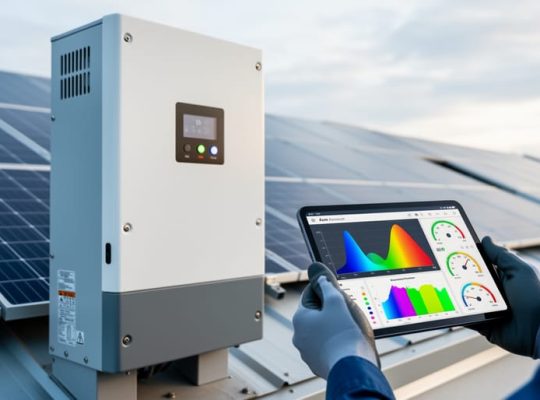
Performance monitoring data reveals when output degradation began. Export historical production graphs from your inverter or monitoring platform. Sudden drops or persistent underperformance patterns support claims more effectively than anecdotal observations.
Store all documentation digitally in multiple locations with cloud backup.
Manufacturer Response Obligations
Once you file a warranty claim, manufacturers operate under both industry norms and legal obligations that dictate their response timeline and resolution process. While specific requirements vary by jurisdiction, most reputable solar manufacturers follow a standard protocol to maintain their market standing and comply with consumer protection laws.
Response Timeline Standards
Industry practice expects an initial acknowledgment within 5-7 business days of claim submission. Manufacturers then typically have 30-45 days to conduct their assessment and propose a resolution, though complex cases involving on-site inspections may extend this window to 60 days. In the European Union, consumer protection directives require sellers (and by extension, manufacturers) to remedy defects within a “reasonable time”, generally interpreted as 30 days maximum unless technical circumstances justify delays. U.S. warranty law under the Magnuson-Moss Warranty Act doesn’t specify timelines but requires manufacturers to handle claims “within a reasonable time.”
Inspection Protocols
For visible defects like delamination or frame damage, photographic evidence often suffices. Manufacturers may request specific images: close-ups of the affected area, serial number plates, and wide shots showing the module’s position in the array. When physical inspection is necessary, manufacturers either dispatch authorized technicians or require you to ship the module to their facility at their expense. Some contracts allow third-party inspectors certified by bodies like TÜV or UL to verify defects.
Resolution Hierarchy
Manufacturers must offer one of three remedies: repair (for minor, localized defects), replacement (most common for material failures), or refund (typically prorated based on age). You’re entitled to reject repair attempts if they compromise system performance or aesthetics.
Serial Defect Insurance: Additional Protection Layer
How Serial Defect Insurance Works
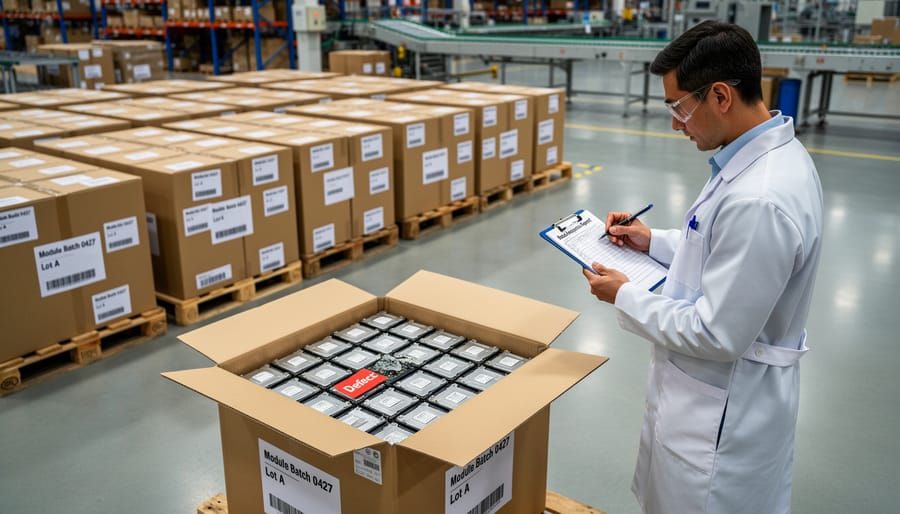
Serial Defect Insurance activates when a manufacturing flaw affects multiple modules from the same production batch rather than isolated units. Unlike standard manufacturer warranties that address individual panel failures, this insurance covers systemic issues, think encapsulant delamination across an entire manufacturing run or widespread junction box failures in modules produced during a specific timeframe.
Third-party insurers typically underwrite these policies separately from module manufacturers. Companies like Munich Re and Swiss Re offer specialized coverage that remains valid even if the manufacturer faces financial difficulties or closes operations. The insurance provider maintains independent reserves to honor claims, creating a financial backstop that outlasts the original equipment maker.
Manufacturer-backed programs, by contrast, rely on the company’s own balance sheet. While they may cost less initially, their value depends entirely on the manufacturer’s long-term solvency, a crucial distinction when solar panels carry 25-year performance expectations.
Coverage triggers when defect rates exceed predetermined thresholds. If field failures in a production batch surpass 5% within a specified period, insurers may classify it as a serial defect event. This threshold prevents activation for normal failure rates while capturing genuine batch-wide problems. Once triggered, the insurance covers testing, replacement modules, and often labor costs for affected installations.
Insurance providers verify serial defects through independent engineering analysis before authorizing claims, ensuring that legitimate batch issues receive coverage while filtering out installation errors or environmental damage misattributed to manufacturing flaws.
Real-World Scenarios
Between 2012 and 2015, a major Asian module manufacturer discovered that an entire production series exhibited accelerated backsheet delamination within 36 months of installation. The defect originated from a chemical formulation change in the encapsulant material that reduced UV resistance. Systems across three continents developed visible bubbling and moisture ingress, affecting approximately 180,000 modules. Serial Defect Insurance covered replacement costs when field failures exceeded statistical thresholds, triggering batch-wide remediation rather than individual warranty claims.
Hot-spot failures from defective bypass diodes represent another documented pattern. In 2018, field inspections revealed that modules from a specific production quarter showed localized heating exceeding 85°C during normal operation. The manufacturer traced the issue to a subcontractor who supplied diodes with inadequate reverse breakdown voltage specifications. The defect manifested as thermal degradation visible through infrared scanning, affecting roughly 45,000 modules before the production line implemented component testing protocols.
Micro-crack patterns present more subtle challenges. A European manufacturer identified in 2020 that automated handling equipment during cell stringing introduced hairline fractures in a six-month production window. These cracks remained invisible during electrical testing but propagated under thermal cycling, causing power loss within 18-24 months. The manufacturer proactively recalled affected batches after statistical analysis revealed failure rates three times above baseline, demonstrating how serial defect mechanisms can identify systemic issues before widespread field failures occur.
Verifying Warranty Strength Before Purchase
Before committing to a solar module purchase, evaluate the manufacturer’s ability to honour warranty commitments 10-25 years into the future. Start with financial stability: publicly traded companies publish quarterly reports showing revenue trends, debt levels, and cash reserves. Private manufacturers are harder to assess, but industry rankings from Bloomberg New Energy Finance (Tier 1 status) or similar analysts indicate production scale and market staying power. A manufacturer with consistent annual output above 1 GW and multi-year operating history demonstrates the financial foundation to support long-term obligations.
Insurance backing transforms warranty promises from corporate commitments into contractually guaranteed protection. Ask whether the manufacturer carries risk insurance coverage or third-party warranty insurance through reputable providers. Some manufacturers partner with insurers to underwrite warranties independently of company finances, meaning claims get paid even if the original company fails. Request written confirmation of insurance policy numbers and coverage limits, not just marketing statements about “insured warranties.”
| Evaluation Criteria | Positive Indicators | Red Flags |
|---|---|---|
| Financial Stability | Tier 1 ranking, 5+ years operation, public financials available, revenue growth | Recent ownership changes, undisclosed finances, newly established brand |
| Insurance Backing | Named insurer, verifiable policy, third-party administrator contact provided | Vague “insured” claims, no policy details, self-insurance only |
| Claim History | Published claim response times, customer testimonials, installer feedback | No claim process documentation, complaints about non-response, extended delays |
| Warranty Transfer | Automatic transfer to new property owner, simple notification process | Transfer restrictions, fees required, original purchaser only coverage |
Warranty transferability matters if you plan to sell the property. Some manufacturers allow seamless transfer to new owners with basic notification, while others impose restrictions or fees that reduce system value at resale. Get written confirmation that warranties transfer automatically with property ownership, protecting your investment’s market value. Review the warranty document itself rather than relying on installer summaries, the actual terms reveal coverage limits, exclusions, and enforcement procedures that sales materials often gloss over.
Common Warranty Enforcement Challenges
When Manufacturers Go Out of Business
When a solar module manufacturer declares bankruptcy or ceases operations, your warranty doesn’t automatically vanish, but enforcement becomes more complex. Start by checking whether your modules came with third-party warranty insurance, which functions independently of the manufacturer’s solvency. Many tier-one manufacturers secure this coverage specifically to protect buyers; if your system has it, file directly with the insurance underwriter listed in your warranty documentation.
If no insurance exists, contact your installer or distributor immediately. In many jurisdictions, distributors and installation contractors bear secondary liability for warranty fulfillment, particularly when they represented the manufacturer’s stability during the sale. They may have access to replacement modules from the same production line acquired by a successor company, or they might negotiate settlements to avoid litigation.
For internationally-sourced modules, enforcement grows harder. Language barriers, jurisdictional differences, and customs delays compound the problem when pursuing claims across borders. Review your purchase agreement for arbitration clauses; some contracts stipulate dispute resolution venues that favor consumer protection. Additionally, verify whether your installer maintained proper PV import compliance records, as these documents sometimes reveal importer-of-record responsibilities that create alternative liability pathways.
Class-action opportunities occasionally emerge when manufacturers with large installed bases fail, pooling affected system owners to pursue collective remedies against remaining corporate assets or successor entities.
Educational Resources and Professional Development
Understanding warranty enforcement and quality assurance goes beyond protecting individual solar investments, it represents essential professional knowledge for anyone entering the photovoltaic industry. Installers, consultants, and system designers must advise clients on warranty reliability, identify potential manufacturing defects during installation, and guide customers through claim procedures when issues arise.
Mose Solar collaborates with universities to integrate comprehensive warranty education into renewable energy curricula. These programs equip students with practical skills in defect identification, covering visual inspection techniques for common manufacturing flaws like micro-cracks, delamination patterns, and junction box anomalies. Students learn to differentiate installation damage from factory defects, a critical skill for accurate warranty assessment.
Curriculum modules address warranty law fundamentals, including the Magnuson-Moss Warranty Act provisions, international warranty jurisdiction complexities, and insurance backing verification methods. Case studies examine real warranty disputes, teaching students to navigate manufacturer response protocols and documentation requirements that protect both consumers and installation businesses from liability.
Quality assurance training emphasizes proactive defect prevention through proper handling protocols, storage procedures, and pre-installation testing. This education creates professionals who can identify potential warranty issues before they become system failures, ultimately strengthening consumer confidence in solar technology.
For aspiring PV professionals, warranty literacy translates directly to career readiness. Employers value installers who can communicate warranty coverage accurately to clients, document installations to preserve warranty validity, and manage claim processes efficiently, skills that reduce business risk while enhancing customer satisfaction.
Frequently Asked Questions
How does a manufacturer defect warranty differ from a performance warranty?
Manufacturer defect warranties cover physical flaws and workmanship issues like delamination or junction box failures, typically lasting 10-12 years. Performance warranties guarantee power output levels over 25-30 years and address degradation beyond specified rates, not material defects.
Can I appeal if my warranty claim is rejected?
Yes, rejected claims can be appealed by providing additional documentation, independent third-party inspection reports, or demonstrating that the defect existed prior to installation. Many manufacturers have escalation procedures, and your installer may assist with technical evidence to strengthen your case.
Does my warranty transfer when I sell my home?
Most manufacturer defect warranties are transferable to subsequent property owners, but verify the specific terms in your warranty document. Some require formal transfer notification to the manufacturer, while others transfer automatically with proper documentation of the original installation.
How long does a typical warranty claim take to resolve?
Resolution timelines vary from 30 days to six months depending on manufacturer response speed, inspection requirements, and replacement part availability. Manufacturers typically respond to initial claims within 10-30 business days, with physical inspection adding another 2-4 weeks before final resolution.
Beyond these common questions, understanding warranty mechanics helps you avoid surprises during the claim process. The distinction between defects and normal performance variations trips up many system owners. A slight power output drop may not qualify as a defect but rather falls under performance warranty thresholds, while visible physical deterioration like bubbling encapsulant clearly constitutes a manufacturing flaw.
Documentation habits established at installation time prove invaluable years later when filing claims. Take dated photographs of your modules immediately after installation, showing pristine condition and serial numbers. Maintain records of all system maintenance, cleaning schedules, and monitoring data that demonstrate proper care. This evidence counters manufacturer arguments that damage resulted from neglect or environmental factors outside warranty scope.
System owners sometimes confuse warranty coverage with installer workmanship guarantees. Your installer typically provides separate coverage for mounting, wiring, and system integration issues distinct from module manufacturing defects. When problems arise, determining whether the root cause stems from product defects or installation errors establishes which warranty applies and which party bears responsibility for resolution.
Understanding your manufacturer defect warranty isn’t just paperwork, it’s financial protection for a 25-year investment. The difference between a module failure that costs you nothing and one that drains thousands from your pocket often comes down to documentation quality, warranty verification at purchase, and knowledge of enforcement procedures.
Before you sign any solar contract, verify the manufacturer’s financial stability and confirm whether Serial Defect Insurance backs their warranty promises. These steps take an hour but protect decades of expected system performance. Request clear documentation of warranty terms, transferability conditions, and claim procedures. Store purchase records, installation certifications, and system performance data where you can access them quickly if issues emerge.
Module Warranty Enforcement mechanisms exist because defects happen, even with reputable manufacturers. Your ability to exercise these protections depends entirely on preparation, knowing what’s covered, what evidence you need, and how to initiate claims before response windows close.
For photovoltaic professionals, warranty literacy separates advisors who truly protect clients from those who simply sell systems. Mose Solar’s university partnerships emphasize these consumer protection frameworks because educated professionals create better outcomes across the entire industry. Your solar investment deserves informed protection from day one.