Solar powered camping gear transforms backcountry adventures by eliminating battery anxiety and reducing pack weight, with modern portable panels now delivering 100-200 watts of reliable charging capacity for everything from smartphones to refrigerators. Today’s market offers integrated solar solutions across five equipment categories: lighting systems, power banks with built-in panels, portable panel arrays, solar-heated showers, and battery-powered appliances designed specifically for photovoltaic charging.
The technology has matured significantly. Where early camping solar panels struggled to charge a phone over two days of full sun, current monocrystalline designs achieve 22-24% efficiency and can fully power a 50-liter cooler while simultaneously topping off communication devices. This reliability matters for extended trips, emergency preparedness, and environmentally conscious recreation that avoids disposable batteries.
Choosing the right solar camping equipment requires matching panel wattage and battery capacity to your specific power draw, understanding the difference between polycrystalline and monocrystalline cell construction, and accounting for real-world conditions like partial shade and panel angle. A weekend car camper running LED lights needs far different specifications than a two-week backpacker relying on GPS navigation and satellite communication.
This guide examines the critical factors that determine system performance, compares equipment types across price and capability ranges, and provides recommendations based on camping style and duration. Through collaboration with universities researching portable renewable energy systems and our educational program offerings in photovoltaic fundamentals, we’ve identified the most common purchasing mistakes and how to avoid them when building your off-grid power solution.
Why Solar Powered Camping Gear Matters for Outdoor Enthusiasts
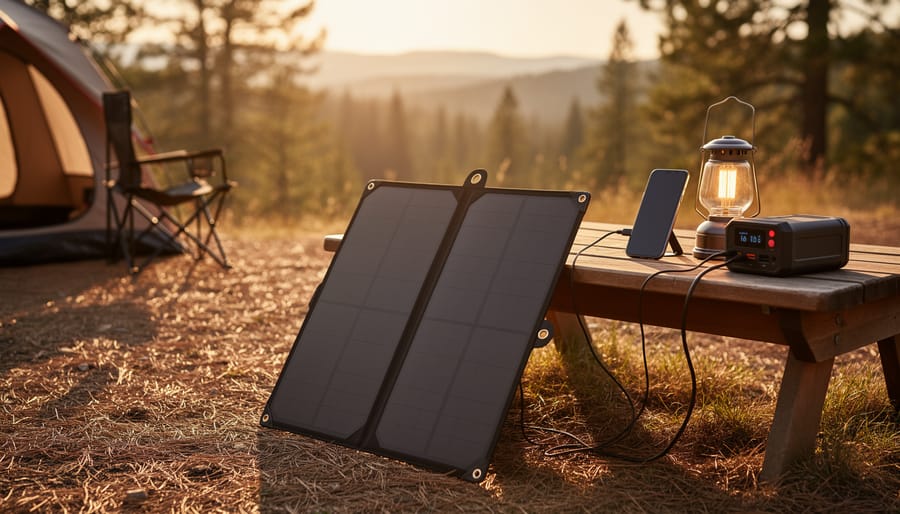
Solar powered camping gear transforms outdoor adventures by eliminating dependence on electrical grids and disposable batteries. When you venture into remote wilderness areas, traditional power sources become unavailable or impractical, but solar equipment harnesses abundant sunlight to keep essential devices running. This energy independence means you can charge navigation tools, communication devices, and safety equipment regardless of how far from civilization your journey takes you.
The environmental advantages extend beyond the immediate camping trip. Unlike fuel-powered generators that emit carbon dioxide and noise pollution, solar chargers and panels operate silently while producing zero emissions. Over repeated trips, this equipment prevents hundreds of disposable batteries from entering landfill streams. As photovoltaic technology matures, the manufacturing process has also improved, with initiatives like solar panel recycling ensuring end-of-life components return to the production cycle rather than becoming waste.
Cost savings accumulate faster than most campers expect. A quality portable solar panel system typically pays for itself within two years of regular weekend trips when compared to buying disposable batteries or running a gas generator. Recent advances in monocrystalline cell efficiency mean today’s compact panels deliver 20-22% conversion rates, substantially higher than the 12-15% common just five years ago. This efficiency improvement translates to lighter gear that charges devices faster, even in partially cloudy conditions.
Reliability in backcountry settings has improved dramatically as panel durability standards have tightened and battery storage technology has advanced. Modern solar camping equipment withstands temperature extremes, moisture, and physical impact that would destroy earlier generations of portable panels.
Essential Factors to Consider When Buying Solar Camping Equipment
Understanding Your Power Requirements
Before you buy any solar camping gear, calculate how much power you actually need. Start by listing every device you’ll charge during your trip: smartphone, tablet, camera, headlamp, GPS unit, portable speaker, or e-reader. Each has a battery capacity measured in milliamp-hours (mAh) or watt-hours (Wh).
Find the capacity on your device’s battery or specification sheet. A typical smartphone holds 3,000-4,000 mAh (roughly 11-15 Wh), a tablet 7,000-10,000 mAh (25-37 Wh), and a camera battery 1,000-2,000 mAh (7-14 Wh). GPS units and headlamps usually fall in the 1,000-3,000 mAh range (4-11 Wh).
Estimate how many times you’ll charge each device over your trip. On a three-day weekend, you might charge your phone twice, your headlamp once, and your camera battery once. Multiply each device’s capacity by the number of charges, then add them together. For the example above: (13 Wh × 2) + (10 Wh × 1) + (10 Wh × 1) = 46 Wh total.
Add 25-30 percent to account for charging inefficiency and cloudy weather. That 46 Wh becomes roughly 60 Wh of solar capacity you’ll need to generate. If your trip lasts three days and you get four hours of good sun daily, you need a panel producing at least 5 watts (60 Wh ÷ 12 sun-hours).
This calculation prevents over-buying heavy equipment or under-buying and running out of power mid-trip.
Panel Technology: Monocrystalline vs. Multi-Crystalline
Portable solar panels use one of two main silicon technologies: monocrystalline or multi-crystalline. Monocrystalline panels convert 18-24% of sunlight into electricity, making them the more efficient choice. They weigh less per watt of output, which matters when you’re carrying gear on your back. Multi-crystalline panels typically achieve 15-18% efficiency and cost less upfront, but you’ll need a larger surface area to generate the same power.
For camping, the efficiency gap translates to real differences. A 100-watt monocrystalline panel might measure 40×20 inches and weigh 4.5 pounds, while a multi-crystalline panel of the same output could be 10-15% larger and heavier. Mose Solar’s monocrystalline PERC technology pushes efficiency even higher, using passivated rear cells to capture light that standard panels would lose.
Choose monocrystalline for backpacking trips where every ounce counts, extended treks with limited sun exposure, or when you need maximum output from a compact panel. Multi-crystalline panels work well for car camping or base camps where weight isn’t critical and you want to reduce initial costs. Most serious backcountry users pay the premium for monocrystalline, the weight savings and faster charging justify the expense on multi-day trips.
Types of Solar Powered Camping Gear Compared
Portable Solar Panels and Chargers
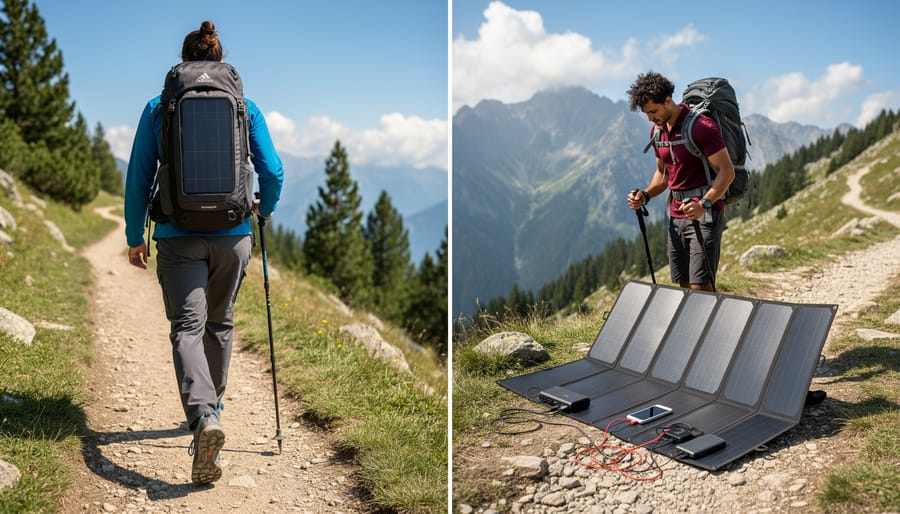
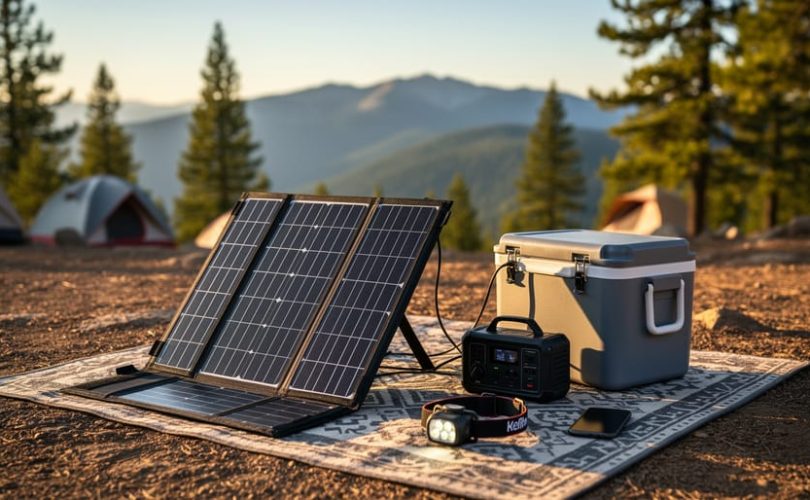
Portable solar panels designed for camping fall into three main formats, each balancing power output against portability. Foldable panels, typically ranging from 20 to 100 watts, offer the best compromise for most campers. They fold into compact briefcase-sized units, deploy in seconds, and include built-in kickstands to angle toward the sun. A 60-watt foldable panel can fully charge a laptop or power bank in four to six hours of direct sunlight.
Roll-up panels prioritize weight savings. These flexible units wrap around trekking poles or pack flat in backpack side pockets, making them ideal for backcountry trips where every ounce matters. Trade-off: they produce 10-15% less power per square foot than rigid panels and lack built-in stands, requiring creative positioning with rocks or cord.
Rigid portable panels deliver maximum efficiency (often 22-24% conversion rates with monocrystalline cells) but add bulk. Best suited for car camping or base camp setups where transport weight isn’t critical. Look for models with multiple USB ports and DC outputs to charge several devices simultaneously, essential when sharing gear among group members.
Setup considerations: all formats need unobstructed southern exposure (northern hemisphere) and clean panel surfaces. Dust and debris reduce output by 20-30%. Most quality units now include charge controllers to prevent device damage from voltage fluctuations during passing clouds.
Solar Power Stations and Battery Banks
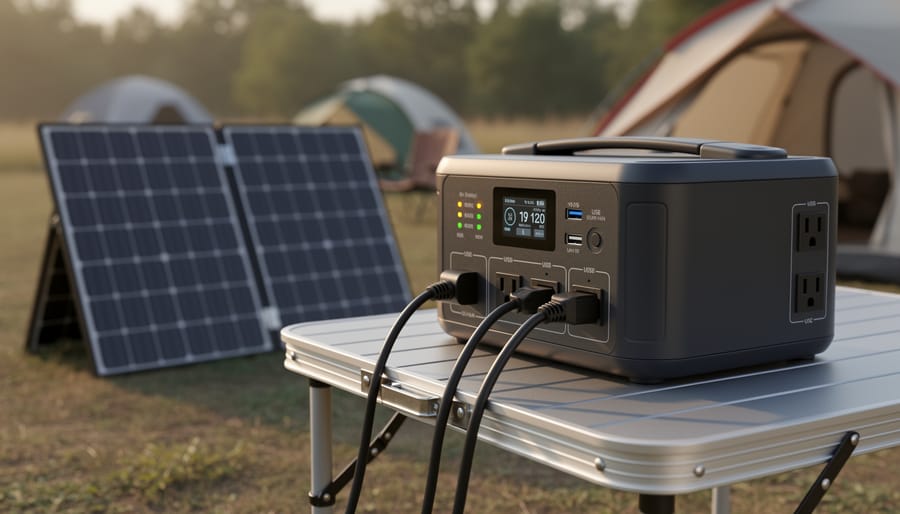
Solar power stations combine battery storage with solar charging capability, offering a more robust solution than panels alone. These integrated units store energy for use anytime, not just when the sun is out, making them ideal for extended camping trips or powering devices throughout the night.
Capacity typically ranges from 150Wh for lightweight backpacking models to 3000Wh+ for car camping and RV setups. A 500Wh unit can charge a phone 40 times or run a small camping fridge for several hours. Consider your daily consumption: add up the watt-hours needed for all devices, multiply by trip length, and add 30% buffer for cloudy conditions.
Output options matter significantly. Look for multiple USB ports (including USB-C Power Delivery for fast charging), AC outlets for standard plugs, and 12V car ports. Better units offer simultaneous charging, you can recharge the battery via solar while powering devices from stored energy.
The investment makes sense when you need reliable power beyond what direct solar charging provides: multi-day trips without full sun, running higher-wattage gear like laptops or medical devices, or car camping where weight isn’t critical. For weekend trips with minimal electronics, portable panels and a small power bank cost less and weigh considerably lighter. The trade-off is always portability versus capacity, a 1000Wh station weighs 20-30 pounds, manageable for vehicle-based camping but impractical for backpacking.
Solar Lighting and Accessories
Solar lanterns remain the workhorse of camping lighting, with modern LED units drawing 2-5 watts and running 8-12 hours on a full charge. Top-tier models include USB output ports, letting them double as power banks for phones in a pinch. Look for IP65 or higher waterproof ratings and collapsible designs that pack flat.
Solar headlamps suit hikers who need hands-free lighting without carrying spare batteries. Most integrate a small panel on the headband, though cloudy-day performance suffers; expect 6-8 hours of charging for 2-3 hours of runtime. Combo models with removable battery packs offer more flexibility.
String lights and accent lighting add minimal weight but significant comfort to base camps. Panel-integrated strings typically store enough charge for 4-6 hours of ambient lighting. Avoid models with non-replaceable batteries, they become landfill waste when cells degrade.
Specialty items like solar-powered camp showers and portable fans fill niche roles for car campers with space to spare. Evaluate these by power-to-weight ratio: a 200-gram solar fan that barely moves air wastes pack space, while a 1.5-liter solar shower heats water passively and folds to nothing.
Top Solar Camping Gear Recommendations by Use Case
Choosing the right solar camping gear depends entirely on your camping style, power needs, and mobility requirements. Here’s what to look for in each scenario.
Weekend Car Camping
For two- to three-day trips with vehicle access, prioritize convenience and capacity over weight. A 50-100W foldable solar panel paired with a power station offering 200-300Wh capacity handles phones, cameras, tablets, and portable speakers comfortably. Look for multiple USB ports (both USB-A and USB-C PD) plus AC outlets if you’ll run small appliances. Rigid panels mounted on your vehicle roof work well for base camp setups, while foldable units offer flexibility to reposition for optimal sun exposure throughout the day.
Backpacking Trips
Weight becomes critical when you’re carrying everything on your back. Seek ultra-light roll-up or foldable panels in the 10-20W range, weighing under one pound. These charge phones and GPS devices directly during the day or top up a compact 10,000-20,000mAh power bank overnight. Monocrystalline panels deliver better efficiency per ounce, crucial when every gram counts. Skip integrated battery systems; carry a separate lightweight power bank instead to maintain flexibility. For multi-day treks, calculate whether solar charging matches your consumption or if you need supplemental battery capacity.
Extended Off-Grid Adventures
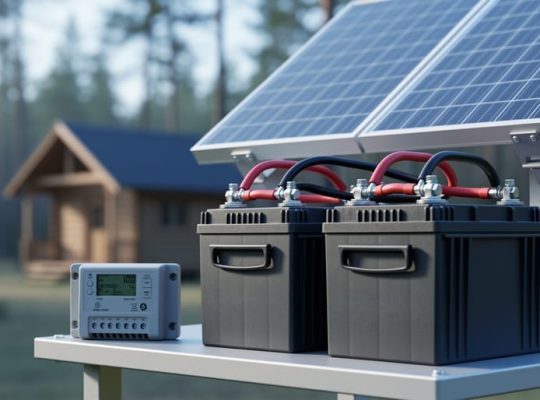
Week-long or longer expeditions require robust, high-capacity systems. Consider 100-200W panel arrays with 500-1000Wh power stations that support simultaneous charging and discharging. Features like MPPT charge controllers maximize efficiency in variable conditions. Ensure IP65 or higher weather resistance ratings and reinforced corners on panels. Some campers combine solar panels with solar camping cooling solutions for hot-weather comfort without draining batteries. Prioritize systems with replaceable components rather than sealed units.
RV and Van Camping
Permanent roof-mounted installations work best for mobile living, typically 200-400W configurations with dedicated charge controllers feeding house batteries. Look for panels rated for vibration resistance and secure mounting hardware. Portable supplemental panels (50-100W) add flexibility when parked in partial shade, allowing you to chase sunlight while the vehicle stays put. Ensure compatibility between your existing electrical system voltage (12V, 24V, or 48V) and any solar additions.
Emergency Preparedness
Reliability and simplicity matter most for backup power. Choose all-in-one power stations with integrated solar inputs, 300-500Wh capacity, and built-in LED lights. Store a 60-100W foldable panel that deploys quickly without tools. Prioritize units with pass-through charging, letting you power devices while the battery recharges simultaneously, and look for low-temperature operation ratings if you live in cold climates.
Common Mistakes to Avoid When Purchasing Solar Camping Equipment
Most buyers commit preventable errors that compromise their solar camping setup’s effectiveness and value. Learning from these missteps helps you select equipment that actually delivers reliable power when you need it most.
The biggest pitfall is underestimating power requirements. Many campers eyeball their needs instead of calculating them. If you plan to charge two smartphones (10Wh each), a tablet (30Wh), and run LED lights (5Wh for 4 hours), you need roughly 70Wh daily, yet many purchase a 50Wh power bank and wonder why it runs dry. Add a 30-40% buffer for inefficiencies and cloudy conditions to avoid frustration in the field.
Price-driven decisions frequently backfire. A $40 panel with 14% efficiency may cost less upfront than a 22% monocrystalline option, but you’ll spend hours waiting for adequate charge and may not get usable power on partly cloudy days. The cheaper unit often weighs more for equivalent output, undermining portability. Calculate the cost per usable watt over the product’s lifespan, not just the initial receipt.
- Underestimating power needs, leads to dead devices and reliance on battery reserves that drain quickly
- Ignoring weather resistance ratings, an IP65-rated panel survives rain; an unrated one may short-circuit
- Choosing solely on price, low-cost panels often use outdated polycrystalline cells with 12-15% efficiency vs. modern PERC technology at 20%+
- Neglecting device compatibility, USB-A-only chargers can’t fast-charge newer USB-C phones without adapters that add weight and failure points
- Overlooking weight for backpacking, a robust 25W rigid panel weighing 3 pounds becomes a burden on a 5-day trek vs. a 1-pound foldable alternative
- Buying outdated panel technology, multi-crystalline panels produce 20-30% less power per square inch than current monocrystalline options
- Failing to account for real-world charging time, lab ratings assume perfect sun angle and clear skies; actual field charging takes 40-60% longer
Compatibility issues create genuine headaches. Check that your solar charger’s output voltage and connector types match your devices. A 5V USB output won’t charge a 12V portable fridge, and many newer laptops require 20V USB-C Power Delivery that standard solar panels don’t provide.
Backpackers routinely choose gear based on car camping criteria, then regret carrying a 4-pound solar panel on a multi-day hike. Weight matters exponentially when you’re covering miles. For trips where every ounce counts, prioritize watt-per-pound ratios over absolute power output. A flexible 15W panel at 12 ounces often serves backpackers better than a rigid 25W unit at 3 pounds.
Neglecting cloudy-day performance ranks among the costliest oversights. Panels lose 50-80% output under overcast skies. If you’re camping in regions prone to afternoon clouds or during shoulder seasons, size your system assuming reduced daily production. A 40Wh daily need might require 80-100Wh of panel capacity to reliably meet it across varying conditions.
Understanding Solar Panel Efficiency and Real-World Performance
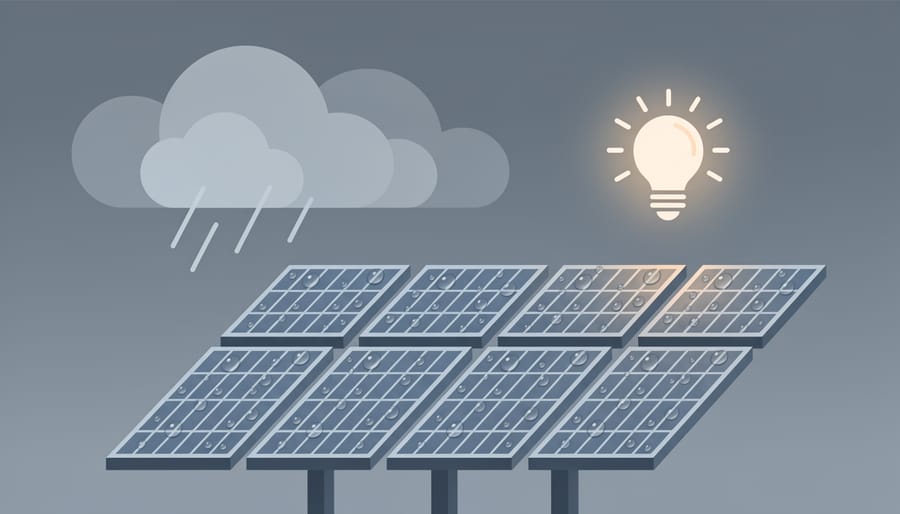
Laboratory efficiency ratings provide a useful baseline, but camping conditions rarely mirror the controlled environments where panels are tested. A panel rated at 22% efficiency in the lab might deliver 15-18% in the field, and understanding why helps you set realistic expectations and choose equipment that performs when it matters.
Sun angle makes the biggest difference. Panels generate maximum power when sunlight hits them at a perpendicular angle, which happens only briefly each day unless you manually adjust orientation. A panel tilted at 30 degrees in the morning might produce half the output it delivers at solar noon. In practical camping terms, this means a “20-watt” panel might deliver 12 watts in early morning or late afternoon, affecting how you plan charging windows.
Temperature works against efficiency. Most crystalline silicon panels lose about 0.4% output for every degree Celsius above 25°C. On a hot summer day when your panel reaches 60°C, you’re looking at a 14% performance drop from heat alone, something laboratory ratings don’t reflect. This matters because panels sitting in direct sun on a dark tent or vehicle surface can exceed ambient temperature by 20-30 degrees.
Shade is unforgiving. Even partial shading across a small section can disproportionately reduce total output because of how cells are wired in series. A leaf shadow covering 10% of a panel might cut production by 40% or more. Positioning matters enormously in camp: clear southern exposure (in the Northern Hemisphere) throughout the day beats convenience every time.
Weather conditions beyond cloud cover affect performance too. Morning dew or dust buildup scatters incoming light, reducing efficiency until you wipe the surface. Humidity and haze diffuse sunlight, cutting output by 5-15% even on ostensibly clear days.
Mose Solar’s mono PERC panels and similar advanced technologies improve real-world yield by capturing a broader spectrum of available light and maintaining efficiency at elevated temperatures better than older multi-crystalline designs. The factors behind PV efficiency involve cell architecture that reduces electron recombination, meaning these panels extract more useful power from the same sunlight hitting your campsite.
Expect charging times to run 30-50% longer than manufacturer estimates suggest. A power bank advertised as “charges in four hours” might need six hours of good sun, or spread across two partial days. Plan accordingly, and remember that proper disposal of battery and panel waste becomes important as you eventually replace aging equipment.
Frequently Asked Questions About Solar Powered Camping Gear
Can solar camping gear charge in cloudy weather?
Yes, but at significantly reduced efficiency, typically 10-25% of full-sun output depending on cloud density. Expect charging times to increase three to five times compared to clear conditions, so plan extra charging windows during overcast periods.
How long does it take to fully charge a smartphone with portable solar panels?
A 20-watt panel in direct sunlight charges most smartphones in 2-3 hours, while a 10-watt unit needs 4-6 hours. Actual times vary based on battery capacity, panel efficiency, sun angle, and whether you’re using the phone simultaneously.
Are portable solar panels waterproof?
Most quality camping solar panels carry IP65 or IP67 ratings, meaning they resist rain and splashes but shouldn’t be submerged. Check specifications carefully, “water-resistant” differs from “waterproof,” and connection ports often require protective covers when wet.
What’s the typical lifespan of solar camping equipment?
Quality portable solar panels last 10-15 years with proper care, though efficiency gradually decreases by roughly 0.5% annually. Battery banks typically need replacement after 500-1000 charge cycles (3-5 years of regular use), while solar lights often last 2-4 years before LED or battery degradation becomes noticeable.
Do I need a battery bank or can I charge devices directly from panels?
Direct charging works when the sun is strong and you’re present to monitor devices, but a battery bank provides crucial flexibility, it stores energy for evening use, maintains steady voltage output, and lets you charge during optimal sun hours for use anytime.
Can I charge multiple devices at once with solar camping gear?
Yes, if your setup has multiple USB ports or outputs and sufficient wattage. Add the power draw of all connected devices, if the total exceeds your panel or battery bank’s rated output, charging slows considerably or stops entirely.
How should I maintain solar powered camping gear?
Clean panels with a soft cloth and water after dusty trips, store equipment in dry conditions away from extreme temperatures, and keep connection ports covered when not in use. Avoid folding panels with excessive force and recharge battery banks every 3-4 months during storage to prevent deep discharge damage.
Beyond these common queries, consider your specific camping environment when evaluating solar gear capabilities. High-altitude locations receive more intense sunlight and charge faster, while dense forest canopy dramatically reduces panel effectiveness regardless of equipment quality. Similarly, winter camping poses dual challenges: shorter daylight hours and cold temperatures that slow chemical reactions in lithium batteries, reducing both charge acceptance and discharge capacity.
If you’re transitioning from traditional battery-powered camping setups, start with a modest solar charger rather than immediately investing in a complete power station. This lets you learn solar charging patterns in your typical camping locations before committing to larger, more expensive integrated systems that might not match your actual usage.
The Future of Solar-Powered Outdoor Recreation
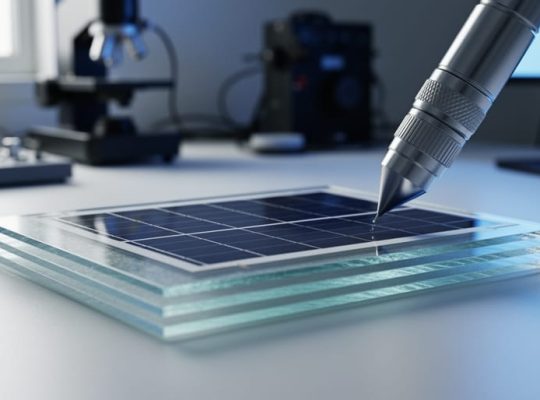
The next wave of portable photovoltaic technology promises to make solar camping gear lighter, more efficient, and seamlessly integrated into outdoor equipment. Researchers are developing tandem solar cells that layer multiple semiconductor materials to capture different wavelengths of light, potentially pushing portable panel efficiency beyond 30 percent, a substantial leap from today’s typical 20-23 percent monocrystalline panels. These advances translate directly to smaller, lighter panels that generate the same power, critical for backpackers counting every ounce.
Flexible solar film technology is evolving rapidly, enabling panels that roll up tighter or integrate into tent fabrics, backpack surfaces, and jacket shoulders without adding rigid bulk. Combined with ultra-thin lithium batteries, future solar camping systems could weigh half what current equipment does while delivering comparable capacity. Smart integration is another frontier: panels that communicate with your devices to optimize charging rates, battery banks that report remaining capacity to your phone, and systems that automatically adjust output based on cloud cover and device needs.
Educational initiatives play a crucial role in accelerating these innovations. University collaboration programs, including Mose Solar’s partnerships with research institutions, connect academic photovoltaic advances with real-world consumer applications. Students and researchers testing new materials and cell architectures in laboratory settings help identify which technologies can withstand outdoor conditions and scale to affordable production. This pipeline from campus to campsite ensures that breakthrough efficiency gains and novel panel designs reach outdoor enthusiasts within years rather than decades, steadily expanding what’s possible for off-grid power in remote locations.
Choosing the right solar powered camping gear comes down to understanding your actual power needs and matching equipment to your camping style. Before you buy, calculate your daily energy consumption based on the devices you’ll charge and your trip duration. This prevents both underpowering your setup and carrying unnecessary weight or capacity into the backcountry.
The most common mistake is selecting solar camping equipment based on specifications alone without considering real-world conditions. Panel efficiency, battery storage, weather resistance, and charging speed all matter, but only in the context of how you’ll actually use the gear. A weekend car camper has vastly different requirements than a long-distance backpacker or someone outfitting an RV.
As photovoltaic technology advances, solar powered camping gear continues to become lighter, more efficient, and more affordable. The same innovations driving utility-scale solar adoption, from improved panel designs to better energy education programs, are making portable solar more practical for outdoor recreation. Today’s equipment delivers reliable off-grid power that was difficult to achieve just a few years ago.
Start with your power requirements, choose equipment that matches your specific camping scenarios, and invest in quality gear that will perform across multiple seasons. Solar camping gear represents genuine freedom from traditional power sources when you select the right tools for your adventures.