
The federal solar Investment Tax Credit (ITC) currently offers a 30% tax credit on the total cost of solar photovoltaic system installations for residential and commercial properties, a benefit that remains in effect through the end of 2032 before beginning a scheduled stepdown. This credit applies to the full system cost, including equipment, labor, permitting, and related installation expenses, making it one of the most significant financial incentives driving solar adoption across the United States.
Understanding how this tax credit works is essential for anyone planning a solar investment in 2026. The credit directly reduces federal tax liability dollar-for-dollar, meaning a qualifying installation can generate substantial tax savings in the year the system becomes operational. Unlike a deduction that simply reduces taxable income, this credit offers full-value offset against what you owe the IRS.
Recent legislative and regulatory developments have refined how the credit applies to different installation types, ownership structures, and energy storage additions. Battery systems paired with solar installations can now qualify for the full credit percentage when charged primarily by the solar array, expanding the financial benefits beyond panels alone. These clarifications matter for project planning, financing decisions, and return-on-investment calculations.
For photovoltaic professionals, renewable energy enthusiasts, and environmentally conscious consumers, staying current on ITC provisions shapes everything from system design choices to installation timing. Academic researchers and industry stakeholders monitoring solar market trends recognize the credit as a fundamental driver of deployment patterns and technological innovation. The policy landscape continues to evolve, with implementation guidance from federal agencies affecting how different project types qualify and claim the benefit.
What Changed: Recent Developments in the Federal Solar ITC
The federal solar Investment Tax Credit maintains its 30% level through the end of 2032 under the framework established by the Inflation Reduction Act of 2022. This legislation extended and enhanced the previous ITC structure, providing a clear timeline for solar investments across residential, commercial, and utility-scale projects. The credit applies to the total cost of qualifying solar energy systems, including equipment, labor, and certain associated installation expenses.
The IRS has issued guidance clarifying several application aspects since the credit’s extension. Treasury Department regulations specify how the “beginning of construction” test applies for projects with extended development timelines, particularly relevant for large-scale installations. Developers can establish their qualification date either through physical work on-site or by meeting safe harbor requirements through equipment purchases representing at least five percent of total project costs.
Recent regulatory clarifications address how the credit interacts with bonus adders available for projects meeting domestic content requirements or prevailing wage and apprenticeship standards. Commercial and utility-scale projects can access higher credit percentages when meeting these criteria, though residential installations remain at the base 30% level regardless of these factors.
The framework also established step-down provisions beginning in 2033, when the residential credit drops to 26% and commercial credits begin phasing toward zero unless projects serve qualifying low-income communities or meet other extension criteria. This timeline creates planning urgency for stakeholders evaluating solar investments with development periods extending into the latter part of this decade.
Key Developments Shaping Solar Investment in 2026
1. Commercial and Utility-Scale Project Acceleration
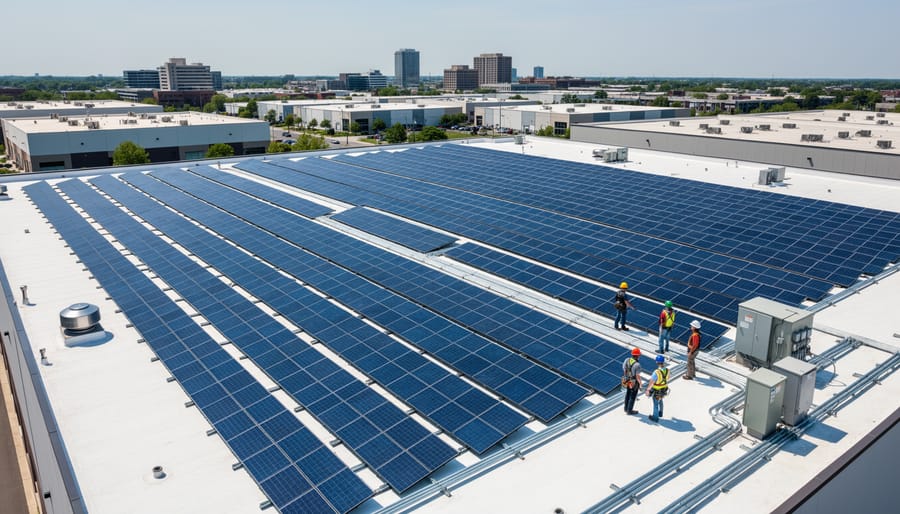
The 30% federal ITC fundamentally reshapes the economics of commercial and utility-scale solar projects by reducing upfront capital requirements and improving project returns for institutional investors. Large solar installations typically require significant financing coordination among equity investors, tax equity partners, and debt providers, each evaluating how the credit affects their position in the capital stack.
For project developers, the credit directly improves project internal rates of return and enables more competitive power purchase agreement pricing. Tax equity investors, who monetize the credit by providing capital in exchange for tax benefits, remain essential partners in most large-scale projects. The credit’s structure influences decisions about project timing, ownership structures, and whether to pursue direct pay options where available.
The current 30% credit level creates a solar investment turning point for utility-scale developers weighing project pipelines against future credit step-downs. Developers balance immediate development against construction timelines, interconnection queue positions, and equipment procurement lead times. Community solar projects and commercial rooftop installations face similar financing considerations, though at different scales and with varying stakeholder complexities.
The credit also influences technology choices, as developers evaluate whether higher-efficiency panels justify premium costs when calculating total eligible project expenses for credit purposes.
2. Residential Solar Adoption Patterns

The 30% federal solar investment tax credit serves as a powerful catalyst in residential solar decisions, transforming systems that might otherwise remain financially marginal into compelling investments for homeowners across diverse income brackets and property types. Rather than viewing the credit as a simple discount, prospective solar adopters typically integrate it into comprehensive financing strategies that align upfront costs with long-term energy savings and property value considerations.
The credit’s influence extends across multiple financing pathways that homeowners commonly evaluate:
- Cash purchases where the credit reduces effective system cost through tax liability offset
- Solar loans structured with monthly payments that factor in anticipated credit recovery
- Lease arrangements where third-party owners claim the credit and pass savings through reduced lease rates
- Power purchase agreements (PPAs) where credit benefits influence per-kilowatt-hour pricing structures
Each approach carries distinct implications for how quickly homeowners realize the credit’s value and how it interacts with other financial considerations like mortgage interest deductions or home equity positions.
Decision timing often hinges on the credit’s scheduled phase-down trajectory rather than immediate energy costs alone. Homeowners weighing solar adoption typically balance the certainty of current credit levels against anticipated technology cost reductions and evolving efficiency standards, creating planning windows that extend beyond simple payback calculations. Installers and financing providers increasingly frame proposals around these temporal considerations, helping homeowners understand not just whether solar makes economic sense, but when entry timing optimizes the combined effect of technology value and policy incentives.
3. Technology and Manufacturing Investment Incentives
The 30% ITC extends beyond installation projects to influence manufacturing investment decisions across the solar supply chain. When combined with domestic content requirements and manufacturing tax credits established through recent industrial policy legislation, the ITC creates layered incentives that reward developers who source components from American solar manufacturing facilities. This policy structure encourages capital deployment in U.S.-based production of advanced photovoltaic technologies.
Manufacturers developing next-generation products, including mono PERC cells, bifacial modules, and building-integrated photovoltaics like solar tiles, benefit from increased market demand driven by the ITC while navigating complex supply chain decisions. The credit lowers the cost barrier for adopting newer technologies in commercial and residential projects, creating market pull that justifies manufacturing investment in advanced production lines.
For organizations like Mose Solar engaged in technology development and educational collaboration, these intersecting incentives shape research priorities and workforce training programs. As manufacturers expand domestic capacity to meet ITC-driven demand, they require engineers and technicians trained in advanced PV technologies and manufacturing processes. This connection between tax policy, industrial investment, and workforce development underscores why aspiring photovoltaic professionals need to understand both the technical and policy dimensions of the industry they’re entering.
4. Educational and Workforce Development Implications

The sustained solar investment enabled by the 30% ITC drives growing demand for qualified photovoltaic professionals across installation, design, project management, and system maintenance roles. As developers launch more residential and commercial projects to capitalize on the current credit rate, the industry faces workforce gaps that threaten project timelines and quality standards. Mose Solar addresses this challenge through university-collaboration educational programs that prepare aspiring professionals with both technical photovoltaic knowledge and practical installation experience. These partnerships connect academic curricula to real-world solar deployment needs, ensuring graduates understand not only panel technology and electrical systems but also the financing structures, including tax credit applications, that make projects viable. For individuals considering renewable energy careers, the ITC-driven expansion creates entry opportunities in a field combining environmental impact with professional growth potential.
Why the 30% ITC Matters for Solar Stakeholders
The 30% federal ITC shapes solar economics across every market segment, making previously marginal projects financially viable and accelerating deployment timelines throughout the industry.
For project developers and community solar developers the credit directly affects project finance structures and investor returns. Large-scale installations carry substantial upfront costs, and the 30% credit can represent the difference between securing financing and shelving a project. Developers structure deals around tax equity partnerships specifically to monetize these credits, with the credit percentage influencing leverage ratios and return calculations throughout the capital stack.
Investors and financial institutions view the ITC as a de-risking mechanism that improves project economics and shortens payback periods. The credit’s current level supports diverse financing products, from power purchase agreements to community solar subscriptions, making solar accessible to customers who cannot install systems on their own properties.
For installation companies and EPC contractors, a robust ITC drives project pipelines and supports workforce expansion. Higher credit percentages generate more customer demand, which translates directly into installation volume and employment opportunities across the supply chain.
Residential and commercial consumers benefit from improved system economics that lower effective installation costs and accelerate energy savings timelines. The credit makes solar competitive with grid electricity in more markets, expanding geographic viability beyond the sunniest regions.
For aspiring PV professionals, sustained tax credit support creates career stability and growth opportunities. Industry expansion driven by favorable economics requires trained technicians, project managers, and engineers, roles that Mose Solar’s university-collaboration programs help prepare candidates to fill as the sector continues scaling deployment nationwide.
What to Watch: Upcoming Changes and Considerations
The solar investment tax credit landscape includes several known transition points that stakeholders should monitor as they plan projects and investments. Understanding these scheduled changes helps developers, installers, and consumers make informed timing decisions that maximize available incentives.
Current legislation establishes a step-down structure where the 30% credit rate for residential installations is scheduled to decrease to 26% in 2033 and further to 22% in 2034, absent congressional action to extend the higher rate. Commercial projects face a different timeline, with the credit transitioning to a permanent 10% rate for projects that don’t meet specific labor and domestic content requirements. These thresholds create planning windows where project economics shift significantly based on when equipment is installed and placed in service.
Market participants should track regulatory guidance updates from the Treasury Department and IRS regarding credit eligibility criteria, particularly as they relate to energy storage additions, prevailing wage requirements, and domestic manufacturing bonus calculations. The interaction between federal incentives and evolving state-level programs creates a complex optimization landscape where timing decisions affect total project returns.
Technology advancement through digital innovation in system design, monitoring, and financing tools continues to improve how stakeholders evaluate credit benefits across different project configurations. Installation firms and finance providers increasingly use sophisticated modeling to compare scenarios where projects capture current rates versus those potentially affected by future step-downs.
Workforce development remains a consideration as expanded solar deployment creates sustained demand for trained PV professionals regardless of specific credit percentages. The fundamental economics supporting solar investment extend beyond single policy provisions, though understanding the credit timeline helps aspiring professionals identify when market activity may accelerate around transition dates.
Frequently Asked Questions About the Solar ITC
The federal solar investment tax credit applies to both residential and commercial installations, but the process and requirements differ significantly between applications. Understanding these distinctions helps stakeholders navigate the claiming process effectively.
Who qualifies for the solar ITC?
The credit is available to any taxpayer who installs solar energy equipment on property they own in the United States, including homeowners, businesses, agricultural operations, and tax-exempt entities through direct pay provisions. The system must generate electricity for use at the installation site.
How do I claim the solar tax credit?
Homeowners claim the credit on IRS Form 5695 when filing their federal tax return, while commercial and utility-scale projects use Form 3468. The credit reduces tax liability dollar-for-dollar and can be carried forward to future tax years if it exceeds current liability.
What expenses qualify for the credit?
Eligible costs include solar panels, inverters, mounting equipment, wiring, energy storage systems installed with the solar array, and installation labor. Expenses must be directly related to the functioning solar energy system to qualify.
Can I combine the federal ITC with state incentives?
Yes, the federal credit can generally be stacked with state and local incentives, though how those incentives affect the cost basis for calculating the federal credit varies by program structure. Consult with a tax professional to understand specific interactions in your jurisdiction.
Documentation requirements differ between residential and commercial applications. Homeowners typically need receipts, proof of payment, and manufacturer certifications showing equipment meets applicable standards. Commercial projects face more extensive reporting requirements, including detailed cost breakdowns, project timelines, and compliance documentation.
The credit applies to both owned and financed systems, though leased or power-purchase-agreement systems transfer the tax benefit to the equipment owner rather than the property owner. This distinction matters significantly when evaluating different financing structures.
For aspiring PV professionals, understanding these application nuances is increasingly valuable as the industry grows. Mose Solar’s educational programs incorporate practical knowledge of incentive structures alongside technical training, preparing graduates to advise clients effectively on maximizing available benefits while ensuring compliance with federal requirements.
The 30% federal solar investment tax credit remains a cornerstone of solar financing and investment strategy in 2026, influencing decisions across residential installations, commercial projects, and utility-scale developments. Its role extends beyond immediate cost reduction, the credit shapes project timelines, financing structures, and technology adoption patterns throughout the photovoltaic industry.
For stakeholders navigating solar investments this year, staying current on policy timelines and regulatory guidance is essential. The credit’s scheduled adjustments create planning imperatives for developers, investors, and property owners alike. Understanding how the ITC interacts with state incentives, financing mechanisms, and project eligibility requirements can mean the difference between a viable investment and a missed opportunity.
The expansion of solar investment driven by the ITC also creates significant demand for qualified professionals who understand both the technical and policy dimensions of photovoltaic systems. Mose Solar addresses this workforce need through university-collaboration educational programs that prepare aspiring PV professionals for careers in installation, system design, project management, and solar finance.
Whether you’re evaluating a solar investment, developing project pipelines, or considering a career transition into renewable energy, the 30% ITC’s influence on the industry underscores the value of informed decision-making and professional expertise in capturing the opportunities this policy creates.