Quantum computing’s environmental impact is neither categorically good nor bad. It represents a complex trade-off between significant energy consumption during operation and cooling against potentially transformative benefits for optimizing renewable energy systems, including solar power generation and grid management.
The question matters urgently for photovoltaic professionals because quantum systems capable of revolutionizing solar forecasting and materials discovery currently require extreme cooling to near absolute zero, consuming substantial electricity and relying on rare helium-3 isotopes. A single quantum computer facility can draw megawatts of power continuously. Yet these same machines promise to solve optimization problems in minutes that would take classical supercomputers millennia, potentially accelerating breakthroughs in solar cell efficiency, energy storage chemistry, and smart grid operations that could offset their operational footprint many times over.
This creates a genuine dilemma for the renewable energy sector in 2026. Should the industry embrace quantum computing tools for analyzing vast photovoltaic datasets and simulating new materials, despite their current environmental costs? The answer depends on understanding what quantum computing actually consumes, how that compares to classical computing alternatives, and whether specific applications in solar energy justify the resource investment.
This article breaks down the environmental costs of quantum computing across energy use, cooling requirements, and material sourcing, then examines concrete applications in photovoltaic system optimization where quantum advantages might warrant those costs. Through collaboration with university research programs studying both quantum algorithms and renewable energy systems, we provide aspiring solar professionals with the framework to evaluate quantum computing solutions critically, weighing genuine environmental trade-offs rather than accepting simplified narratives about emerging technology.
What Quantum Computing Means for Environmental Impact
Quantum computing’s environmental footprint refers to the total resource consumption and emissions generated throughout the lifecycle of quantum computing systems, from manufacturing through operation to disposal. Unlike classical computers that use binary bits, quantum computers manipulate qubits, quantum bits that exist in multiple states simultaneously, enabling them to solve certain complex problems exponentially faster. However, this computational power comes at a steep environmental price that differs fundamentally from traditional computing infrastructure.
The most significant environmental consideration is the extreme cooling requirement. Quantum computers need temperatures approaching absolute zero (around -273°C or -459°F) to maintain qubit stability and prevent decoherence, where quantum states collapse from environmental interference. Achieving these temperatures requires specialized dilution refrigerators that consume enormous amounts of electricity continuously, far exceeding the cooling needs of conventional data centers. A single quantum processor might draw as much power as several hundred standard desktop computers while performing calculations that would take classical machines years to complete.
Beyond cooling, quantum systems require sophisticated infrastructure built from rare materials and precision-engineered components. The manufacturing process itself carries substantial embodied carbon, and the facilities housing quantum computers need vibration isolation, electromagnetic shielding, and redundant power systems. To understand quantum computing’s environmental trade-off, we need to grasp several key concepts:
- Qubit Stability
- The ability of quantum bits to maintain their quantum state long enough to perform calculations. Instability requires ultra-low temperatures and intensive energy input to preserve.
- Cryogenic Cooling
- The process of maintaining near-absolute-zero temperatures using dilution refrigerators. This continuous cooling accounts for the majority of a quantum computer’s operational energy consumption.
- Quantum Advantage Threshold
- The point at which a quantum computer can solve a specific problem faster or more efficiently than the best classical supercomputer, making the energy investment potentially worthwhile.
- Energy Efficiency Ratio
- The computational output achieved per unit of energy consumed. Quantum systems currently have poor ratios for most tasks but excel dramatically for certain specialized problems.
- Carbon Intensity
- The amount of carbon dioxide emissions generated per unit of energy consumed, determined by the power source feeding the quantum facility.
The environmental impact equation becomes meaningful only when we compare the resources quantum computing consumes against the computational value it delivers. For problems where quantum computers offer no speed advantage, their environmental cost is indefensible. For optimization challenges that classical computers struggle with, like analyzing massive solar array datasets or simulating new materials, the calculation shifts. The framework for evaluation must weigh both immediate energy draw and potential long-term environmental benefits through better solutions.
How Quantum Computing Infrastructure Works and Why It Matters
Energy Requirements and Cooling Systems

Quantum computers demand energy-intensive infrastructure that dwarfs conventional computing requirements. At their core, most quantum systems rely on superconducting qubits, quantum bits that function only at temperatures approaching absolute zero. Specifically, these systems operate at roughly 15 millikelvin, about one hundred times colder than outer space. Achieving and maintaining such extreme cold requires specialized equipment called dilution refrigerators, complex cooling towers that consume substantial power around the clock.
The energy profile of a dilution refrigerator illustrates why quantum computing carries such environmental weight. These units draw between 15 and 25 kilowatts continuously, primarily to pump helium isotopes through multiple cooling stages. A single quantum processor might need three to four months just to cool down to operating temperature, during which power flows constantly. Once operational, the dilution refrigerators reach near absolute zero temperatures but never stop consuming energy, even brief warmup periods can take weeks and waste the cooling investment.
Compare this to a classical data center rack serving similar computational square footage. A standard server rack draws 5 to 15 kilowatts, roughly comparable at first glance, but the quantum system delivers far fewer operations per watt in its current state. Classical processors can throttle down during idle periods and operate at room temperature with conventional HVAC. Quantum systems offer no such flexibility; their thermodynamic requirements remain constant regardless of workload.
Beyond refrigeration, quantum facilities need vibration isolation, electromagnetic shielding, and backup power systems, each adding to baseline consumption. The infrastructure supporting a 50-qubit quantum computer can easily match the energy footprint of several hundred conventional servers, before performing a single calculation.
Infrastructure and Manufacturing Footprint

The environmental footprint of quantum computing extends far beyond the electricity meter. Before a single qubit processes data, significant carbon has already been embedded in the physical infrastructure and specialized components that make quantum computing possible.
Manufacturing quantum processors requires materials that are both rare and energy-intensive to produce. Superconducting qubits, currently the most common approach, rely on niobium, a metal found in limited global deposits that requires high-temperature processing to refine. The semiconductor fabrication process itself takes place in ultra-clean facilities comparable to those producing advanced microchips, consuming substantial energy to maintain particle-free environments. Dilution refrigerators, the heart of quantum cooling systems, contain exotic isotopes like helium-3, which is scarce and primarily produced as a byproduct of nuclear weapons programs. A single dilution refrigerator can cost upwards of $1 million and requires precision-engineered components made from specialized alloys.
The construction of quantum computing facilities adds another layer of environmental impact. These buildings must house vibration-isolation systems, electromagnetic shielding, and redundant power supplies, all of which demand materials and energy during both construction and operation. A dedicated quantum research center typically requires reinforced flooring to support heavy refrigeration equipment, specialized HVAC systems to manage waste heat, and backup infrastructure to prevent quantum state collapse during power fluctuations.
The full lifecycle picture includes several compounding factors:
- Extraction and processing of specialized materials like niobium, sapphire substrates, and rare-earth elements
- Cleanroom facility construction and continuous operation with strict environmental controls
- Refrigeration system components containing helium isotopes and precision cryogenic engineering
- Electronic waste from decommissioned quantum chips and rapid technological obsolescence
- Limited facility lifespan as quantum technology evolves faster than traditional data centers
This embodied carbon creates a debt that quantum systems must repay through computational benefits. For solar PV professionals evaluating quantum solutions, understanding these upfront environmental costs helps frame realistic expectations about when and whether quantum computing delivers net environmental value. A quantum processor optimizing solar arrays needs to generate efficiency improvements substantial enough to offset not just its operating energy, but also the carbon locked into its creation and the facility housing it.
Categories of Environmental Impact from Quantum Computing
Direct Energy Consumption and Emissions
A single quantum computer operating at scale consumes between 10 and 25 kilowatts continuously, with most of that energy devoted to maintaining dilution refrigerators at 15 millikelvin. Over a year, one quantum system draws roughly 87,600 to 219,000 kilowatt-hours, comparable to powering eight to twenty average American homes. When sourced from fossil-fuel grids, this translates to approximately 40 to 100 metric tons of CO₂ annually per machine, depending on regional energy mix.
The emissions calculation becomes more complex when comparing workload-for-workload performance. For tasks quantum computers excel at, such as processing solar IoT data from thousands of panels simultaneously or running optimization algorithms for DERMS platforms classical supercomputers would require exponentially more energy and time. A quantum processor solving certain molecular simulations in hours might save the carbon footprint of weeks on traditional hardware.
However, for routine solar PV optimization tasks that classical systems handle efficiently, quantum computing introduces unnecessary emissions. The environmental case hinges on problem selection: quantum machines running digital twins for next-generation materials discovery may justify their footprint, while using them for standard analytics would not. Current projections suggest a tenfold increase in quantum installations by 2030, potentially adding 400,000 metric tons of annual CO₂ if powered conventionally, roughly equivalent to 86,000 gasoline vehicles.
Indirect Benefits Through Problem-Solving
While quantum computers consume substantial energy in operation, their ability to solve previously intractable problems could deliver environmental gains that dwarf their own carbon footprint. The critical question isn’t just what quantum systems use, but what they enable.
Energy grid optimization represents the most immediate payoff. Classical computers struggle with the millions of variables in modern power grids, predicting demand, balancing intermittent renewable sources, routing storage capacity. Quantum algorithms can process these complex optimization problems in hours rather than weeks, potentially reducing grid waste by 15-20% according to early modeling. For a regional grid serving two million homes, that translates to preventing thousands of tons of CO₂ annually, far exceeding the emissions from running the quantum facility itself.
Materials discovery offers even larger potential returns. Developing new battery chemistries, more efficient solar absorbers, or carbon capture catalysts currently requires years of trial-and-error experimentation. Quantum simulations can model molecular behavior at the atomic level, compressing decades of lab work into computational sprints. Researchers pursuing quantum solar cells with conversion efficiencies above 40% rely on quantum computing to predict material properties before synthesizing expensive prototypes. A single breakthrough material, silicon alternatives, next-generation perovskites, improved tandem structures, could prevent gigatons of emissions as it scales globally.
Climate modeling provides the third major benefit. Current supercomputers can’t fully resolve cloud formation, ocean circulation, and atmospheric chemistry at scales needed for accurate regional projections. Quantum processors excel at these multi-variable simulations, helping policymakers and engineers design more effective adaptation strategies and target mitigation efforts where they matter most.
The environmental case for quantum computing hinges on deployment speed and application focus. If quantum resources primarily accelerate clean energy breakthroughs and climate solutions, the net impact tilts strongly positive within a decade.
Quantum Computing Applications in Solar PV Data Analysis
Performance Optimization and Grid Integration
Quantum computers excel at handling the kind of complex optimization problems that plague solar PV systems at scale. A single large solar farm generates terabytes of performance data daily, panel voltage curves, temperature readings, shading patterns, inverter efficiency metrics, creating computational challenges that classical systems struggle to process in real time. Quantum algorithms can analyze these massive datasets simultaneously rather than sequentially, identifying performance bottlenecks and optimal configurations that would take conventional computers days or weeks to calculate.
For grid integration, quantum computing addresses one of solar energy’s most persistent challenges: matching intermittent generation with fluctuating demand. Quantum optimization algorithms can model thousands of variables at once, weather forecasts, energy storage states, grid load predictions, pricing signals, to determine the optimal dispatch strategy for solar arrays connected to the grid. This capability becomes critical as renewable penetration increases and grid stability depends on split-second balancing decisions across distributed energy resources.
In materials discovery, quantum simulations are accelerating the development of next-generation photovoltaic cells by modeling molecular interactions at the quantum level. Traditional computational chemistry can take months to simulate how different materials might improve light absorption or reduce electron recombination losses. Quantum computers can perform these calculations exponentially faster, testing thousands of material combinations to identify candidates for higher-efficiency solar cells.
Current applications remain largely experimental, with companies like IBM and Google partnering with energy research institutions to demonstrate proof-of-concept quantum algorithms for PV optimization. Near-term potential focuses on hybrid classical-quantum systems that offload specific optimization tasks to quantum processors while handling routine calculations conventionally. Most photovoltaic professionals will encounter quantum-enhanced software tools before directly accessing quantum hardware, as cloud-based quantum computing services make these capabilities available through familiar interfaces.
The Environmental Trade-Off in Solar Applications
The environmental case for quantum computing in solar applications hinges on a critical calculation: does the efficiency improvement in PV systems outweigh the carbon cost of the quantum processing that achieves it? Early analyses suggest we haven’t reached that break-even point in most applications yet. A quantum computer running optimization algorithms for a large solar farm might consume 50-100 kW continuously, generating approximately 30-60 tons of CO₂ annually if powered by grid electricity. To justify this footprint, the quantum-optimized solar installation would need to generate enough additional clean energy to offset those emissions plus deliver a net environmental gain.
The math becomes more favorable at scale. For massive solar installations, utility-scale arrays with hundreds of megawatts of capacity, quantum algorithms that improve performance by even 2-3% can generate millions of additional kilowatt-hours annually. A quantum-optimized grid integration system that reduces curtailment and improves dispatch efficiency across regional solar portfolios can demonstrate clear environmental payback within months. The challenge lies in smaller-scale applications where the quantum processing overhead exceeds the incremental efficiency gains.
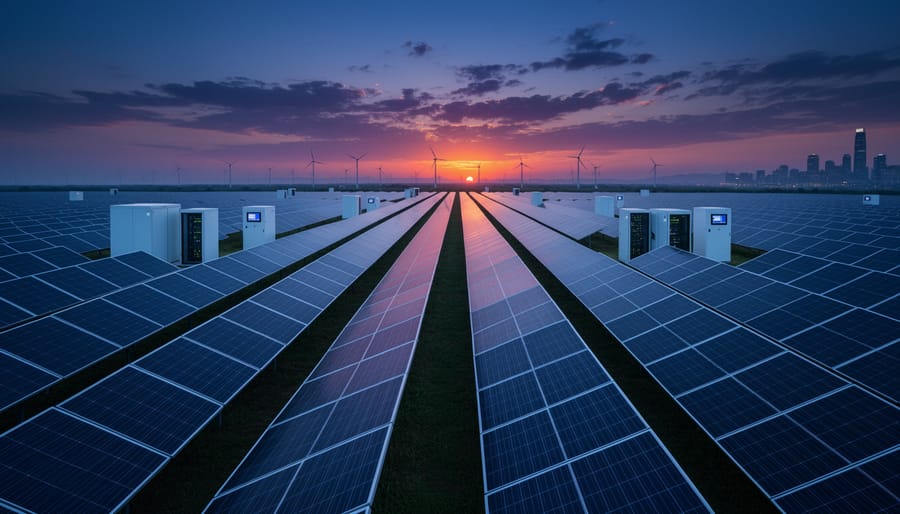
Location and energy source matter enormously. Quantum facilities powered by dedicated renewable energy, increasingly common among providers targeting sustainability-conscious sectors, shift the equation significantly. When the quantum computer analyzing solar data runs on solar or wind power, the carbon cost drops toward zero, making environmental justification straightforward for applications delivering any meaningful efficiency improvement. For photovoltaic professionals evaluating quantum solutions, understanding the power source behind the processing is as critical as assessing the algorithm’s performance benefits.
Current Mitigation Strategies and Future Outlook

Renewable Energy Integration for Quantum Facilities
Several quantum computing facilities have begun addressing their environmental footprint by sourcing power from renewable sources, creating an unexpected synergy with the solar industry. Google’s quantum computing efforts run on carbon-free energy matching their grid consumption hourly, while IBM has committed to net-zero greenhouse gas emissions across its facilities by 2030, including quantum data centers.
The extreme power requirements of quantum systems, ranging from hundreds of kilowatts to several megawatts per facility, make them ideal candidates for on-site solar installations or dedicated renewable power purchase agreements. A typical quantum computing center drawing 2 megawatts continuously would require approximately 17,500 megawatt-hours annually, equivalent to a 10-megawatt solar farm at optimal capacity factors. This scale creates opportunities for solar PV professionals to design specialized renewable systems tailored to quantum facilities’ unique load profiles.
The timing proves particularly advantageous: as quantum computing scales up, solar PV costs have dropped 90% over the past decade, making dedicated renewable installations economically viable. Some facilities have adopted hybrid renewable approaches, combining solar arrays with battery storage to maintain the uninterrupted power quantum systems demand. Microsoft’s Azure Quantum service, for instance, prioritizes data centers with renewable energy access.
This convergence benefits both industries. Quantum providers gain sustainability credentials and operational cost stability, while renewable energy developers secure large, predictable long-term customers. For photovoltaic professionals, quantum facilities represent an emerging market segment requiring sophisticated grid integration and reliability planning.
Emerging Quantum Technologies with Lower Footprints
Several breakthrough quantum technologies in development promise to dramatically reduce the environmental footprint that currently limits widespread adoption. Understanding these emerging approaches helps photovoltaic professionals anticipate when quantum solutions might become environmentally viable for routine solar data analysis.
Room-temperature quantum computing represents the most transformative research direction. Nitrogen-vacancy centers in diamond and topological qubits operating at higher temperatures could eliminate the need for expensive dilution refrigerators. While still years from commercial deployment, these approaches would reduce energy consumption by 90% or more compared to current superconducting systems. Researchers have demonstrated stable qubits at liquid nitrogen temperatures (77 Kelvin versus near-zero Kelvin), cutting cooling energy requirements substantially.
Photonic quantum computers offer another promising path. These systems use light particles instead of superconducting circuits, operating at room temperature with significantly lower power draws. Several companies have built prototype photonic quantum processors that consume less energy than a household refrigerator while maintaining quantum advantage for specific optimization problems.
Silicon spin qubits, leveraging existing semiconductor manufacturing infrastructure, could scale more efficiently than current platforms. Their smaller physical footprint and compatibility with conventional electronics may reduce both embodied carbon and operational energy needs.
For photovoltaic professionals, realistic adoption timelines remain conservative. Room-temperature systems suitable for commercial solar optimization likely won’t reach market maturity until 2030-2032. Near-term quantum applications will continue using current high-energy platforms, making renewable energy integration essential rather than optional.
Practical Considerations for Solar PV Professionals
When Quantum Computing Makes Environmental Sense
For photovoltaic professionals evaluating quantum solutions, environmental justification hinges on three quantifiable factors: problem complexity, computational advantage, and downstream efficiency gains.
Quantum processing makes sense when the problem involves exponential classical scaling. Solar array optimization across thousands of panels with real-time weather data, shading patterns, and grid demands creates computational requirements that double with each added variable. If a classical supercomputer needs weeks for a calculation a quantum system completes in hours, the energy trade-off favors quantum, provided the optimized system operates long enough to offset processing costs.
Calculate the break-even threshold: if quantum optimization increases solar array output by 2% annually, how many years of improved generation equal the carbon cost of processing? For large-scale installations (50+ MW), this payback typically occurs within 18 to 36 months. Smaller systems rarely justify quantum resources unless pooled regionally.
Materials discovery represents the clearest environmental case. Quantum simulation of new photovoltaic compounds can eliminate thousands of failed lab experiments, each with its own material waste and energy consumption. When one simulation prevents 200 physical prototype iterations, the environmental math strongly favors quantum approaches despite their current energy intensity.
Educational Resources and Industry Partnerships
Staying current on quantum computing’s role in photovoltaic research requires access to rigorous academic programs and industry partnerships that translate cutting-edge developments into practical knowledge. Mose Solar collaborates with leading universities to develop curriculum that addresses emerging technologies, including quantum applications in solar energy optimization, ensuring aspiring professionals gain exposure to these tools before they become industry standard.
These educational partnerships bridge the gap between theoretical quantum research and real-world PV implementation. University programs incorporating quantum computing modules help students understand both the computational advantages and environmental considerations of these systems. Coursework typically covers quantum algorithm applications in materials science, energy modeling, and grid optimization, alongside critical analysis of resource requirements and sustainability trade-offs.
For professionals already in the field, continuing education programs offer pathways to quantum literacy without requiring advanced physics backgrounds. Online courses, industry workshops, and collaborative research initiatives provide practical frameworks for evaluating when quantum solutions make environmental and economic sense for specific PV projects.
Academic partnerships also facilitate access to quantum computing resources that individual solar companies might not afford independently. Research collaborations allow photovoltaic professionals to experiment with quantum algorithms on university systems, testing applications like accelerated material discovery or complex grid integration models before committing to commercial quantum services. This hands-on experience proves invaluable for making informed decisions about technology adoption and understanding the true environmental calculus of quantum-enhanced solar research.
Frequently Asked Questions
How much energy does quantum computing actually use compared to classical computing?
Current quantum computers consume significantly more energy per operation than classical systems, primarily due to extreme cooling requirements. However, for specific complex problems like large-scale solar array optimization, quantum systems could eventually solve in hours what would take classical supercomputers years, potentially making them more energy-efficient for certain applications despite higher instantaneous power draw.
Can renewable energy offset quantum computing’s carbon footprint?
Yes, and several quantum computing facilities are already integrating solar and wind power into their operations. The synergy is particularly promising for the solar PV industry: advances in photovoltaic efficiency directly reduce the environmental cost of quantum facilities, while quantum processing helps optimize those same solar systems.
Is quantum computing necessary for solar PV optimization, or are classical methods sufficient?
For most current solar PV applications, classical computing remains sufficient and more environmentally practical. Quantum computing becomes justified for exceptionally complex problems like modeling molecular interactions in new solar cell materials, optimizing utility-scale arrays with millions of variables, or processing massive datasets for grid integration across entire regions.
What’s the current state of quantum computing adoption in the photovoltaic industry?
Quantum computing in the PV sector is primarily in the research phase, with universities and national labs exploring applications in materials science and system optimization. Commercial deployment remains limited, though pilot programs are testing quantum algorithms for specific problems like perovskite solar cell design and real-time performance forecasting for large solar farms.
The practical timeline for widespread quantum computing adoption in solar PV work depends heavily on technological maturation and cost reduction. Aspiring photovoltaic professionals should view quantum computing as an emerging tool rather than an immediate requirement. Educational programs that cover both classical optimization techniques and quantum fundamentals provide the best preparation, allowing professionals to evaluate when quantum solutions offer genuine advantages over established methods.
For those entering the field now, understanding the environmental trade-offs positions you to make informed decisions as quantum applications mature. The question isn’t whether quantum computing will play a role in solar PV advancement, but rather how to deploy it strategically where its computational advantages justify the environmental costs. Professional development programs, including those offered through university partnerships, increasingly address this balance between technological capability and sustainability responsibility.
The question of whether quantum computing harms the environment doesn’t yield a simple yes or no. Right now, these systems consume substantial energy and require resource-intensive infrastructure. A single quantum computer’s cooling apparatus can draw as much power as a small neighborhood. The carbon footprint of manufacturing quantum hardware, extracting rare materials, and maintaining near-absolute-zero temperatures is real and measurable.
Yet the environmental ledger remains incomplete without considering quantum computing’s problem-solving capacity. For solar PV optimization specifically, quantum algorithms can process datasets and model interactions at scales classical computers cannot match. When quantum processing enables a 5% efficiency gain across a regional solar array, the carbon saved through improved renewable generation can dwarf the emissions from running the quantum system, provided that system runs on clean energy.
Context determines the environmental math. A quantum computer powered by coal to solve trivial problems represents pure environmental cost. The same machine, powered by solar energy and optimizing next-generation photovoltaic materials that will deploy globally, delivers net environmental benefit.
As photovoltaic professionals, you occupy a critical position in this equation. Your decisions about when and how to apply quantum computing in solar research and operations will help determine whether this technology accelerates or hinders climate solutions. The path forward requires informed evaluation of specific applications, insistence on renewable-powered quantum facilities, and continued pressure for efficiency improvements. Innovation and sustainability need not conflict, but ensuring they align demands vigilance from those building our renewable energy future.