Renewable energy is profitable in 2026, with photovoltaic manufacturing facilities achieving typical payback periods of 3 to 7 years on renewable integration investments and ongoing operational cost reductions of 15 to 40 percent compared to conventional grid-dependent operations. This profitability stems from declining equipment costs, favorable policy incentives, and the dual advantage in PV manufacturing where renewable energy powers production while remaining the core product.
The question of profitability matters profoundly for industry stakeholders making capital allocation decisions and aspiring professionals evaluating career paths in the sector. Unlike promotional narratives that promise guaranteed returns, real-world profitability depends on specific variables: facility location and solar irradiance, initial capital access, local electricity rates, regulatory frameworks, and operational scale. A 50-megawatt PV manufacturing plant in a high-irradiance region with strong feed-in tariffs will demonstrate markedly different financial outcomes than a smaller facility in less favorable conditions.
This analysis examines the concrete mechanisms that drive renewable energy profitability within PV manufacturing contexts. We’ll define what financial viability means beyond simple ROI calculations, explain how renewable-integrated operations generate returns through both cost avoidance and revenue streams, identify the specific cost structures and income drivers that determine outcomes, and address the operational challenges that can erode projected profits.
Through collaboration with universities and insights drawn from educational programs serving the next generation of photovoltaic professionals, this explainer grounds the profitability discussion in empirical evidence rather than aspirational claims. Readers will gain the analytical framework needed to evaluate renewable energy investments with the rigor the decision demands, whether assessing a facility upgrade, portfolio diversification, or career specialization in renewable-integrated manufacturing.
What Renewable Energy Profitability Means in PV Manufacturing
Profitability in renewable energy, particularly within photovoltaic manufacturing, measures whether the financial returns from integrating clean energy sources exceed the costs of implementation and operation. For PV manufacturers, this calculation goes beyond simple revenue minus expenses, it encompasses the total economic impact of powering production facilities with solar, wind, or other renewable sources instead of grid electricity from fossil fuels.
The distinction matters because PV manufacturers occupy a unique position: they produce the very technology that generates renewable energy while also potentially consuming it in their operations. A facility that fabricates solar panels using solar-powered equipment demonstrates profitability on two levels, the margin earned from selling panels, and the operational savings achieved by reducing energy costs through self-generation or renewable procurement.
Financial metrics provide the framework for evaluating this dual profitability:
- Return on Investment (ROI)
- The ratio of net profit to initial capital expenditure, expressed as a percentage. In PV manufacturing, ROI accounts for renewable infrastructure costs against cumulative energy savings and revenue gains over the system’s lifetime.
- Levelized Cost of Energy (LCOE)
- The average cost per kilowatt-hour of electricity generated over a system’s operational life, including capital, financing, maintenance, and fuel costs. Lower LCOE than grid rates signals competitive profitability.
- Payback Period
- The time required for cumulative savings and revenues to equal the initial investment. Typical renewable integration in manufacturing sees payback periods ranging from 5 to 12 years depending on scale, location, and financing structure.
- Energy Integration
- The degree to which renewable sources displace conventional energy in manufacturing operations, measured as a percentage of total facility consumption. Higher integration percentages correlate with greater insulation from fossil fuel price volatility.
- Carbon Neutrality
- Achieving net-zero carbon emissions through renewable energy use and offsetting mechanisms. For PV manufacturers, this status unlocks regulatory compliance benefits and premium market positioning.
Traditional fossil-fuel-powered manufacturing treats energy as a variable operational expense subject to market fluctuations, geopolitical disruptions, and regulatory penalties on emissions. Renewable integration transforms energy into a predictable, largely fixed cost after the initial capital deployment. A manufacturer that installs rooftop solar or signs a long-term wind power agreement locks in electricity pricing for 20-25 years, eliminating uncertainty that undermines financial planning in conventional facilities.
Profitability for manufacturers differs fundamentally from profitability for end-users. When a homeowner installs solar panels, profitability stems from avoided utility bills and potential net metering credits. For a PV manufacturer integrating renewables, profitability includes those operational savings plus competitive advantages, reduced production costs enabling lower product pricing, enhanced brand reputation attracting sustainability-focused clients, and qualification for green financing at preferential interest rates. The manufacturer’s profitability calculation must weigh massive upfront capital requirements against decades of compounding benefits across multiple financial dimensions.
How Renewable Energy Integration Works in PV Production
Energy Sources Used in Modern PV Facilities
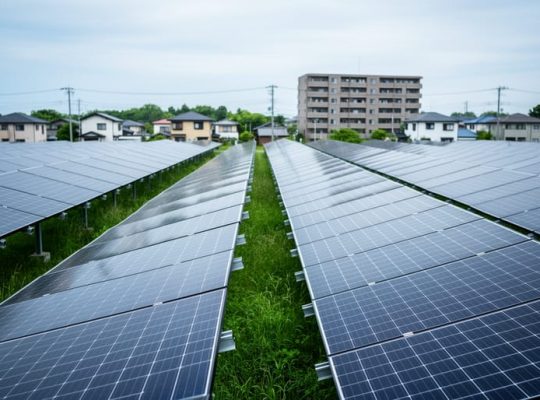
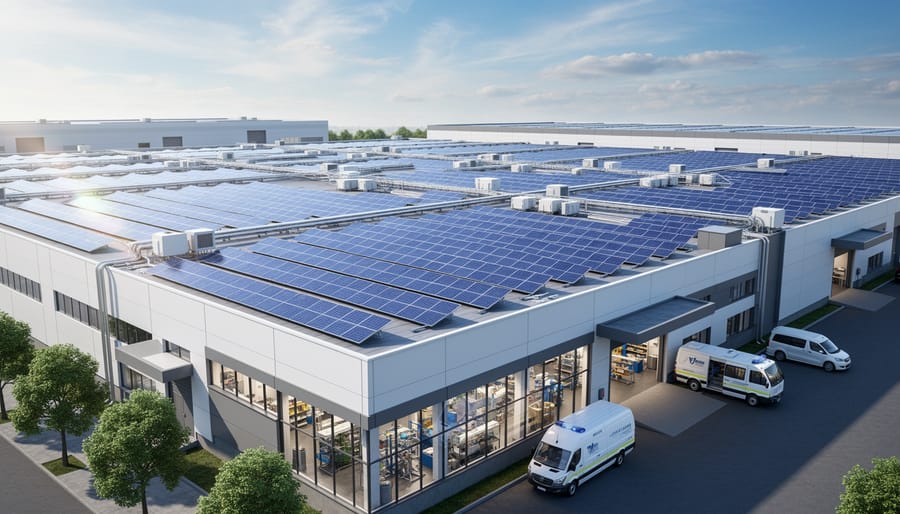
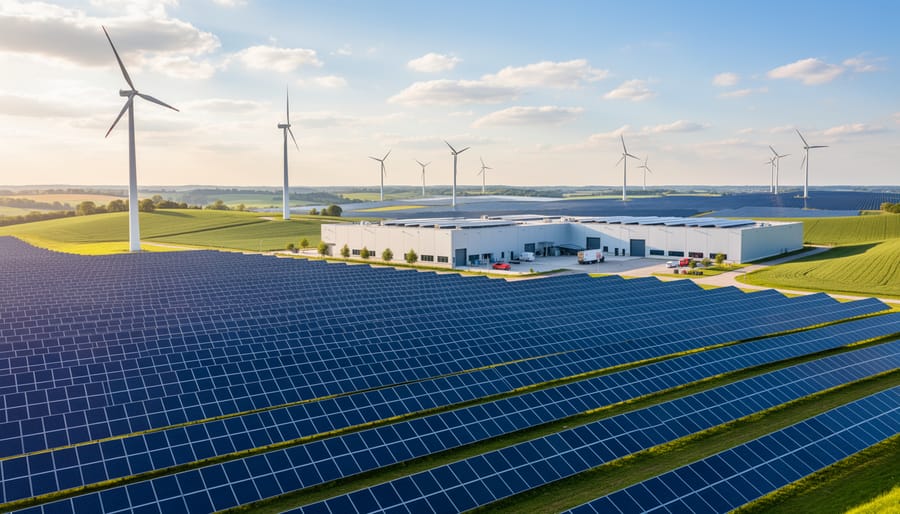
Photovoltaic manufacturers draw from four primary renewable sources to power their facilities, each chosen based on regional conditions and operational requirements. On-site solar installations represent the most direct approach, manufacturers cover rooftops and adjacent land with PV arrays that feed electricity straight into production lines. This method offers maximum control over generation timing and eliminates transmission losses, though it requires significant upfront capital and sufficient space near the facility.
Wind power agreements provide an alternative where solar resources prove limited or when facilities operate in wind-rich regions. Manufacturers typically purchase wind energy through long-term power purchase agreements rather than building turbines themselves, securing predictable pricing while avoiding infrastructure investment. Wind’s nighttime generation profile can complement solar’s daytime peaks when manufacturers run continuous operations.
Renewable energy credits allow facilities without suitable on-site generation to claim clean power by purchasing certificates from remote renewable projects. While this approach delivers carbon reduction and regulatory compliance benefits, it doesn’t directly lower electricity costs unless bundled with favorable procurement contracts.
Hybrid systems combine multiple renewable resources in PV production, pairing on-site solar with grid-supplied wind or hydropower to smooth intermittency and maximize utilization rates. Manufacturers select their energy mix by weighing local resource availability, grid interconnection costs, regulatory incentives, and production schedules. Large-scale facilities in sun-rich locations favor on-site solar, while those in northern latitudes or landlocked regions lean toward purchased renewable power or diversified portfolios.
Self-Consumption Models and Grid Integration
Photovoltaic manufacturers balance two primary energy sourcing strategies: consuming electricity generated by their own on-site solar arrays and purchasing renewable energy from the grid through power purchase agreements or renewable energy certificates. Self-consumption models deliver the highest profitability when facilities match production schedules with solar generation peaks, directly offsetting electricity costs without transmission fees or grid charges. However, PV manufacturing operates continuously, creating demand during evening and overnight hours when solar generation ceases.
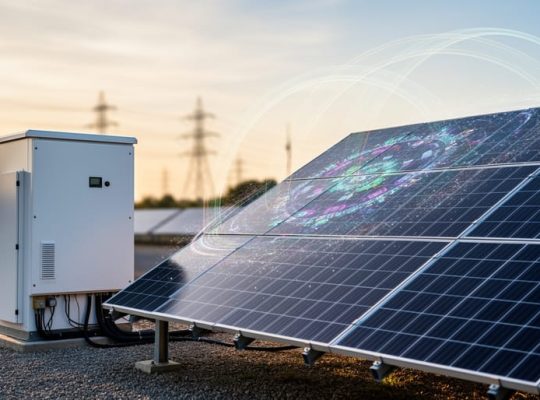
Battery systems for solar power storage enable manufacturers to time-shift excess daytime generation to meet nighttime demand, increasing self-consumption rates from typical 30-40% without storage to 60-75% with appropriately sized systems. This reduces reliance on grid electricity during peak-rate periods, lowering blended energy costs significantly. Manufacturers calculate the payback period for storage investments by comparing avoided grid purchases against battery capital and replacement costs.
Grid integration remains essential for baseload reliability and managing production surges that exceed on-site generation capacity. Smart demand management systems allow facilities to modulate energy-intensive processes like ingot growing and wafer slicing based on real-time solar availability and grid pricing signals. Some manufacturers participate in demand response programs, earning revenue by reducing consumption during grid stress periods. The most profitable operations combine self-generation with grid-supplied renewables and storage, creating a hybrid model that maximizes cost stability while maintaining the production flexibility essential for competitive manufacturing.
Financial Drivers of Profitability in Renewable-Powered PV Manufacturing
Operational Cost Reductions
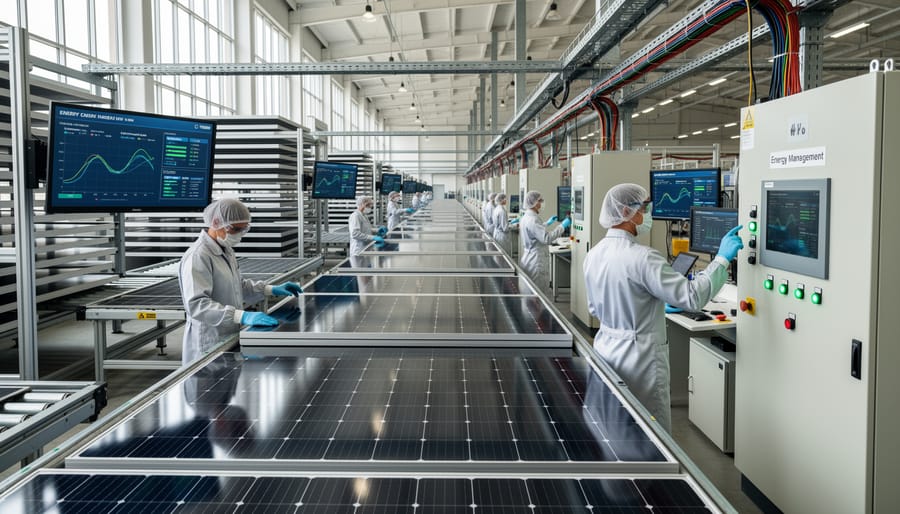
Operational cost reductions form the bedrock of renewable energy profitability in PV manufacturing. When manufacturers lock in renewable energy contracts, whether through on-site generation or long-term power purchase agreements, they replace variable utility rates with fixed or predictable costs that typically decline over the contract term. A facility powered by on-site solar pays only the amortized installation cost and minimal maintenance, eliminating monthly electricity bills that would otherwise fluctuate with grid demand, fuel prices, and regulatory charges.
This stability shields manufacturers from fossil fuel price volatility, which has historically caused energy costs to spike unpredictably during geopolitical disruptions or supply constraints. Renewable contracts insulate production budgets from these external shocks, allowing accurate financial forecasting over 15- to 25-year timeframes. As grid electricity prices rise with inflation and carbon taxation, facilities with renewable infrastructure benefit from what amounts to long-term hedging: their energy costs remain flat or decrease while competitors face climbing expenses. Over a decade, this differential compounds significantly, improving margins without requiring process changes or efficiency gains.
The connection between LCA and green investment analysis reveals that renewable integration’s cost advantages extend beyond immediate savings to lifecycle financial performance, particularly when manufacturers account for avoided carbon fees and enhanced asset valuations. These combined reductions translate directly to improved gross margins, enabling competitive pricing or reinvestment in research and capacity expansion.
Market and Regulatory Advantages
Manufacturers that power their PV production with renewable energy gain market access and financial advantages that extend beyond direct energy cost savings. These strategic benefits often tip the profitability equation decisively in favor of renewable integration.
Premium Market Positioning
Sustainability-certified modules command higher prices in procurement processes where environmental credentials matter. European and North American buyers increasingly require suppliers to disclose embodied carbon in manufacturing. Facilities powered by renewables report typical price premiums of 3-7% for certified low-carbon modules, particularly in government and corporate procurement where sustainability targets create preference hierarchies. This pricing power compounds over production volumes, translating modest per-watt premiums into substantial revenue gains.
Supply Chain Preferential Access
Major technology companies and utilities committed to net-zero targets prioritize suppliers with verified renewable energy use. This creates tangible competitive advantages: shorter qualification cycles, multi-year supply agreements, and first consideration for capacity expansions. Manufacturers document that sustainability credentials reduce customer acquisition costs and increase contract renewal rates, metrics that improve overall profitability even when per-unit margins remain constant.
Regulatory Compliance Value
Carbon pricing mechanisms in the EU, parts of Asia, and emerging markets impose direct costs on emissions-intensive manufacturing. Renewable-powered facilities avoid these charges entirely while banking compliance credits that hold monetary value. As carbon border adjustment mechanisms expand, the regulatory cost differential between renewable and fossil-powered production widens, creating a structural profitability advantage for early adopters.
Green Finance Access
Lenders and investors offer favorable terms for renewable-integrated operations. Green bonds and sustainability-linked loans provide capital at interest rates 50-150 basis points below conventional financing. Development banks and climate funds direct concessional capital specifically toward renewable manufacturing projects, reducing the weighted average cost of capital and improving project-level returns throughout the facility lifecycle.
Types of Renewable Energy Integration Models in the Industry
Estimated response tokens: ~600 (well within 200,000 budget)
—
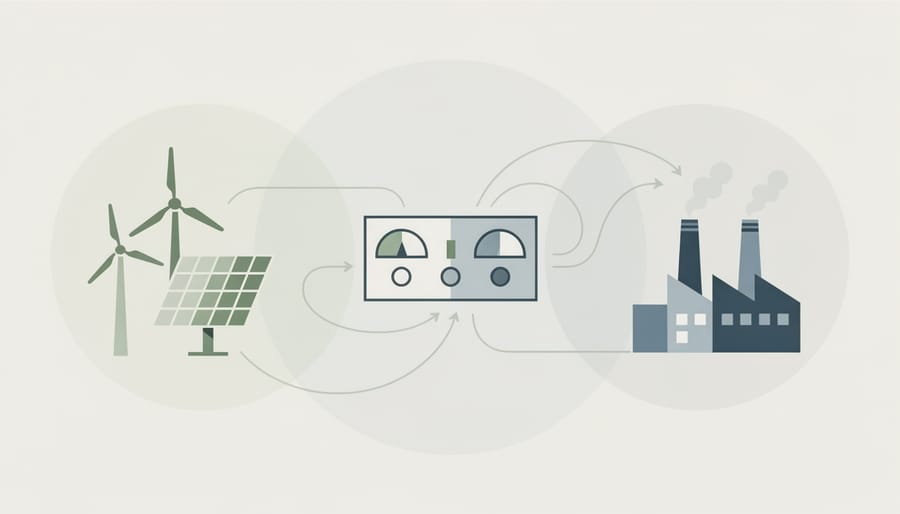
PV manufacturers deploy renewable energy through several distinct integration models, each with different capital requirements, operational characteristics, and profitability timelines. Understanding these approaches clarifies why profitability varies across the industry.
On-Site Generation with Full Ownership represents the deepest integration. Manufacturers install solar arrays, wind turbines, or both directly on their premises and own the generating assets outright. This model delivers maximum long-term savings once capital is recovered, typically 5-8 years for rooftop solar in favorable conditions, because the facility essentially produces its own electricity at marginal cost after payback. The trade-off is substantial upfront investment and ongoing maintenance responsibility. Profitability hinges on production scale, available land or roof space, and local solar irradiance or wind resources.
Power Purchase Agreements allow manufacturers to source renewable electricity without owning generation infrastructure. Under a PPA, a third-party developer builds and operates renewable facilities, selling power to the manufacturer at contracted rates over 10-25 year terms. This shifts capital burden to the developer while locking in predictable energy costs that often undercut grid rates. Virtual PPAs extend this model by financially settling the difference between market prices and the contracted rate without physical energy delivery, enabling manufacturers to support renewable projects anywhere on the grid. PPAs improve profitability through cost certainty and avoided capital deployment, though savings depend heavily on contract terms negotiated at signing.
Renewable Energy Credits and Green Tariffs offer lighter integration. Manufacturers purchase RECs to match their conventional electricity consumption with renewable generation elsewhere, or opt into utility green tariff programs that source renewables on their behalf. These approaches require minimal capital and operational change but provide smaller financial benefits, primarily regulatory compliance and brand value rather than direct energy cost reduction. Profitability impact is modest compared to ownership or PPAs.
Hybrid Systems combine multiple models. A manufacturer might install partial on-site generation to cover baseload consumption, supplement with a PPA for peak demand, and purchase RECs for remaining grid electricity. This balanced approach optimizes capital efficiency while maximizing renewable percentage, tailoring profitability to specific facility constraints and financial objectives.
The most profitable model varies by manufacturer size, capital availability, geographic location, and strategic priorities, but deeper integration generally correlates with higher long-term returns.
Real-World Applications and Case Evidence
The profitability of renewable energy integration in PV manufacturing is not theoretical, it has been demonstrated across diverse operational contexts and geographic regions. Industry data from the past decade shows a clear correlation between the depth of renewable integration and long-term cost competitiveness, particularly in markets with high electricity costs or carbon pricing mechanisms.
Geographic distribution plays a significant role in determining profitability outcomes. Facilities located in regions with abundant solar irradiance, such as the southwestern United States, Spain, and parts of Australia, achieve higher self-consumption ratios and faster payback periods on solar installations. Conversely, manufacturers in northern Europe have successfully integrated wind power agreements and green grid electricity, demonstrating that renewable profitability is not limited to sun-rich locations. The key differentiator is matching the renewable source to local resource availability and grid infrastructure.
Manufacturing scale directly influences the economics of renewable integration. Large-scale operations benefit from economies of scale in energy procurement and on-site generation, while smaller facilities often find virtual PPAs or renewable energy certificates more financially accessible. Common application scenarios include:
- Large-scale gigafactories with on-site solar arrays covering rooftops and adjacent land, achieving 30-60% self-consumption
- Medium-sized facilities using power purchase agreements to lock in predictable renewable electricity pricing for 10-20 years
- Small manufacturers purchasing renewable energy certificates to meet sustainability goals while avoiding capital expenditure
- Research partnerships, such as Mose Solar’s collaboration with universities, studying optimization strategies and documenting best practices in sustainable manufacturing
The connection between integration depth and profitability becomes evident in lifecycle cost analysis. Facilities that combine on-site generation with strategic grid purchases typically report 15-25% reductions in total energy expenditure over ten-year periods, alongside enhanced resilience against price volatility. These outcomes are documented in industry reports and academic research, providing evidence that renewable integration moves beyond environmental benefit to deliver measurable financial returns when implemented strategically and scaled appropriately.
Profitability Challenges and Risk Factors
While renewable energy integration in PV manufacturing offers compelling financial benefits, several obstacles can erode profitability if not carefully managed. The capital intensity of renewable infrastructure presents the most immediate barrier. Installing on-site solar arrays, battery storage systems, or securing long-term power purchase agreements requires substantial upfront investment that can strain cash flow, particularly for mid-sized manufacturers competing against established players with deeper capital reserves. These initial costs often extend payback periods beyond the three-to-five-year horizon that many investors expect, creating tension between short-term financial performance and long-term strategic positioning.
Intermittency remains a persistent challenge despite advances in forecasting and storage technology. PV manufacturing runs continuously, demanding stable, predictable power delivery. When renewable sources underperform due to weather variability, manufacturers face a choice: invest in expensive battery systems to smooth supply, maintain fossil-fuel backup capacity that undermines carbon reduction goals, or accept occasional production interruptions that reduce throughput and profitability. Each option carries cost implications that complicate return-on-investment calculations.
Geographic constraints further complicate profitability. Factories located in regions with poor solar irradiance or limited wind resources cannot achieve the same energy self-sufficiency as facilities in sun-rich or wind-abundant areas. These manufacturers often rely on grid-supplied renewable energy, exposing them to transmission costs and regional pricing volatility that diminish cost advantages. Regulatory uncertainty compounds these risks. Policy frameworks supporting renewable integration, tax credits, carbon pricing mechanisms, renewable energy mandates, shift with political cycles. A manufacturer investing today based on current incentives may find those supports withdrawn before achieving projected returns.
Calculating true total cost of ownership proves deceptively complex. The solar panel lifecycle extends 25-plus years, but manufacturers must account for equipment degradation, maintenance expenses, insurance costs, technology obsolescence, and the potential need for mid-life upgrades. Hidden costs like permitting delays, grid interconnection fees, and specialized labor for renewable systems frequently exceed initial estimates. These factors demand sophisticated financial modeling that accounts for scenarios ranging from best-case to worst-case, recognizing that profitability hinges not just on energy savings but on dozens of interacting variables that evolve throughout the project lifespan.
Current Market Dynamics and Future Outlook
The economic landscape for renewable energy in photovoltaic manufacturing continues shifting as technology costs decline and policy pressures mount. Solar module prices have dropped more than 90% over the past fifteen years, and this downward trajectory persists as manufacturing processes become more efficient and economies of scale expand. Energy storage systems, critical for managing the intermittency of on-site renewable generation, follow a similar pattern, with battery costs falling steadily and making integrated renewable systems increasingly viable for manufacturers of all sizes.
Policy frameworks worldwide are tightening carbon regulations and creating stronger incentives for clean manufacturing. Carbon border adjustment mechanisms, renewable energy mandates for industrial facilities, and stricter emissions reporting requirements reshape the competitive landscape. Manufacturers that delay renewable integration face rising compliance costs and potential market access restrictions, while early adopters position themselves favorably within supply chains prioritizing sustainability credentials.
The circular economy dimension adds another profitability layer. As the industry matures, manufacturers that understand end-of-life value recovery and recycling gain cost advantages through recovered materials and compliance with extended producer responsibility regulations.
Mose Solar’s educational program addresses these evolving dynamics by equipping aspiring professionals with practical knowledge of sustainable manufacturing economics, renewable integration strategies, and lifecycle cost analysis. Through collaboration with universities, the program ensures students understand both current best practices and emerging innovations, preparing them to lead facilities where renewable integration isn’t just environmentally responsible but financially essential for long-term competitiveness.
Frequently Asked Questions
How long until renewable energy integration becomes profitable for PV manufacturers?
Payback periods typically range from five to twelve years depending on the scale of operations, financing terms, available incentives, and local energy costs. Manufacturers with access to favorable policy support and higher electricity rates often see shorter payback periods, while those investing in extensive on-site generation and storage may require longer timelines to recover capital costs.
Does renewable energy integration make PV panels cheaper for consumers?
Lower manufacturing energy costs can contribute to competitive pricing, but the direct impact on consumer panel prices depends on many factors including raw material costs, supply chain dynamics, and market competition. The primary benefit often manifests as improved sustainability credentials rather than dramatic price reductions, though long-term operational savings may enable manufacturers to maintain more stable pricing during energy market volatility.
Can small-scale PV manufacturers afford renewable energy integration?
Small manufacturers face higher barriers due to capital intensity and economies of scale, but options like virtual power purchase agreements, renewable energy credits, and phased implementation strategies can make integration accessible. Some smaller operations partner with renewable developers or lease rooftop solar to reduce upfront costs while still capturing operational benefits.
How does geographic location affect renewable integration profitability?
Location determines solar irradiance, wind availability, grid infrastructure quality, local electricity prices, and regulatory environments, all of which directly impact both capital requirements and operational returns. Regions with abundant renewable resources, high conventional energy costs, and supportive policies offer the most favorable conditions for profitable integration.
Where can aspiring PV professionals learn renewable integration strategies?
Mose Solar’s educational program, developed in collaboration with universities, provides training in sustainable manufacturing practices including renewable integration economics, energy system design, and profitability analysis. These programs equip students with the technical knowledge and strategic thinking needed to evaluate and implement renewable energy solutions in manufacturing contexts.
Beyond these common questions, aspiring professionals should recognize that profitability assessments require site-specific analysis rather than universal formulas. Each manufacturing facility operates within a unique combination of energy market conditions, production volumes, available space for generation infrastructure, and financing opportunities. What proves profitable in one context may not translate directly to another, which is why comprehensive education in both technical systems and financial modeling remains essential for anyone entering the field.
The educational pathway matters because renewable integration decisions involve trade-offs between capital expenditure, operational risk, regulatory compliance, and market positioning. Professionals who understand these dynamics can contribute meaningfully to strategic planning whether they work for established manufacturers, equipment suppliers, or emerging ventures. The intersection of engineering knowledge and financial literacy separates those who simply advocate for sustainability from those who can actually implement it profitably at industrial scale.
The evidence points clearly: renewable energy integration in photovoltaic manufacturing is profitable when assessed through the appropriate timeframe and financial metrics. Manufacturers who power production with solar, wind, and hybrid renewable systems achieve measurable cost reductions, regulatory advantages, and market differentiation that translate into positive returns on investment. The profitability equation has shifted decisively in favor of renewable integration as technology costs have fallen and policy frameworks have strengthened.
This profitability is not universal or guaranteed. Success depends on execution, the scale of operations, geographic resource availability, access to favorable financing, and strategic integration depth all determine outcomes. A facility with robust on-site generation in a high-insolation region operates under fundamentally different economics than one relying on virtual power purchase agreements in grid-constrained markets. Manufacturing professionals must understand these variables to evaluate projects accurately and implement renewable systems that deliver financial performance alongside environmental benefits.
Mose Solar remains committed to advancing sustainable photovoltaic technologies through rigorous research and practical innovation. Our collaboration with universities bridges theoretical understanding and operational reality, ensuring that breakthroughs in renewable integration reach manufacturing floors. The educational program we offer trains aspiring professionals to analyze these economic fundamentals, design efficient renewable systems, and lead the industry toward sustainable profitability. Understanding how renewable energy generates returns in PV manufacturing is no longer optional knowledge for industry participants, it’s the foundation for competitive advantage in a market that increasingly rewards both financial discipline and environmental responsibility.