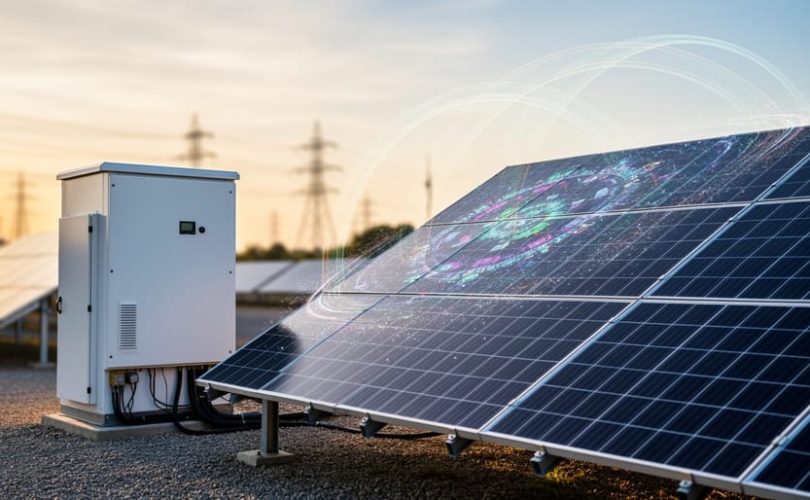
A quantum solar system is a photovoltaic installation that uses quantum computing algorithms to optimize energy storage, distribution, and consumption in real time. Unlike traditional solar arrays that rely on preset charge controllers and basic automation, quantum solar systems leverage quantum processors to analyze thousands of variables simultaneously, including weather patterns, grid demand, battery chemistry, and electricity pricing, to make split-second decisions about when to store, discharge, or sell solar-generated power.
The technology represents a significant evolution in how we manage PV energy storage. As battery systems become larger and more complex, particularly in commercial and utility-scale installations, traditional computing struggles to optimize storage decisions across multiple variables. A typical 5MW commercial solar installation with battery storage might need to consider dozens of factors every minute: current state of charge, predicted solar irradiance for the next 48 hours, real-time electricity prices, battery degradation rates, and contractual obligations to the grid. Classical computers process these variables sequentially. Quantum processors evaluate them in parallel states, identifying optimal solutions that conventional systems would miss.
This article explains what quantum solar systems are, how quantum optimization works in practice, the components required to implement this technology, and real-world applications emerging from university research partnerships and industry trials. While quantum computing for solar optimization remains in early deployment stages, understanding its architecture and potential prepares PV professionals for a sector where storage efficiency will increasingly determine project economics.
What Quantum Solar Systems Mean for Energy Storage
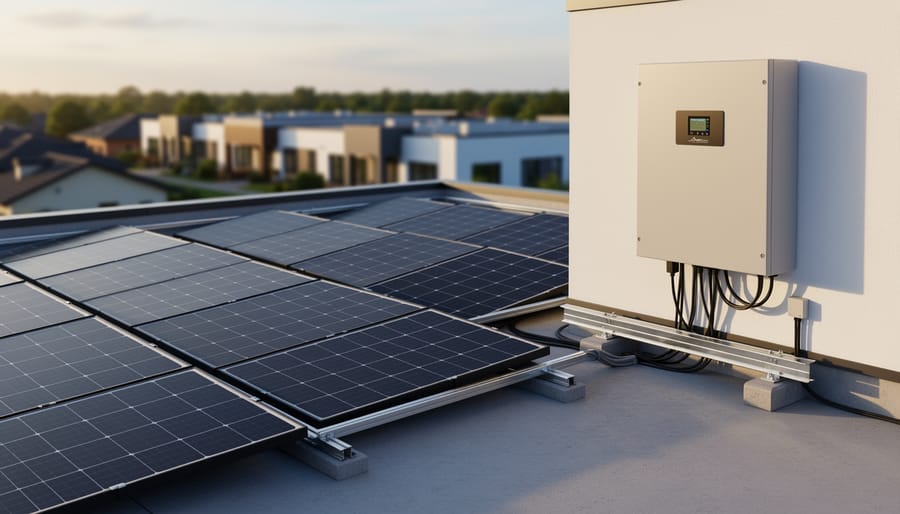
The term “quantum solar systems” can be confusing at first glance. It doesn’t refer to solar panels built on quantum physics principles or exotic materials from the quantum realm. Instead, it describes conventional photovoltaic installations whose storage operations are optimized by quantum computing algorithms running in the background.
At its core, a quantum solar system pairs standard solar PV arrays and battery storage with quantum-powered optimization software. This software tackles the complex decision-making around when to charge batteries, when to discharge stored energy, and when to send power to the grid. Classical computers handle these calculations sequentially, which becomes limiting when you’re juggling dozens of variables simultaneously. Quantum computers process multiple scenarios at once, finding optimal storage strategies that keep power when sun sets while maximizing economic returns and battery longevity.
To clarify the terminology used in this emerging field:
- Quantum Computing
- A computing approach that uses quantum bits (qubits) to process information in superposition states, allowing simultaneous evaluation of multiple solutions to complex problems.
- Quantum Algorithms
- Specialized computational procedures designed to run on quantum processors, exploiting quantum properties like superposition and entanglement to solve optimization problems faster than classical methods.
- PV Storage Optimization
- The process of determining optimal charge/discharge schedules for battery systems connected to solar arrays, balancing factors like energy prices, demand patterns, and battery health.
- Quantum Annealing
- A quantum computing technique particularly suited for optimization problems, finding the lowest-energy state (best solution) among many possibilities by gradually reducing quantum fluctuations.
This approach differs from other quantum applications in energy, such as quantum dot solar cells or quantum coherence in photosynthesis research. Those technologies aim to improve energy conversion at the physical level. Quantum solar systems leave the hardware unchanged and enhance decision-making intelligence instead, making them compatible with existing PV infrastructure and more immediately accessible to the industry.
How Quantum Computing Optimizes Solar Storage
The Storage Optimization Challenge
Solar storage optimization forces operators to solve multiple moving puzzles at once. A battery controller must decide when to charge, discharge, or hold energy based on dozens of interacting variables that shift by the hour.
Weather forecasting drives the first layer of complexity. Tomorrow’s solar generation depends on cloud cover, temperature, and seasonal patterns, but predictions carry error margins that compound over time. The controller must hedge against both overproduction scenarios (where excess solar gets curtailed without storage capacity) and underproduction days when batteries need reserves.
Demand prediction adds another dimension. A commercial building’s energy needs fluctuate with occupancy, HVAC loads, and operational schedules. Residential systems face evening peaks and weekend variations. Miscalculating demand means either wasting solar energy or drawing expensive grid power when the battery runs low.
Grid pricing introduces financial optimization. Time-of-use rates, demand charges, and real-time wholesale markets create windows where stored energy becomes more valuable. The system must balance immediate savings against future opportunities, often weighing whether to discharge now or wait for higher-priced peak hours.
Battery life constraints tighten the equation further. Each charge-discharge cycle degrades cell chemistry, and deep discharges accelerate wear. Optimizing for battery degradation and uncertainty requires predicting long-term capacity loss while maximizing current value.
Classical computers evaluate these variables sequentially or through simplified models. Quantum algorithms can explore the full solution space simultaneously, testing thousands of operational scenarios in parallel to find the truly optimal path.
Quantum Algorithm Processing
Quantum algorithms approach solar storage optimization differently than step-by-step classical computation. Instead of testing storage scenarios one at a time, quantum processors leverage superposition, the principle that allows quantum bits (qubits) to represent multiple states simultaneously. A quantum algorithm can encode thousands of possible storage decisions (charge battery, discharge to grid, hold energy) into qubits and evaluate them all at once, collapsing to the optimal solution through measurement.
Two quantum algorithm types show promise for this application. Quantum annealing algorithms, used by systems like D-Wave, excel at finding the lowest-energy state of a problem, translating to the most cost-effective storage schedule when variables are framed as an optimization landscape. These algorithms naturally handle the “should I store now or discharge later?” trade-offs that define battery management. Variational quantum eigensolvers (VQE) take a hybrid approach, using quantum processors for computationally expensive calculations while classical computers refine parameters iteratively, making them practical on today’s noisy intermediate-scale quantum (NISQ) devices.
The advantages over classical methods stem from fundamental differences in processing architecture:
- Parallel scenario evaluation, testing thousands of storage configurations simultaneously rather than sequentially
- Combinatorial problem solving, efficiently handling the exponential growth of variables as battery systems scale
- Sub-second optimization cycles, enabling real-time response to grid price changes and weather updates
- Multi-objective integration, balancing competing goals (cost savings, battery longevity, grid stability) in a single calculation
For a solar system operator, this translates to storage decisions that account for next-hour weather forecasts, dynamic electricity pricing, predicted demand spikes, and battery health constraints, all optimized together instead of approximated through simplified rules. The quantum processor identifies the charge-discharge pattern that maximizes economic return while extending battery life, recalculating as conditions change throughout the day.
Components of a Quantum-Optimized Solar System

A quantum-optimized solar system operates as an integrated stack of physical hardware, software algorithms, and communication infrastructure working in concert to maximize storage value. Understanding the architecture helps PV professionals evaluate implementation pathways and integration requirements.
Physical Energy Infrastructure
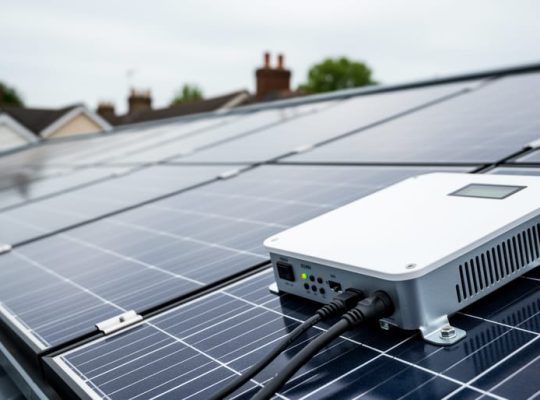
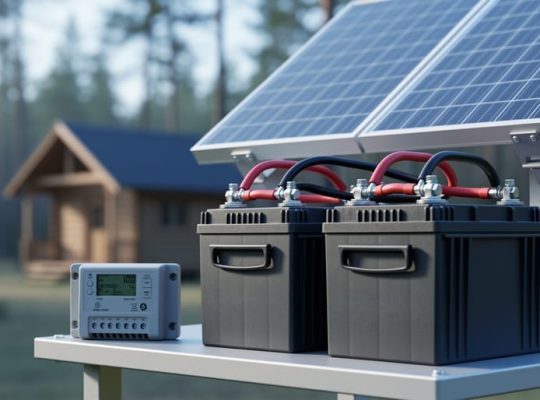
The foundation begins with standard solar PV components, photovoltaic arrays, inverters, and battery energy storage systems (BESS). Arrays generate DC power, inverters convert to AC, and battery banks store surplus energy for later dispatch. What differentiates quantum-optimized systems is the instrumentation layer: each component connects to IoT sensors monitoring real-time performance data, array voltage and current, battery state of charge, temperature gradients, and power flow directions. Smart meters track consumption patterns and grid import/export, feeding continuous data streams to the optimization engine.
Battery management systems (BMS) gain enhanced decision-making capabilities through quantum integration. Rather than operating on fixed charge/discharge schedules or simple heuristics, the BMS receives optimized dispatch instructions calculated by quantum algorithms that account for hundreds of variables simultaneously, weather forecasts, electricity price signals, demand predictions, and battery health metrics.
Quantum Computing Layer
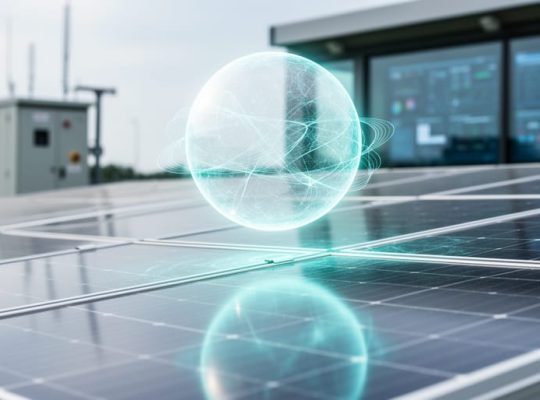
The optimization brain operates through hybrid classical-quantum processors. Most 2026 implementations use cloud-based quantum computing services rather than on-site quantum hardware. Classical computers handle data preprocessing, real-time monitoring, and straightforward calculations, routing complex optimization problems to quantum processors via secure API connections. Companies like IBM Quantum, D-Wave, and IonQ provide quantum computing access through cloud platforms specifically designed for energy optimization applications.
Quantum algorithms, typically quantum annealing or variational quantum eigensolvers (VQE), evaluate millions of potential charge/discharge scenarios across future time horizons. The quantum processor returns optimized solutions to classical computers, which translate those solutions into actionable control signals for the BMS.
Integration and Communication Infrastructure
Edge computing devices serve as local command centers, executing real-time decisions when latency matters while queuing complex optimization requests for quantum processing. Communication protocols (MQTT, OPC-UA) connect hardware to software, ensuring sensor data flows upstream and control commands propagate downstream without bottlenecks.
The software stack includes middleware translating business objectives, minimize costs, maximize self-consumption, provide grid services, into mathematical optimization problems formatted for quantum solvers. Dashboard interfaces give operators visibility into system performance and allow manual overrides when needed.
This layered architecture enables incremental adoption: existing solar installations can integrate quantum optimization through software upgrades and sensor additions without replacing functional hardware.
Applications Across the Solar Industry
Commercial and Industrial Deployments
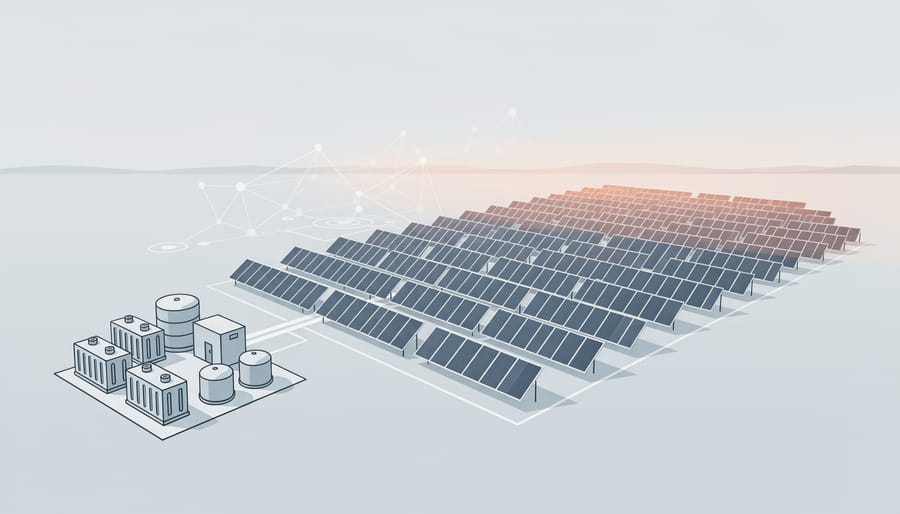
Large commercial and industrial facilities stand to gain the most immediate benefits from quantum-optimized solar storage. These installations typically face substantial demand charges, fees based on their peak electricity consumption during a billing period, that can represent 30-50% of their total electricity costs. Quantum algorithms analyze real-time solar generation, building load patterns, and utility rate structures to determine when to discharge batteries and shave peak demand, reducing these charges by precisely timing storage use across multiple rate periods simultaneously.
Time-of-use arbitrage presents another significant opportunity. Quantum optimization models evaluate wholesale electricity prices, solar production forecasts, and battery state-of-charge to execute profitable charge-discharge cycles throughout the day. This capability becomes particularly valuable for facilities with grid-connected storage participating in demand response programs or wholesale energy markets.
Manufacturing plants, data centers, and distribution warehouses with solar arrays exceeding 500 kW are testing quantum-classical hybrid optimization platforms in 2026. Early deployments report 12-18% improvements in storage utilization compared to rule-based control systems, translating to faster return on investment for battery assets. The technology proves especially effective for facilities operating across multiple time zones or managing complex production schedules where conventional optimization software struggles with computational complexity.
Research and Development Initiatives
University partnerships represent the primary vehicle advancing quantum solar optimization from theoretical research to practical implementation. Leading institutions including MIT, Stanford, and the National Renewable Energy Laboratory have established dedicated research programs examining quantum algorithm applications for photovoltaic storage management. These collaborations typically pair computer science departments specializing in quantum computing with energy engineering programs focused on solar systems, creating cross-disciplinary teams that address both algorithmic development and real-world deployment challenges.
Industry partnerships bridge the gap between academic research and commercial viability. IBM Quantum Network and Google Quantum AI have launched collaborative programs with solar developers to test optimization algorithms on operational installations. These initiatives provide quantum computing resources to energy companies while generating the real-world data sets necessary for algorithm refinement. Current research priorities include reducing algorithm execution time, developing hybrid classical-quantum approaches accessible to smaller installations, and creating standardized interfaces between quantum processors and existing battery management systems.
For aspiring photovoltaic professionals, these university collaborations offer educational pathways into this emerging field. Graduate programs now incorporate quantum computing fundamentals alongside renewable energy coursework, preparing the next generation of engineers to implement these advanced optimization techniques as the technology matures toward widespread commercial deployment.
Implementation Considerations for 2026

As quantum solar optimization moves from laboratory demonstration to commercial consideration in 2026, the technology landscape presents a mix of emerging possibilities and practical constraints that photovoltaic professionals must understand clearly.
Current Technology Access
Full-scale quantum computers capable of complex storage optimization remain primarily accessible through cloud-based quantum computing services from providers like IBM, Amazon Braket, and specialized quantum computing firms. Most solar industry applications in 2026 rely on hybrid classical-quantum approaches, classical algorithms handle routine calculations while quantum processors tackle specific optimization bottlenecks that benefit from quantum speedup. This hybrid architecture allows solar companies to experiment with quantum optimization without requiring dedicated quantum hardware on-site.
The quantum processors available through cloud platforms in 2026 typically range from 50 to 200 qubits, sufficient for optimizing storage decisions across medium-scale solar installations but not yet capable of processing utility-scale problems involving thousands of variables simultaneously. These limitations mean practical implementations focus on specific optimization challenges rather than comprehensive system-wide quantum control.
Cost-Benefit Reality
Quantum computing access currently costs between $0.30 and $3.00 per second of quantum processor time, making continuous real-time optimization economically impractical for most installations. Instead, viable approaches involve using quantum algorithms to solve complex planning scenarios periodically, weekly demand forecasting, seasonal storage strategies, or long-term degradation modeling, while classical systems handle minute-by-minute control.
For commercial installations with storage capacity above 500 kWh, quantum optimization can deliver measurable value through improved demand charge avoidance and time-of-use arbitrage, potentially offsetting quantum computing costs within 6 to 18 months. Smaller residential systems rarely justify quantum computing expenses with current pricing, though costs continue declining as quantum service providers scale operations.
Integration Pathways
Solar developers exploring quantum optimization in 2026 typically begin with pilot programs targeting specific decision points: battery cycling strategies, seasonal storage allocation, or multi-site portfolio coordination. These focused applications allow teams to measure quantum performance against classical benchmarks without overhauling entire control systems.
Hybrid systems that combine quantum algorithms with conventional battery management software represent the most accessible entry point, requiring software integration rather than hardware replacement.
Aspiring PV professionals should expect gradual adoption rather than rapid transformation, with quantum capabilities augmenting rather than replacing classical optimization methods through at least 2028.
Common Questions About Quantum Solar Systems
Most professionals encountering quantum solar optimization for the first time have practical concerns about implementation, cost, and the skills required to work with this technology. Below we address the questions that arise most frequently in industry discussions and educational settings.
Do I need a quantum computer on-site to implement quantum solar optimization?
No. Current quantum solar systems access quantum computing resources through cloud platforms provided by companies like IBM, Google, or Amazon Braket. The on-site hardware remains conventional PV equipment with sensors and network connectivity.
Are quantum solar systems available commercially in 2026?
Hybrid classical-quantum optimization services are available through specialized providers and pilot programs, primarily for utility-scale and large commercial installations. Fully quantum solutions remain in research and development stages, with wider commercial availability expected in the next three to five years.
What skills do PV professionals need to work with quantum-optimized systems?
You need a solid understanding of solar PV fundamentals, energy storage principles, and basic data analytics. Familiarity with optimization concepts helps, but deep quantum physics knowledge is not required since most professionals interact through software interfaces rather than programming quantum algorithms directly.
How does quantum optimization differ from AI-based storage management?
AI and machine learning excel at pattern recognition and forecasting based on historical data, while quantum computing specializes in solving complex optimization problems with many variables simultaneously. Many advanced systems combine both approaches, using AI for prediction and quantum algorithms for optimization decisions.
Return on investment timelines vary significantly based on installation size and electricity rate structures. Large commercial and utility-scale projects participating in pilot programs have reported optimization improvements within 12 to 18 months, primarily through better demand charge management and grid service revenue. For smaller installations, the cost of quantum optimization services currently exceeds the financial benefit, making this technology more suitable for larger deployments where percentage gains translate to substantial dollar amounts.
Educational pathways for learning this technology are expanding through university programs and industry partnerships. Several institutions now offer coursework combining renewable energy engineering with quantum computing applications, and professional development programs tailored for working PV professionals are emerging. These programs focus on practical application rather than theoretical quantum mechanics, recognizing that most industry roles involve system design and deployment rather than algorithm development.