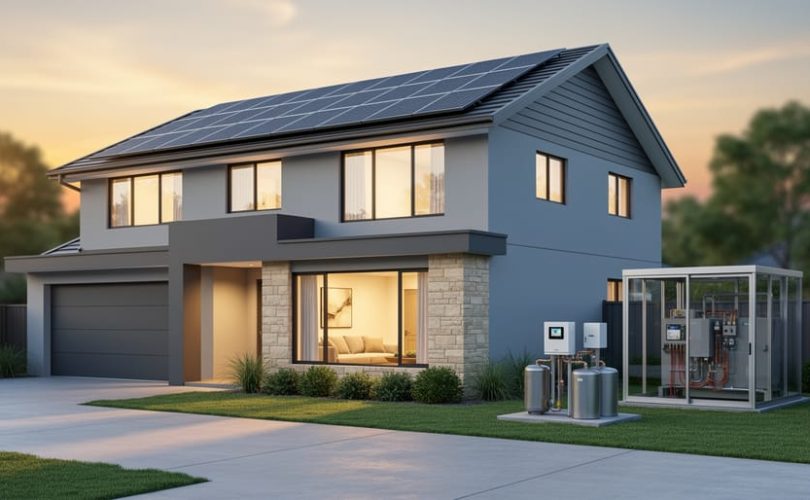
Solar energy home solutions extend far beyond rooftop panels feeding your utility meter. Modern photovoltaic systems now power comprehensive climate control, water heating, pool maintenance, outdoor lighting, and energy management platforms that optimize every watt. These integrated approaches typically reduce household energy costs by 40 to 70 percent while increasing property values and cutting carbon footprints to near-zero levels.
The transition from grid dependence to solar self-sufficiency requires matching specific technologies to your home’s energy profile, climate zone, and long-term financial goals. A desert residence benefits from different equipment than a coastal property. Understanding which systems deliver measurable returns versus marketing hype separates successful installations from expensive disappointments.
This article examines proven solar applications for heating and cooling spaces, sizing hybrid systems that balance initial investment against operational savings, and navigating the technical requirements that determine whether your home can support advanced solar infrastructure. We draw on field data from university research partnerships and real-world installations to provide actionable guidance for homeowners evaluating solar climate control in 2026.
Whether you’re planning new construction or retrofitting an existing property, the economic case for comprehensive solar solutions has never been stronger. Federal incentives, improved equipment efficiency, and falling component costs now make whole-home solar integration accessible to middle-income households across most U.S. climate zones.
Understanding Solar-Powered Climate Control Systems
Solar-powered climate control represents a sophisticated evolution in residential energy systems, moving beyond simple electricity generation to comprehensive solutions for year-round comfort. At its core, a solar climate control system converts sunlight into usable energy that powers heating, cooling, and ventilation equipment throughout your home. The technology fundamentally changes how homeowners approach temperature management, replacing fossil fuel dependence with clean, renewable power.
Two distinct approaches exist for harnessing solar energy for climate control. Passive solar design relies on architectural elements like strategic window placement, thermal mass materials, and natural ventilation to regulate indoor temperatures without mechanical systems. Active solar systems, by contrast, use photovoltaic panels to generate electricity that powers conventional HVAC equipment or specialized heating and cooling technologies. Most modern installations combine both approaches, using passive design principles to reduce overall energy needs while active solar PV systems handle the remaining heating and cooling loads.
- Active Solar Systems
- Mechanical systems that use solar-generated electricity to power pumps, fans, and HVAC equipment for climate control.
- Passive Solar Design
- Architectural strategies that manage heat gain and loss through building orientation, materials, and natural airflow without mechanical intervention.
- Solar Thermal
- Technology that captures the sun’s heat directly for water heating or space heating, distinct from PV panels that generate electricity.
- Solar PV for Climate Control
- Photovoltaic systems that convert sunlight to electricity specifically sized to power heating and cooling equipment.
- Net Metering
- Utility billing arrangement that credits solar system owners for excess electricity sent to the grid, offsetting energy drawn during high-demand periods.
The critical challenge in solar climate control lies in matching intermittent solar production with variable heating and cooling demands. Energy storage for solar addresses this mismatch, allowing systems to bank excess midday production for evening and overnight use. Battery capacity must account for the substantial power draw of climate control equipment, particularly air conditioning units that can consume 3-5 kilowatts during operation. System integration requires careful coordination between the solar array, inverter, battery storage, and HVAC equipment to ensure seamless operation regardless of weather conditions or time of day.
Successful solar climate control implementation demands proper system sizing from the outset. Undersized arrays leave homeowners dependent on grid power during peak demand, while oversized systems represent unnecessary capital expenditure. The goal is finding the sweet spot where solar production, storage capacity, and equipment efficiency align with your home’s actual heating and cooling needs across all seasons.
Solar Solutions for Home Heating
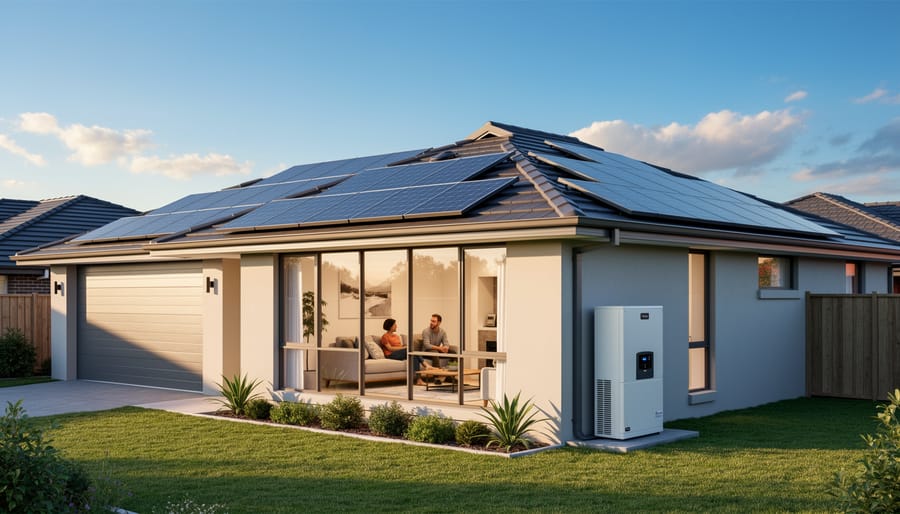
Air-Source Heat Pumps Powered by Solar PV
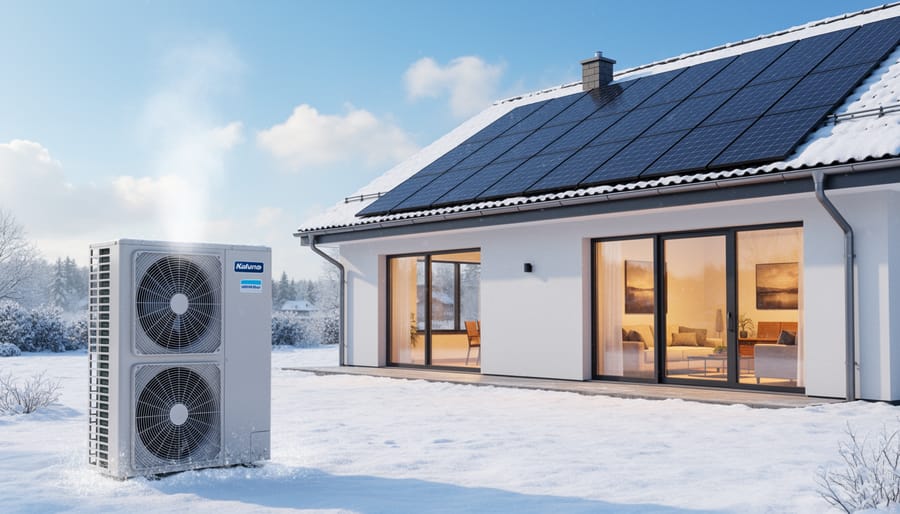
Air-source heat pumps represent one of the most compelling applications of solar PV technology for residential climate control, combining high efficiency with straightforward installation. Unlike traditional resistance heating that converts one kilowatt of electricity into one kilowatt of heat, modern heat pumps achieve coefficient of performance (COP) ratings of 3.0 to 4.5 in moderate climates, meaning they move three to four and a half kilowatts of heat energy for every kilowatt of electricity consumed. This efficiency advantage makes solar-powered heating and cooling economically viable even in regions with limited sun exposure during winter months.
The key to successful integration lies in matching your heat pump’s power draw to your solar array’s production capacity. A typical three-ton air-source heat pump draws 3,000 to 3,500 watts during heating operation, requiring roughly twelve 300-watt monocrystalline panels to power directly during daylight hours. Mono PERC panels offer superior performance in low-light winter conditions, making them particularly suitable for heating applications where morning and late afternoon generation matters most. Battery storage becomes critical for overnight heating needs, though many homeowners opt for grid connection as backup rather than sizing batteries for worst-case winter heating loads.
Performance varies significantly by climate zone. In moderate regions where winter temperatures rarely drop below freezing, heat pumps maintain high efficiency throughout the heating season. Cold-climate models now operate effectively down to -15°F, though COP ratings decline as outdoor temperatures fall. System sizing should account for your coldest expected conditions while recognizing that peak heating loads occur precisely when solar production is lowest, during cold, cloudy winter days and long nights.
Ground-Source (Geothermal) Heat Pumps with Solar
Ground-source heat pumps extract heat from the stable underground temperature rather than the fluctuating outdoor air, delivering efficiency ratings that can reach 400 to 500 percent. While air-source systems struggle when outdoor temperatures drop below freezing, geothermal units maintain consistent performance because soil temperature remains relatively constant year-round at depths of six feet or more.
The primary barrier is installation cost. Drilling boreholes or excavating horizontal loop fields typically adds $10,000 to $30,000 beyond the cost of the heat pump itself. However, this upfront investment translates to dramatically lower operating costs. A geothermal system might consume 30 to 40 percent less electricity than an air-source heat pump, which means a smaller solar array can power your heating needs.
For homeowners installing both geothermal and solar simultaneously, the economics improve considerably. The reduced electrical load means fewer panels are required, and the system pays for itself through energy savings over 10 to 15 years in most climates. Properties with sufficient land for horizontal loops or suitable geology for vertical boreholes see the best returns.
Geothermal systems shine in extreme climates where air-source heat pumps lose efficiency. If you experience harsh winters with extended periods below 20°F, or if you plan to stay in your home long-term, the combination of geothermal efficiency and solar power generation creates the most cost-effective heating solution available in 2026.
Radiant Floor Heating and Solar Integration
Radiant floor heating systems operate at significantly lower temperatures than traditional forced-air systems, typically between 85-130°F compared to the 140-180°F required for baseboard or radiator heating. This lower temperature requirement translates directly into higher efficiency when paired with solar-powered heat pumps, which perform optimally when producing modest temperature differentials.
The thermal mass of concrete slabs or tile floors creates a natural energy storage buffer. Once heated, these surfaces continue radiating warmth for hours, effectively smoothing out the intermittent nature of solar generation. This characteristic makes radiant systems particularly compatible with daytime solar production, as the floor absorbs heat during peak generation hours and releases it gradually through evening and nighttime.
For climates with extended cloudy periods, battery storage sizing becomes critical. A well-insulated home with radiant heating typically requires 10-15 kWh of stored energy to maintain comfortable temperatures overnight without solar input. More cost-effective approaches combine modest battery capacity with strategic use of the thermal mass itself as storage, superheating floors slightly during sunny periods to extend the heating duration.
System controls that prioritize floor heating during peak solar production hours maximize self-consumption and reduce grid dependency, improving overall economics compared to conventional heating methods.
Solar Solutions for Home Cooling
Traditional Air Conditioning with Solar PV
Running solar air conditioning represents one of the most economically attractive PV applications because cooling demand peaks precisely when panels generate maximum power. A 2,500-square-foot home typically requires 3 to 5 tons of cooling capacity (roughly 3,600 to 6,000 watts during operation), which translates to 18 to 30 kilowatt-hours daily during summer months.
Sizing your solar array for AC loads requires calculating both instantaneous power draw and total daily consumption. Start with your unit’s nameplate wattage, multiply by expected daily runtime, then add 20 percent overhead for inverter losses and weather variability. A system producing 10 kilowatts at peak hours can comfortably run a 4-ton central AC unit while powering other household loads simultaneously.
The natural synchronization between afternoon solar production and cooling demand means you’ll consume much of the generated power immediately rather than sending it back to the grid. This self-consumption pattern improves system economics compared to heating applications that require more storage.
Battery storage becomes critical for evening comfort after sunset. A modest 10-kilowatt-hour battery bank can provide three to four hours of supplemental cooling, bridging the gap until off-peak utility rates kick in or overnight temperatures drop. Homes in regions with time-of-use electricity pricing see the fastest payback periods, since batteries let you avoid premium rates during 4 to 9 PM peak hours when both AC demand and grid costs spike simultaneously.
Solar-Powered Evaporative Cooling
Evaporative cooling represents one of the most energy-efficient climate control options for homes in arid and semi-arid regions. These systems work by drawing warm outdoor air through water-saturated pads, where evaporation naturally cools the air before distributing it throughout your home. Unlike conventional air conditioning that compresses refrigerants, evaporative coolers use simple fans and water pumps, consuming 75-80% less electricity. This dramatic reduction in power requirements makes them ideal candidates for solar integration, as a modest 3-4 kW solar array can easily power a whole-house evaporative cooling system while leaving capacity for other household loads.
The effectiveness of evaporative cooling depends heavily on local humidity levels. These systems perform best in climates where relative humidity stays below 40%, delivering temperature drops of 15-25 degrees Fahrenheit. Western states like Arizona, Nevada, New Mexico, and parts of California see exceptional results. However, performance degrades significantly when humidity exceeds 50%, making evaporative cooling unsuitable for humid southeastern or coastal regions. Your solar storage strategy for evaporative cooling can be minimal since peak demand aligns perfectly with solar production hours, though modest battery capacity helps extend cooling into early evening when outdoor humidity remains low.
Absorption Cooling Systems
Absorption cooling systems represent a fundamentally different approach to solar-powered cooling by using thermal energy rather than electricity. These systems operate on a heat-driven refrigeration cycle, where solar thermal collectors provide the temperature differential needed to drive the cooling process. A liquid desiccant or lithium bromide solution absorbs refrigerant vapor, which is then heated to release the refrigerant, completing the cooling cycle without mechanical compression.
For residential applications, absorption chillers historically faced significant barriers. The technology required high activation temperatures, large equipment footprints, and substantial upfront investment that made economic sense primarily for commercial buildings. However, recent advances have produced compact units operating at lower temperatures compatible with evacuated tube collectors, bringing residential viability closer to reality.
Current residential-scale systems remain limited in 2026, with few manufacturers offering units under 10 kW capacity at accessible price points. Installation complexity and specialized maintenance requirements further constrain adoption. The technology shows most promise in climates with intense summer cooling loads and available roof space for both thermal collectors and PV panels.
The outlook for absorption cooling depends heavily on continued miniaturization and cost reduction. For most homeowners currently, conventional solar PV powering electric air conditioning delivers better economics and simpler installation, though absorption systems merit consideration in specific applications where thermal collectors serve dual heating and cooling functions.
System Design Considerations for Year-Round Climate Control
Choosing the Right Solar PV Technology
When designing a solar-powered heating and cooling system, panel selection directly impacts how much roof space you need and whether your system can meet year-round energy demands. The choice between monocrystalline, multi-crystalline, and advanced mono PERC technologies depends on your roof dimensions, budget, and climate control loads.
Monocrystalline panels deliver the highest efficiency, typically 19-22%, making them ideal when roof space is limited. For homes with complex roof geometries or shading issues, these panels generate more power per square foot, which matters considerably when you’re powering energy-intensive heat pumps or air conditioning. Multi-crystalline modules offer a lower-cost entry point at 15-17% efficiency and work well on larger, unobstructed roofs where space isn’t constrained.
Mono PERC (Passivated Emitter and Rear Cell) technology represents a significant efficiency improvement, reaching 20-23% by capturing light that would otherwise pass through standard cells. Mose Solar’s mono PERC product line addresses the specific needs of climate control applications where maximizing output during peak heating and cooling seasons is critical. These panels perform better in low-light conditions and at higher temperatures, maintaining production during summer afternoons when air conditioning demand peaks.
| Technology | Efficiency Range | Best Application | Space Requirements | Cost Considerations |
|---|---|---|---|---|
| Monocrystalline | 19-22% | Limited roof space, high loads | Lowest per kW | Mid-to-high upfront |
| Multi-crystalline | 15-17% | Large roofs, budget-conscious | Highest per kW | Most economical |
| Mono PERC | 20-23% | Year-round climate control, hot climates | Very low per kW | Premium, best long-term ROI |
| Solar Tiles/Shingles | 14-18% | New construction, aesthetic priority | Entire roof surface | Highest installed cost |
Solar tiles and shingles integrate directly into your roof structure, creating a seamless aesthetic that appeals to homeowners in communities with strict architectural guidelines. While they typically deliver 14-18% efficiency and carry higher installation costs, they eliminate the visual profile of traditional racked panels. For new construction or complete roof replacements, the incremental cost compared to premium roofing materials plus conventional panels narrows considerably.
Mose Solar’s product range spans these technologies to match different project requirements. A compact urban home with limited south-facing roof area benefits from mono PERC panels, while a suburban property with ample roof space might achieve better economics with multi-crystalline modules sized appropriately for the heating and cooling loads.
Energy Storage and Backup Strategies
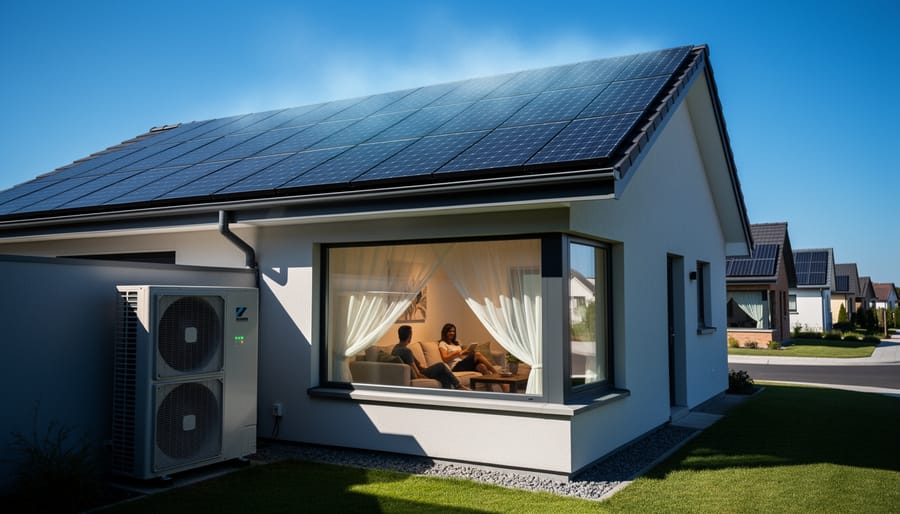
Properly sizing battery storage for climate control requires calculating your peak heating and cooling loads, not just average daily consumption. A typical central air conditioner draws 3,000 to 5,000 watts during operation, while a heat pump may consume 2,000 to 4,000 watts. Multiply these figures by your expected runtime during grid outages to determine minimum storage capacity. For reference, a 10 kWh battery supports roughly two to three hours of continuous cooling or heating under moderate loads.
Full autonomy systems, designed to operate independently during extended outages, demand significantly larger battery banks, often 20 to 40 kWh for a typical home. These installations carry premium costs and may prove financially impractical unless you face frequent, prolonged grid disruptions or prioritize complete energy independence. Grid-supplemented configurations offer a more economical approach. Size batteries to cover evening peak demand and overnight heating needs, relying on grid power as backup during rare extended cloudy periods or extreme weather events.
Lithium iron phosphate batteries dominate residential installations in 2026 due to their longevity and safety profile. Look for systems with at least 6,000 cycle warranties and built-in thermal management. Some manufacturers now offer modular designs that allow capacity expansion as your needs evolve. When evaluating options, compare usable capacity rather than total capacity, as most systems reserve 10 to 20 percent for battery health protection.
Economic Analysis and Return on Investment
The financial case for solar-powered heating and cooling depends on multiple variables that vary significantly by location, household energy usage patterns, and available incentives. Understanding these economic factors helps homeowners make informed decisions about whether comprehensive solar climate control solutions align with their financial goals.
Upfront costs for a solar PV system sized to support year-round heating and cooling typically range from $25,000 to $45,000 for a residential installation before incentives. This includes the solar array, inverters, and basic installation. Heat pump systems add another $8,000 to $20,000 depending on whether you choose air-source or ground-source technology. Battery storage capable of supporting evening climate control loads represents an additional $10,000 to $15,000 for most households. These figures place comprehensive solar climate solutions in the $40,000 to $80,000 range for turnkey installations, though costs have decreased steadily as technology matures.
Federal, state, and local incentives dramatically improve project economics. The federal Investment Tax Credit allows homeowners to deduct 30% of solar installation costs from federal taxes through 2032. Many states offer additional rebates, property tax exemptions, or performance-based incentives that further reduce effective costs. California, Massachusetts, and New York provide particularly generous state-level support, while utility-specific programs in states like Arizona and Colorado offer cash rebates for solar installations paired with energy-efficient heat pumps.
Operational savings depend heavily on your regional utility rate structure and climate. Households replacing electric resistance heating or traditional air conditioning in areas with electricity costs above $0.15 per kWh typically see annual savings of $1,800 to $3,500. Time-of-use rates amplify savings when peak solar production coincides with peak cooling demand during summer afternoons. Conversely, regions with low electricity rates or heavy heating loads during winter months when solar production is minimal may see payback periods extend to 12 or 15 years.
Most comprehensive solar heating and cooling systems achieve payback in eight to twelve years in favorable markets. Systems continue generating value for 25 to 30 years, producing substantial lifetime returns. Homes in the Sun Belt with high cooling loads and expensive electricity rates often achieve the shortest payback periods, while northern climates with lower electricity costs require longer timeframes to recoup initial investment.
Educational Resources and Professional Development
Successfully designing and implementing solar heating and cooling systems requires specialized knowledge that goes beyond basic photovoltaic installation. The complexity of integrating PV systems with heat pumps, HVAC equipment, and energy storage demands comprehensive training for professionals entering the field.
Mose Solar has developed an extensive educational program in collaboration with leading universities to prepare the next generation of PV professionals. These programs combine theoretical foundations with practical application, covering everything from electrical engineering principles to climate-specific system design considerations. Participants learn to calculate heating and cooling loads accurately, select appropriate equipment combinations, and optimize panel placement for maximum year-round performance. The curriculum addresses critical topics including thermal dynamics, refrigeration cycles, and the integration of solar PV with existing building systems.
For aspiring professionals, this training proves essential when designing systems that must perform reliably across varying seasonal demands. Proper education ensures installers understand how to size inverters for peak heating loads, configure battery systems for overnight climate control, and account for efficiency losses in different temperature ranges. The program also covers emerging technologies and sustainability considerations, including panel recycling processes that will become increasingly important as early solar installations reach end-of-life.
Homeowners benefit from this professional development ecosystem through access to qualified installers who can design systems that genuinely meet their needs. Mose Solar provides educational resources that help consumers ask informed questions, understand proposals, and make decisions aligned with their climate control requirements. This combination of professional training and consumer education creates a foundation for successful solar heating and cooling implementations that deliver promised performance and returns on investment.
Solar energy home solutions have matured far beyond supplemental power generation. The systems outlined in this guide demonstrate that photovoltaic technology can now reliably support comprehensive climate control throughout the year, powering heat pumps in winter, air conditioning in summer, and specialized systems tailored to regional climates. The natural alignment between peak solar production and cooling demand, combined with advances in battery storage for heating applications, makes this approach increasingly practical for homeowners committed to energy independence.
The economic case strengthens as equipment costs decline and utility rates rise. Pairing high-efficiency mono PERC panels with properly sized heat pumps delivers operational savings that compound over decades, while reducing your environmental footprint substantially. The key to success lies in careful system design that accounts for your specific heating and cooling loads, local climate patterns, and available roof space.
Before moving forward, conduct a thorough assessment of your home’s energy profile and consult with qualified professionals who understand both solar PV systems and HVAC integration. Mose Solar supports this transition through partnerships with universities and educational programs that train the next generation of PV professionals in proper system design and installation practices. These initiatives ensure that aspiring installers and homeowners alike have access to accurate information about solar lifestyle solutions.
The technology exists today to heat and cool your home entirely with solar power. The question is whether your situation aligns with the requirements for optimal performance and economic returns.