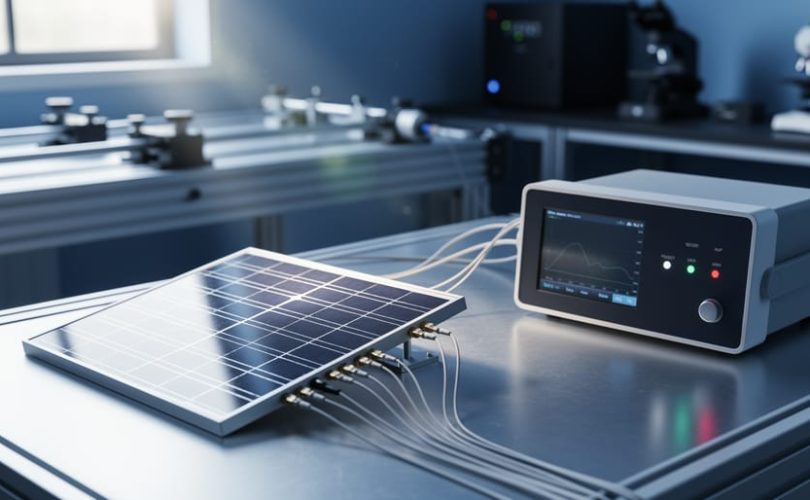
Quantum efficiency in solar cells measures the proportion of incident photons at each wavelength that generate collectible electron-hole pairs and contribute to electrical current. This metric serves as one of the most revealing indicators of photovoltaic device performance, exposing how effectively a solar cell converts light energy across the electromagnetic spectrum into usable electricity.
Understanding quantum efficiency matters because no single number tells you whether a solar cell performs well across all wavelengths or simply excels in a narrow band. Two cells with identical power conversion efficiency ratings can exhibit vastly different spectral responses. A cell optimized for blue light might underperform in red wavelengths, while another device captures infrared photons that most competitors waste entirely. These differences translate directly into real-world energy yields under varying sky conditions, cloud cover, and seasonal light quality shifts.
For photovoltaic professionals and researchers, quantum efficiency measurements provide the diagnostic precision needed to identify loss mechanisms, compare material systems, and optimize device architectures. Engineering students encounter quantum efficiency data as a bridge between semiconductor physics and practical device characterization. The metric appears in two primary forms: external quantum efficiency accounts for all incident light, while internal quantum efficiency focuses only on absorbed photons, isolating conversion losses from optical losses.
This article explains the underlying physics of quantum efficiency, distinguishes between measurement approaches, compares performance across established and emerging solar cell technologies, and examines how real-time quantum efficiency monitoring through advanced systems enhances energy harvesting strategies. Through collaboration with university research programs, the field continues refining measurement protocols and pushing the theoretical limits of spectral response in next-generation photovoltaic devices.
What Quantum Efficiency Means in Photovoltaics
Quantum efficiency measures how effectively a solar cell converts incoming light particles into usable electrical current. At its core, the metric expresses a simple ratio: the number of charge carriers (electrons) that the cell successfully collects divided by the number of photons striking its surface. Think of it as a conversion rate, if 100 photons hit the cell and 85 electrons reach the circuit, the quantum efficiency at that wavelength is 85%.
This measurement reveals far more than a single efficiency percentage. Every photon carries energy determined by its wavelength, and solar cells respond differently across the spectrum. A cell might convert 95% of red light photons into current while managing only 60% conversion for blue light photons. Understanding these wavelength-specific responses helps engineers optimize cell design for real-world sunlight conditions rather than laboratory ideals.
- Quantum Efficiency (QE)
- The ratio of collected charge carriers to incident photons, expressed as a function of wavelength. It describes how effectively a solar cell converts light into electricity across different parts of the solar spectrum.
- External Quantum Efficiency (EQE)
- Quantum efficiency measurement that includes all optical losses such as reflection from the cell surface and absorption in non-active layers. EQE represents real-world photon-to-electron conversion as experienced by the complete device.
- Internal Quantum Efficiency (IQE)
- Quantum efficiency calculated after removing optical losses like reflection and parasitic absorption. IQE isolates the electronic quality of the semiconductor material and junction itself.
- Spectral Response
- The wavelength-dependent current output of a solar cell when illuminated by monochromatic light. Spectral response data directly relates to quantum efficiency and reveals which portions of the solar spectrum a cell utilizes most effectively.
The theoretical maximum quantum efficiency is 100%, every photon generates one collectable electron. Real solar cells fall short of this ideal for multiple reasons. Photons reflect off the surface before entering the cell. Some photons pass through without being absorbed. Generated electrons recombine with holes before reaching the circuit. High-energy photons waste excess energy as heat rather than producing multiple electrons. Commercial silicon cells typically achieve peak quantum efficiencies between 80% and 95% in the visible spectrum where most solar energy concentrates, with performance dropping sharply in ultraviolet and near-infrared regions where silicon’s material properties limit photon capture and conversion.
How Quantum Efficiency Works in Solar Cells
The Spectral Dimension
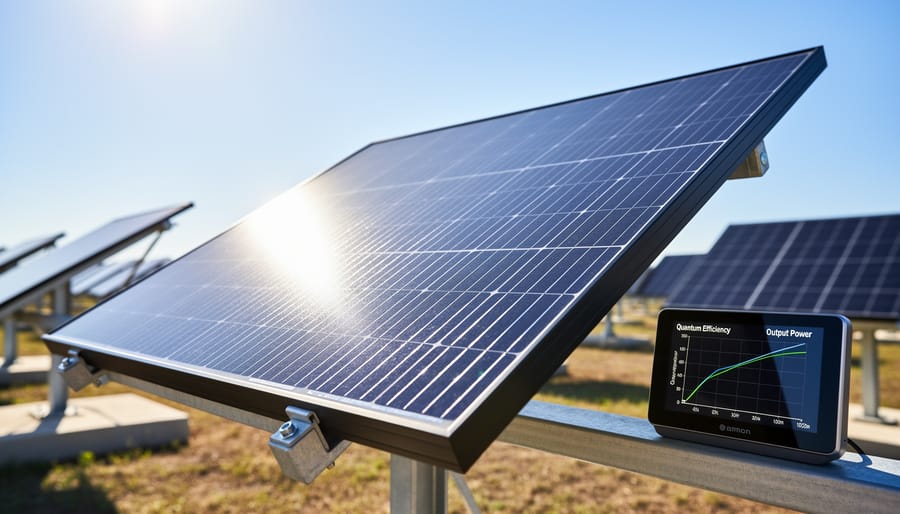
Solar cells don’t respond equally to all colors of light. A cell that converts blue photons efficiently might perform poorly with red light, and this wavelength-dependent behavior defines the spectral dimension of quantum efficiency.
The solar spectrum spans ultraviolet wavelengths around 300 nanometers through visible light (400-700 nm) to near-infrared beyond 1,200 nm. Each photon carries energy inversely proportional to its wavelength, blue photons pack more energy than red ones. But higher energy doesn’t guarantee better conversion.
A solar cell’s spectral response traces directly to its semiconductor bandgap, the minimum energy needed to free an electron from the material’s atomic structure. Silicon’s 1.1 eV bandgap means photons with less energy (longer wavelengths beyond about 1,100 nm) pass straight through without generating charge carriers. The cell is effectively transparent to infrared light that exceeds this threshold.
At the opposite end, high-energy ultraviolet and blue photons carry more energy than the bandgap requires. A 400 nm photon delivers roughly 3.1 eV to a silicon cell, but only 1.1 eV becomes electrical energy. The excess 2 eV converts to heat through a process called thermalization, wasting potential electricity as the excited electron rapidly sheds energy before collection.
Peak quantum efficiency typically occurs in the visible spectrum where photon energy closely matches the bandgap, enough energy to generate carriers without excessive thermalization losses. For silicon cells, this sweet spot falls between 600-900 nm, where quantum efficiency often exceeds 90%. Understanding this spectral response explains why cells optimized for one climate or lighting condition may underperform in another environment with different spectral characteristics.
Loss Mechanisms That Reduce Quantum Efficiency
Real solar cells fall short of their theoretical quantum efficiency potential because several physical processes intercept photons or prevent charge carriers from contributing to electrical current. Understanding these loss mechanisms helps engineers identify optimization opportunities and explains why even high-quality cells typically achieve 85-95% quantum efficiency at their peak wavelengths rather than 100%.
Reflection losses occur when photons bounce off the cell surface instead of entering the semiconductor material. Untreated silicon reflects about 30% of incident light, though modern anti-reflection coatings reduce this to 2-4%. The remaining reflection still represents lost energy that never reaches the active layer.
Thermalization causes the largest quantum efficiency reduction in conventional cells. When high-energy photons (like blue or UV light) are absorbed, they generate electron-hole pairs with excess energy above the bandgap. This extra energy dissipates as heat within picoseconds rather than contributing to electrical output. Thermalization alone accounts for 30-35% efficiency loss in silicon cells, as photons carrying more energy than needed are effectively downgraded to the bandgap level.
Carrier recombination happens when generated electrons and holes reunite before reaching the cell’s electrical contacts, canceling each other out without producing current. Recombination occurs at material defects, grain boundaries, the front and back surfaces, and even in the bulk material. This mechanism typically reduces quantum efficiency by 5-10% in well-manufactured cells but can cause much larger losses in lower-grade materials.
The major loss mechanisms and their typical impact include:
- Surface reflection: 2-4% loss despite anti-reflection coatings
- Thermalization: 30-35% loss from excess photon energy converted to heat
- Carrier recombination: 5-10% loss in high-quality cells, more in defective material
- Optical losses: 1-3% from incomplete absorption in thin cells or wrong wavelengths
- Contact shadowing: 2-3% from metal grid fingers blocking incoming light
Incomplete absorption affects long-wavelength photons (near-infrared) that can pass through the cell without generating carriers, particularly in thinner wafers or materials with poor infrared response. Parasitic absorption occurs when non-active layers (like contact materials or transparent conductors) absorb photons that should reach the semiconductor junction. Together, these optical losses explain why quantum efficiency drops sharply outside each material’s optimal wavelength range and why cell thickness, layer design, and material selection directly impact spectral performance.
Types of Quantum Efficiency Measurements
External Quantum Efficiency (EQE)
External quantum efficiency represents the ratio of collected charge carriers to incident photons before any light reaches the active solar cell material. Unlike its internal counterpart, EQE accounts for every optical loss that occurs at the module surface and within non-active layers, reflection from the front glass, absorption in encapsulants and anti-reflective coatings, and parasitic absorption in contacts or buffer layers.
This inclusive measurement matters because it reflects what actually happens when sunlight hits a real solar panel. A cell might have excellent internal electronic quality, but poor anti-reflective coating or excessive front contact shading will drag down the EQE and, consequently, the power output you get from an installed system.
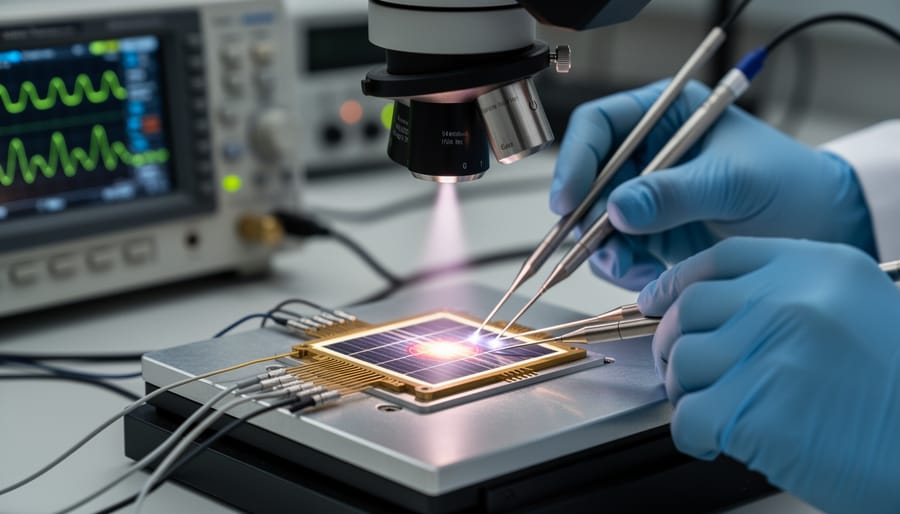
In laboratory settings, researchers measure EQE using monochromatic light sources that sweep through wavelengths from ultraviolet to near-infrared. The cell is illuminated at each wavelength while current output is recorded, building a spectral response curve. This reveals not just peak efficiency but also how well the cell captures different portions of the solar spectrum.
Field measurements have become more practical with portable spectral response analyzers. These devices shine calibrated light onto installed modules and calculate EQE under actual operating conditions, accounting for temperature, soiling, and aging effects that laboratory tests cannot fully replicate.
For system designers and operators, EQE data guides technology selection for specific climates and helps diagnose performance issues. A sudden drop in EQE at certain wavelengths might indicate encapsulant degradation or contamination affecting light transmission to the active layers.
Internal Quantum Efficiency (IQE)
Internal quantum efficiency strips away the optical losses that obscure a solar cell’s true electronic performance. Where EQE measures everything that happens to incoming photons, including reflection off the front surface and absorption in inactive layers, IQE isolates what happens after light actually enters the active semiconductor material. It answers a fundamental question: once photons reach the junction, how effectively does the cell convert them to electrical current?
The calculation accounts for reflection losses and parasitic absorption in metal contacts, anti-reflection coatings, and transparent conducting layers. What remains is a pure measure of the semiconductor’s ability to generate, separate, and collect charge carriers. A cell might show modest EQE numbers due to poor surface treatment, yet reveal excellent IQE values indicating high-quality material and junction design. This distinction matters enormously in manufacturing and research contexts.
IQE typically exceeds EQE values, sometimes approaching 100% at optimal wavelengths for well-designed cells. These near-unity figures demonstrate that almost every photon absorbed in the active region creates a usable electron-hole pair that reaches the external circuit. When IQE falls below expected levels, it signals problems with material purity, crystal defects, improper doping profiles, or inadequate junction formation, issues requiring different solutions than optical losses.
Researchers use IQE measurements to evaluate new semiconductor materials, compare fabrication processes, and diagnose performance limitations that surface treatments cannot address. It reveals whether efficiency losses stem from fixable optical issues or fundamental material quality problems.
Quantum Efficiency Across Different Solar Cell Technologies
Quantum efficiency performance varies significantly across solar cell technologies, reflecting fundamental differences in material quality, structure, and light management strategies. Understanding these variations helps match the right technology to specific applications and performance requirements.
Monocrystalline silicon cells represent the high-performance standard in commercial photovoltaics, typically achieving external quantum efficiency above 90% across the visible spectrum from 400 to 900 nanometers. The uniform crystal structure minimizes grain boundary recombination, allowing generated charge carriers to reach the junction efficiently. Peak EQE values often exceed 95% in the 600-700nm range where silicon’s absorption is strongest. However, performance drops sharply beyond 1100nm as photon energy falls below silicon’s 1.1eV bandgap, and UV response suffers from surface recombination losses.
Multi-crystalline silicon cells show slightly reduced quantum efficiency compared to monocrystalline counterparts, with EQE values ranging from 85-92% at peak wavelengths. The grain boundaries between crystals act as recombination centers where electron-hole pairs are lost before contributing to current. This effect becomes more pronounced at longer wavelengths where photons penetrate deeper into the material, closer to grain boundaries. Despite the 2-5% efficiency penalty, multi-crystalline technology remains cost-effective for large-scale installations where the performance-to-price ratio matters more than absolute peak efficiency.
PERC (Passivated Emitter and Rear Cell) technology has revolutionized silicon cell performance by addressing rear surface recombination losses. The dielectric passivation layer and local back contacts boost quantum efficiency particularly in the red and near-infrared spectrum, where longer-wavelength photons penetrate to the rear surface. PERC cells commonly achieve 1-2 percentage points higher EQE in the 900-1100nm range compared to standard cells, translating to meaningful energy yield improvements. Mose Solar’s high-efficiency module offerings leverage PERC architecture to deliver superior real-world performance, especially in low-light conditions where longer wavelengths dominate.
Emerging technologies show distinct quantum efficiency signatures. Heterojunction cells combine crystalline silicon with thin-film layers, achieving exceptional short-wavelength response through superior surface passivation while maintaining high red response. Their broad spectral QE often translates to better performance under diffuse light conditions common in many climates.
Thin-film technologies like CIGS and CdTe exhibit different quantum efficiency profiles shaped by their narrower bandgaps. CdTe cells show strong response in the visible spectrum but limited near-infrared collection, while CIGS technology can be tuned across different bandgaps, allowing spectral optimization for specific environments.
Tandem and multi-junction cells, though currently limited to specialized applications, achieve remarkable quantum efficiency by stacking materials with different bandgaps. Each subcell captures its optimal spectral range, collectively converting a broader spectrum more efficiently than any single-junction device can achieve. As manufacturing costs decrease, these advanced architectures may find wider deployment in space-constrained installations where maximizing output per square meter justifies the premium.
How Quantum Efficiency Is Used in Real-World Applications
Manufacturing Quality Control
During solar cell manufacturing, quantum efficiency testing serves as a critical quality gate that reveals defects invisible to standard visual inspection or simple electrical testing. QE measurements detect material inconsistencies such as impurity concentrations, crystallographic defects, and junction formation problems by analyzing how efficiently different wavelengths convert to current. A cell with reduced blue response might indicate surface passivation issues, while poor infrared performance often signals bulk material problems or insufficient light trapping.
Production lines use automated QE testing systems to screen every cell or statistical samples from each batch. When measurements fall outside specification windows, typically ±2-3% from target values at key wavelengths, the batch triggers investigation into process parameters like diffusion temperature, coating thickness, or raw material quality. This immediate feedback allows manufacturers to adjust processes before producing thousands of defective cells.
QE testing also validates that finished modules meet performance warranties and certification standards. Since quantum efficiency directly correlates with energy yield under real-world spectral conditions, manufacturers can predict long-term output and identify cells that might degrade prematurely. This upstream quality control reduces field failures and maintains the reputation that customers expect from certified solar products.
System Design and Site Optimization
Solar cell selection increasingly relies on matching quantum efficiency profiles to site-specific spectral conditions rather than simply choosing the highest-rated modules. A region with frequent cloud cover presents a diffuse-light spectrum weighted toward blue wavelengths, favoring cells with strong QE response in the 400-500nm range. Desert installations receive more direct sunlight with enhanced red and near-infrared content, where cells maintaining high QE beyond 900nm deliver better annual yields.
Atmospheric composition matters more than many designers recognize. Coastal locations with higher water vapor content shift the incident spectrum, absorbing certain infrared wavelengths before they reach the array. High-altitude sites receive less atmospheric filtering, presenting a broader spectral distribution that rewards cells with consistent QE across the entire solar range. Urban environments introduce aerosol scattering that modifies both spectral content and angle of incidence throughout the day.
Seasonal spectrum variations can swing energy production by 8-12% between summer and winter in temperate climates. Winter months deliver proportionally more diffuse blue light even on clear days due to longer atmospheric path lengths, while summer provides stronger direct radiation with red-shifted spectra. Matching cell QE characteristics to the dominant seasonal conditions of your location, particularly if seasonal demand peaks align with certain spectral profiles, optimizes total system economics beyond what nameplate efficiency suggests.
Edge Computing for Real-Time Quantum Efficiency Monitoring
Real-Time Performance Analytics
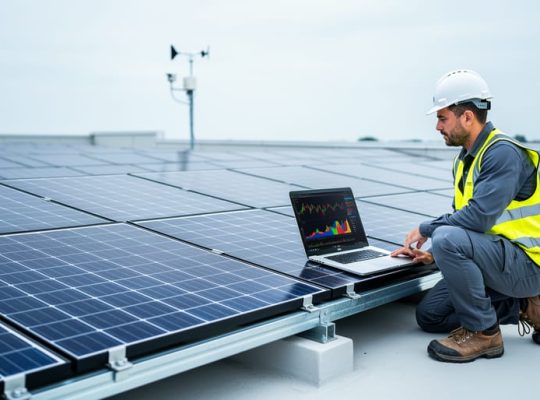
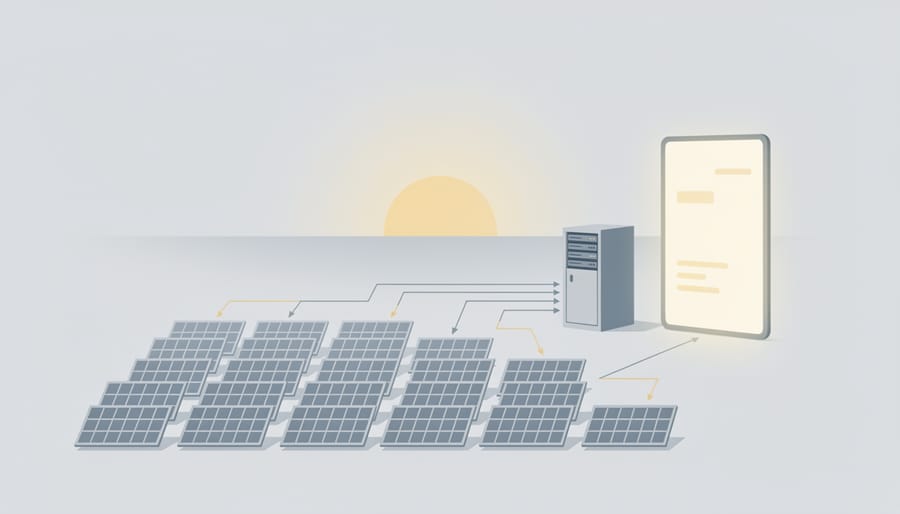
Edge devices deployed at the array level now process multiple data streams simultaneously to calculate effective quantum efficiency as operating conditions change. Onboard sensors measure spectral irradiance at different wavelengths, module temperature, and current-voltage output every few seconds. Microprocessors at each monitoring point apply QE calculation algorithms that account for temperature coefficients and spectral variations specific to the installed cell technology, generating real-time efficiency metrics without sending raw data to remote servers.
This edge computing approach enables immediate detection of performance deviations that indicate degradation or soiling. When measured quantum efficiency drops below expected values for current irradiance and temperature conditions, the system flags the affected modules within minutes rather than waiting for scheduled inspections. Advanced IoT PV monitoring platforms distinguish between temporary losses from passing clouds and persistent reductions from dust accumulation or cell damage by analyzing the spectral signature of the efficiency decline.
The localized processing reduces latency to under five seconds for most systems, allowing operators to correlate efficiency changes with specific events like weather transitions or grid disturbances. Edge devices store baseline QE profiles for each module during optimal conditions, then continuously compare real-time measurements against these references to quantify performance degradation with precision previously available only through laboratory testing.
Adaptive System Optimization
Edge computing transforms quantum efficiency monitoring into actionable intelligence by enabling instantaneous system adjustments that respond to measured performance variations. When edge devices detect shifts in spectral quantum efficiency, whether from changing cloud cover, atmospheric haze, or module temperature fluctuations, they trigger immediate optimization responses without waiting for centralized processing.
The most direct application involves maximum power point tracking (MPPT) algorithms. Traditional MPPT operates on voltage-current curves alone, but edge computing integrates spectral quantum efficiency data to predict optimal operating points under specific light conditions. When sensors detect reduced blue-wavelength response due to soiling, for instance, the system recalibrates MPPT parameters to extract maximum power from the remaining usable spectrum. This real-time optimization recovers 2-4% of energy that conventional systems would leave uncollected.
Load management strategies also benefit from quantum efficiency feedback. Edge processors can shift energy-intensive operations to periods when spectral conditions favor higher conversion efficiency, or route power between multiple arrays based on which configuration currently exhibits superior quantum efficiency for the incident spectrum. In bifacial installations, edge computing adjusts ground albedo assumptions and rear-side contribution estimates based on measured quantum efficiency from both surfaces, optimizing inverter loading and string configurations throughout the day. These micro-adjustments compound into measurable gains across thousands of operating hours annually.
Improving Quantum Efficiency: Current Strategies and Innovations

In 2026, the solar industry deploys a sophisticated toolkit of proven techniques and emerging innovations to push quantum efficiency toward theoretical limits. These strategies span from nanoscale surface modifications to entirely new cell architectures, each targeting specific loss mechanisms identified through spectral analysis.
Surface engineering remains the most accessible path to QE gains. Modern commercial cells routinely incorporate:
- Multi-layer anti-reflective coatings tuned to minimize reflection across the solar spectrum
- Pyramid or honeycomb surface texturing that traps light through multiple internal reflections
- Advanced passivation layers using aluminum oxide or silicon nitride to reduce surface recombination
- PERC (Passivated Emitter and Rear Cell) technology with dielectric rear reflectors
- Bifacial designs capturing reflected light from both cell surfaces
- Tandem cell architectures stacking materials with different bandgaps to capture broader spectra
- Spectrum-splitting systems directing specific wavelengths to optimally-matched cells
These surface treatments address the reflection and thermalization losses that account for the largest efficiency gaps between theoretical and actual performance. A well-optimized anti-reflective coating alone can boost external quantum efficiency by 3-5 percentage points across the visible spectrum.
Passivation technology has advanced significantly, with atomic layer deposition enabling ultra-thin, conformal coatings that virtually eliminate surface recombination in high-efficiency cells. These layers protect the crucial junction region where photogenerated carriers must separate and travel toward contacts without recombining.
Material innovations focus on improving internal quantum efficiency through purer silicon with fewer crystal defects, selective emitter designs that concentrate doping where it’s needed, and carrier-selective contacts that use work-function differences rather than heavy doping to extract charges. Perovskite-silicon tandems, now entering commercial production, achieve record quantum efficiencies by splitting the solar spectrum between complementary absorbers.
Edge computing platforms integrated with predictive maintenance systems enable real-time monitoring of these enhancements in operational arrays. Sensors track how quantum efficiency responds to different optimization strategies, allowing manufacturers and installers to validate which techniques deliver the greatest performance improvements under actual field conditions rather than idealized laboratory testing. This feedback loop accelerates the translation of laboratory innovations into commercially viable products, as developers can quantify real-world QE gains within weeks instead of years.
Quantum Efficiency in Mose Solar’s Educational Programs
Mose Solar’s university-partnered curriculum places quantum efficiency measurement and analysis at the core of its photovoltaic professional training program. Students gain practical experience with industry-standard spectroradiometers and quantum efficiency test systems, learning to conduct both EQE and IQE measurements on various cell technologies under controlled laboratory conditions. The hands-on modules guide participants through the complete measurement workflow, from sample preparation and calibration procedures through data acquisition and spectral response analysis.
The educational program emphasizes translating laboratory QE data into actionable insights for real-world system optimization. Trainees work with case studies examining how spectral mismatch between theoretical and measured quantum efficiency curves reveals specific performance issues, teaching diagnostic skills essential for identifying underperforming panels in operational installations. Students also learn to correlate quantum efficiency degradation patterns with environmental factors, manufacturing defects, and aging mechanisms.
Advanced modules introduce edge computing integration for continuous QE monitoring, preparing graduates to implement the real-time analytics systems increasingly deployed across commercial solar installations. This combination of fundamental measurement theory, hands-on laboratory skills, and modern data-driven optimization techniques equips program participants with the comprehensive expertise needed to advance photovoltaic technology and system performance throughout their careers.
Frequently Asked Questions About Quantum Efficiency
What is considered good quantum efficiency for solar cells?
Modern commercial silicon solar cells typically achieve external quantum efficiency above 80% in the visible spectrum range (400-700 nm), with premium PERC and multi-busbar designs reaching 90% or higher at peak wavelengths. Internal quantum efficiency often exceeds 95% in well-manufactured cells, indicating excellent electronic quality after accounting for optical losses.
How does quantum efficiency differ from overall cell efficiency?
Quantum efficiency measures how many photons at specific wavelengths generate collected charge carriers, while overall cell efficiency (typically 18-23% for commercial silicon) represents the total electrical power output divided by incident solar energy across all wavelengths. A cell can have high quantum efficiency at certain wavelengths but moderate overall efficiency due to fundamental bandgap limitations and resistive losses.
Can quantum efficiency exceed 100%?
Yes, through a phenomenon called multiple exciton generation or carrier multiplication, where high-energy photons generate more than one electron-hole pair. This occurs primarily with photons carrying significantly more energy than the bandgap and has been demonstrated in quantum dot solar cells and some advanced materials, though commercial silicon cells remain below 100% quantum efficiency at all wavelengths.
How does temperature affect quantum efficiency?
Higher operating temperatures generally reduce quantum efficiency by increasing recombination rates and shifting the semiconductor bandgap, particularly affecting performance in the near-infrared region. Silicon cells typically lose 0.3-0.5% of their quantum efficiency per degree Celsius above 25°C, making thermal management crucial for maintaining optimal performance in field installations.
How often should quantum efficiency be measured in operating systems?
Laboratory-grade spectral quantum efficiency measurements are typically performed annually or when performance anomalies appear, as they require specialized equipment. Edge computing systems with integrated sensors can monitor effective quantum efficiency continuously under actual operating conditions, providing real-time alerts when values drop outside expected ranges due to soiling, degradation, or equipment issues.
What causes quantum efficiency to degrade over time?
Primary degradation mechanisms include encapsulant discoloration that absorbs short-wavelength photons, anti-reflection coating damage, junction passivation breakdown, and metallization corrosion. Environmental stressors such as UV exposure, thermal cycling, and moisture ingress accelerate these processes, typically resulting in 0.5-1% annual quantum efficiency decline in the most affected spectral regions, with blue and UV response degrading faster than red and infrared.
These questions reflect the concerns of both technical professionals evaluating cell performance and system owners monitoring long-term energy production. Understanding quantum efficiency answers helps bridge the gap between laboratory specifications and field expectations.
One frequent point of confusion centers on why quantum efficiency values appear high while overall system efficiency remains in the 20% range. The answer lies in fundamental physics rather than manufacturing limitations. Even a cell with perfect 100% quantum efficiency at every wavelength would face the Shockley-Queisser limit, which restricts single-junction silicon cells to theoretical maximum efficiency around 33%. This limit stems from unavoidable losses: photons with energy below the bandgap pass through unconverted, while excess energy from high-energy photons dissipates as heat through thermalization. Quantum efficiency describes how well the cell handles each wavelength it can convert, not whether it captures all solar energy.
The distinction between internal and external quantum efficiency also generates questions about which metric matters more. For researchers developing new materials and cell structures, internal quantum efficiency reveals the true electronic quality independent of optical design. For system designers and installers, external quantum efficiency better predicts real-world performance since it includes reflection and absorption losses that affect actual electricity generation. Both metrics provide value depending on the application, which is why comprehensive characterization reports include both measurements across the full spectral range.
Temperature dependencies of quantum efficiency deserve particular attention for installations in hot climates or poorly ventilated mounting configurations. The efficiency loss compounds because higher temperatures both reduce quantum efficiency directly and increase series resistance, creating a performance penalty that affects energy harvest during peak production hours when cooling is most challenging.
Quantum efficiency stands as the fundamental measure of how effectively a solar cell converts photons into electrical current. Throughout this exploration, we’ve seen that it’s not merely an academic metric, it directly determines how much energy your solar installation generates from available sunlight. Understanding quantum efficiency empowers manufacturers to refine production processes, helps system designers select optimal technologies for specific environments, and enables operators to maximize return on investment.
The integration of edge computing has revolutionized how we engage with quantum efficiency in operational settings. What was once confined to laboratory characterization now happens continuously at the array level, with real-time analytics detecting performance shifts and triggering immediate optimization responses. This transformation bridges the gap between theoretical performance and field reality, ensuring solar systems maintain peak efficiency under changing conditions.
As solar cell technologies advance, we’re witnessing simultaneous improvements in both quantum efficiency values and our ability to monitor them. Emerging materials push spectral response into previously underutilized wavelengths, while sophisticated sensors and processing capabilities provide unprecedented visibility into cell-level performance. For professionals entering the photovoltaic industry, mastering quantum efficiency concepts, from fundamental physics to practical optimization, remains essential knowledge.
The future of solar energy depends on extracting maximum value from every photon, making quantum efficiency the metric that matters most.